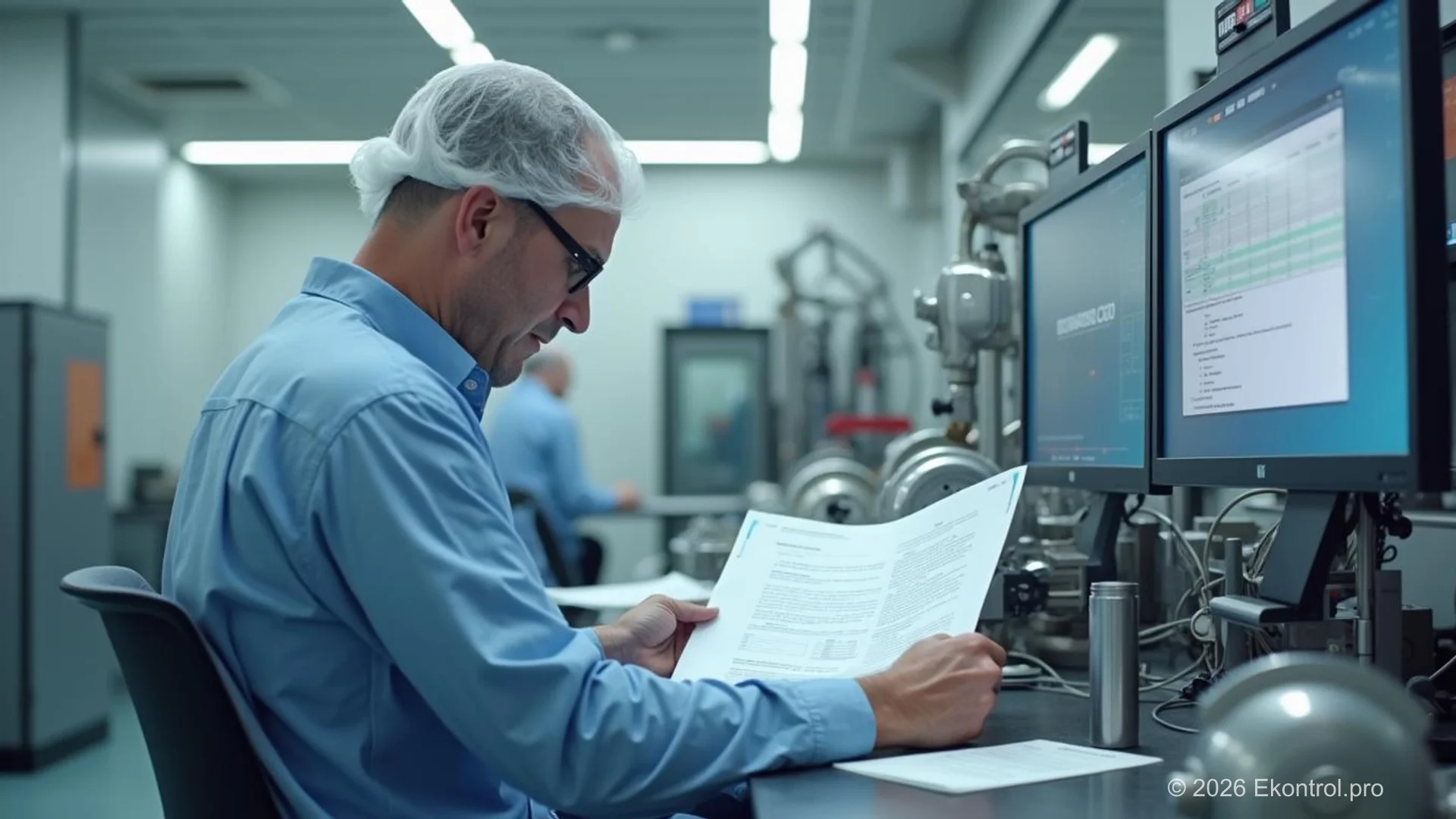

What batch traceability is and why AQAP 2110 requires it
Defense batch traceability is the ability to reconstruct the full history of a product or batch within minutes: which material was used, who the supplier was, when and by whom every operation was performed, what the test results were, where the batch was shipped. If your quality team can't pull this data on a specific drone serial number produced last month within 20 minutes, you don't have working traceability: you only have the appearance of it.
For a civilian manufacturer, traceability is about customer complaints. For a defense supplier, it's about safety of people in the field, fulfillment of a contract with the Ministry of Defense or NSPA, and the company's survival on the first serious complaint. A shell that didn't detonate, a drone that crashed on itself, a targeting complex with faulty optics: in every case the customer arrives with a simple question: «Show me which batch the components came from, which suppliers, and whether other batches from the same lots are affected». Without traceability, the only path is a full production recall.
AQAP 2110 clause 8.5.2 requires traceability directly: the manufacturer must identify products at every stage of the life cycle and keep records that allow the origin of any batch to be traced in both directions. The standard adds a record retention requirement: minimum 10 years, and for critical products (missile systems) it's life cycle plus another 10. For a 2026 shell, that means real archive retention until 2055-2060. The full approach to the standard is covered in the complete AQAP 2110 guide.
The two directions of traceability work together. Forward traceability: from material to where it is now: you bought a batch of aluminum, you need to know which drone airframes it went into and which of them have already shipped. Backward traceability: from finished product back: you have a defective drone, you need to figure out within 30 minutes which material lots it was built from, which supplier provided the board, what firmware was on it. Both directions are mandatory under AQAP 2110, and they're tested separately during the audit.
Forward vs backward traceability
Forward traceability answers the question «where is this material now»: you bought a lot of STM32 microcontrollers and need to find all drones that used this lot: in which batches, in which warehouses, with which customers. Backward traceability answers «where did this product come from»: you have a defective drone serial FPV-X-2026-0457 and need to pull the full history of materials, suppliers, operations and inspections within 30 minutes. AQAP 2110 requires both directions, and both are tested with separate scenarios in Stage 2 audits. Records must be kept for at least 10 years, life cycle plus 10 for critical products.
3 levels of traceability in defense manufacturing
Not every product needs the same depth of traceability, and AQAP 2110 acknowledges this. The standard talks about an «adequate level»: the manufacturer justifies it based on risks, customer requirements and product value. Three typical levels have emerged in Ukrainian defense industry, and you need to pick the right one from day one, because retrofitting upward is painful.
Level 1: Lot/batch traceability. The minimum for mass-produced items: FPV kits, small-caliber ammunition, simple auxiliary systems. The batch gets a single lot number, individual units within the batch aren't distinguished. Records are kept at the batch level: which material batch went in, who assembled it, when it passed QC. Sufficient for an MoD contract supplying kamikaze drones in series of 200-500 units.
Level 2: Serialized traceability. Each unit has a unique serial number, history is tied to the serial. Mandatory for critical products: mid-class reconnaissance and strike UAVs, communications systems, navigation equipment, satcom terminals, optics. The baseline level for drone manufacturers under AQAP 2110 targeting exports to Alliance countries.
Level 3: Item-level with electronic logging. The highest depth: serials on units and on critical internal components, all data in an electronic system with full audit trail. Mandatory for precision systems, missile equipment, interceptors. The electronic log captures not just the result of each operation, but who performed it, when, on which equipment. Expensive to implement, but mandatory for serious NSPA or NATO Air Force export contracts.
How to choose? Simple criterion: what kind of contract do you want to fulfill in the next 3-5 years. Supplying FPVs to the Ukrainian MoD in batches: Level 1, paying extra for Level 2 is economically unjustified. Exporting reconnaissance UAVs to Poland, Czechia or the UK: Level 2 minimum. Heavy strike UAVs: Level 3 without question, because a single unit costs millions and customer expectation is full traceability across decades.
Identification: how to identify batches and components
Before traceability comes identification: the batch or product must be physically marked so that nobody in production, in the warehouse, or in the field confuses one batch with another. It's a two-part task: a logical numbering system and physical marking that survives operating conditions.
Lot number / Batch ID: the basis for Level 1. A good format includes year of release, product type, sequential batch number, design revision. Example: «FPV-X-2026-L047-R3»: «FPV-X model, 2026, 47th batch, revision 3». Better than just «047», because in 5 years you'll have five batches numbered 047.
Serial number: for Level 2 and up. Each unit has a unique number across the company's entire production history. Format «FPV-X-2026-0457» (model + year + sequential) works for an annual batch of up to 9999 units. The serial is applied to a visible surface, duplicated on the board and in the electronic log. If one of three doesn't match, that's a nonconformity.
Marking methods depend on component type. The flight control board gets laser engraving on the mask: survives moisture, temperature, shocks. Aluminum housing: laser on an unprocessed area or QR code under a protective coat. Cable: heat-shrink with printed serial. For critical products: Data Matrix or QR with built-in error correction. RFID tags are used less often due to cost, but for tracking batches between workshops and warehouse: ideal.
Identification document is more than a number: it's a travelling pack. Birth Certificate accompanies the product from assembly to customer: serial, release date, key tests, serials of critical components inside. Material Certificate: for materials, with supplier, lot, MTR (Material Test Report) results. Component Card: for critical components (board, motor, battery) tied to the finished product's serial. For an FPV drone the pack contains: drone birth certificate, component card for the flight controller board, material certificates for aluminum and carbon fiber, and a separate record for firmware with build hash. An industry example of identification design for drones is covered in the drone manufacturer certification guide.
| Component type | Marking method | Data storage | Why |
|---|---|---|---|
| Flight controller board | Laser engraving on solder mask | Serial in birth certificate + in firmware (read-only register) | Survives moisture, temperature, shocks; readable in the field |
| Aluminum drone housing | Laser on unprocessed area or QR under varnish | Lot number in birth certificate | Resistant to environment, visible to naked eye |
| Tactical-grade battery | QR sticker + duplicate barcode | Component card with lot, manufacture date, MSDS batch | Lot directly affects safety, quick identification critical |
| Power cable | Heat-shrink with printed serial | Supplier's material certificate | High bend resistance, doesn't wear off during assembly |
| Flight controller firmware | Git hash + version tag in binary | Hash recorded in component card and birth certificate | Software is a CI, needs exact version at release |
| Camera optics | Engraving on module housing | Component card with supplier and lot | Optics critical for reconnaissance, needs separate linkage |
| Ammunition (explosive charge) | Engraving on body + lot on packaging | Material certificate with MTR and clearance protocol | Safety-critical, full traceability mandatory |
End-to-end traceability: from material to finished product
Now that identification exists, you can build end-to-end traceability: connecting material at the inlet to the finished product at the outlet. This is the hardest part of implementation, because it requires synchronous work from procurement, warehouse, production, quality and logistics. If even one link drops out, traceability breaks.
Incoming inspection is the starting point. Each batch of material is registered with the full data set: supplier, delivery date, supplier's lot number, volume, supplier documents (MTR, CoA, CoC), incoming inspection results, decision. The supplier's lot is tied to your internal lot, which you assign on your side. If the supplier didn't provide a lot: the batch is rejected, because traceability breaks at the very start. The traceability requirements here are noticeably stricter than ISO 9001, where clause 8.5.2 talks about identification in general terms without defense-batch specifics.
Warehouse logistics is a critical link. FIFO is mandatory policy, especially for materials with limited shelf life (batteries, pyrotechnics, adhesives). The storage card is tied to the warehouse zone, and every movement is recorded with lot linkage. In small operations this is Excel with discipline, in mid-size: a WMS. Without movement records, traceability works only one way.
Production process is the heart of traceability. Each operation records: which material lot was used, who performed it, on what equipment, at what time, with what result. For an FPV drone the typical chain: board soldering with component lot and firmware linkage → board mounting in housing with serial fixation → powertrain connection with motor and ESC lot linkage → battery installation → flight testing. Each operation is a separate record tied to the drone's serial. The concrete difference between loose-ISO and AQAP traceability approaches is well covered in the AQAP 2110 vs ISO 9001 comparison.
Quality control runs a parallel branch. Sampling a batch for testing is also an operation with recording: which batch, how many units, which tests, results. Failed sample: Non-Conformance Report (NCR) tied to the batch and a decision about rework, scrap or conditional acceptance. Results become part of the product's birth certificate.
Finished product is the convergence point. The birth certificate must contain: drone serial, serials of critical internal components, airframe material lots, firmware version, final test results, release date, responsible quality engineer. This document travels with the product and stays in the archive for 10+ years.
Shipping adds another link: shipping manifest with serials, packing list, GQAR attestation for customer deliveries. Warranty service closes the loop: every returned unit is identified by serial, history is pulled from the archive. If a defect is widespread, forward analysis kicks in: which other drones from this board lot, do they need a preventive recall. The end-to-end traceability logic aligns with the IAQG approach described in IAQG 9137 guidance for the application of AQAP 2110 within an AS 9100 QMS.
| Stage | Action | Record | Owner |
|---|---|---|---|
| 1. Incoming material inspection | Register supplier, lot, MTR, quality check | Material certificate, incoming inspection protocol | Incoming inspector |
| 2. Warehouse receipt | Place in zone with lot fixation, link to storage card | Storage card, WMS or Excel record | Warehouse supervisor |
| 3. Release to production | Write off from lot, link to specific production order | Release docket, production batch card | Shop floor supervisor |
| 4. Flight controller board assembly | Soldering with component lot and board serial fixation | Production log, board component card | Electronics engineer |
| 5. Firmware and programming | Firmware flash with Git hash fixation, self-test results | Firmware log with hash, component card | Embedded engineer |
| 6. Final assembly and QC | Drone assembly with all component linkage, flight tests | Birth certificate with all serials and lots | Assembler + quality engineer |
| 7. Packing with shipping manifest | Packing with container, serial and packing list fixation | Packing list, shipping manifest | Logistics-picker |
| 8. Shipment to customer | GQAR handover, customer signature, archive update | Signed shipping manifest, GQAR attestation | Logistics + quality representative |
Ready to build AQAP 2110-grade traceability?
Free 30-minute consultation with assessment of your current traceability process. Bureau Veritas partner in Ukraine.
Get consultationRecording and storing traceability data: systems and formats
Technically traceability can be run with many tools, AQAP 2110 doesn't dictate technology. The standard requires functional output: complete records, reliable, available for audit, and retained for the required term.
Excel + paper: starter stack for small manufacturers (up to 20 staff, volume up to 100-200 units per month). Structured storage: separate tables for material lot register, production batches, birth certificates. Paper: for critical signed records. Weak spots: incompatible parallel edits, searching historical data after 3-5 years takes hours. Sufficient for Stage 2, but scaling past 30 staff hurts.
ERP systems (1C, SAP Business One, Microsoft Dynamics 365, Odoo): the level for mid-size manufacturers (30-150 staff). If the ERP has WMS and production accounting modules, most traceability tasks close «out of the box». Lot tracking, serialization, material-to-order linkage: standard functionality. Weak spot: integration with QC documents.
MES + PLM: the level for large defense companies (150+ staff, volumes from 2000 units per month). MES collects traceability data from equipment in real time, PLM manages design documentation and ECOs. Implementation takes 12-18 months and $200-500K investment, but delivers an industrial-grade audit trail.
For defense, predominantly on-premise: customer contracts with MoD, NSPA or the Alliance often explicitly forbid storing traceability data in public clouds outside national jurisdiction. For critical products: only own servers or a private cloud.
Record retention: minimum 10 years for all traceability records, life cycle plus 10 for critical products. For a drone with a 5-year service life that's 15 years of archive, for a heavy UAV with 15-year life cycle: 25 years, for missile equipment with 20-year life cycle: 30 years. The archive must have physical reliability (RAID, geo-distributed backup), a format migration procedure, an off-site copy. The full documentation block design is covered in the AQAP 2110 documents checklist.
Auditor's traceability checks: what assessors look for
A Bureau Veritas, NSPA or MoD auditor in Stage 2 or a customer audit always tests traceability: and does it against real artefacts, not papers. You have to prepare separately, because simulating a working system in a week is impossible.
Classic backward traceability test: «Show me the origin of this batch». The auditor walks into the finished goods warehouse, picks 2-3 serialized units at random, asks for history. The team must produce the birth certificate, airframe material lots tied to specific suppliers, the board's component card with firmware version, QC protocols within 15-30 minutes. If history is incomplete: non-conformance from minor (missing record) to major (no birth certificate).
Reverse test on forward traceability: «Find all products that used this material lot». The auditor picks an entry in the material register (e.g. aluminum lot L-AL-2026-019), asks which drones this aluminum went into. The team has 30-45 minutes to produce a list of serials and the current status of each. This test is significantly harder than backward, because it requires indexes and search mechanisms in the system.
FIFO compliance check. The auditor picks a random material batch and its receipt date, then asks whether the same material from later batches was released earlier. FIFO violations for critical materials with limited shelf life (batteries, thermal paste): always major.
Cross-system consistency. The auditor checks whether data about one batch matches in the production log, the QC warehouse, and the birth certificate archive. If the production log shows firmware v2.4.1, the archive shows v2.4.0, and the drone physically has v2.3.0: that's a failure on two counts: change control and traceability. Such checks are closely related to configuration management under AQAP 2110, because in defense CM and traceability work as a single mechanism.
MoD customer audit adds its own scenarios: a GQAR auditor often brings a specific defective product from the polygon and asks for production history. The time gap can be 6-12 months, and records must be in the archive in full. The NATO inspection approach that NATO customers use as a reference is documented in the public AQAP documents on Bundeswehr.de. Details of preparing for customer audits are in the MoD customer audit guide.
5 typical traceability mistakes in Ukrainian defense manufacturers
Across defense projects we've supported, the same mistakes keep coming up. Almost all are the result of implementing traceability as «a checkbox for certification» rather than a working tool. Five most common.
First: «traceability in words» without records. The team claims to know the origin of every batch, but actual records don't exist. When the auditor says «show me», what comes out is a collage from the foreman's memory, a photo on the technologist's phone, a few invoices. That's not traceability. You can't fix this a week before the audit: you need at minimum 3-6 months of systematic record implementation at every workstation.
Second: you have your own lot number, but it's not linked to the supplier's lot. Internal numbering works, but the external supplier lot for a specific aluminum batch wasn't recorded. When a defect appears, you can't notify the supplier about the problematic batch. Fixed by changing the incoming inspection procedure: supplier's lot is mandatory, without it the batch isn't accepted.
Third: repacking batches without updating records. Classic situation: a 5000-unit lot of microcontrollers arrived in factory packaging, part was repacked into working containers for the shop, and the new containers didn't get a lot or linking to the original. A month later, nobody can say which lot the microcontroller in a specific container came from. Fixed by strict policy: any repack creates a new internal lot with fixed linking to the external lot.
Fourth: no traceability for in-house manufactured components. If you buy boards, you have their lot. If you make boards yourself (most serious UAV manufacturers do), internal lot numbering for boards is often missing, and the board goes into assembly without a birth identifier. The drone exists, the board exists, but the board's origin isn't tracked. Fixed by treating in-house production as a separate subsystem with its own traceability.
Fifth and most painful: losing traceability during repair or rework. The product came back from QC with a faulty board, the technologist swapped the board without updating the birth certificate. In documents it's a drone with board A, physically it's with board B. At a customer audit, GQAR opens the housing (the contract allows it), sees a board serial that doesn't match the birth certificate. Major nonconformity and shipment blocked. Fixed by a strict rule: any component change after assembly is a formal procedure with documentation and synchronous birth certificate update. The economics are covered in the AQAP 2110 certification cost guide, and the broader context of requirements for defense industry helps set the right priorities.
The most critical traceability mistake
Losing traceability during repair or rework isn't a «minor inaccuracy»: it's a delivery blocker and potential contract termination trigger. The technologist swapped a faulty board, didn't update the birth certificate: documents show one thing, physically another. GQAR at acceptance audit opens the housing, sees the discrepancy: major nonconformity, shipment stopped, repeat audit in 1-3 months. In the bad scenario: AQAP 2110 certificate revocation, no recertification for 12 months. Set a hard rule: any component swap is formal, with synchronous document update.
Need a certification consultation?
Free ConsultationOn This Page
- What batch traceability is and why AQAP 2110 requires it
- 3 levels of traceability in defense manufacturing
- Identification: how to identify batches and components
- End-to-end traceability: from material to finished product
- Recording and storing traceability data: systems and formats
- Auditor's traceability checks: what assessors look for
- 5 typical traceability mistakes in Ukrainian defense manufacturers
- FAQ: Common questions about defense batch traceability
What batch traceability is and why AQAP 2110 requires it
Defense batch traceability is the ability to reconstruct the full history of a product or batch within minutes: which material was used, who the supplier was, when and by whom every operation was performed, what the test results were, where the batch was shipped. If your quality team can't pull this data on a specific drone serial number produced last month within 20 minutes, you don't have working traceability: you only have the appearance of it.
For a civilian manufacturer, traceability is about customer complaints. For a defense supplier, it's about safety of people in the field, fulfillment of a contract with the Ministry of Defense or NSPA, and the company's survival on the first serious complaint. A shell that didn't detonate, a drone that crashed on itself, a targeting complex with faulty optics: in every case the customer arrives with a simple question: «Show me which batch the components came from, which suppliers, and whether other batches from the same lots are affected». Without traceability, the only path is a full production recall.
AQAP 2110 clause 8.5.2 requires traceability directly: the manufacturer must identify products at every stage of the life cycle and keep records that allow the origin of any batch to be traced in both directions. The standard adds a record retention requirement: minimum 10 years, and for critical products (missile systems) it's life cycle plus another 10. For a 2026 shell, that means real archive retention until 2055-2060. The full approach to the standard is covered in the complete AQAP 2110 guide.
The two directions of traceability work together. Forward traceability: from material to where it is now: you bought a batch of aluminum, you need to know which drone airframes it went into and which of them have already shipped. Backward traceability: from finished product back: you have a defective drone, you need to figure out within 30 minutes which material lots it was built from, which supplier provided the board, what firmware was on it. Both directions are mandatory under AQAP 2110, and they're tested separately during the audit.
Forward vs backward traceability
Forward traceability answers the question «where is this material now»: you bought a lot of STM32 microcontrollers and need to find all drones that used this lot: in which batches, in which warehouses, with which customers. Backward traceability answers «where did this product come from»: you have a defective drone serial FPV-X-2026-0457 and need to pull the full history of materials, suppliers, operations and inspections within 30 minutes. AQAP 2110 requires both directions, and both are tested with separate scenarios in Stage 2 audits. Records must be kept for at least 10 years, life cycle plus 10 for critical products.
3 levels of traceability in defense manufacturing
Not every product needs the same depth of traceability, and AQAP 2110 acknowledges this. The standard talks about an «adequate level»: the manufacturer justifies it based on risks, customer requirements and product value. Three typical levels have emerged in Ukrainian defense industry, and you need to pick the right one from day one, because retrofitting upward is painful.
Level 1: Lot/batch traceability. The minimum for mass-produced items: FPV kits, small-caliber ammunition, simple auxiliary systems. The batch gets a single lot number, individual units within the batch aren't distinguished. Records are kept at the batch level: which material batch went in, who assembled it, when it passed QC. Sufficient for an MoD contract supplying kamikaze drones in series of 200-500 units.
Level 2: Serialized traceability. Each unit has a unique serial number, history is tied to the serial. Mandatory for critical products: mid-class reconnaissance and strike UAVs, communications systems, navigation equipment, satcom terminals, optics. The baseline level for drone manufacturers under AQAP 2110 targeting exports to Alliance countries.
Level 3: Item-level with electronic logging. The highest depth: serials on units and on critical internal components, all data in an electronic system with full audit trail. Mandatory for precision systems, missile equipment, interceptors. The electronic log captures not just the result of each operation, but who performed it, when, on which equipment. Expensive to implement, but mandatory for serious NSPA or NATO Air Force export contracts.
How to choose? Simple criterion: what kind of contract do you want to fulfill in the next 3-5 years. Supplying FPVs to the Ukrainian MoD in batches: Level 1, paying extra for Level 2 is economically unjustified. Exporting reconnaissance UAVs to Poland, Czechia or the UK: Level 2 minimum. Heavy strike UAVs: Level 3 without question, because a single unit costs millions and customer expectation is full traceability across decades.
Identification: how to identify batches and components
Before traceability comes identification: the batch or product must be physically marked so that nobody in production, in the warehouse, or in the field confuses one batch with another. It's a two-part task: a logical numbering system and physical marking that survives operating conditions.
Lot number / Batch ID: the basis for Level 1. A good format includes year of release, product type, sequential batch number, design revision. Example: «FPV-X-2026-L047-R3»: «FPV-X model, 2026, 47th batch, revision 3». Better than just «047», because in 5 years you'll have five batches numbered 047.
Serial number: for Level 2 and up. Each unit has a unique number across the company's entire production history. Format «FPV-X-2026-0457» (model + year + sequential) works for an annual batch of up to 9999 units. The serial is applied to a visible surface, duplicated on the board and in the electronic log. If one of three doesn't match, that's a nonconformity.
Marking methods depend on component type. The flight control board gets laser engraving on the mask: survives moisture, temperature, shocks. Aluminum housing: laser on an unprocessed area or QR code under a protective coat. Cable: heat-shrink with printed serial. For critical products: Data Matrix or QR with built-in error correction. RFID tags are used less often due to cost, but for tracking batches between workshops and warehouse: ideal.
Identification document is more than a number: it's a travelling pack. Birth Certificate accompanies the product from assembly to customer: serial, release date, key tests, serials of critical components inside. Material Certificate: for materials, with supplier, lot, MTR (Material Test Report) results. Component Card: for critical components (board, motor, battery) tied to the finished product's serial. For an FPV drone the pack contains: drone birth certificate, component card for the flight controller board, material certificates for aluminum and carbon fiber, and a separate record for firmware with build hash. An industry example of identification design for drones is covered in the drone manufacturer certification guide.
| Component type | Marking method | Data storage | Why |
|---|---|---|---|
| Flight controller board | Laser engraving on solder mask | Serial in birth certificate + in firmware (read-only register) | Survives moisture, temperature, shocks; readable in the field |
| Aluminum drone housing | Laser on unprocessed area or QR under varnish | Lot number in birth certificate | Resistant to environment, visible to naked eye |
| Tactical-grade battery | QR sticker + duplicate barcode | Component card with lot, manufacture date, MSDS batch | Lot directly affects safety, quick identification critical |
| Power cable | Heat-shrink with printed serial | Supplier's material certificate | High bend resistance, doesn't wear off during assembly |
| Flight controller firmware | Git hash + version tag in binary | Hash recorded in component card and birth certificate | Software is a CI, needs exact version at release |
| Camera optics | Engraving on module housing | Component card with supplier and lot | Optics critical for reconnaissance, needs separate linkage |
| Ammunition (explosive charge) | Engraving on body + lot on packaging | Material certificate with MTR and clearance protocol | Safety-critical, full traceability mandatory |
End-to-end traceability: from material to finished product
Now that identification exists, you can build end-to-end traceability: connecting material at the inlet to the finished product at the outlet. This is the hardest part of implementation, because it requires synchronous work from procurement, warehouse, production, quality and logistics. If even one link drops out, traceability breaks.
Incoming inspection is the starting point. Each batch of material is registered with the full data set: supplier, delivery date, supplier's lot number, volume, supplier documents (MTR, CoA, CoC), incoming inspection results, decision. The supplier's lot is tied to your internal lot, which you assign on your side. If the supplier didn't provide a lot: the batch is rejected, because traceability breaks at the very start. The traceability requirements here are noticeably stricter than ISO 9001, where clause 8.5.2 talks about identification in general terms without defense-batch specifics.
Warehouse logistics is a critical link. FIFO is mandatory policy, especially for materials with limited shelf life (batteries, pyrotechnics, adhesives). The storage card is tied to the warehouse zone, and every movement is recorded with lot linkage. In small operations this is Excel with discipline, in mid-size: a WMS. Without movement records, traceability works only one way.
Production process is the heart of traceability. Each operation records: which material lot was used, who performed it, on what equipment, at what time, with what result. For an FPV drone the typical chain: board soldering with component lot and firmware linkage → board mounting in housing with serial fixation → powertrain connection with motor and ESC lot linkage → battery installation → flight testing. Each operation is a separate record tied to the drone's serial. The concrete difference between loose-ISO and AQAP traceability approaches is well covered in the AQAP 2110 vs ISO 9001 comparison.
Quality control runs a parallel branch. Sampling a batch for testing is also an operation with recording: which batch, how many units, which tests, results. Failed sample: Non-Conformance Report (NCR) tied to the batch and a decision about rework, scrap or conditional acceptance. Results become part of the product's birth certificate.
Finished product is the convergence point. The birth certificate must contain: drone serial, serials of critical internal components, airframe material lots, firmware version, final test results, release date, responsible quality engineer. This document travels with the product and stays in the archive for 10+ years.
Shipping adds another link: shipping manifest with serials, packing list, GQAR attestation for customer deliveries. Warranty service closes the loop: every returned unit is identified by serial, history is pulled from the archive. If a defect is widespread, forward analysis kicks in: which other drones from this board lot, do they need a preventive recall. The end-to-end traceability logic aligns with the IAQG approach described in IAQG 9137 guidance for the application of AQAP 2110 within an AS 9100 QMS.
| Stage | Action | Record | Owner |
|---|---|---|---|
| 1. Incoming material inspection | Register supplier, lot, MTR, quality check | Material certificate, incoming inspection protocol | Incoming inspector |
| 2. Warehouse receipt | Place in zone with lot fixation, link to storage card | Storage card, WMS or Excel record | Warehouse supervisor |
| 3. Release to production | Write off from lot, link to specific production order | Release docket, production batch card | Shop floor supervisor |
| 4. Flight controller board assembly | Soldering with component lot and board serial fixation | Production log, board component card | Electronics engineer |
| 5. Firmware and programming | Firmware flash with Git hash fixation, self-test results | Firmware log with hash, component card | Embedded engineer |
| 6. Final assembly and QC | Drone assembly with all component linkage, flight tests | Birth certificate with all serials and lots | Assembler + quality engineer |
| 7. Packing with shipping manifest | Packing with container, serial and packing list fixation | Packing list, shipping manifest | Logistics-picker |
| 8. Shipment to customer | GQAR handover, customer signature, archive update | Signed shipping manifest, GQAR attestation | Logistics + quality representative |
Ready to build AQAP 2110-grade traceability?
Free 30-minute consultation with assessment of your current traceability process. Bureau Veritas partner in Ukraine.
Get consultationRecording and storing traceability data: systems and formats
Technically traceability can be run with many tools, AQAP 2110 doesn't dictate technology. The standard requires functional output: complete records, reliable, available for audit, and retained for the required term.
Excel + paper: starter stack for small manufacturers (up to 20 staff, volume up to 100-200 units per month). Structured storage: separate tables for material lot register, production batches, birth certificates. Paper: for critical signed records. Weak spots: incompatible parallel edits, searching historical data after 3-5 years takes hours. Sufficient for Stage 2, but scaling past 30 staff hurts.
ERP systems (1C, SAP Business One, Microsoft Dynamics 365, Odoo): the level for mid-size manufacturers (30-150 staff). If the ERP has WMS and production accounting modules, most traceability tasks close «out of the box». Lot tracking, serialization, material-to-order linkage: standard functionality. Weak spot: integration with QC documents.
MES + PLM: the level for large defense companies (150+ staff, volumes from 2000 units per month). MES collects traceability data from equipment in real time, PLM manages design documentation and ECOs. Implementation takes 12-18 months and $200-500K investment, but delivers an industrial-grade audit trail.
For defense, predominantly on-premise: customer contracts with MoD, NSPA or the Alliance often explicitly forbid storing traceability data in public clouds outside national jurisdiction. For critical products: only own servers or a private cloud.
Record retention: minimum 10 years for all traceability records, life cycle plus 10 for critical products. For a drone with a 5-year service life that's 15 years of archive, for a heavy UAV with 15-year life cycle: 25 years, for missile equipment with 20-year life cycle: 30 years. The archive must have physical reliability (RAID, geo-distributed backup), a format migration procedure, an off-site copy. The full documentation block design is covered in the AQAP 2110 documents checklist.
Auditor's traceability checks: what assessors look for
A Bureau Veritas, NSPA or MoD auditor in Stage 2 or a customer audit always tests traceability: and does it against real artefacts, not papers. You have to prepare separately, because simulating a working system in a week is impossible.
Classic backward traceability test: «Show me the origin of this batch». The auditor walks into the finished goods warehouse, picks 2-3 serialized units at random, asks for history. The team must produce the birth certificate, airframe material lots tied to specific suppliers, the board's component card with firmware version, QC protocols within 15-30 minutes. If history is incomplete: non-conformance from minor (missing record) to major (no birth certificate).
Reverse test on forward traceability: «Find all products that used this material lot». The auditor picks an entry in the material register (e.g. aluminum lot L-AL-2026-019), asks which drones this aluminum went into. The team has 30-45 minutes to produce a list of serials and the current status of each. This test is significantly harder than backward, because it requires indexes and search mechanisms in the system.
FIFO compliance check. The auditor picks a random material batch and its receipt date, then asks whether the same material from later batches was released earlier. FIFO violations for critical materials with limited shelf life (batteries, thermal paste): always major.
Cross-system consistency. The auditor checks whether data about one batch matches in the production log, the QC warehouse, and the birth certificate archive. If the production log shows firmware v2.4.1, the archive shows v2.4.0, and the drone physically has v2.3.0: that's a failure on two counts: change control and traceability. Such checks are closely related to configuration management under AQAP 2110, because in defense CM and traceability work as a single mechanism.
MoD customer audit adds its own scenarios: a GQAR auditor often brings a specific defective product from the polygon and asks for production history. The time gap can be 6-12 months, and records must be in the archive in full. The NATO inspection approach that NATO customers use as a reference is documented in the public AQAP documents on Bundeswehr.de. Details of preparing for customer audits are in the MoD customer audit guide.
5 typical traceability mistakes in Ukrainian defense manufacturers
Across defense projects we've supported, the same mistakes keep coming up. Almost all are the result of implementing traceability as «a checkbox for certification» rather than a working tool. Five most common.
First: «traceability in words» without records. The team claims to know the origin of every batch, but actual records don't exist. When the auditor says «show me», what comes out is a collage from the foreman's memory, a photo on the technologist's phone, a few invoices. That's not traceability. You can't fix this a week before the audit: you need at minimum 3-6 months of systematic record implementation at every workstation.
Second: you have your own lot number, but it's not linked to the supplier's lot. Internal numbering works, but the external supplier lot for a specific aluminum batch wasn't recorded. When a defect appears, you can't notify the supplier about the problematic batch. Fixed by changing the incoming inspection procedure: supplier's lot is mandatory, without it the batch isn't accepted.
Third: repacking batches without updating records. Classic situation: a 5000-unit lot of microcontrollers arrived in factory packaging, part was repacked into working containers for the shop, and the new containers didn't get a lot or linking to the original. A month later, nobody can say which lot the microcontroller in a specific container came from. Fixed by strict policy: any repack creates a new internal lot with fixed linking to the external lot.
Fourth: no traceability for in-house manufactured components. If you buy boards, you have their lot. If you make boards yourself (most serious UAV manufacturers do), internal lot numbering for boards is often missing, and the board goes into assembly without a birth identifier. The drone exists, the board exists, but the board's origin isn't tracked. Fixed by treating in-house production as a separate subsystem with its own traceability.
Fifth and most painful: losing traceability during repair or rework. The product came back from QC with a faulty board, the technologist swapped the board without updating the birth certificate. In documents it's a drone with board A, physically it's with board B. At a customer audit, GQAR opens the housing (the contract allows it), sees a board serial that doesn't match the birth certificate. Major nonconformity and shipment blocked. Fixed by a strict rule: any component change after assembly is a formal procedure with documentation and synchronous birth certificate update. The economics are covered in the AQAP 2110 certification cost guide, and the broader context of requirements for defense industry helps set the right priorities.
The most critical traceability mistake
Losing traceability during repair or rework isn't a «minor inaccuracy»: it's a delivery blocker and potential contract termination trigger. The technologist swapped a faulty board, didn't update the birth certificate: documents show one thing, physically another. GQAR at acceptance audit opens the housing, sees the discrepancy: major nonconformity, shipment stopped, repeat audit in 1-3 months. In the bad scenario: AQAP 2110 certificate revocation, no recertification for 12 months. Set a hard rule: any component swap is formal, with synchronous document update.