

ISO 9001:2026 Status: Published, With the 2015 Edition Withdrawn
The sixth edition of ISO 9001 came out on 16 September 2026, and since then ISO 9001:2026 has been the current edition of the quality management system (QMS) standard. In the ISO catalogue, ISO 9001:2015 and its 2024 climate amendment (Amd 1:2024) are now listed as withdrawn. If you're certified, there's no need to panic: a 2015 certificate stays valid until 30 September 2029, and the transition can ride along with a scheduled audit. Below we walk through what actually changed in clauses 4–10, which documents need rewriting, and how to pick a transition audit scenario so you don't pay for an extra auditor visit.
If you're new to the standard, start with our complete ISO 9001 guide: it covers the structure, principles and certification stages. This article is for people whose certificate is already hanging on the wall.
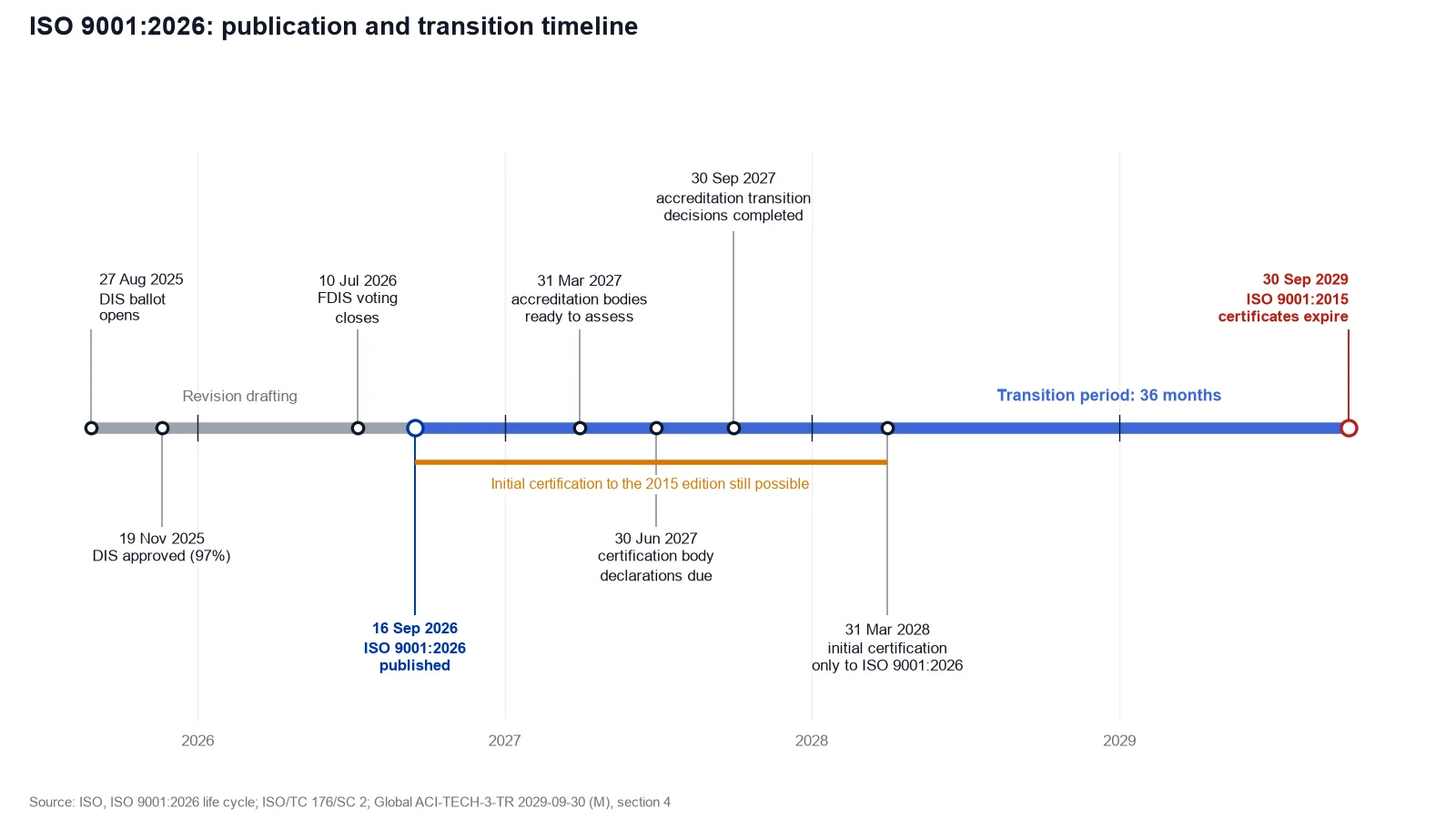
A quick timeline to clear up the confusion about "drafts". ISO registered the revision project in November 2023. The Draft International Standard (DIS) went to ballot on 27 August 2025 and, according to subcommittee ISO/TC 176/SC 2, won 97% approval. Voting on the Final Draft (FDIS) closed on 10 July 2026, and the standard was published in September. It runs to 36 pages, and its ISO catalogue number is 88464.
In Ukraine, the national standards body, DP "UkrNDNC", announced the new edition: the English version is out together with the Redline, and the timeline for a national version is still to be announced (UkrNDNC news). So for the next few months you'll be working from the English text.
We explain how the Ukrainian DSTU versions relate to the international editions in our guide to DSTU ISO 9001.
ISO 9001:2026 status: one version of the truth
ISO 9001:2026 (sixth edition) was published on 16.09.2026. On iso.org, ISO 9001:2015 and ISO 9001:2015/Amd 1:2024 are marked Withdrawn, and the new edition folds the climate amendment into its text. The transition period is three years and ends on 30.09.2029 under the Global ACI-TECH-3-TR document. Phrases like "draft ISO 9001:2026" or "FDIS" are now out of date. If you see them in older material, including on our own site, go by these dates.
What Changed in ISO 9001:2026: Six Changes Listed in the Foreword
The most reliable list of changes is the foreword of the standard itself, not a sales brochure. ISO names six changes there:
- Terms in clause 3. The clause used to just point to ISO 9000. It now contains a limited set of core management system terms: organization, interested party, top management, policy, objective and a few others. ISO 9000 is still the normative reference for all quality terms.
- Quality culture and ethical behaviour now appear in the requirements themselves, mainly in leadership, awareness and the environment for the operation of processes.
- Risks separated from opportunities. They're distinguished more clearly, with separate actions for each.
- Requirements for managing changes to the QMS have been reinforced so that changes deliver their intended results.
- Annex A has been rewritten: it explains the structure, terminology and intent of the requirements and adds no new requirements.
- Annex B, which listed other ISO/TC 176 standards, is gone; those references moved to Annex A and the committee website.
One more detail that's easy to miss: the sixth edition incorporates ISO 9001:2015/Amd 1:2024 on climate. The requirement to determine whether climate change is a relevant issue (clause 4.1) and the note on interested parties' climate-related requirements (clause 4.2) are staying. In their 2024 joint communiqué, IAF and ISO said plainly that the overall intent of 4.1 and 4.2 doesn't change; it's a clarification.
Our take after reading the text: this isn't a revolution. ISO's own explainer for businesses says the same thing: the new edition strengthens existing requirements and clarifies their intent rather than introducing a new approach. Global ACI's transition document calls the overall changes minimal. Still, "minimal" doesn't mean "zero". Quality culture and the split between risks and opportunities will need new evidence at the audit, and a new paragraph in the quality manual won't cover it.
ISO 9001:2026 Changes by Clause 4–10 and What to Rewrite in Your Documents
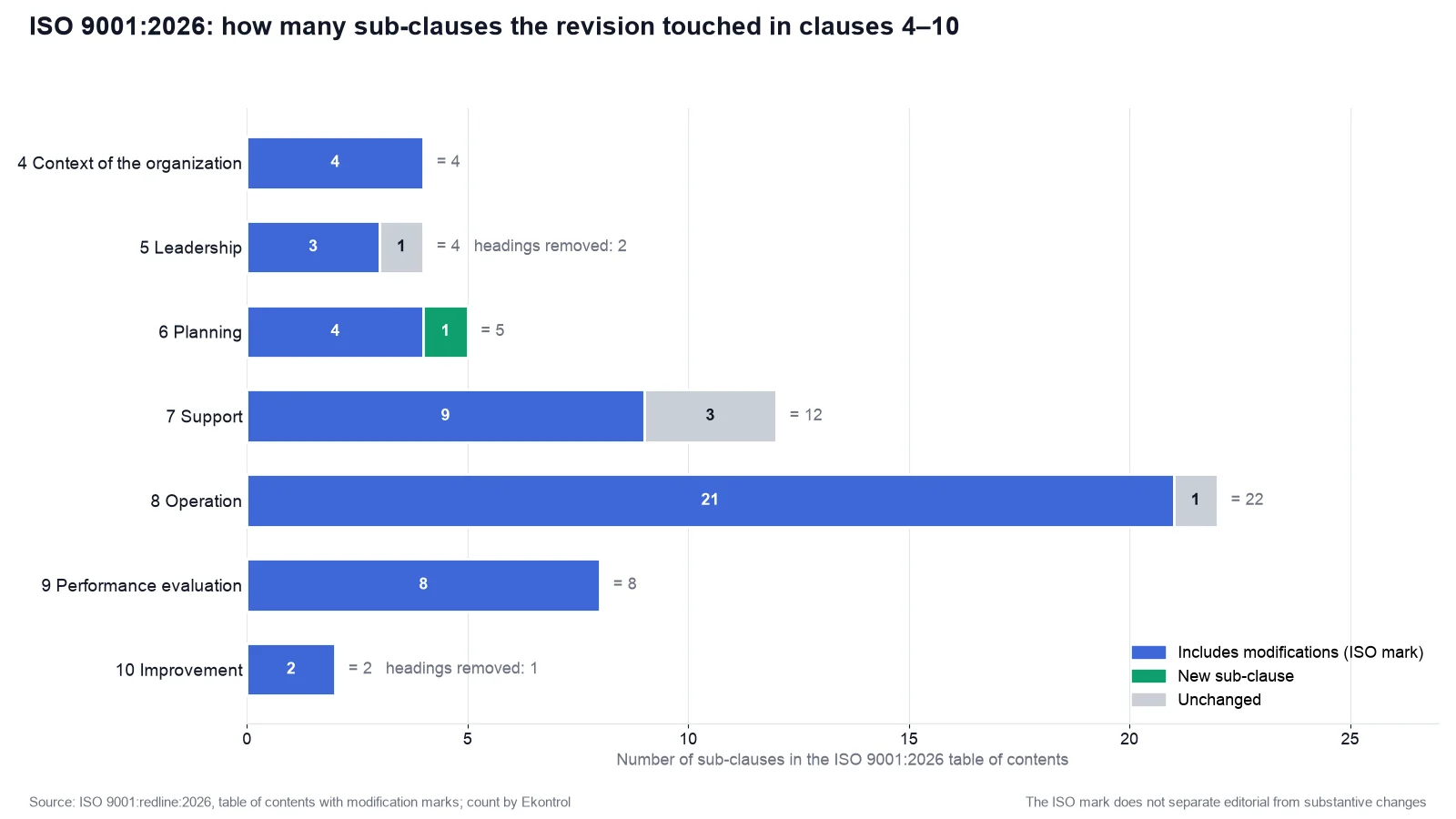
The ten-clause structure stays: ISO confirms the new edition keeps the Harmonized Structure used across management system standards. But open the official Redline version, which compares the sixth edition with the fifth, and almost everything is marked yellow. We counted: the table of contents for clauses 4–10 lists 57 lowest-level sub-clauses, and ISO marks 51 of them as including modifications. One sub-clause is new (6.1.3), five are unchanged, and three headings disappeared.
Don't let that number scare you. ISO marks any edit, editorial ones included: in the title of 8.2.2, for instance, a single small word changed. The substantive changes sit in a handful of places, and Global ACI's transition document lists them, with the caveat that its list isn't exhaustive.
For a full walk-through of the requirements under the current structure, see our article on ISO 9001 requirements, clauses 4–10. Here we cover only what changed.
Clauses 3 and 4: terms and climate
The clause 3 terms will mostly affect your glossary. The climate requirement in 4.1 has been in force since 2024 and should already be in your context analysis. If it isn't, add it now: transition auditors will check it as part of the revised standard. The title of 4.4 is now just "Quality management system", and its text is marked as modified too, so check your process description against it.
Clause 5: leadership, quality culture and ethical behaviour
Clause 5.1.1 gains a new item i): top management has to promote quality culture and ethical behaviour. "Improvement" becomes "continual improvement", and a new Note 2 explains that an organization's quality culture and ethical behaviour show up in its shared values, attitudes and established practices.
The quality policy requirements (clause 5.2) now say directly that the policy takes into account the organization's context and supports its strategic direction. The separate headings 5.2.1 and 5.2.2 are gone, and the clause is simply called "Quality policy". Clause 5.3 is renamed "Roles, responsibilities and authorities".
In our view, quality culture is the hardest part of the transition because you can't "write" it. The auditor will talk to the managing director and to people on the shop floor, and the answers need to match. We covered the questions auditors ask top management in our article on ISO 9001 leadership.
Clause 6 of ISO 9001:2026: risks and opportunities handled separately
Clause 6.1 now has three sub-clauses: 6.1.1 "Determining risks and opportunities", 6.1.2 "Actions to address risks" and the new 6.1.3 "Actions to address opportunities". In practice, an "opportunities" column tacked onto the end of a risk register won't cut it anymore. Opportunities need their own actions, owners and evaluation of results.
In clause 6.3 "Planning of changes", the second paragraph now opens with a purpose: changes have to be implemented effectively to achieve intended results. Three items are added to the existing list: e) how the effectiveness of changes will be monitored and evaluated, f) communication of the changes, g) how to review the results of the changes. In our experience, plenty of companies don't have a change management procedure at all; changes just "happen". Here you'll have to write a procedure, or at least a form, from scratch.
Clause 7: awareness and documented information
Clause 7.3 "Awareness" gains item e): people need to be aware of the organizational quality culture and ethical behaviour. That's a clear signal to update induction training and refresher briefings. On documented information, Global ACI notes a new phrase and a clarification that documented information "shall be available". Sub-clauses 7.1.1, 7.1.2 and 7.4 are unchanged.
Clauses 8–10: less than meets the eye
On the chart, clause 8 looks the most "touched", yet Global ACI doesn't list a single substantive change there. We think it's mostly editorial clarification. Still, check the text yourself, especially 8.3 (design and development) and 8.4 (external providers) if those processes are critical for you.
In 9.2, the sub-clauses now have titles: "General" and "Internal audit programme". In 9.3.2, "shall be planned and carried out taking into consideration" becomes "shall include", and there's a new input c): changes in the needs and expectations of interested parties that are relevant to the QMS. Clause 9.3.3 is now titled "Management review results". Clause 10 drops "General", continual improvement becomes 10.1, and nonconformity and corrective action becomes 10.2. If your procedures refer to "clause 10.3", update the references.
| Clause | ISO 9001:2015 | ISO 9001:2026 | What to change in your documents |
|---|---|---|---|
| 3 Terms and definitions | Reference to ISO 9000 only | Core management system terms in the standard itself | Check the quality manual glossary and remove conflicting definitions |
| 4.1, 4.2 Context and interested parties | Climate added by Amd 1:2024 | Climate wording incorporated into the text | Record in your context analysis whether climate change is relevant |
| 5.1.1 Leadership | Promoting improvement | New item i) on quality culture and ethical behaviour, "continual improvement", Note 2 | Evidence of management action on quality culture |
| 5.2 Quality policy | Sub-clauses 5.2.1 and 5.2.2 | Single clause; policy reflects context and supports strategic direction | Review the policy text for its link to strategy |
| 6.1 Risks and opportunities | Untitled 6.1.1 and 6.1.2, joint actions | 6.1.1 determining, 6.1.2 actions on risks, 6.1.3 actions on opportunities | Separate actions, owners and evaluation for opportunities |
| 6.3 Planning of changes | Items a)–d) | New e), f), g): effectiveness evaluation, communication, review of results | Update the change management procedure or form |
| 7.3 Awareness | Items a)–d) | New e): organizational quality culture and ethical behaviour | Update induction and briefing programmes |
| 7.5 Documented information | Previous wording without this clarification | New wording: documented information shall be available | Check that evidence records are actually accessible |
| 9.3.2 Management review inputs | "Planned and carried out taking into consideration" | "Shall include", new input c) on changes in interested party needs | Add an item to the management review template |
| 10 Improvement | 10.1 General, 10.3 Continual improvement | 10.1 Continual improvement, 10.2 Nonconformity and corrective action | Update clause number references in procedures |
| Annexes A and B | A explains structure, B lists TC 176 standards | A expanded with no new requirements, B removed | Nothing, but read Annex A first |
Transition Period: How Long an ISO 9001:2015 Certificate Stays Valid
The transition deadlines aren't set by ISO but by Global Accreditation Cooperation (Global ACI). IAF ceased operations on 1 January 2026; its website is now an archive that points visitors to Global ACI. The document Global ACI-TECH-3-TR 2029-09-30 (M) was issued on 4 September 2026. It's mandatory for accreditation bodies that signed the MRA and for the certification bodies they accredit (Global ACI announcement).
Ukraine's national accreditation agency, NAAU, has been a Global ACI MRA signatory since November 2025, including for management system certification bodies (NAAU history). So these dates apply to Ukrainian certification bodies as well as international ones. Put five dates in your calendar:
- 31.03.2027: accreditation bodies must be ready to assess certification bodies against the new edition.
- 30.06.2027: certification bodies submit their transition readiness declaration.
- 30.09.2027: accreditation bodies complete their transition decisions.
- 31.03.2028: after this date, initial certification is possible only to ISO 9001:2026.
- 30.09.2029: accredited ISO 9001:2015 certificates are no longer valid.
Here's a practical point people rarely mention. Your certification body can issue an accredited ISO 9001:2026 certificate only after its own accreditation has been transitioned to the new edition. Want to transition at a surveillance audit in spring 2027? First ask your certification body when it expects that decision.
Will your certificate's validity be cut short? Global ACI doesn't require certification bodies to change the expiry date on existing certificates, but it lets them do so to avoid confusing the market. And if an organization says it won't transition, its certificate can't run past 30.09.2029, even when the certification cycle formally ends later.
For comparison, the move from ISO 9001:2008 to 2015 also took three years, and 2008 certificates expired on 15 September 2018 (IAF resolution 2017-13). From our experience of that transition, the queue for auditors builds up in the final year.
31 March 2028: the last date for an initial certificate to the 2015 edition
After 31.03.2028, certification bodies issue initial certificates only to ISO 9001:2026, and Global ACI specifically warns them to plan stage 1 and stage 2 audits around this date. If you're only implementing a QMS now, build it for the new edition from day one. A 2015 certificate obtained in 2027 would still have to be transitioned by September 2029, so you'd pay twice for the same work.
Three Transition Audit Scenarios: Surveillance, Recertification or Special Audit
Global ACI allows the transition audit to be combined with a surveillance audit, combined with a recertification audit, or run as a separate special audit. The auditor reviews the changed requirements of ISO 9001:2026, changes to your context, and whether any other changes to your system are needed. It can be done remotely if the certification body can show the audit objectives are met (IAF MD 4).
Surveillance audit. The most common choice. The certification body decides whether extra time is needed and justifies the calculation under ISO/IEC 17021-1 and IAF MD 5. For a small company with tidy documentation, it's usually the cheapest route. The downside: surveillance audits are short, so prepare evidence for the new requirements in advance.
Recertification. This is a full system audit, and Global ACI states plainly that extra time may not be needed for it. If your cycle ends between 2027 and mid-2029, it's the natural option. There's one risk: if serious nonconformities come up, both the renewal and the transition are on the line.
Special audit. Needed when your audit schedule doesn't line up with the deadline, or when a customer wants a certificate to the new edition sooner. That happens with defence customers and retail chains. It's the most expensive option because it adds a separate visit and a separate report.
A calendar example. A certificate was issued in March 2026, surveillance audits fall in 2027 and 2028, and recertification is due in early 2029. Transitioning at the second surveillance audit in 2028 makes sense: your certification body should have its accreditation for the new edition by then, and you keep a buffer before 30.09.2029 in case of nonconformities.
We break down how auditor-days are calculated and what drives the price in our article on ISO 9001 certification cost.
| Scenario | Best for | Audit time | What to watch |
|---|---|---|---|
| With a surveillance audit | Surveillance falls in 2027–2028 | The certification body decides on extra time under IAF MD 5 | Short audit, so prepare evidence for the new requirements early |
| With recertification | Certificate expires before September 2029 | Extra time may not be needed for a full system audit | Renewal and transition depend on one audit |
| Separate special audit | A customer wants the new edition sooner | Separate time calculation and separate report | The most expensive option because of the extra visit |
| Remote (any of the three) | Document review, multi-site organizations | Allowed under IAF MD 4 if audit objectives are met | In our experience, production processes are better shown in person |
Planning your move to ISO 9001:2026?
We'll run a gap analysis of your system against the new edition, update documents for clauses 5.1, 6.1, 6.3, 7.3 and 9.3, and help you agree a transition audit scenario with your certification body without extra visits.
Discuss your transition planA Six-Step ISO 9001:2026 Transition Plan
ISO's explainer suggests five steps: understand the changes, assess your system with a gap analysis, strengthen your approach, engage your people, and agree a plan with your certification body. We add a sixth: an internal audit and management review run against the new edition.
- Buy the standard together with the Redline. The Redline shows every insertion and deletion, which makes the gap analysis noticeably faster.
- Run a gap analysis using the table above. For each row, note what you already have, what's missing, who owns it and the deadline.
- Update your documents. At a minimum: quality policy, risk and opportunity register, change procedure, training programme, management review template.
- Talk to your people. Quality culture and ethical behaviour are now part of the awareness requirements, so you won't close this item without training and concrete examples from your own operations.
- Run an internal audit against ISO 9001:2026, plus a management review that covers the new input c).
- Agree the date, scenario and duration of the transition audit with your certification body.
If you run an integrated system with ISO 14001, transition both together: ISO 14001:2026 came out in April 2026, and we've set out the plan in our article on the ISO 14001:2026 transition. One gap analysis and one audit for two systems usually cost less than two separate projects.
Our article on the integrated management system explains how to combine processes from several standards without duplication.
If you need help during the certification body's audit itself, we can step in through our audit support service.
| Step | Owner | When (guide) | Output |
|---|---|---|---|
| 1. Standard and Redline | Quality manager | November–December 2026 | List of changes relevant to your company |
| 2. Gap analysis | Quality manager and process owners | By end of Q1 2027 | Gap table with deadlines |
| 3. Documents | Process owners | Q2 2027 | New policy, risk and opportunity register, change procedure |
| 4. Training | HR and quality manager | In parallel with step 3 | Updated briefing programme |
| 5. Internal audit and management review | Internal auditors, managing director | 1–2 months before the certification audit | Audit report and management review record |
| 6. Agreement with the certification body | Quality manager | Once the body holds ISO 9001:2026 accreditation | Confirmed transition audit date and scenario |
The minimum evidence package for a transition audit
An updated quality policy linked to strategy. A risk and opportunity register with separate actions for opportunities. A change management procedure or form covering effectiveness evaluation, communication and review of results. A training programme that covers quality culture and ethics. A management review record with the new input on interested parties. An internal audit report against ISO 9001:2026. A recorded decision on climate in your context analysis. With this package in hand, the auditor can see at once that the changes have taken hold.
Internal Audit Before the Transition: ISO 19011:2026 and Team Training
Almost at the same time as ISO 9001, the guideline for auditing management systems was updated too: ISO 19011:2026 (fourth edition) came out in May 2026. Internal auditors trained on the 2018 version need to catch up on two fronts: what to check (the new ISO 9001 requirements) and how to check it (the new edition of the guideline).
By the way, your internal audit programme should get a separate line for the new requirements. An annual "every process once a year" cycle may not produce evidence in time for a spring transition audit. A detailed breakdown of the ISO 19011 changes is coming in our article on internal audits under ISO 19011:2026.
For teams, we've put together two online courses in November. The three-day ISO 9001:2026 and ISO 19011:2026 course runs on 11–13 November, 13:00 to 17:00 each day.
Defence manufacturers will get more out of the five-day AQAP 2110, ISO 9001:2026 and ISO 19011:2026 programme on 9–13 November. AQAP 2110 builds on ISO 9001, so the transition of the base standard affects your defence requirements as well.
Common Mistakes When Moving to the New ISO 9001 Edition
We went through the move to the 2015 edition with our clients, and the same mistakes came up with remarkable consistency. Some of them are already showing up this time.
- Waiting for 2029. Three years feel like forever, until it turns out the nearest available auditor only has dates after the deadline.
- Renumbering the quality manual to match the new clauses. The introduction to the standard says plainly that it doesn't require your documentation to follow its clause structure. Update the content, not the numbering.
- A "Quality culture policy" instead of a change in behaviour. An auditor will spot a document with no examples, no objectives and no management response to breaches within five minutes on the shop floor.
- Opportunities as the last column of the risk register. Clause 6.1.3 requires separate actions on opportunities, and an empty column can easily turn into a nonconformity.
- Not asking your certification body about its own ISO 9001:2026 accreditation, then booking the transition for a date when it can't issue the new certificate yet.
- Forgetting climate in 4.1. "Not relevant" is an acceptable answer, but you need to justify it.
A word on sectors. Food manufacturers that already run a food safety culture programme shouldn't create a parallel "quality culture": extend the existing programme and show the link. Defence manufacturers with AQAP 2110 should keep in mind that a defence customer may ask for a certificate to the new edition well before 2029. IT companies with ISO 27001 have it easier: the structure is the same, so shared procedures only need updating once.
ISO 9001:2026 Transition Checklist for Quality Managers
Before you agree a date for the transition audit, run through this list:
- ISO 9001:2026 and the Redline purchased
- Gap analysis completed for clauses 3, 4.1, 5.1.1, 5.2, 6.1, 6.3, 7.3, 7.5 and 9.3.2
- Quality policy reviewed for its link to strategic direction
- Risk and opportunity register split, with separate actions for opportunities
- Change management procedure covers effectiveness evaluation, communication and review of results
- Training on quality culture and ethical behaviour delivered and recorded
- Climate decision recorded in the context analysis
- Internal audit and management review carried out against the new edition
- Certification body has confirmed it holds ISO 9001:2026 accreditation
- Transition audit date and scenario agreed, with a buffer before 30.09.2029
Our conclusion is simple. ISO 9001:2026 doesn't require you to rebuild your system, but it does require you to prove that quality culture, work on opportunities and change management actually work. Start the gap analysis this quarter and plan the transition for your nearest audit in 2027–2028, not for the last months before the deadline.
You'll find how we prepare companies for certification and transition on our ISO 9001 certification page.

Need a certification consultation?
Free ConsultationOn This Page
- ISO 9001:2026 Status: Published, With the 2015 Edition Withdrawn
- What Changed in ISO 9001:2026: Six Changes Listed in the Foreword
- ISO 9001:2026 Changes by Clause 4–10 and What to Rewrite in Your Documents
- Transition Period: How Long an ISO 9001:2015 Certificate Stays Valid
- Three Transition Audit Scenarios: Surveillance, Recertification or Special Audit
- A Six-Step ISO 9001:2026 Transition Plan
- Internal Audit Before the Transition: ISO 19011:2026 and Team Training
- Common Mistakes When Moving to the New ISO 9001 Edition
- ISO 9001:2026 Transition Checklist for Quality Managers
ISO 9001:2026 Status: Published, With the 2015 Edition Withdrawn
The sixth edition of ISO 9001 came out on 16 September 2026, and since then ISO 9001:2026 has been the current edition of the quality management system (QMS) standard. In the ISO catalogue, ISO 9001:2015 and its 2024 climate amendment (Amd 1:2024) are now listed as withdrawn. If you're certified, there's no need to panic: a 2015 certificate stays valid until 30 September 2029, and the transition can ride along with a scheduled audit. Below we walk through what actually changed in clauses 4–10, which documents need rewriting, and how to pick a transition audit scenario so you don't pay for an extra auditor visit.
If you're new to the standard, start with our complete ISO 9001 guide: it covers the structure, principles and certification stages. This article is for people whose certificate is already hanging on the wall.
A quick timeline to clear up the confusion about "drafts". ISO registered the revision project in November 2023. The Draft International Standard (DIS) went to ballot on 27 August 2025 and, according to subcommittee ISO/TC 176/SC 2, won 97% approval. Voting on the Final Draft (FDIS) closed on 10 July 2026, and the standard was published in September. It runs to 36 pages, and its ISO catalogue number is 88464.
In Ukraine, the national standards body, DP "UkrNDNC", announced the new edition: the English version is out together with the Redline, and the timeline for a national version is still to be announced (UkrNDNC news). So for the next few months you'll be working from the English text.
We explain how the Ukrainian DSTU versions relate to the international editions in our guide to DSTU ISO 9001.
ISO 9001:2026 status: one version of the truth
ISO 9001:2026 (sixth edition) was published on 16.09.2026. On iso.org, ISO 9001:2015 and ISO 9001:2015/Amd 1:2024 are marked Withdrawn, and the new edition folds the climate amendment into its text. The transition period is three years and ends on 30.09.2029 under the Global ACI-TECH-3-TR document. Phrases like "draft ISO 9001:2026" or "FDIS" are now out of date. If you see them in older material, including on our own site, go by these dates.
What Changed in ISO 9001:2026: Six Changes Listed in the Foreword
The most reliable list of changes is the foreword of the standard itself, not a sales brochure. ISO names six changes there:
- Terms in clause 3. The clause used to just point to ISO 9000. It now contains a limited set of core management system terms: organization, interested party, top management, policy, objective and a few others. ISO 9000 is still the normative reference for all quality terms.
- Quality culture and ethical behaviour now appear in the requirements themselves, mainly in leadership, awareness and the environment for the operation of processes.
- Risks separated from opportunities. They're distinguished more clearly, with separate actions for each.
- Requirements for managing changes to the QMS have been reinforced so that changes deliver their intended results.
- Annex A has been rewritten: it explains the structure, terminology and intent of the requirements and adds no new requirements.
- Annex B, which listed other ISO/TC 176 standards, is gone; those references moved to Annex A and the committee website.
One more detail that's easy to miss: the sixth edition incorporates ISO 9001:2015/Amd 1:2024 on climate. The requirement to determine whether climate change is a relevant issue (clause 4.1) and the note on interested parties' climate-related requirements (clause 4.2) are staying. In their 2024 joint communiqué, IAF and ISO said plainly that the overall intent of 4.1 and 4.2 doesn't change; it's a clarification.
Our take after reading the text: this isn't a revolution. ISO's own explainer for businesses says the same thing: the new edition strengthens existing requirements and clarifies their intent rather than introducing a new approach. Global ACI's transition document calls the overall changes minimal. Still, "minimal" doesn't mean "zero". Quality culture and the split between risks and opportunities will need new evidence at the audit, and a new paragraph in the quality manual won't cover it.
ISO 9001:2026 Changes by Clause 4–10 and What to Rewrite in Your Documents
The ten-clause structure stays: ISO confirms the new edition keeps the Harmonized Structure used across management system standards. But open the official Redline version, which compares the sixth edition with the fifth, and almost everything is marked yellow. We counted: the table of contents for clauses 4–10 lists 57 lowest-level sub-clauses, and ISO marks 51 of them as including modifications. One sub-clause is new (6.1.3), five are unchanged, and three headings disappeared.
Don't let that number scare you. ISO marks any edit, editorial ones included: in the title of 8.2.2, for instance, a single small word changed. The substantive changes sit in a handful of places, and Global ACI's transition document lists them, with the caveat that its list isn't exhaustive.
For a full walk-through of the requirements under the current structure, see our article on ISO 9001 requirements, clauses 4–10. Here we cover only what changed.
Clauses 3 and 4: terms and climate
The clause 3 terms will mostly affect your glossary. The climate requirement in 4.1 has been in force since 2024 and should already be in your context analysis. If it isn't, add it now: transition auditors will check it as part of the revised standard. The title of 4.4 is now just "Quality management system", and its text is marked as modified too, so check your process description against it.
Clause 5: leadership, quality culture and ethical behaviour
Clause 5.1.1 gains a new item i): top management has to promote quality culture and ethical behaviour. "Improvement" becomes "continual improvement", and a new Note 2 explains that an organization's quality culture and ethical behaviour show up in its shared values, attitudes and established practices.
The quality policy requirements (clause 5.2) now say directly that the policy takes into account the organization's context and supports its strategic direction. The separate headings 5.2.1 and 5.2.2 are gone, and the clause is simply called "Quality policy". Clause 5.3 is renamed "Roles, responsibilities and authorities".
In our view, quality culture is the hardest part of the transition because you can't "write" it. The auditor will talk to the managing director and to people on the shop floor, and the answers need to match. We covered the questions auditors ask top management in our article on ISO 9001 leadership.
Clause 6 of ISO 9001:2026: risks and opportunities handled separately
Clause 6.1 now has three sub-clauses: 6.1.1 "Determining risks and opportunities", 6.1.2 "Actions to address risks" and the new 6.1.3 "Actions to address opportunities". In practice, an "opportunities" column tacked onto the end of a risk register won't cut it anymore. Opportunities need their own actions, owners and evaluation of results.
In clause 6.3 "Planning of changes", the second paragraph now opens with a purpose: changes have to be implemented effectively to achieve intended results. Three items are added to the existing list: e) how the effectiveness of changes will be monitored and evaluated, f) communication of the changes, g) how to review the results of the changes. In our experience, plenty of companies don't have a change management procedure at all; changes just "happen". Here you'll have to write a procedure, or at least a form, from scratch.
Clause 7: awareness and documented information
Clause 7.3 "Awareness" gains item e): people need to be aware of the organizational quality culture and ethical behaviour. That's a clear signal to update induction training and refresher briefings. On documented information, Global ACI notes a new phrase and a clarification that documented information "shall be available". Sub-clauses 7.1.1, 7.1.2 and 7.4 are unchanged.
Clauses 8–10: less than meets the eye
On the chart, clause 8 looks the most "touched", yet Global ACI doesn't list a single substantive change there. We think it's mostly editorial clarification. Still, check the text yourself, especially 8.3 (design and development) and 8.4 (external providers) if those processes are critical for you.
In 9.2, the sub-clauses now have titles: "General" and "Internal audit programme". In 9.3.2, "shall be planned and carried out taking into consideration" becomes "shall include", and there's a new input c): changes in the needs and expectations of interested parties that are relevant to the QMS. Clause 9.3.3 is now titled "Management review results". Clause 10 drops "General", continual improvement becomes 10.1, and nonconformity and corrective action becomes 10.2. If your procedures refer to "clause 10.3", update the references.
| Clause | ISO 9001:2015 | ISO 9001:2026 | What to change in your documents |
|---|---|---|---|
| 3 Terms and definitions | Reference to ISO 9000 only | Core management system terms in the standard itself | Check the quality manual glossary and remove conflicting definitions |
| 4.1, 4.2 Context and interested parties | Climate added by Amd 1:2024 | Climate wording incorporated into the text | Record in your context analysis whether climate change is relevant |
| 5.1.1 Leadership | Promoting improvement | New item i) on quality culture and ethical behaviour, "continual improvement", Note 2 | Evidence of management action on quality culture |
| 5.2 Quality policy | Sub-clauses 5.2.1 and 5.2.2 | Single clause; policy reflects context and supports strategic direction | Review the policy text for its link to strategy |
| 6.1 Risks and opportunities | Untitled 6.1.1 and 6.1.2, joint actions | 6.1.1 determining, 6.1.2 actions on risks, 6.1.3 actions on opportunities | Separate actions, owners and evaluation for opportunities |
| 6.3 Planning of changes | Items a)–d) | New e), f), g): effectiveness evaluation, communication, review of results | Update the change management procedure or form |
| 7.3 Awareness | Items a)–d) | New e): organizational quality culture and ethical behaviour | Update induction and briefing programmes |
| 7.5 Documented information | Previous wording without this clarification | New wording: documented information shall be available | Check that evidence records are actually accessible |
| 9.3.2 Management review inputs | "Planned and carried out taking into consideration" | "Shall include", new input c) on changes in interested party needs | Add an item to the management review template |
| 10 Improvement | 10.1 General, 10.3 Continual improvement | 10.1 Continual improvement, 10.2 Nonconformity and corrective action | Update clause number references in procedures |
| Annexes A and B | A explains structure, B lists TC 176 standards | A expanded with no new requirements, B removed | Nothing, but read Annex A first |
Transition Period: How Long an ISO 9001:2015 Certificate Stays Valid
The transition deadlines aren't set by ISO but by Global Accreditation Cooperation (Global ACI). IAF ceased operations on 1 January 2026; its website is now an archive that points visitors to Global ACI. The document Global ACI-TECH-3-TR 2029-09-30 (M) was issued on 4 September 2026. It's mandatory for accreditation bodies that signed the MRA and for the certification bodies they accredit (Global ACI announcement).
Ukraine's national accreditation agency, NAAU, has been a Global ACI MRA signatory since November 2025, including for management system certification bodies (NAAU history). So these dates apply to Ukrainian certification bodies as well as international ones. Put five dates in your calendar:
- 31.03.2027: accreditation bodies must be ready to assess certification bodies against the new edition.
- 30.06.2027: certification bodies submit their transition readiness declaration.
- 30.09.2027: accreditation bodies complete their transition decisions.
- 31.03.2028: after this date, initial certification is possible only to ISO 9001:2026.
- 30.09.2029: accredited ISO 9001:2015 certificates are no longer valid.
Here's a practical point people rarely mention. Your certification body can issue an accredited ISO 9001:2026 certificate only after its own accreditation has been transitioned to the new edition. Want to transition at a surveillance audit in spring 2027? First ask your certification body when it expects that decision.
Will your certificate's validity be cut short? Global ACI doesn't require certification bodies to change the expiry date on existing certificates, but it lets them do so to avoid confusing the market. And if an organization says it won't transition, its certificate can't run past 30.09.2029, even when the certification cycle formally ends later.
For comparison, the move from ISO 9001:2008 to 2015 also took three years, and 2008 certificates expired on 15 September 2018 (IAF resolution 2017-13). From our experience of that transition, the queue for auditors builds up in the final year.
31 March 2028: the last date for an initial certificate to the 2015 edition
After 31.03.2028, certification bodies issue initial certificates only to ISO 9001:2026, and Global ACI specifically warns them to plan stage 1 and stage 2 audits around this date. If you're only implementing a QMS now, build it for the new edition from day one. A 2015 certificate obtained in 2027 would still have to be transitioned by September 2029, so you'd pay twice for the same work.
Three Transition Audit Scenarios: Surveillance, Recertification or Special Audit
Global ACI allows the transition audit to be combined with a surveillance audit, combined with a recertification audit, or run as a separate special audit. The auditor reviews the changed requirements of ISO 9001:2026, changes to your context, and whether any other changes to your system are needed. It can be done remotely if the certification body can show the audit objectives are met (IAF MD 4).
Surveillance audit. The most common choice. The certification body decides whether extra time is needed and justifies the calculation under ISO/IEC 17021-1 and IAF MD 5. For a small company with tidy documentation, it's usually the cheapest route. The downside: surveillance audits are short, so prepare evidence for the new requirements in advance.
Recertification. This is a full system audit, and Global ACI states plainly that extra time may not be needed for it. If your cycle ends between 2027 and mid-2029, it's the natural option. There's one risk: if serious nonconformities come up, both the renewal and the transition are on the line.
Special audit. Needed when your audit schedule doesn't line up with the deadline, or when a customer wants a certificate to the new edition sooner. That happens with defence customers and retail chains. It's the most expensive option because it adds a separate visit and a separate report.
A calendar example. A certificate was issued in March 2026, surveillance audits fall in 2027 and 2028, and recertification is due in early 2029. Transitioning at the second surveillance audit in 2028 makes sense: your certification body should have its accreditation for the new edition by then, and you keep a buffer before 30.09.2029 in case of nonconformities.
We break down how auditor-days are calculated and what drives the price in our article on ISO 9001 certification cost.
| Scenario | Best for | Audit time | What to watch |
|---|---|---|---|
| With a surveillance audit | Surveillance falls in 2027–2028 | The certification body decides on extra time under IAF MD 5 | Short audit, so prepare evidence for the new requirements early |
| With recertification | Certificate expires before September 2029 | Extra time may not be needed for a full system audit | Renewal and transition depend on one audit |
| Separate special audit | A customer wants the new edition sooner | Separate time calculation and separate report | The most expensive option because of the extra visit |
| Remote (any of the three) | Document review, multi-site organizations | Allowed under IAF MD 4 if audit objectives are met | In our experience, production processes are better shown in person |
Planning your move to ISO 9001:2026?
We'll run a gap analysis of your system against the new edition, update documents for clauses 5.1, 6.1, 6.3, 7.3 and 9.3, and help you agree a transition audit scenario with your certification body without extra visits.
Discuss your transition planA Six-Step ISO 9001:2026 Transition Plan
ISO's explainer suggests five steps: understand the changes, assess your system with a gap analysis, strengthen your approach, engage your people, and agree a plan with your certification body. We add a sixth: an internal audit and management review run against the new edition.
- Buy the standard together with the Redline. The Redline shows every insertion and deletion, which makes the gap analysis noticeably faster.
- Run a gap analysis using the table above. For each row, note what you already have, what's missing, who owns it and the deadline.
- Update your documents. At a minimum: quality policy, risk and opportunity register, change procedure, training programme, management review template.
- Talk to your people. Quality culture and ethical behaviour are now part of the awareness requirements, so you won't close this item without training and concrete examples from your own operations.
- Run an internal audit against ISO 9001:2026, plus a management review that covers the new input c).
- Agree the date, scenario and duration of the transition audit with your certification body.
If you run an integrated system with ISO 14001, transition both together: ISO 14001:2026 came out in April 2026, and we've set out the plan in our article on the ISO 14001:2026 transition. One gap analysis and one audit for two systems usually cost less than two separate projects.
Our article on the integrated management system explains how to combine processes from several standards without duplication.
If you need help during the certification body's audit itself, we can step in through our audit support service.
| Step | Owner | When (guide) | Output |
|---|---|---|---|
| 1. Standard and Redline | Quality manager | November–December 2026 | List of changes relevant to your company |
| 2. Gap analysis | Quality manager and process owners | By end of Q1 2027 | Gap table with deadlines |
| 3. Documents | Process owners | Q2 2027 | New policy, risk and opportunity register, change procedure |
| 4. Training | HR and quality manager | In parallel with step 3 | Updated briefing programme |
| 5. Internal audit and management review | Internal auditors, managing director | 1–2 months before the certification audit | Audit report and management review record |
| 6. Agreement with the certification body | Quality manager | Once the body holds ISO 9001:2026 accreditation | Confirmed transition audit date and scenario |
The minimum evidence package for a transition audit
An updated quality policy linked to strategy. A risk and opportunity register with separate actions for opportunities. A change management procedure or form covering effectiveness evaluation, communication and review of results. A training programme that covers quality culture and ethics. A management review record with the new input on interested parties. An internal audit report against ISO 9001:2026. A recorded decision on climate in your context analysis. With this package in hand, the auditor can see at once that the changes have taken hold.
Internal Audit Before the Transition: ISO 19011:2026 and Team Training
Almost at the same time as ISO 9001, the guideline for auditing management systems was updated too: ISO 19011:2026 (fourth edition) came out in May 2026. Internal auditors trained on the 2018 version need to catch up on two fronts: what to check (the new ISO 9001 requirements) and how to check it (the new edition of the guideline).
By the way, your internal audit programme should get a separate line for the new requirements. An annual "every process once a year" cycle may not produce evidence in time for a spring transition audit. A detailed breakdown of the ISO 19011 changes is coming in our article on internal audits under ISO 19011:2026.
For teams, we've put together two online courses in November. The three-day ISO 9001:2026 and ISO 19011:2026 course runs on 11–13 November, 13:00 to 17:00 each day.
Defence manufacturers will get more out of the five-day AQAP 2110, ISO 9001:2026 and ISO 19011:2026 programme on 9–13 November. AQAP 2110 builds on ISO 9001, so the transition of the base standard affects your defence requirements as well.
Common Mistakes When Moving to the New ISO 9001 Edition
We went through the move to the 2015 edition with our clients, and the same mistakes came up with remarkable consistency. Some of them are already showing up this time.
- Waiting for 2029. Three years feel like forever, until it turns out the nearest available auditor only has dates after the deadline.
- Renumbering the quality manual to match the new clauses. The introduction to the standard says plainly that it doesn't require your documentation to follow its clause structure. Update the content, not the numbering.
- A "Quality culture policy" instead of a change in behaviour. An auditor will spot a document with no examples, no objectives and no management response to breaches within five minutes on the shop floor.
- Opportunities as the last column of the risk register. Clause 6.1.3 requires separate actions on opportunities, and an empty column can easily turn into a nonconformity.
- Not asking your certification body about its own ISO 9001:2026 accreditation, then booking the transition for a date when it can't issue the new certificate yet.
- Forgetting climate in 4.1. "Not relevant" is an acceptable answer, but you need to justify it.
A word on sectors. Food manufacturers that already run a food safety culture programme shouldn't create a parallel "quality culture": extend the existing programme and show the link. Defence manufacturers with AQAP 2110 should keep in mind that a defence customer may ask for a certificate to the new edition well before 2029. IT companies with ISO 27001 have it easier: the structure is the same, so shared procedures only need updating once.
ISO 9001:2026 Transition Checklist for Quality Managers
Before you agree a date for the transition audit, run through this list:
- ISO 9001:2026 and the Redline purchased
- Gap analysis completed for clauses 3, 4.1, 5.1.1, 5.2, 6.1, 6.3, 7.3, 7.5 and 9.3.2
- Quality policy reviewed for its link to strategic direction
- Risk and opportunity register split, with separate actions for opportunities
- Change management procedure covers effectiveness evaluation, communication and review of results
- Training on quality culture and ethical behaviour delivered and recorded
- Climate decision recorded in the context analysis
- Internal audit and management review carried out against the new edition
- Certification body has confirmed it holds ISO 9001:2026 accreditation
- Transition audit date and scenario agreed, with a buffer before 30.09.2029
Our conclusion is simple. ISO 9001:2026 doesn't require you to rebuild your system, but it does require you to prove that quality culture, work on opportunities and change management actually work. Start the gap analysis this quarter and plan the transition for your nearest audit in 2027–2028, not for the last months before the deadline.
You'll find how we prepare companies for certification and transition on our ISO 9001 certification page.