
Statutory Basis for Dish Technological Cards in Ukraine: Order No. 219, Law No. 771/97-VR, and Order No. 590
A properly engineered technological card for a dish in a commercial kitchen, supermarket culinary department, or school canteen works just like a mechanical blueprint on a factory floor. It locks in the exact raw material input before trimming ($M_{\text{gross}}$), allowable cold-processing waste percentages during peeling and deboning ($W_{\text{cold}}$), the net weight of the prepared semi-finished ingredient ($M_{\text{net}}$), moisture and fat losses during boiling or baking ($W_{\text{therm}}$), the final plated portion yield ($M_{\text{yield}}$), and the exact time-temperature safety limits. In practice, across more than 200 food safety engineering projects delivered by the Ekontrol team, we usually walk into a very different reality: the accountant's binder holds three-year-old POS printouts with zero cooking temperatures, while line cooks work from personal notebooks.
As long as nobody audits the kitchen, that disconnect quietly drains your food cost, creates monthly inventory write-offs, and causes portion weights to drift. The day an inspector from the State Service of Ukraine on Food Safety and Consumer Protection (SSUFSCP / Derzhprodspozhyvsluzhba) or a retail chain auditor walks in, outdated technological cards immediately tear down your HACCP and ISO 22000 defenses. Inspectors don't read a card in isolation. They pick one dish off your live menu and place the technological card right next to incoming supplier delivery notes, the portion scale on the pass, and your CCP temperature logs.
Four Ukrainian Statutory Acts Linking Technological Cards to Food Safety
Many restaurant owners still believe that once Soviet GOST standards were repealed, technological cards became optional internal paperwork. That's a costly legal misconception during a state inspection. Today, mandatory technological documentation in Ukraine rests on four interlocking statutory acts:
- Ministry of Economy Order No. 219 of 24.07.2002 "On Approval of the Rules for the Operation of Restaurant Establishments (Enterprises)" (registered under No. 680/6968). Section 2 explicitly mandates that food business operators producing culinary items must comply with technological production regimes (ingredient compatibility, valid substitutions, and cold and thermal processing parameters) defined in approved Recipe Collections, standards, technical specifications, technological cards (TCs), and technical and technological cards (TTCs). Clause 2.3 of Order No. 219 directly requires that cooks and pastry chefs have technological cards at their workstations.
- Law of Ukraine No. 771/97-VR "On Basic Principles and Requirements for Food Safety and Quality". Articles 20 and 21 require every food business operator to develop, implement, and maintain permanent procedures based on HACCP principles, while Article 22 mandates "one step back, one step forward" traceability. You can't prove mass-balance traceability from raw meat batches to finished portions or justify thermal critical limits without valid technological cards.
- Ministry of Agrarian Policy Order No. 590 of 01.10.2012 "On Approval of Requirements for the Development, Implementation and Application of Permanent Procedures Based on the Principles of the Food Safety Management System (HACCP)". Clause 6.5 requires a complete product description (composition, physicochemical and microbiological characteristics, processing method, packaging, shelf life, and storage conditions) alongside a verified process flow diagram. In HoReCa, catering, and culinary production, a technological card for a dish template and structure aligned with your HACCP plan acts as both the product description and the line instruction.
- Law of Ukraine No. 2639-VIII of 06.12.2018 "On Information for Consumers Regarding Food Products". Harmonized with EU Regulation No. 1169/2011, this law makes written disclosure of the 14 major allergens listed in Annex I mandatory for every dish (including non-prepacked restaurant and canteen meals) and standardizes energy value calculations in both kilocalories ($\text{kcal}$) and kilojoules ($\text{kJ}$).
Here's the practical reality: when an inspector finds a mismatch between actual kitchen preparation, missing thermal parameters in your cards, and entries in your monitoring logs, they classify it under Article 65 of Law of Ukraine No. 2042-VIII as a failure to apply permanent HACCP procedures. That triggers a direct fine of 30 minimum wages for legal entities or 15 minimum wages for sole proprietors (FOP).
Difference Between a Technological Card (TC), Technical and Technological Card (TTC), and Costing Card: Structure and Fields
During most inspections in cafes, restaurants, bakeries, and supermarket kitchens, teams mix up three distinct documents: the Technological Card (TC), the Technical and Technological Card (TTC), and the Costing Card. Often, a manager exports an ingredient table with purchase prices from Syrve/iiko, Poster, R-Keeper, or BAS, labels it a "tech card," and hands it to the inspector. To an auditor, that printout isn't technological documentation at all.
Understanding the exact difference between technological card TTC and costing card under Ministry of Economy Order No. 219 comes down to what each document controls on the floor.
1. Technological Card for a Dish or Culinary Item (TC)
You compile a standard Technological Card (Технологічна карта, ТК) when your kitchen prepares a dish strictly according to an officially approved Recipe Collection (Збірник рецептур страв і кулінарних виробів) without altering the core process or main ingredients. Because the recipe collection has already validated the baseline physicochemical and microbiological parameters, the TC acts as an operational workstation sheet with five mandatory blocks:
- Identification header: legal name of the food business operator, exact dish name (matching the printed menu and fiscal receipt word for word), recipe collection number and column, effective date, and the director's approval signature.
- Ingredient input table: every raw material listed with its gross weight ($M_{\text{gross}}$) and net or semi-finished weight ($M_{\text{net}}$) per 1 portion (in grams) and per 100 portions or $10\text{ kg}$ batch (in kilograms), plus the exact finished portion yield ($M_{\text{yield}}$).
- Step-by-step technological process: mechanical preparation sequence, ingredient addition order, exact thermal processing parameters (core temperature in $,^\circ\text{C}$ and exposure time in minutes), and plating rules.
- Sensory (organoleptic) quality criteria: appearance, texture, color, taste, and aroma standards used during daily batch release.
- Storage, holding, and allergen parameters: hot-holding temperature on the steam table ($\ge +65,^\circ\text{C}$) or cold display temperature ($+2\dots+6,^\circ\text{C}$), maximum holding time in hours, and Annex I allergens under Law No. 2639-VIII.
2. Technical and Technological Card (TTC) for New and Signature Dishes
Under clause 2.2 of Order No. 219, establishments can develop new, signature, or chef-authored dishes absent from standard recipe collections, or modify traditional cooking methods (such as Sous-Vide cooking, house-fermented sauces, or gluten-free pastry). For every such item, you must develop a Technical and Technological Card (Техніко-технологічна карта, ТТК). A TTC carries the status of an internal enterprise standard and includes five expanded engineering sections:
- Scope of application: specifies the exact production site or restaurant chain authorized to produce and sell the signature dish.
- Raw material quality and safety requirements: references to national DSTU standards, technical specifications, and mandatory supplier safety certificates for each incoming batch.
- Raw material consumption, waste, and yield norms: full gross, cold-waste percentage, net, thermal-loss percentage, and final yield figures backed by an official Act of Control Dish Preparation.
- Physicochemical and microbiological safety indicators: maximum or minimum limits for dry matter, fat, sugar, and salt content, plus microbiological criteria (Total Plate Count / КМАФАнМ, coliforms / БГКП, Staphylococcus aureus, Proteus, Salmonella, and Listeria monocytogenes) verified in ISO/IEC 17025 accredited laboratories.
- Nutritional and energy value table: proteins, fats (including saturated fats), carbohydrates (including sugars), and salt per $100\text{ g}$ and per portion, plus energy value in both $\text{kcal}$ and $\text{kJ}$.
3. Costing Card (Калькуляційна картка)
A Costing Card doesn't contain cooking instructions, core temperatures, or microbiological limits. Its sole job is accounting: calculating the direct raw material cost of 100 portions and setting the selling price. In practice, ingredients transfer from the TC/TTC into the Costing Card exclusively at GROSS weight ($M_{\text{gross}}$) because you buy unpeeled vegetables and untrimmed meat from suppliers at gross weight. If an accountant mistakenly plugs net weights into the costing card, the software understates dish cost by $15-40%$ and creates an unexplained warehouse shortage every month.
| Comparison Criterion | Technological Card (TC / ТК) | Technical & Technological Card (TTC / ТТК) | Costing Card (Калькуляційна карта) |
|---|---|---|---|
| When required under Order No. 219 | For dishes prepared strictly by official Recipe Collections | For new, chef-authored, and signature dishes or modified cooking processes | For every priced menu item and whenever supplier purchase prices change |
| Primary engineering purpose | Line cook instruction: exact input weights, cooking steps, and target yield | Internal enterprise standard defining process, physicochemistry, and microbiology | Accounting calculation of direct ingredient cost and menu selling price |
| Raw material weight basis | Gross weight, net weight, and finished yield for 1 and 100 portions | Gross weight, % cold waste, net weight, % thermal loss, and yield per Control Act | Exclusively gross weight per 100 portions multiplied by supplier unit price |
| Process description & HACCP CCPs | Mandatory: operation sequence, exposure time, core temperature, holding rules | Expanded: stage regimes, CCP/OPRP critical limits, packaging, and labeling | None (lists only ingredient names, SKU codes, gross norms, and UAH values) |
| Physicochemical & microbiological limits | Referenced via the underlying Recipe Collection or national DSTU standard | Mandatory section: dry matter, fat, salt, TPC, coliforms, Salmonella, Listeria | None |
| Allergens & kcal/kJ (Law No. 2639-VIII) | Annex I allergen declaration and reference nutritional value | Mandatory calculation of proteins, fats, carbs, salt, kcal/kJ, and allergen matrix | None |
| Who drafts and who approves | Drafted by technologist or head chef; signed and dated by the director/FOP | Engineered by technologist based on Control Act; approved by company director | Compiled by costing accountant; signed by head chef, accountant, and director |
| Who inspects during audits | SSUFSCP inspector, ISO 22000 auditor, internal quality release committee | SSUFSCP, retail chain auditor, ISO/IEC 17025 accredited testing laboratory | Tax authorities (STS), financial auditors, State Audit Service in public tenders |
Why Using Net Weight Instead of Gross Weight in Tenders and Costing Triggers Double Penalties
In public schools and preschools (under clause 13 of Cabinet of Ministers Resolution No. 305) as well as industrial canteens, food procurement must be calculated in gross weight according to technological documentation. If a procurement officer enters net weight into a Prozorro tender or costing card (for example, ordering 1,000 kg of peeled carrots instead of 1,250 kg of unpeeled carrots after January 1 at 20% waste), the kitchen faces an immediate 250 kg raw material deficit. When cooks shrink portion weights on the serving line to stretch stock, an SSUFSCP inspector weighing portions records both consumer deception and a breach of statutory nutrition norms.
Calculating Cold and Thermal Processing Losses: Gross, Net, Final Yield Formulas, and Seasonal Waste Norms
When a food technologist builds a technological card or audits a restaurant's recipe database, the first mathematical check is end-to-end mass balance. Every ingredient passes through two sequential transformations: mechanical (cold) preparation in the prep area and thermal (heat) treatment on the hot line. If a card simply lists three weights that don't connect mathematically through standard loss percentages, an ISO 22000 auditor spots manual number-fudging immediately.
Forward and Reverse Mass-Balance Engineering Formulas
Let's define our variables: $M_{\text{gross}}$ is the incoming untrimmed weight (g), $W_{\text{cold}}$ is the cold-processing waste percentage during peeling, deboning, trimming, or thawing (%), $M_{\text{net}}$ is the cleaned semi-finished weight entering the pan or oven (g), $W_{\text{therm}}$ is the thermal-processing loss percentage during boiling, baking, stewing, or frying (%), and $M_{\text{yield}}$ is the finished plated component weight (g).
1. Forward calculation (from purchased raw material weight to finished dish yield):
During cold processing, you subtract non-edible trimmings, peel, bones, sinew, and thaw drip from the gross weight:
$$M_{\text{net}} = M_{\text{gross}} \times \left(1 - \frac{W_{\text{cold}}}{100}\right)$$
During thermal processing, protein denaturation evaporates moisture and renders out fat:
$$M_{\text{yield}} = M_{\text{net}} \times \left(1 - \frac{W_{\text{therm}}}{100}\right) = M_{\text{gross}} \times \left(1 - \frac{W_{\text{cold}}}{100}\right) \times \left(1 - \frac{W_{\text{therm}}}{100}\right)$$
Watch out for the classic rookie mistake: you can't simply add $W_{\text{cold}}$ and $W_{\text{therm}}$ together! If Category I beef on the bone has $W_{\text{cold}} = 26%$ during deboning and $W_{\text{therm}} = 38%$ during boiling, total mass loss isn't $26 + 38 = 64%$. Instead, you multiply the retention factors: $1 - (0.74 \times 0.62) = 54.12%$. From $1,000\text{ g}$ of gross beef, you get $740\text{ g}$ of trimmed net meat and exactly $459\text{ g}$ of boiled beef.
2. Reverse calculation (from a fixed menu portion yield back to gross procurement weight):
In restaurants, catering, and school canteens, you usually work backwards from a fixed menu portion (say, $M_{\text{yield}} = 120\text{ g}$ of baked pike-perch fillet) to find how much raw fillet the cook needs ($M_{\text{net}}$) and how much whole fish the warehouse must write off ($M_{\text{gross}}$):
$$M_{\text{net}} = \frac{M_{\text{yield}}}{1 - \frac{W_{\text{therm}}}{100}}, \quad M_{\text{gross}} = \frac{M_{\text{net}}}{1 - \frac{W_{\text{cold}}}{100}}$$
For whole pike-perch filleted with skin on and no bones, $W_{\text{cold}} = 48%$ and combi-oven baking loss is $W_{\text{therm}} = 20%$. To plate $120\text{ g}$ of cooked fish, you need $M_{\text{net}} = 120 / 0.80 = 150\text{ g}$ of raw fillet and $M_{\text{gross}} = 150 / 0.52 = 288.5\text{ g}$ of whole fish.
Grain Hydration Gain, Ice Glaze on Seafood, and Seasonal Root-Vegetable Waste
Three special physical behaviors must be built into your gross net yield and thermal loss calculation:
- Hydration gain (swell) in grains, legumes, and pasta. Dry grains absorb water during cooking and increase in mass by $2.1-3.2$ times. You first deduct $1.0-1.5%$ cold waste for sorting and rinsing, then apply the hydration multiplier (for example, $1\text{ kg}$ of dry buckwheat absorbs $1.5\text{ kg}$ of water and salt, yielding $2.1\text{ kg}$ of fluffy porridge after accounting for $1%$ kettle-wall loss).
- Protective ice glaze on frozen fish and shrimp. Declared glaze weight ($5-14%$ on the supplier label) must be stripped out before applying the $3-7%$ muscle-drip thawing loss; otherwise, your plated seafood portion will come up $10-15%$ short.
- Seasonal root-vegetable aging. As potatoes sit in storage from autumn to spring, their skin thickens and sprouts. Official Ukrainian potato waste norms shift five times a year: $20%$ before September 1, $25%$ from September 1 to October 31, $30%$ from November 1 to December 31, $35%$ from January 1 to February 28/29, and $40%$ from March 1 onward. Carrots and beetroot jump from $20%$ before January 1 to $25%$ after January 1.
| Raw Material Group & Processing Method | Cold-Processing Waste (W cold, %) | Thermal-Processing Loss (W therm, %) | Overall Yield Factor from Gross & Engineering Notes |
|---|---|---|---|
| Ware potatoes (peeling, boiling, baking, or deep-frying) | Before 01.09: 20%; 01.09-31.10: 25%; 01.11-31.12: 30%; 01.01-28.02: 35%; from 01.03: 40% | Boiling peeled: 3%; oven baking: 15-20%; deep-frying: 37-50% | Boiled potato yield factor from gross drops from 0.776 in August to 0.582 in March (+33% purchase volume) |
| Table carrots and beetroot (peeling, dicing/julienne, boiling or sautéing) | Before January 1: 20%; from January 1: 25% | Boiling peeled: 3-5%; poaching: 8-10%; sautéing carrots with fat: 22-25% | When boiled in skin, peeling waste and thermal loss are combined after cooling |
| Bulb onions (root/skin trimming, slicing, sautéing or frying) | 16% year-round (green spring onions: 20%) | Sautéing in oil or butter: 50%; deep-frying until golden: 58% | 1,000 g of gross onions yields 840 g of raw sliced net onion and 420 g of sautéed onion |
| Fresh white cabbage (outer leaf trimming, coring, boiling or braising) | 20% year-round (cauliflower: 45-48%; fresh broccoli: 28-35%) | Steaming or boiling: 7-10%; braising with sauce: 12-15% (of cabbage mass) | For IQF frozen cauliflower or broccoli florets, W cold = 0% and boiling loss is 12-15% |
| Chilled bone-in beef (deboning, sinew trimming, boiling or stewing) | Category I carcass: 26%; Category II carcass: 31% (boneless trimmed primal: 7-12%) | Boiling large cuts: 38-40%; stewing portion cuts: 36-38%; roasting: 35-37% | Boiled beef yield from a Category I carcass is 44.4-45.9% of initial gross weight |
| Pork meat (fat/sinew trimming, roasting, pan-frying, or minced cutlets) | Bone-in carcass: 15-18%; boneless chilled neck or loin: 5-8% | Roasting or frying portion cuts: 30-33%; steamed or baked minced cutlets: 18-22% | Minced items lose less moisture during baking because bread/grain binders retain juices |
| Poultry: drawn broiler carcass vs chilled trimmed chicken breast fillet | Drawn carcass to boneless skinless fillet: 38-42%; chilled trimmed fillet: 3-6% | Poaching fillet: 25-28%; combi-oven baking at 30% steam: 22-25% | Switching from whole carcasses to trimmed fillets requires an Act of Control Dish Preparation |
| Fish: pike-perch, cod, hake, salmon (filleting, poaching, or baking) | Whole fish to skin-on boneless fillet: 45-52%; chilled trimmed fillet: 2-4% | Steam poaching: 18-20%; oven baking or pan-frying: 20-24% | For frozen fillets, subtract declared ice glaze first, then apply 5-7% thaw drip loss |
| Dry grains (buckwheat, polished rice, millet, oats) and durum pasta | Sorting and rinsing grains: 1.0-1.5%; dry pasta: 0% | Mass gain from water absorption: buckwheat +110% (210% yield), rice +180% (280% yield) | Card inputs list dry grain weight; yield accounts for 1% portioning loss on the line |
| Acid-curd cottage cheese 5-9% fat (sieving, syrnyky pancakes, or casserole) | Mechanical loss during sieving and mixing: 1.5-2.0% | Combi-oven curd casserole: 11-14%; pan-seared and oven-finished syrnyky: 12-15% | If incoming curd moisture exceeds 75%, press out whey and record via a Control Act |
Act of Control Dish Preparation and Worked Engineering Sample of a Technological Card (1 and 100 Portions)
What should your technologist do when loss norms from a 1982 or 2000 Recipe Collection don't match what happens in your kitchen today? Modern restaurants, caterers, and school canteens buy washed calibrated potatoes, vacuum-packed peeled vegetables, skinless boneless chicken breast, and Trim D salmon fillets. Cooking in a modern combi-steamer at 30% humidity with a core temperature probe cuts meat shrinkage to $20-22%$ instead of the $35-38%$ seen in old static ovens.
The only legally valid way to establish custom waste and shrinkage norms at your facility is to run a physical test batch and execute an official Act of Control Dish Preparation (Акт контрольного опрацювання страви).
5-Step Protocol for an Act of Control Dish Preparation
To make sure your Act of Control Dish Preparation holds up during both tax audits (for cost-of-goods write-offs) and SSUFSCP HACCP inspections, follow five rules:
- Appoint a commission by director's order: at least 3 members (head chef or food technologist, costing accountant, and a management representative or HACCP team leader).
- Use calibrated scales and a representative batch: weigh on metrologically verified kitchen scales using at least 3-5 portions (or $3-10\text{ kg}$ of raw material), running three parallel batches to calculate an arithmetic mean.
- Weigh every fraction by stage: record initial gross weight $M_{\text{gross}}$, net trimmed semi-finished weight $M_{\text{net}}$, usable trimmings, and non-edible waste. Calculate actual cold waste as: $$W_{\text{cold.act}} = \frac{M_{\text{gross}} - M_{\text{net}}}{M_{\text{gross}}} \times 100%$$
- Measure thermal loss at the exact CCP target: cook the semi-finished batch in your standard combi-oven or kettle until the core reaches the CCP limit (e.g., $+76,^\circ\text{C}$) and weigh at serving temperature ($+65,^\circ\text{C}$): $$W_{\text{therm.act}} = \frac{M_{\text{net}} - M_{\text{yield}}}{M_{\text{net}}} \times 100%$$
- Approve and reference the Act: all commission members sign the Act, the director approves it, and its number and date go directly into the header of your TC or TTC.
Worked Sample of a Technological Card for 1 and 100 Portions
Let's examine a complete technological card for a dish template and structure for a composite main course: "Baked Chicken Fillet in Mustard-Cream Sauce with Mashed Potatoes" with a total plated yield of $M_{\text{yield}} = 300\text{ g}$ ($110\text{ g}$ baked fillet, $40\text{ g}$ sauce, $150\text{ g}$ mashed potatoes). This calculation covers November-December (potato waste $30%$; chilled chicken breast fillet governed by Act of Control Dish Preparation No. 14 of 12.10.2026 at $W_{\text{cold}} = 5%$ membrane trim and $W_{\text{therm}} = 22%$ combi-oven baking loss).
| Raw Material & Component Name | Gross per 1 Portion (g) | W cold (%) | Net per 1 Portion (g) | W therm (%) | Yield per 1 Portion (g) | Per 100 Portions: Gross / Net (kg) | Allergens (Law No. 2639-VIII) & Calculation Note |
|---|---|---|---|---|---|---|---|
| 1. Chilled chicken breast fillet | 148.5 | 5.0% | 141.0 | 22.0% | 110.0 | 14.85 / 14.10 | No allergens. Per Act No. 14: 148.5 * 0.95 = 141.0 g; 141.0 * 0.78 = 110.0 g |
| Refined sunflower oil (for GN pan greasing) | 2.0 | 0.0% | 2.0 | 100% | 0.0 | 0.20 / 0.20 | No allergens. Technological pan-release allowance |
| 2. Pasteurized dairy cream 20% fat (sauce) | 38.0 | 0.0% | 38.0 | 15.0% | 32.3 | 3.80 / 3.80 | Allergen No. 7: Milk and dairy products (including lactose) |
| Whole-grain Dijon mustard | 4.5 | 0.0% | 4.5 | 15.0% | 3.8 | 0.45 / 0.45 | Allergen No. 10: Mustard and products thereof |
| Premium wheat flour (roux thickener) | 2.0 | 0.0% | 2.0 | 15.0% | 1.7 | 0.20 / 0.20 | Allergen No. 1: Cereals containing gluten (wheat) |
| Unsalted dairy butter 73% fat (sauce) | 2.6 | 0.0% | 2.6 | 15.0% | 2.2 | 0.26 / 0.26 | Allergen No. 7: Milk (lactose). Total finished sauce yield: 40.0 g |
| 3. Fresh ware potatoes (season 01.11-31.12) | 167.9 | 30.0% | 117.5 | 3.0% | 114.0 | 16.79 / 11.75 | No allergens. From March 1 at 40% waste, gross rises to 195.8 g (19.58 kg / 100) |
| Pasteurized cow's milk 2.5% fat (mash) | 30.0 | 0.0% | 30.0 | 0.0% | 30.0 | 3.00 / 3.00 | Allergen No. 7: Milk and dairy products (including lactose) |
| Dairy butter 73% fat (mash) | 5.0 | 0.0% | 5.0 | 0.0% | 5.0 | 0.50 / 0.50 | Allergen No. 7: Milk and dairy products (lactose) |
| Iodized table salt (total across components) | 2.5 | 0.0% | 2.5 | 60.0% | 1.0 | 0.25 / 0.25 | No allergens. Part of the salt drains with potato cooking water |
| TOTAL PLATED DISH YIELD (110 / 40 / 150) | 403.0 | 14.4% | 345.1 | 13.1% | 300.0 | 40.30 / 34.51 (yield 30.0 kg) | Mandatory menu declaration: Gluten (wheat), Milk (lactose), Mustard |
Do Your Technological Cards Match What Your Kitchen Actually Cooks?
Ekontrol food technologists conduct on-site diagnostic audits for restaurants, retail culinary departments, and canteens, run control dish preparations, and align your technological cards, POS costing, and HACCP logs within 5 to 10 working days.
Book a Diagnostic AuditEmbedding HACCP and ISO 22000 Critical Control Points (CCPs) into the Technological Card: Temperatures, Blast Chilling, and Labeling
When an ISO 22000 certification auditor or a state inspector working under Order No. 590 opens your technological card, they look for a direct engineering bridge to your HACCP Plan. The biggest flaw in legacy cards is vague wording in the cooking instructions: "pan-fry until golden brown," "boil until tender," or "leave to cool on the table."
In food safety engineering, "until tender" means nothing because it lacks a measurable Critical Limit. For a technological card to protect your business during an inspection, its text must embed four operational controls for Critical Control Points (CCPs) and Operational Prerequisite Programs (OPRPs).
1. Thermal Processing (Cooking CCP): Core Temperature in the Geometric Center
The primary biological hazard when cooking meat, poultry, fish, eggs, and dairy dishes is the survival of vegetative pathogens (Salmonella spp., Listeria monocytogenes, enterohemorrhagic E. coli, and Campylobacter jejuni). Achieving a safe $6\text{-log reduction}$ requires heating the coldest spot (the geometric center of the thickest piece on the middle tray) to a validated core temperature for a set exposure time:
- Poultry dishes (chicken, turkey, duck), minced meat items (cutlets, meatballs, loaves), stuffed items, and egg casseroles/omelets: core temperature at least $+75,^\circ\text{C}$ (held for at least 15-30 seconds), while school canteen regulations often verify $+80\dots+85,^\circ\text{C}$ inside minced cutlets.
- Whole-muscle pork, veal, beef, lamb roasts, and portioned fish: core temperature at least $+72,^\circ\text{C}$ (or a unified $+75,^\circ\text{C}$ threshold across the hot line).
- First courses (borscht, soups, broths), sauces, and boiled milk for mashed potatoes: bring to a rolling boil at $+95\dots+98,^\circ\text{C}$ for 3-5 minutes.
- Secondary heat treatment (regeneration of chilled semi-finished items): rapid reheating in a combi-oven or kettle to a core temperature of at least $+75,^\circ\text{C}$ within 60 minutes.
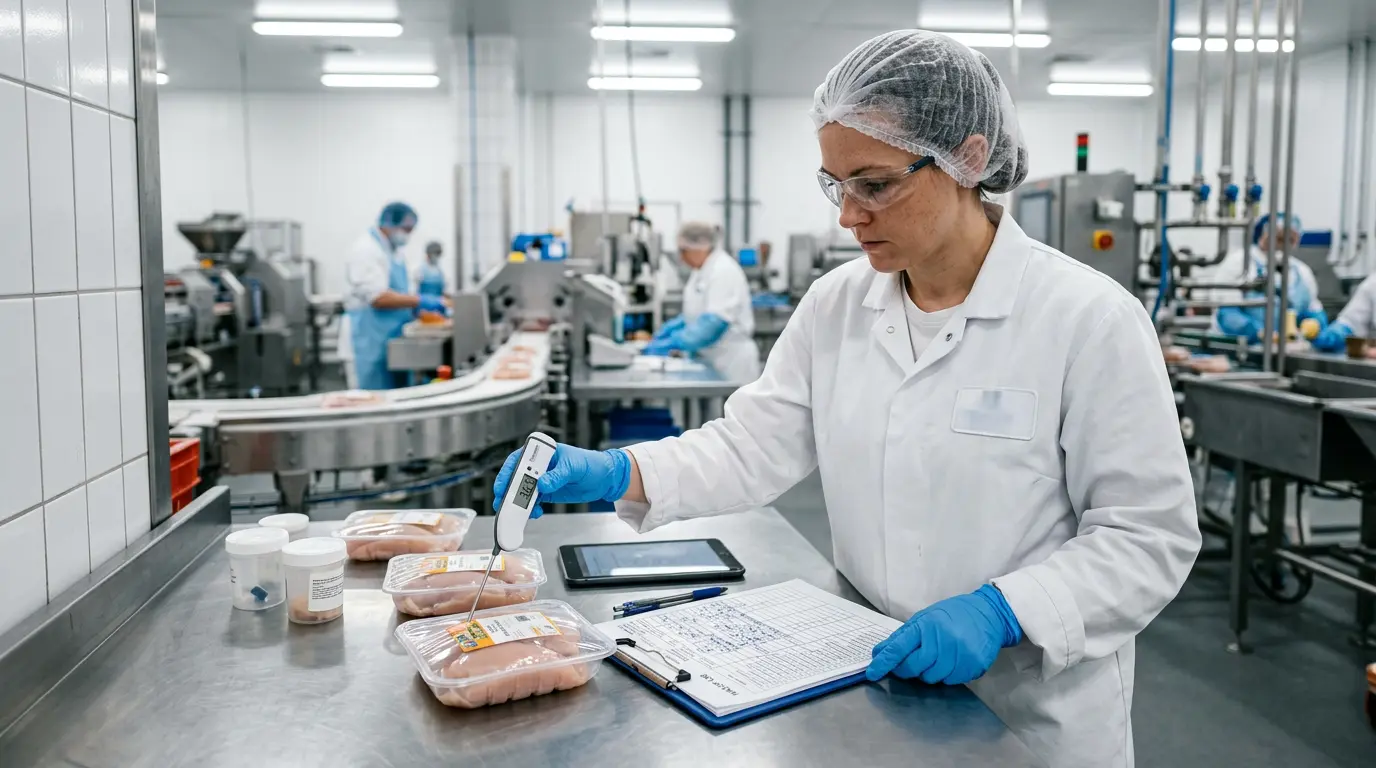
In our sample technological card ("Baked Chicken Fillet in Mustard-Cream Sauce"), this step is written with engineering precision: "Arrange trimmed chicken fillets in a single layer on greased GN 1/1 pans and bake in a combi-oven in combination steam mode ($+165,^\circ\text{C}$, $30%$ humidity) for 18-22 minutes until the geometric center of the thickest piece reaches at least $+75,^\circ\text{C}$ (CCP 1, verified in every batch with a calibrated probe thermometer sanitized with $70%$ isopropyl alcohol and recorded in the Thermal Processing Monitoring Log)".
2. Blast Chilling (Cooling CCP): Crossing the Microbiological Danger Zone
Whenever your technological card involves boiling meat for salads, preparing batch sauces, or running a Cook & Chill operation (for catering, central kitchens, dark kitchens, or supermarket grab-and-go), cooling becomes a critical control point. The temperature window between $+65,^\circ\text{C}$ and $+10,^\circ\text{C}$ is the rapid spore-germination zone for anaerobic Clostridium perfringens and Bacillus cereus, whose spores survive normal boiling.
Leaving a hot stockpot or tray of boiled chicken to cool at room temperature is strictly prohibited. Your technological card must specify the blast-chiller critical limit: chilling the core of the product from $+65,^\circ\text{C}$ down to $+10,^\circ\text{C}$ within $\le 120\text{ minutes}$, followed by further chilling to $+2\dots+4,^\circ\text{C}$ cold-storage temperature.
3. Hot Holding, Cold Display, and Semi-Finished Traceability Labeling
In the "Storage and Serving Conditions" block of the technological card, you must lock in serving-line limits and internal labeling rules:
- Hot holding on steam tables (bain-maries): soups held at at least $+75,^\circ\text{C}$, main courses, sides, and hot sauces at at least $+65,^\circ\text{C}$ for no longer than 2-3 hours (maximum 2 hours in schools). Any unserved portions past that window are written off.
- Cold dishes and salads: held in refrigerated displays at $+2\dots+6,^\circ\text{C}$; multi-ingredient salads are stored undressed at $+2\dots+4,^\circ\text{C}$ and dressed right before serving.
- Internal labeling of semi-finished preps: the technological card sets the exact shelf life in cold storage (e.g., trimmed raw chicken fillet in a closed stainless-steel GN container at $+2\dots+4,^\circ\text{C}$ for up to 24 hours), and the cook applies a label showing four fields: semi-finished item name per TC, preparation date and exact hour, expiration date and hour, and the cook's last name.
The Inspector's 60-Second Triangle Cross-Check
An experienced SSUFSCP inspector or ISO 22000 auditor always runs a three-way cross-check: they read the cooking and holding temperatures in your Technological Card (for example, baking poultry to +75 °C and hot holding at +65 °C for up to 2 hours), compare them against the critical limits in your HACCP Plan, and open last week's Hot-Line Temperature Monitoring Log. If the card says +65 °C, the HACCP plan says +70 °C, and the log shows +58 °C every afternoon, the auditor records a systemic failure of CCP control.
Law of Ukraine No. 2639-VIII in the Technological Card: Mapping the 14 Mandatory Allergens (Annex I) and Calculating kcal and kJ
Under Law of Ukraine No. 2639-VIII "On Information for Consumers Regarding Food Products", the technological card is the primary engineering data source for allergen declarations and nutritional values printed on restaurant menus, school canteen boards, delivery apps, and supermarket grab-and-go labels.
Articles 4 and 6 of Law No. 2639-VIII mandate written disclosure of substances causing allergic reactions or intolerances even for non-prepacked meals served in restaurants and canteens. Failing to provide accurate allergen information carries a fine under Article 65 of Law of Ukraine No. 2042-VIII of 30 minimum wages for legal entities and 20 minimum wages for sole proprietors (FOP).
Mapping the 14 Mandatory Allergens Under Annex I of Law No. 2639-VIII
Front-of-house staff can't guess hidden sauce ingredients by eye. Every technological card must explicitly map the 14 regulated allergen categories listed in Annex I to Law No. 2639-VIII:
- Cereals containing gluten (wheat, rye, barley, oats, spelt, kamut) and products thereof (roux flour, breadcrumbs, traditional brewed soy sauce, bulgur, couscous).
- Crustaceans and products thereof (shrimp, prawns, crabs, langoustines, lobsters, crayfish, shrimp paste).
- Eggs and products thereof (chicken and quail eggs, liquid melange, egg powder, mayonnaise, meringue).
- Fish and products thereof (all fish species, roe, dashi stock, anchovies hidden in Caesar dressing and Worcestershire sauce).
- Peanuts and products thereof (peanut butter, unrefined peanut oil, confectionery toppings).
- Soybeans and products thereof (soy sauce, tofu, textured soy protein, and hidden soy lecithin E322 in chocolate glazes and margarines).
- Milk and dairy products, including lactose (cream, butter, sour cream, cheeses, milk powder, whey in baked goods).
- Tree nuts (almonds, hazelnuts, walnuts, cashews, pecans, Brazil nuts, pistachios, macadamia; including almond flour in macarons and cashews in pesto).
- Celery and products thereof (celery root and stalks in broths, celery seed in spice mixes).
- Mustard and products thereof (whole-grain and Dijon mustard, mustard powder in marinades and sauces).
- Sesame seeds and products thereof (sesame buns, sushi rolls, tahini paste in hummus, sesame oil).
- Sulphur dioxide and sulphites at concentrations exceeding $10\text{ mg/kg}$ or $10\text{ mg/L}$ expressed as total $\text{SO}_2$ (dried apricots and raisins treated with E220, wine reductions, sulphited peeled potatoes).
- Lupin and products thereof (lupin flour in gluten-free bakery items).
- Molluscs and products thereof (mussels, oysters, squid, octopus, scallops, oyster sauce).
When building HACCP and ISO 22000 documentation, Ekontrol engineers split card allergen fields into "Direct Recipe Allergens" and "Cross-Contact Risk (Traces)" from shared deep-fryers, slicers, grinders, and combi-ovens.
Calculating Nutritional and Energy Value ($\text{kcal}$ and $\text{kJ}$) Adjusted for Thermal Losses
In Technical and Technological Cards (TTCs), packaged retail culinary items, and school menus, nutritional and energy values must be calculated per $100\text{ g}$ of finished dish. The most common spreadsheet error is summing raw net proteins, fats, and carbs without accounting for two physical changes during cooking:
- Thermal nutrient retention ($K_{\text{ret}}$): during boiling and baking, part of the nutrients leaches into broth or renders onto the pan. Average culinary retention factors for main dishes are $K_{\text{ret.P}} = 0.92-0.94$ for proteins ($6-8%$ loss), $K_{\text{ret.F}} = 0.75-0.90$ for fats ($10-25%$ loss), and $K_{\text{ret.C}} = 0.91-0.95$ for digestible carbohydrates ($5-9%$ loss).
- Finished yield mass change ($M_{\text{yield}}$) vs raw net mass: when chicken fillet loses $22%$ moisture in the oven, nutrient density per $100\text{ g}$ of cooked meat increases; conversely, when dry buckwheat swells $2.1$ times in water, calories per $100\text{ g}$ of cooked porridge drop proportionally.
The exact engineering formula for each nutrient ($N \in {\text{Protein } P, \text{Fat } F, \text{Carbs } C}$) per $100\text{ g}$ of finished dish is:
$$N_{100} = \frac{\sum_{i=1}^{n} \left( \frac{M_{\text{net}, i}}{100} \times n_i \times K_{\text{ret}, i} \right)}{M_{\text{yield.tot}}} \times 100$$
where $M_{\text{net}, i}$ is the net input mass of ingredient $i$ (g), $n_i$ is the reference nutrient content per $100\text{ g}$ of edible raw ingredient $i$ (g), $K_{\text{ret}, i}$ is the thermal retention factor, and $M_{\text{yield.tot}}$ is the total finished dish yield from the card (g).
Next, using the statutory Atwater conversion coefficients in Law of Ukraine No. 2639-VIII, calculate energy value in both kilocalories and kilojoules (where $DF_{100}$ is dietary fiber, $OA_{100}$ is organic acids, and $Alc_{100}$ is ethanol):
$$E_{\text{kcal}} = 4 \times P_{100} + 9 \times F_{100} + 4 \times C_{100} + 2 \times DF_{100} + 3 \times OA_{100} + 7 \times Alc_{100}$$
$$E_{\text{kJ}} = 17 \times P_{100} + 37 \times F_{100} + 17 \times C_{100} + 8 \times DF_{100} + 13 \times OA_{100} + 29 \times Alc_{100}$$
For our worked sample dish "Baked Chicken Fillet in Mustard-Cream Sauce with Mashed Potatoes" ($M_{\text{yield.tot}} = 300\text{ g}$), the values per $100\text{ g}$ of finished dish are: protein $P_{100} = 11.8\text{ g}$, fat $F_{100} = 6.4\text{ g}$ (saturated fat $3.6\text{ g}$), digestible carbohydrates $C_{100} = 7.5\text{ g}$ (sugars $1.2\text{ g}$), dietary fiber $DF_{100} = 0.6\text{ g}$, and salt $0.33\text{ g}$. That gives an energy value per $100\text{ g}$ of:
- $E_{\text{kcal}} = 4 \times 11.8 + 9 \times 6.4 + 4 \times 7.5 + 2 \times 0.6 = 136.0\text{ kcal}$ ($408\text{ kcal}$ per $300\text{ g}$ portion);
- $E_{\text{kJ}} = 17 \times 11.8 + 37 \times 6.4 + 17 \times 7.5 + 8 \times 0.6 = 569.7 \approx 570\text{ kJ}$ ($1,710\text{ kJ}$ per $300\text{ g}$ portion).
Laboratory Verification of TTCs in ISO/IEC 17025 Accredited Laboratories and Sector-Specific Rules
When is a spreadsheet calculation enough, and when will your Technical and Technological Card fail an audit without a test report from an ISO/IEC 17025 accredited laboratory? That depends on how you package and distribute the food.
Four Scenarios Requiring ISO/IEC 17025 Laboratory Testing
In a traditional sit-down restaurant where dishes are cooked to order and served within 15 minutes, nutritional values in your TC can be calculated analytically from ingredient specifications. However, laboratory testing in a center accredited by the National Accreditation Agency of Ukraine (NAAU) under DSTU EN ISO/IEC 17025 becomes essential in four cases:
- Launching packaged retail culinary items and signature products under a TTC. When a central kitchen, bakery, or supermarket culinary shop packages ready meals, sandwiches, salads, or desserts into containers for retail shelves or delivery, safety indicators in the TTC must be backed by laboratory test protocols.
- Validating extended shelf life (Shelf-Life Studies). If you use blast chilling (Cook & Chill), Sous-Vide vacuum pouches, or Modified Atmosphere Packaging (MAP with $\text{N}_2 + \text{CO}_2$) and claim a 72-hour or 5-to-10-day shelf life at $+2\dots+4,^\circ\text{C}$ in your TTC, FSSC 22000, BRCGS, and IFS auditors require microbiological storage-stability reports.
- Periodic HACCP verification under Order No. 590. Principle 6 of HACCP requires scheduled microbiological testing of finished dishes (Total Plate Count / КМАФАнМ, coliforms / БГКП, Staphylococcus aureus, Proteus, Salmonella in $25\text{ g}$, and Listeria monocytogenes in $25\text{ g}$ for chilled Ready-to-Eat meals) alongside environmental swabs from slicers, cutting boards, and staff hands.
- Substantiating "Gluten-Free" and nutrition claims. Claims like "Gluten-Free" ($< 20\text{ mg/kg}$ verified via ELISA), "Lactose-Free," or arbitration checks on Kjeldahl protein, Soxhlet fat, dry matter, and sodium require accredited laboratory analysis.
Sector-Specific Rules: Schools (Resolution No. 305), HoReCa, and Food Plants
While gross-to-net math stays constant, regulatory expectations shift across three sectors:
- Schools, lyceums, and preschools (Cabinet Resolution No. 305). Technological cards feed into a four-week seasonal menu with strict caps on salt, free sugars, and saturated fats, plus a ban on trans fats, artificial colors, mushrooms, and deep-frying. Public tenders must calculate quantities in gross weight (clause 13 of Resolution No. 305). Using an unaltered Ministry of Health recipe collection requires no extra sign-off, whereas custom recipes or ingredient substitutions require SSUFSCP approval.
- Restaurants, hotels, and dark kitchens (HoReCa). High-volume kitchens rely on a two-tier card architecture: separate technological cards for house-made semi-finished bases (stocks, sauces, marinated meats calculated per $1\text{ kg}$ yield with cold-room shelf life) and final plated dish cards.
- Retail culinary production and the food industry. Industrial lines integrate TTCs directly into ISO 22000 and GFSI schemes, adding net-weight packaging tolerances, metal-detector or X-ray test-piece limits, and barrier-film specifications.
How to Defend a 72+ Hour Shelf Life for Chilled Meals (Cook & Chill) During Audits
If your central kitchen or culinary workshop supplies boxed meals to coffee shops or supermarkets with a 3-to-5-day shelf life at +2...+4 °C, Ekontrol engineers recommend locking this into your TTC via a three-point protocol in an ISO/IEC 17025 laboratory. The lab tests microbiology (TPC, coliforms, S. aureus, Salmonella, Listeria monocytogenes) and sensory quality at Hour 0, at the end of declared shelf life (72 hours), and at a +25% stress margin (90 hours). Having that accredited report on file eliminates shelf-life disputes with both state inspectors and retail QA teams.
Common SSUFSCP Inspection Failures and Turnkey Development of Technological Cards and HACCP with Ekontrol
While supporting SSUFSCP inspections and retail supplier audits, we repeatedly encounter seven technological card failures that trigger compliance orders and fines:
- Disconnect between the live menu and the card binder: the head chef launched a seasonal menu a month ago, dishes ring up at the register, but the kitchen has no approved technological cards for the new items.
- Undocumented ingredient substitutions: the card specifies $82.5%$ dairy butter, extra-virgin olive oil, and Parmesan, while warehouse invoices show vegetable-fat spreads and cheese substitutes, which inspectors treat as consumer deception.
- Missing Acts of Control Dish Preparation: the card claims $0%$ waste on washed potatoes or $20%$ combi-oven meat shrinkage instead of the standard $35%$, without a signed commission Control Act.
- Temperature conflicts between the card, HACCP plan, and logs: the card says "serve at $+60,^\circ\text{C}$," the HACCP plan sets a $\ge +65,^\circ\text{C}$ critical limit, and the daily log shows carbon-copy numbers.
- Missing Annex I allergens and kJ energy values under Law No. 2639-VIII: neither the cards nor the guest menu flag gluten, lactose, mustard, celery, sesame, or soy, and packaged meals omit kilojoules ($\text{kJ}$).
- Using a single set of vegetable cards year-round: ignoring potato waste rising from $20%$ in August to $40%$ in March causes systematic portion shortages in spring.
- Unsigned drafts instead of legal documents: POS printouts lack an effective date, technologist's signature, and the director's approval stamp.
Turnkey Technological Card and HACCP Engineering with Ekontrol
When a restaurant, bakery, retail culinary plant, or school canteen needs to bring its recipe documentation into full statutory compliance without slowing down kitchen operations, the Ekontrol engineering team delivers the project turnkey in four stages:
- Stage 1. On-site diagnostic audit of your kitchen or plant. We reconcile your live menu, supplier invoices, POS accounting setup (Poster, Syrve, R-Keeper, BAS), thermal and blast-chilling equipment, and current HACCP records. For broader system templates, see our guides on HACCP document templates and HACCP in a school canteen.
- Stage 2. Engineering development of TCs, TTCs, Control Acts, and HACCP implementation. We draft compliant Technological and Technical-Technological Cards under Ministry of Economy Order No. 219, execute Acts of Control Dish Preparation, calculate gross, net, and seasonal yield norms, build protein, fat, carbohydrate, $\text{kcal}/\text{kJ}$, and 14-allergen matrices under Law No. 2639-VIII, and synchronize card regimes with your HACCP Plan under Order No. 590 and ISO 22000.
- Stage 3. Laboratory verification under ISO/IEC 17025. We organize sampling of signature dishes, semi-finished items, and surface swabs for microbiological and physicochemical testing in NAAU accredited laboratories.
- Stage 4. Staff training and audit support. We train cooks to work with cards, probe thermometers, and CCP logs, and represent your facility during SSUFSCP inspections or ISO 22000, FSSC 22000, BRCGS, and IFS certification audits. Reach out via the Ekontrol contact page to scope your menu.
Need Turnkey Technological Cards (TC & TTC) and HACCP or ISO 22000 Implementation?
Get a tailored engineering quote for developing Order No. 219 technological documentation, Law No. 2639-VIII allergen and kcal/kJ calculations, and a complete HACCP system from Ekontrol's food technologists.
Request a Technologist Consultation
Need a certification consultation?
Free ConsultationOn This Page
- Statutory Basis for Dish Technological Cards in Ukraine: Order No. 219, Law No. 771/97-VR, and Order No. 590
- Difference Between a Technological Card (TC), Technical and Technological Card (TTC), and Costing Card: Structure and Fields
- Calculating Cold and Thermal Processing Losses: Gross, Net, Final Yield Formulas, and Seasonal Waste Norms
- Act of Control Dish Preparation and Worked Engineering Sample of a Technological Card (1 and 100 Portions)
- Embedding HACCP and ISO 22000 Critical Control Points (CCPs) into the Technological Card: Temperatures, Blast Chilling, and Labeling
- Law of Ukraine No. 2639-VIII in the Technological Card: Mapping the 14 Mandatory Allergens (Annex I) and Calculating kcal and kJ
- Laboratory Verification of TTCs in ISO/IEC 17025 Accredited Laboratories and Sector-Specific Rules
- Common SSUFSCP Inspection Failures and Turnkey Development of Technological Cards and HACCP with Ekontrol
- Frequently Asked Questions About Dish Technological Cards, Yield Calculation, TTCs, and HACCP Requirements
Statutory Basis for Dish Technological Cards in Ukraine: Order No. 219, Law No. 771/97-VR, and Order No. 590
A properly engineered technological card for a dish in a commercial kitchen, supermarket culinary department, or school canteen works just like a mechanical blueprint on a factory floor. It locks in the exact raw material input before trimming ($M_{\text{gross}}$), allowable cold-processing waste percentages during peeling and deboning ($W_{\text{cold}}$), the net weight of the prepared semi-finished ingredient ($M_{\text{net}}$), moisture and fat losses during boiling or baking ($W_{\text{therm}}$), the final plated portion yield ($M_{\text{yield}}$), and the exact time-temperature safety limits. In practice, across more than 200 food safety engineering projects delivered by the Ekontrol team, we usually walk into a very different reality: the accountant's binder holds three-year-old POS printouts with zero cooking temperatures, while line cooks work from personal notebooks.
As long as nobody audits the kitchen, that disconnect quietly drains your food cost, creates monthly inventory write-offs, and causes portion weights to drift. The day an inspector from the State Service of Ukraine on Food Safety and Consumer Protection (SSUFSCP / Derzhprodspozhyvsluzhba) or a retail chain auditor walks in, outdated technological cards immediately tear down your HACCP and ISO 22000 defenses. Inspectors don't read a card in isolation. They pick one dish off your live menu and place the technological card right next to incoming supplier delivery notes, the portion scale on the pass, and your CCP temperature logs.
Four Ukrainian Statutory Acts Linking Technological Cards to Food Safety
Many restaurant owners still believe that once Soviet GOST standards were repealed, technological cards became optional internal paperwork. That's a costly legal misconception during a state inspection. Today, mandatory technological documentation in Ukraine rests on four interlocking statutory acts:
- Ministry of Economy Order No. 219 of 24.07.2002 "On Approval of the Rules for the Operation of Restaurant Establishments (Enterprises)" (registered under No. 680/6968). Section 2 explicitly mandates that food business operators producing culinary items must comply with technological production regimes (ingredient compatibility, valid substitutions, and cold and thermal processing parameters) defined in approved Recipe Collections, standards, technical specifications, technological cards (TCs), and technical and technological cards (TTCs). Clause 2.3 of Order No. 219 directly requires that cooks and pastry chefs have technological cards at their workstations.
- Law of Ukraine No. 771/97-VR "On Basic Principles and Requirements for Food Safety and Quality". Articles 20 and 21 require every food business operator to develop, implement, and maintain permanent procedures based on HACCP principles, while Article 22 mandates "one step back, one step forward" traceability. You can't prove mass-balance traceability from raw meat batches to finished portions or justify thermal critical limits without valid technological cards.
- Ministry of Agrarian Policy Order No. 590 of 01.10.2012 "On Approval of Requirements for the Development, Implementation and Application of Permanent Procedures Based on the Principles of the Food Safety Management System (HACCP)". Clause 6.5 requires a complete product description (composition, physicochemical and microbiological characteristics, processing method, packaging, shelf life, and storage conditions) alongside a verified process flow diagram. In HoReCa, catering, and culinary production, a technological card for a dish template and structure aligned with your HACCP plan acts as both the product description and the line instruction.
- Law of Ukraine No. 2639-VIII of 06.12.2018 "On Information for Consumers Regarding Food Products". Harmonized with EU Regulation No. 1169/2011, this law makes written disclosure of the 14 major allergens listed in Annex I mandatory for every dish (including non-prepacked restaurant and canteen meals) and standardizes energy value calculations in both kilocalories ($\text{kcal}$) and kilojoules ($\text{kJ}$).
Here's the practical reality: when an inspector finds a mismatch between actual kitchen preparation, missing thermal parameters in your cards, and entries in your monitoring logs, they classify it under Article 65 of Law of Ukraine No. 2042-VIII as a failure to apply permanent HACCP procedures. That triggers a direct fine of 30 minimum wages for legal entities or 15 minimum wages for sole proprietors (FOP).
Difference Between a Technological Card (TC), Technical and Technological Card (TTC), and Costing Card: Structure and Fields
During most inspections in cafes, restaurants, bakeries, and supermarket kitchens, teams mix up three distinct documents: the Technological Card (TC), the Technical and Technological Card (TTC), and the Costing Card. Often, a manager exports an ingredient table with purchase prices from Syrve/iiko, Poster, R-Keeper, or BAS, labels it a "tech card," and hands it to the inspector. To an auditor, that printout isn't technological documentation at all.
Understanding the exact difference between technological card TTC and costing card under Ministry of Economy Order No. 219 comes down to what each document controls on the floor.
1. Technological Card for a Dish or Culinary Item (TC)
You compile a standard Technological Card (Технологічна карта, ТК) when your kitchen prepares a dish strictly according to an officially approved Recipe Collection (Збірник рецептур страв і кулінарних виробів) without altering the core process or main ingredients. Because the recipe collection has already validated the baseline physicochemical and microbiological parameters, the TC acts as an operational workstation sheet with five mandatory blocks:
- Identification header: legal name of the food business operator, exact dish name (matching the printed menu and fiscal receipt word for word), recipe collection number and column, effective date, and the director's approval signature.
- Ingredient input table: every raw material listed with its gross weight ($M_{\text{gross}}$) and net or semi-finished weight ($M_{\text{net}}$) per 1 portion (in grams) and per 100 portions or $10\text{ kg}$ batch (in kilograms), plus the exact finished portion yield ($M_{\text{yield}}$).
- Step-by-step technological process: mechanical preparation sequence, ingredient addition order, exact thermal processing parameters (core temperature in $,^\circ\text{C}$ and exposure time in minutes), and plating rules.
- Sensory (organoleptic) quality criteria: appearance, texture, color, taste, and aroma standards used during daily batch release.
- Storage, holding, and allergen parameters: hot-holding temperature on the steam table ($\ge +65,^\circ\text{C}$) or cold display temperature ($+2\dots+6,^\circ\text{C}$), maximum holding time in hours, and Annex I allergens under Law No. 2639-VIII.
2. Technical and Technological Card (TTC) for New and Signature Dishes
Under clause 2.2 of Order No. 219, establishments can develop new, signature, or chef-authored dishes absent from standard recipe collections, or modify traditional cooking methods (such as Sous-Vide cooking, house-fermented sauces, or gluten-free pastry). For every such item, you must develop a Technical and Technological Card (Техніко-технологічна карта, ТТК). A TTC carries the status of an internal enterprise standard and includes five expanded engineering sections:
- Scope of application: specifies the exact production site or restaurant chain authorized to produce and sell the signature dish.
- Raw material quality and safety requirements: references to national DSTU standards, technical specifications, and mandatory supplier safety certificates for each incoming batch.
- Raw material consumption, waste, and yield norms: full gross, cold-waste percentage, net, thermal-loss percentage, and final yield figures backed by an official Act of Control Dish Preparation.
- Physicochemical and microbiological safety indicators: maximum or minimum limits for dry matter, fat, sugar, and salt content, plus microbiological criteria (Total Plate Count / КМАФАнМ, coliforms / БГКП, Staphylococcus aureus, Proteus, Salmonella, and Listeria monocytogenes) verified in ISO/IEC 17025 accredited laboratories.
- Nutritional and energy value table: proteins, fats (including saturated fats), carbohydrates (including sugars), and salt per $100\text{ g}$ and per portion, plus energy value in both $\text{kcal}$ and $\text{kJ}$.
3. Costing Card (Калькуляційна картка)
A Costing Card doesn't contain cooking instructions, core temperatures, or microbiological limits. Its sole job is accounting: calculating the direct raw material cost of 100 portions and setting the selling price. In practice, ingredients transfer from the TC/TTC into the Costing Card exclusively at GROSS weight ($M_{\text{gross}}$) because you buy unpeeled vegetables and untrimmed meat from suppliers at gross weight. If an accountant mistakenly plugs net weights into the costing card, the software understates dish cost by $15-40%$ and creates an unexplained warehouse shortage every month.
| Comparison Criterion | Technological Card (TC / ТК) | Technical & Technological Card (TTC / ТТК) | Costing Card (Калькуляційна карта) |
|---|---|---|---|
| When required under Order No. 219 | For dishes prepared strictly by official Recipe Collections | For new, chef-authored, and signature dishes or modified cooking processes | For every priced menu item and whenever supplier purchase prices change |
| Primary engineering purpose | Line cook instruction: exact input weights, cooking steps, and target yield | Internal enterprise standard defining process, physicochemistry, and microbiology | Accounting calculation of direct ingredient cost and menu selling price |
| Raw material weight basis | Gross weight, net weight, and finished yield for 1 and 100 portions | Gross weight, % cold waste, net weight, % thermal loss, and yield per Control Act | Exclusively gross weight per 100 portions multiplied by supplier unit price |
| Process description & HACCP CCPs | Mandatory: operation sequence, exposure time, core temperature, holding rules | Expanded: stage regimes, CCP/OPRP critical limits, packaging, and labeling | None (lists only ingredient names, SKU codes, gross norms, and UAH values) |
| Physicochemical & microbiological limits | Referenced via the underlying Recipe Collection or national DSTU standard | Mandatory section: dry matter, fat, salt, TPC, coliforms, Salmonella, Listeria | None |
| Allergens & kcal/kJ (Law No. 2639-VIII) | Annex I allergen declaration and reference nutritional value | Mandatory calculation of proteins, fats, carbs, salt, kcal/kJ, and allergen matrix | None |
| Who drafts and who approves | Drafted by technologist or head chef; signed and dated by the director/FOP | Engineered by technologist based on Control Act; approved by company director | Compiled by costing accountant; signed by head chef, accountant, and director |
| Who inspects during audits | SSUFSCP inspector, ISO 22000 auditor, internal quality release committee | SSUFSCP, retail chain auditor, ISO/IEC 17025 accredited testing laboratory | Tax authorities (STS), financial auditors, State Audit Service in public tenders |
Why Using Net Weight Instead of Gross Weight in Tenders and Costing Triggers Double Penalties
In public schools and preschools (under clause 13 of Cabinet of Ministers Resolution No. 305) as well as industrial canteens, food procurement must be calculated in gross weight according to technological documentation. If a procurement officer enters net weight into a Prozorro tender or costing card (for example, ordering 1,000 kg of peeled carrots instead of 1,250 kg of unpeeled carrots after January 1 at 20% waste), the kitchen faces an immediate 250 kg raw material deficit. When cooks shrink portion weights on the serving line to stretch stock, an SSUFSCP inspector weighing portions records both consumer deception and a breach of statutory nutrition norms.
Calculating Cold and Thermal Processing Losses: Gross, Net, Final Yield Formulas, and Seasonal Waste Norms
When a food technologist builds a technological card or audits a restaurant's recipe database, the first mathematical check is end-to-end mass balance. Every ingredient passes through two sequential transformations: mechanical (cold) preparation in the prep area and thermal (heat) treatment on the hot line. If a card simply lists three weights that don't connect mathematically through standard loss percentages, an ISO 22000 auditor spots manual number-fudging immediately.
Forward and Reverse Mass-Balance Engineering Formulas
Let's define our variables: $M_{\text{gross}}$ is the incoming untrimmed weight (g), $W_{\text{cold}}$ is the cold-processing waste percentage during peeling, deboning, trimming, or thawing (%), $M_{\text{net}}$ is the cleaned semi-finished weight entering the pan or oven (g), $W_{\text{therm}}$ is the thermal-processing loss percentage during boiling, baking, stewing, or frying (%), and $M_{\text{yield}}$ is the finished plated component weight (g).
1. Forward calculation (from purchased raw material weight to finished dish yield):
During cold processing, you subtract non-edible trimmings, peel, bones, sinew, and thaw drip from the gross weight:
$$M_{\text{net}} = M_{\text{gross}} \times \left(1 - \frac{W_{\text{cold}}}{100}\right)$$
During thermal processing, protein denaturation evaporates moisture and renders out fat:
$$M_{\text{yield}} = M_{\text{net}} \times \left(1 - \frac{W_{\text{therm}}}{100}\right) = M_{\text{gross}} \times \left(1 - \frac{W_{\text{cold}}}{100}\right) \times \left(1 - \frac{W_{\text{therm}}}{100}\right)$$
Watch out for the classic rookie mistake: you can't simply add $W_{\text{cold}}$ and $W_{\text{therm}}$ together! If Category I beef on the bone has $W_{\text{cold}} = 26%$ during deboning and $W_{\text{therm}} = 38%$ during boiling, total mass loss isn't $26 + 38 = 64%$. Instead, you multiply the retention factors: $1 - (0.74 \times 0.62) = 54.12%$. From $1,000\text{ g}$ of gross beef, you get $740\text{ g}$ of trimmed net meat and exactly $459\text{ g}$ of boiled beef.
2. Reverse calculation (from a fixed menu portion yield back to gross procurement weight):
In restaurants, catering, and school canteens, you usually work backwards from a fixed menu portion (say, $M_{\text{yield}} = 120\text{ g}$ of baked pike-perch fillet) to find how much raw fillet the cook needs ($M_{\text{net}}$) and how much whole fish the warehouse must write off ($M_{\text{gross}}$):
$$M_{\text{net}} = \frac{M_{\text{yield}}}{1 - \frac{W_{\text{therm}}}{100}}, \quad M_{\text{gross}} = \frac{M_{\text{net}}}{1 - \frac{W_{\text{cold}}}{100}}$$
For whole pike-perch filleted with skin on and no bones, $W_{\text{cold}} = 48%$ and combi-oven baking loss is $W_{\text{therm}} = 20%$. To plate $120\text{ g}$ of cooked fish, you need $M_{\text{net}} = 120 / 0.80 = 150\text{ g}$ of raw fillet and $M_{\text{gross}} = 150 / 0.52 = 288.5\text{ g}$ of whole fish.
Grain Hydration Gain, Ice Glaze on Seafood, and Seasonal Root-Vegetable Waste
Three special physical behaviors must be built into your gross net yield and thermal loss calculation:
- Hydration gain (swell) in grains, legumes, and pasta. Dry grains absorb water during cooking and increase in mass by $2.1-3.2$ times. You first deduct $1.0-1.5%$ cold waste for sorting and rinsing, then apply the hydration multiplier (for example, $1\text{ kg}$ of dry buckwheat absorbs $1.5\text{ kg}$ of water and salt, yielding $2.1\text{ kg}$ of fluffy porridge after accounting for $1%$ kettle-wall loss).
- Protective ice glaze on frozen fish and shrimp. Declared glaze weight ($5-14%$ on the supplier label) must be stripped out before applying the $3-7%$ muscle-drip thawing loss; otherwise, your plated seafood portion will come up $10-15%$ short.
- Seasonal root-vegetable aging. As potatoes sit in storage from autumn to spring, their skin thickens and sprouts. Official Ukrainian potato waste norms shift five times a year: $20%$ before September 1, $25%$ from September 1 to October 31, $30%$ from November 1 to December 31, $35%$ from January 1 to February 28/29, and $40%$ from March 1 onward. Carrots and beetroot jump from $20%$ before January 1 to $25%$ after January 1.
| Raw Material Group & Processing Method | Cold-Processing Waste (W cold, %) | Thermal-Processing Loss (W therm, %) | Overall Yield Factor from Gross & Engineering Notes |
|---|---|---|---|
| Ware potatoes (peeling, boiling, baking, or deep-frying) | Before 01.09: 20%; 01.09-31.10: 25%; 01.11-31.12: 30%; 01.01-28.02: 35%; from 01.03: 40% | Boiling peeled: 3%; oven baking: 15-20%; deep-frying: 37-50% | Boiled potato yield factor from gross drops from 0.776 in August to 0.582 in March (+33% purchase volume) |
| Table carrots and beetroot (peeling, dicing/julienne, boiling or sautéing) | Before January 1: 20%; from January 1: 25% | Boiling peeled: 3-5%; poaching: 8-10%; sautéing carrots with fat: 22-25% | When boiled in skin, peeling waste and thermal loss are combined after cooling |
| Bulb onions (root/skin trimming, slicing, sautéing or frying) | 16% year-round (green spring onions: 20%) | Sautéing in oil or butter: 50%; deep-frying until golden: 58% | 1,000 g of gross onions yields 840 g of raw sliced net onion and 420 g of sautéed onion |
| Fresh white cabbage (outer leaf trimming, coring, boiling or braising) | 20% year-round (cauliflower: 45-48%; fresh broccoli: 28-35%) | Steaming or boiling: 7-10%; braising with sauce: 12-15% (of cabbage mass) | For IQF frozen cauliflower or broccoli florets, W cold = 0% and boiling loss is 12-15% |
| Chilled bone-in beef (deboning, sinew trimming, boiling or stewing) | Category I carcass: 26%; Category II carcass: 31% (boneless trimmed primal: 7-12%) | Boiling large cuts: 38-40%; stewing portion cuts: 36-38%; roasting: 35-37% | Boiled beef yield from a Category I carcass is 44.4-45.9% of initial gross weight |
| Pork meat (fat/sinew trimming, roasting, pan-frying, or minced cutlets) | Bone-in carcass: 15-18%; boneless chilled neck or loin: 5-8% | Roasting or frying portion cuts: 30-33%; steamed or baked minced cutlets: 18-22% | Minced items lose less moisture during baking because bread/grain binders retain juices |
| Poultry: drawn broiler carcass vs chilled trimmed chicken breast fillet | Drawn carcass to boneless skinless fillet: 38-42%; chilled trimmed fillet: 3-6% | Poaching fillet: 25-28%; combi-oven baking at 30% steam: 22-25% | Switching from whole carcasses to trimmed fillets requires an Act of Control Dish Preparation |
| Fish: pike-perch, cod, hake, salmon (filleting, poaching, or baking) | Whole fish to skin-on boneless fillet: 45-52%; chilled trimmed fillet: 2-4% | Steam poaching: 18-20%; oven baking or pan-frying: 20-24% | For frozen fillets, subtract declared ice glaze first, then apply 5-7% thaw drip loss |
| Dry grains (buckwheat, polished rice, millet, oats) and durum pasta | Sorting and rinsing grains: 1.0-1.5%; dry pasta: 0% | Mass gain from water absorption: buckwheat +110% (210% yield), rice +180% (280% yield) | Card inputs list dry grain weight; yield accounts for 1% portioning loss on the line |
| Acid-curd cottage cheese 5-9% fat (sieving, syrnyky pancakes, or casserole) | Mechanical loss during sieving and mixing: 1.5-2.0% | Combi-oven curd casserole: 11-14%; pan-seared and oven-finished syrnyky: 12-15% | If incoming curd moisture exceeds 75%, press out whey and record via a Control Act |
Act of Control Dish Preparation and Worked Engineering Sample of a Technological Card (1 and 100 Portions)
What should your technologist do when loss norms from a 1982 or 2000 Recipe Collection don't match what happens in your kitchen today? Modern restaurants, caterers, and school canteens buy washed calibrated potatoes, vacuum-packed peeled vegetables, skinless boneless chicken breast, and Trim D salmon fillets. Cooking in a modern combi-steamer at 30% humidity with a core temperature probe cuts meat shrinkage to $20-22%$ instead of the $35-38%$ seen in old static ovens.
The only legally valid way to establish custom waste and shrinkage norms at your facility is to run a physical test batch and execute an official Act of Control Dish Preparation (Акт контрольного опрацювання страви).
5-Step Protocol for an Act of Control Dish Preparation
To make sure your Act of Control Dish Preparation holds up during both tax audits (for cost-of-goods write-offs) and SSUFSCP HACCP inspections, follow five rules:
- Appoint a commission by director's order: at least 3 members (head chef or food technologist, costing accountant, and a management representative or HACCP team leader).
- Use calibrated scales and a representative batch: weigh on metrologically verified kitchen scales using at least 3-5 portions (or $3-10\text{ kg}$ of raw material), running three parallel batches to calculate an arithmetic mean.
- Weigh every fraction by stage: record initial gross weight $M_{\text{gross}}$, net trimmed semi-finished weight $M_{\text{net}}$, usable trimmings, and non-edible waste. Calculate actual cold waste as: $$W_{\text{cold.act}} = \frac{M_{\text{gross}} - M_{\text{net}}}{M_{\text{gross}}} \times 100%$$
- Measure thermal loss at the exact CCP target: cook the semi-finished batch in your standard combi-oven or kettle until the core reaches the CCP limit (e.g., $+76,^\circ\text{C}$) and weigh at serving temperature ($+65,^\circ\text{C}$): $$W_{\text{therm.act}} = \frac{M_{\text{net}} - M_{\text{yield}}}{M_{\text{net}}} \times 100%$$
- Approve and reference the Act: all commission members sign the Act, the director approves it, and its number and date go directly into the header of your TC or TTC.
Worked Sample of a Technological Card for 1 and 100 Portions
Let's examine a complete technological card for a dish template and structure for a composite main course: "Baked Chicken Fillet in Mustard-Cream Sauce with Mashed Potatoes" with a total plated yield of $M_{\text{yield}} = 300\text{ g}$ ($110\text{ g}$ baked fillet, $40\text{ g}$ sauce, $150\text{ g}$ mashed potatoes). This calculation covers November-December (potato waste $30%$; chilled chicken breast fillet governed by Act of Control Dish Preparation No. 14 of 12.10.2026 at $W_{\text{cold}} = 5%$ membrane trim and $W_{\text{therm}} = 22%$ combi-oven baking loss).
| Raw Material & Component Name | Gross per 1 Portion (g) | W cold (%) | Net per 1 Portion (g) | W therm (%) | Yield per 1 Portion (g) | Per 100 Portions: Gross / Net (kg) | Allergens (Law No. 2639-VIII) & Calculation Note |
|---|---|---|---|---|---|---|---|
| 1. Chilled chicken breast fillet | 148.5 | 5.0% | 141.0 | 22.0% | 110.0 | 14.85 / 14.10 | No allergens. Per Act No. 14: 148.5 * 0.95 = 141.0 g; 141.0 * 0.78 = 110.0 g |
| Refined sunflower oil (for GN pan greasing) | 2.0 | 0.0% | 2.0 | 100% | 0.0 | 0.20 / 0.20 | No allergens. Technological pan-release allowance |
| 2. Pasteurized dairy cream 20% fat (sauce) | 38.0 | 0.0% | 38.0 | 15.0% | 32.3 | 3.80 / 3.80 | Allergen No. 7: Milk and dairy products (including lactose) |
| Whole-grain Dijon mustard | 4.5 | 0.0% | 4.5 | 15.0% | 3.8 | 0.45 / 0.45 | Allergen No. 10: Mustard and products thereof |
| Premium wheat flour (roux thickener) | 2.0 | 0.0% | 2.0 | 15.0% | 1.7 | 0.20 / 0.20 | Allergen No. 1: Cereals containing gluten (wheat) |
| Unsalted dairy butter 73% fat (sauce) | 2.6 | 0.0% | 2.6 | 15.0% | 2.2 | 0.26 / 0.26 | Allergen No. 7: Milk (lactose). Total finished sauce yield: 40.0 g |
| 3. Fresh ware potatoes (season 01.11-31.12) | 167.9 | 30.0% | 117.5 | 3.0% | 114.0 | 16.79 / 11.75 | No allergens. From March 1 at 40% waste, gross rises to 195.8 g (19.58 kg / 100) |
| Pasteurized cow's milk 2.5% fat (mash) | 30.0 | 0.0% | 30.0 | 0.0% | 30.0 | 3.00 / 3.00 | Allergen No. 7: Milk and dairy products (including lactose) |
| Dairy butter 73% fat (mash) | 5.0 | 0.0% | 5.0 | 0.0% | 5.0 | 0.50 / 0.50 | Allergen No. 7: Milk and dairy products (lactose) |
| Iodized table salt (total across components) | 2.5 | 0.0% | 2.5 | 60.0% | 1.0 | 0.25 / 0.25 | No allergens. Part of the salt drains with potato cooking water |
| TOTAL PLATED DISH YIELD (110 / 40 / 150) | 403.0 | 14.4% | 345.1 | 13.1% | 300.0 | 40.30 / 34.51 (yield 30.0 kg) | Mandatory menu declaration: Gluten (wheat), Milk (lactose), Mustard |
Do Your Technological Cards Match What Your Kitchen Actually Cooks?
Ekontrol food technologists conduct on-site diagnostic audits for restaurants, retail culinary departments, and canteens, run control dish preparations, and align your technological cards, POS costing, and HACCP logs within 5 to 10 working days.
Book a Diagnostic AuditEmbedding HACCP and ISO 22000 Critical Control Points (CCPs) into the Technological Card: Temperatures, Blast Chilling, and Labeling
When an ISO 22000 certification auditor or a state inspector working under Order No. 590 opens your technological card, they look for a direct engineering bridge to your HACCP Plan. The biggest flaw in legacy cards is vague wording in the cooking instructions: "pan-fry until golden brown," "boil until tender," or "leave to cool on the table."
In food safety engineering, "until tender" means nothing because it lacks a measurable Critical Limit. For a technological card to protect your business during an inspection, its text must embed four operational controls for Critical Control Points (CCPs) and Operational Prerequisite Programs (OPRPs).
1. Thermal Processing (Cooking CCP): Core Temperature in the Geometric Center
The primary biological hazard when cooking meat, poultry, fish, eggs, and dairy dishes is the survival of vegetative pathogens (Salmonella spp., Listeria monocytogenes, enterohemorrhagic E. coli, and Campylobacter jejuni). Achieving a safe $6\text{-log reduction}$ requires heating the coldest spot (the geometric center of the thickest piece on the middle tray) to a validated core temperature for a set exposure time:
- Poultry dishes (chicken, turkey, duck), minced meat items (cutlets, meatballs, loaves), stuffed items, and egg casseroles/omelets: core temperature at least $+75,^\circ\text{C}$ (held for at least 15-30 seconds), while school canteen regulations often verify $+80\dots+85,^\circ\text{C}$ inside minced cutlets.
- Whole-muscle pork, veal, beef, lamb roasts, and portioned fish: core temperature at least $+72,^\circ\text{C}$ (or a unified $+75,^\circ\text{C}$ threshold across the hot line).
- First courses (borscht, soups, broths), sauces, and boiled milk for mashed potatoes: bring to a rolling boil at $+95\dots+98,^\circ\text{C}$ for 3-5 minutes.
- Secondary heat treatment (regeneration of chilled semi-finished items): rapid reheating in a combi-oven or kettle to a core temperature of at least $+75,^\circ\text{C}$ within 60 minutes.
In our sample technological card ("Baked Chicken Fillet in Mustard-Cream Sauce"), this step is written with engineering precision: "Arrange trimmed chicken fillets in a single layer on greased GN 1/1 pans and bake in a combi-oven in combination steam mode ($+165,^\circ\text{C}$, $30%$ humidity) for 18-22 minutes until the geometric center of the thickest piece reaches at least $+75,^\circ\text{C}$ (CCP 1, verified in every batch with a calibrated probe thermometer sanitized with $70%$ isopropyl alcohol and recorded in the Thermal Processing Monitoring Log)".
2. Blast Chilling (Cooling CCP): Crossing the Microbiological Danger Zone
Whenever your technological card involves boiling meat for salads, preparing batch sauces, or running a Cook & Chill operation (for catering, central kitchens, dark kitchens, or supermarket grab-and-go), cooling becomes a critical control point. The temperature window between $+65,^\circ\text{C}$ and $+10,^\circ\text{C}$ is the rapid spore-germination zone for anaerobic Clostridium perfringens and Bacillus cereus, whose spores survive normal boiling.
Leaving a hot stockpot or tray of boiled chicken to cool at room temperature is strictly prohibited. Your technological card must specify the blast-chiller critical limit: chilling the core of the product from $+65,^\circ\text{C}$ down to $+10,^\circ\text{C}$ within $\le 120\text{ minutes}$, followed by further chilling to $+2\dots+4,^\circ\text{C}$ cold-storage temperature.
3. Hot Holding, Cold Display, and Semi-Finished Traceability Labeling
In the "Storage and Serving Conditions" block of the technological card, you must lock in serving-line limits and internal labeling rules:
- Hot holding on steam tables (bain-maries): soups held at at least $+75,^\circ\text{C}$, main courses, sides, and hot sauces at at least $+65,^\circ\text{C}$ for no longer than 2-3 hours (maximum 2 hours in schools). Any unserved portions past that window are written off.
- Cold dishes and salads: held in refrigerated displays at $+2\dots+6,^\circ\text{C}$; multi-ingredient salads are stored undressed at $+2\dots+4,^\circ\text{C}$ and dressed right before serving.
- Internal labeling of semi-finished preps: the technological card sets the exact shelf life in cold storage (e.g., trimmed raw chicken fillet in a closed stainless-steel GN container at $+2\dots+4,^\circ\text{C}$ for up to 24 hours), and the cook applies a label showing four fields: semi-finished item name per TC, preparation date and exact hour, expiration date and hour, and the cook's last name.
The Inspector's 60-Second Triangle Cross-Check
An experienced SSUFSCP inspector or ISO 22000 auditor always runs a three-way cross-check: they read the cooking and holding temperatures in your Technological Card (for example, baking poultry to +75 °C and hot holding at +65 °C for up to 2 hours), compare them against the critical limits in your HACCP Plan, and open last week's Hot-Line Temperature Monitoring Log. If the card says +65 °C, the HACCP plan says +70 °C, and the log shows +58 °C every afternoon, the auditor records a systemic failure of CCP control.
Law of Ukraine No. 2639-VIII in the Technological Card: Mapping the 14 Mandatory Allergens (Annex I) and Calculating kcal and kJ
Under Law of Ukraine No. 2639-VIII "On Information for Consumers Regarding Food Products", the technological card is the primary engineering data source for allergen declarations and nutritional values printed on restaurant menus, school canteen boards, delivery apps, and supermarket grab-and-go labels.
Articles 4 and 6 of Law No. 2639-VIII mandate written disclosure of substances causing allergic reactions or intolerances even for non-prepacked meals served in restaurants and canteens. Failing to provide accurate allergen information carries a fine under Article 65 of Law of Ukraine No. 2042-VIII of 30 minimum wages for legal entities and 20 minimum wages for sole proprietors (FOP).
Mapping the 14 Mandatory Allergens Under Annex I of Law No. 2639-VIII
Front-of-house staff can't guess hidden sauce ingredients by eye. Every technological card must explicitly map the 14 regulated allergen categories listed in Annex I to Law No. 2639-VIII:
- Cereals containing gluten (wheat, rye, barley, oats, spelt, kamut) and products thereof (roux flour, breadcrumbs, traditional brewed soy sauce, bulgur, couscous).
- Crustaceans and products thereof (shrimp, prawns, crabs, langoustines, lobsters, crayfish, shrimp paste).
- Eggs and products thereof (chicken and quail eggs, liquid melange, egg powder, mayonnaise, meringue).
- Fish and products thereof (all fish species, roe, dashi stock, anchovies hidden in Caesar dressing and Worcestershire sauce).
- Peanuts and products thereof (peanut butter, unrefined peanut oil, confectionery toppings).
- Soybeans and products thereof (soy sauce, tofu, textured soy protein, and hidden soy lecithin E322 in chocolate glazes and margarines).
- Milk and dairy products, including lactose (cream, butter, sour cream, cheeses, milk powder, whey in baked goods).
- Tree nuts (almonds, hazelnuts, walnuts, cashews, pecans, Brazil nuts, pistachios, macadamia; including almond flour in macarons and cashews in pesto).
- Celery and products thereof (celery root and stalks in broths, celery seed in spice mixes).
- Mustard and products thereof (whole-grain and Dijon mustard, mustard powder in marinades and sauces).
- Sesame seeds and products thereof (sesame buns, sushi rolls, tahini paste in hummus, sesame oil).
- Sulphur dioxide and sulphites at concentrations exceeding $10\text{ mg/kg}$ or $10\text{ mg/L}$ expressed as total $\text{SO}_2$ (dried apricots and raisins treated with E220, wine reductions, sulphited peeled potatoes).
- Lupin and products thereof (lupin flour in gluten-free bakery items).
- Molluscs and products thereof (mussels, oysters, squid, octopus, scallops, oyster sauce).
When building HACCP and ISO 22000 documentation, Ekontrol engineers split card allergen fields into "Direct Recipe Allergens" and "Cross-Contact Risk (Traces)" from shared deep-fryers, slicers, grinders, and combi-ovens.
Calculating Nutritional and Energy Value ($\text{kcal}$ and $\text{kJ}$) Adjusted for Thermal Losses
In Technical and Technological Cards (TTCs), packaged retail culinary items, and school menus, nutritional and energy values must be calculated per $100\text{ g}$ of finished dish. The most common spreadsheet error is summing raw net proteins, fats, and carbs without accounting for two physical changes during cooking:
- Thermal nutrient retention ($K_{\text{ret}}$): during boiling and baking, part of the nutrients leaches into broth or renders onto the pan. Average culinary retention factors for main dishes are $K_{\text{ret.P}} = 0.92-0.94$ for proteins ($6-8%$ loss), $K_{\text{ret.F}} = 0.75-0.90$ for fats ($10-25%$ loss), and $K_{\text{ret.C}} = 0.91-0.95$ for digestible carbohydrates ($5-9%$ loss).
- Finished yield mass change ($M_{\text{yield}}$) vs raw net mass: when chicken fillet loses $22%$ moisture in the oven, nutrient density per $100\text{ g}$ of cooked meat increases; conversely, when dry buckwheat swells $2.1$ times in water, calories per $100\text{ g}$ of cooked porridge drop proportionally.
The exact engineering formula for each nutrient ($N \in {\text{Protein } P, \text{Fat } F, \text{Carbs } C}$) per $100\text{ g}$ of finished dish is:
$$N_{100} = \frac{\sum_{i=1}^{n} \left( \frac{M_{\text{net}, i}}{100} \times n_i \times K_{\text{ret}, i} \right)}{M_{\text{yield.tot}}} \times 100$$
where $M_{\text{net}, i}$ is the net input mass of ingredient $i$ (g), $n_i$ is the reference nutrient content per $100\text{ g}$ of edible raw ingredient $i$ (g), $K_{\text{ret}, i}$ is the thermal retention factor, and $M_{\text{yield.tot}}$ is the total finished dish yield from the card (g).
Next, using the statutory Atwater conversion coefficients in Law of Ukraine No. 2639-VIII, calculate energy value in both kilocalories and kilojoules (where $DF_{100}$ is dietary fiber, $OA_{100}$ is organic acids, and $Alc_{100}$ is ethanol):
$$E_{\text{kcal}} = 4 \times P_{100} + 9 \times F_{100} + 4 \times C_{100} + 2 \times DF_{100} + 3 \times OA_{100} + 7 \times Alc_{100}$$
$$E_{\text{kJ}} = 17 \times P_{100} + 37 \times F_{100} + 17 \times C_{100} + 8 \times DF_{100} + 13 \times OA_{100} + 29 \times Alc_{100}$$
For our worked sample dish "Baked Chicken Fillet in Mustard-Cream Sauce with Mashed Potatoes" ($M_{\text{yield.tot}} = 300\text{ g}$), the values per $100\text{ g}$ of finished dish are: protein $P_{100} = 11.8\text{ g}$, fat $F_{100} = 6.4\text{ g}$ (saturated fat $3.6\text{ g}$), digestible carbohydrates $C_{100} = 7.5\text{ g}$ (sugars $1.2\text{ g}$), dietary fiber $DF_{100} = 0.6\text{ g}$, and salt $0.33\text{ g}$. That gives an energy value per $100\text{ g}$ of:
- $E_{\text{kcal}} = 4 \times 11.8 + 9 \times 6.4 + 4 \times 7.5 + 2 \times 0.6 = 136.0\text{ kcal}$ ($408\text{ kcal}$ per $300\text{ g}$ portion);
- $E_{\text{kJ}} = 17 \times 11.8 + 37 \times 6.4 + 17 \times 7.5 + 8 \times 0.6 = 569.7 \approx 570\text{ kJ}$ ($1,710\text{ kJ}$ per $300\text{ g}$ portion).
Laboratory Verification of TTCs in ISO/IEC 17025 Accredited Laboratories and Sector-Specific Rules
When is a spreadsheet calculation enough, and when will your Technical and Technological Card fail an audit without a test report from an ISO/IEC 17025 accredited laboratory? That depends on how you package and distribute the food.
Four Scenarios Requiring ISO/IEC 17025 Laboratory Testing
In a traditional sit-down restaurant where dishes are cooked to order and served within 15 minutes, nutritional values in your TC can be calculated analytically from ingredient specifications. However, laboratory testing in a center accredited by the National Accreditation Agency of Ukraine (NAAU) under DSTU EN ISO/IEC 17025 becomes essential in four cases:
- Launching packaged retail culinary items and signature products under a TTC. When a central kitchen, bakery, or supermarket culinary shop packages ready meals, sandwiches, salads, or desserts into containers for retail shelves or delivery, safety indicators in the TTC must be backed by laboratory test protocols.
- Validating extended shelf life (Shelf-Life Studies). If you use blast chilling (Cook & Chill), Sous-Vide vacuum pouches, or Modified Atmosphere Packaging (MAP with $\text{N}_2 + \text{CO}_2$) and claim a 72-hour or 5-to-10-day shelf life at $+2\dots+4,^\circ\text{C}$ in your TTC, FSSC 22000, BRCGS, and IFS auditors require microbiological storage-stability reports.
- Periodic HACCP verification under Order No. 590. Principle 6 of HACCP requires scheduled microbiological testing of finished dishes (Total Plate Count / КМАФАнМ, coliforms / БГКП, Staphylococcus aureus, Proteus, Salmonella in $25\text{ g}$, and Listeria monocytogenes in $25\text{ g}$ for chilled Ready-to-Eat meals) alongside environmental swabs from slicers, cutting boards, and staff hands.
- Substantiating "Gluten-Free" and nutrition claims. Claims like "Gluten-Free" ($< 20\text{ mg/kg}$ verified via ELISA), "Lactose-Free," or arbitration checks on Kjeldahl protein, Soxhlet fat, dry matter, and sodium require accredited laboratory analysis.
Sector-Specific Rules: Schools (Resolution No. 305), HoReCa, and Food Plants
While gross-to-net math stays constant, regulatory expectations shift across three sectors:
- Schools, lyceums, and preschools (Cabinet Resolution No. 305). Technological cards feed into a four-week seasonal menu with strict caps on salt, free sugars, and saturated fats, plus a ban on trans fats, artificial colors, mushrooms, and deep-frying. Public tenders must calculate quantities in gross weight (clause 13 of Resolution No. 305). Using an unaltered Ministry of Health recipe collection requires no extra sign-off, whereas custom recipes or ingredient substitutions require SSUFSCP approval.
- Restaurants, hotels, and dark kitchens (HoReCa). High-volume kitchens rely on a two-tier card architecture: separate technological cards for house-made semi-finished bases (stocks, sauces, marinated meats calculated per $1\text{ kg}$ yield with cold-room shelf life) and final plated dish cards.
- Retail culinary production and the food industry. Industrial lines integrate TTCs directly into ISO 22000 and GFSI schemes, adding net-weight packaging tolerances, metal-detector or X-ray test-piece limits, and barrier-film specifications.
How to Defend a 72+ Hour Shelf Life for Chilled Meals (Cook & Chill) During Audits
If your central kitchen or culinary workshop supplies boxed meals to coffee shops or supermarkets with a 3-to-5-day shelf life at +2...+4 °C, Ekontrol engineers recommend locking this into your TTC via a three-point protocol in an ISO/IEC 17025 laboratory. The lab tests microbiology (TPC, coliforms, S. aureus, Salmonella, Listeria monocytogenes) and sensory quality at Hour 0, at the end of declared shelf life (72 hours), and at a +25% stress margin (90 hours). Having that accredited report on file eliminates shelf-life disputes with both state inspectors and retail QA teams.
Common SSUFSCP Inspection Failures and Turnkey Development of Technological Cards and HACCP with Ekontrol
While supporting SSUFSCP inspections and retail supplier audits, we repeatedly encounter seven technological card failures that trigger compliance orders and fines:
- Disconnect between the live menu and the card binder: the head chef launched a seasonal menu a month ago, dishes ring up at the register, but the kitchen has no approved technological cards for the new items.
- Undocumented ingredient substitutions: the card specifies $82.5%$ dairy butter, extra-virgin olive oil, and Parmesan, while warehouse invoices show vegetable-fat spreads and cheese substitutes, which inspectors treat as consumer deception.
- Missing Acts of Control Dish Preparation: the card claims $0%$ waste on washed potatoes or $20%$ combi-oven meat shrinkage instead of the standard $35%$, without a signed commission Control Act.
- Temperature conflicts between the card, HACCP plan, and logs: the card says "serve at $+60,^\circ\text{C}$," the HACCP plan sets a $\ge +65,^\circ\text{C}$ critical limit, and the daily log shows carbon-copy numbers.
- Missing Annex I allergens and kJ energy values under Law No. 2639-VIII: neither the cards nor the guest menu flag gluten, lactose, mustard, celery, sesame, or soy, and packaged meals omit kilojoules ($\text{kJ}$).
- Using a single set of vegetable cards year-round: ignoring potato waste rising from $20%$ in August to $40%$ in March causes systematic portion shortages in spring.
- Unsigned drafts instead of legal documents: POS printouts lack an effective date, technologist's signature, and the director's approval stamp.
Turnkey Technological Card and HACCP Engineering with Ekontrol
When a restaurant, bakery, retail culinary plant, or school canteen needs to bring its recipe documentation into full statutory compliance without slowing down kitchen operations, the Ekontrol engineering team delivers the project turnkey in four stages:
- Stage 1. On-site diagnostic audit of your kitchen or plant. We reconcile your live menu, supplier invoices, POS accounting setup (Poster, Syrve, R-Keeper, BAS), thermal and blast-chilling equipment, and current HACCP records. For broader system templates, see our guides on HACCP document templates and HACCP in a school canteen.
- Stage 2. Engineering development of TCs, TTCs, Control Acts, and HACCP implementation. We draft compliant Technological and Technical-Technological Cards under Ministry of Economy Order No. 219, execute Acts of Control Dish Preparation, calculate gross, net, and seasonal yield norms, build protein, fat, carbohydrate, $\text{kcal}/\text{kJ}$, and 14-allergen matrices under Law No. 2639-VIII, and synchronize card regimes with your HACCP Plan under Order No. 590 and ISO 22000.
- Stage 3. Laboratory verification under ISO/IEC 17025. We organize sampling of signature dishes, semi-finished items, and surface swabs for microbiological and physicochemical testing in NAAU accredited laboratories.
- Stage 4. Staff training and audit support. We train cooks to work with cards, probe thermometers, and CCP logs, and represent your facility during SSUFSCP inspections or ISO 22000, FSSC 22000, BRCGS, and IFS certification audits. Reach out via the Ekontrol contact page to scope your menu.
Need Turnkey Technological Cards (TC & TTC) and HACCP or ISO 22000 Implementation?
Get a tailored engineering quote for developing Order No. 219 technological documentation, Law No. 2639-VIII allergen and kcal/kJ calculations, and a complete HACCP system from Ekontrol's food technologists.
Request a Technologist Consultation