
Why Downloaded Universal HACCP Document Templates Fail State Food Safety Inspections and GFSI Audits
When a food technologist, restaurant manager, or plant director searches online for "HACCP document templates download," the goal is practical: satisfy regulatory requirements before a state inspector or retail buyer auditor walks through the door. Yet buying a pre-packaged "universal HACCP binder on a flash drive" or downloading free templates from web forums always ends the same way. An inspector from the State Service of Ukraine on Food Safety and Consumer Protection (Derzhprodspozhyvsluzhba / DPSS) spots a copy-pasted template within the first five minutes of an audit.
Why does that happen? In Ukraine, the legal obligation to develop, implement, and continuously apply permanent procedures based on HACCP principles is mandated by Articles 20 and 21 of the Law of Ukraine "On Basic Principles and Requirements for Food Safety and Quality" No. 771/97-VR. The engineering blueprint for structuring all food safety documentation is defined in Ministry of Agrarian Policy and Food Order No. 590 of 01.10.2012, which is harmonized with the international Codex Alimentarius CXC 1-1969 code of practice. Meanwhile, state inspections and HACCP audits are executed under the Law of Ukraine "On State Control Over Compliance with Legislation on Food, Feed, Animal By-products, Animal Health and Welfare" No. 2042-VIII.
How State Inspectors and ISO 22000 Auditors Cross-Check Your Binders Against the Shop Floor
During an official audit or unannounced inspection, a state inspector works through the standardized Inspection Act and the dedicated HACCP Audit Act. The inspector doesn't grade your binder tabs or typography. Instead, they pick up your process flow diagram, HACCP plan, and prerequisite program instructions, walk straight onto the production floor or kitchen line, and compare your written text against physical reality:
- Mismatched equipment and floor layouts. A downloaded sanitation instruction references a CIP station, a vacuum bowl cutter, or a tunnel oven your facility has never owned, or your zoning map omits the freight elevator where dirty returnable crates cross paths with unwrapped ready-to-eat products.
- Fictitious critical limits and non-existent instruments. Your HACCP plan states "CCP 1: Pasteurization at $76,^\circ\text{C}$ for 20 seconds, monitored via automated chart recorder," while on the shop floor an operator stirs an open jacketed kettle and checks temperature once per batch with a handheld probe.
- Statutory financial penalties under Law No. 2042-VIII. Article 65 of Law No. 2042-VIII enforces strict fines for failing to implement permanent HACCP procedures: 30 minimum monthly wages for legal entities and 15 minimum monthly wages for sole proprietors (FOPs). If an inspector proves that your HACCP binder sits untouched in the director's office, monitoring logs are blank or backfilled in identical handwriting for an entire month, and critical limits were copied from another industry, the system is ruled non-existent. Worse still, if an inspector identifies a direct threat to human health, the Chief State Veterinary Inspector has statutory authority to suspend production and product circulation for up to 10 business days.
If your enterprise is preparing for export contracts or national supermarket tenders under ISO 22000, FSSC 22000, BRCGS, or IFS, auditor scrutiny is even tighter. Below, our food safety engineers at Ekontrol break down the complete four-tier HACCP documentation architecture and provide field-by-field engineering specifications for every mandatory procedure, worksheet, and operational monitoring log.
Four-Tier HACCP Documentation Architecture Under Order No. 590 and Codex Alimentarius
A working Food Safety Management System (FSMS) is never a random pile of disconnected instructions. Under the engineering logic of Ministry of Agrarian Policy Order No. 590 and ISO 22000, all food safety documentation is organized into a four-tier pyramid. Each upper tier sets the rules for the tier below it, while the bottom tier (operational monitoring logs) generates daily objective evidence that your controls work.
The Four Tiers of Food Safety Documentation
- Tier 1. Administrative Orders, HACCP Team Charter, and Food Safety Policy. Executive orders appointing and updating the multidisciplinary HACCP Team, team position descriptions, the competence and training matrix, the signed Food Safety Policy, measurable annual food safety objectives, and the order putting the system into operation.
- Tier 2. Prerequisite Programs (PRPs / Програми-передумови). Baseline sanitary, hygiene, and engineering Standard Operating Procedures (SOPs) governed by Section II of Order No. 590 and the ISO/TS 22002 series (ISO/TS 22002-1 for food manufacturing and ISO/TS 22002-2 for catering). PRPs control generic environmental hazards across the facility before raw materials ever reach critical processing steps.
- Tier 3. Core HACCP Plan and Hazard Analysis Worksheets. Raw material and finished product specifications, intended use definitions, on-site verified process flow diagrams, biological/chemical/physical/radiological hazard analysis worksheets scored by Likelihood and Severity ($L \times S$), decision-tree evaluations, validation protocols, and the master CCP / OPRP Control Matrix.
- Tier 4. Operational Monitoring Logs, Verification Records, and Corrective Action Forms. Daily shop-floor logs, temperature sheets, sanitation checklists, and calibration records filled out every shift by line operators, cooks, warehouse staff, shift supervisors, and QA technologists.
The master table below maps the four-tier HACCP documentation architecture against Order No. 590 and ISO 22000 clauses, listing the required engineering fields for each document group.

| Architecture Tier | Document Code & System Title | Statutory & Standard Basis (Order No. 590 / ISO 22000) | Mandatory Engineering Fields & Attributes | Process Owner & Review Frequency |
|---|---|---|---|---|
| Tier 1: Governance & Policy | ORD-01 Order Appointing the HACCP Team, Competence Matrix & Food Safety Policy | Section III Clauses 3.2-3.4 of Order No. 590; Clauses 5.2, 5.3, 7.2 of ISO 22000 | Full names, job titles, and roles of multidisciplinary team members, Team Leader, designated deputies, training matrix, signed Policy | Plant Director / HACCP Team Leader; reviewed annually and upon staff changes |
| Tier 2: Prerequisite Programs (PRPs) | PRP-01 to PRP-12 Prerequisite Program SOPs (sanitation, zoning, pest control, water, allergens, waste, traceability) | Section II Clauses 2.1-2.14 of Order No. 590; Clause 8.2 of ISO 22000 & ISO/TS 22002-1 | Color-coded zoning maps, Sinner's circle wash parameters (concentration, time, temp), bait station maps, glass register, 4-hour recall SOP | Chief Technologist, Chief Engineer, QA Manager; reviewed at least annually |
| Tier 3: Core HACCP Plan | HACCP-01 Product Specs, Verified Flow Diagrams, Hazard Analysis (L x S) & CCP/OPRP Matrix | Section III Clauses 3.5-3.13 & Section IV of Order No. 590; Clause 8.5 of ISO 22000 | Physico-chemical barriers (pH, aw), signed floor-verified flowcharts, risk scoring math, critical limits, monitoring, corrections | Multidisciplinary HACCP Team; reviewed annually and prior to any recipe or line change |
| Tier 4: Operational Logs & Records | LOG-01 to LOG-10 Shift Monitoring Logs for CCPs, cold chain, CIP sanitation, personal hygiene, receiving & quarantine | Section IV Clauses 4.6-4.10 of Order No. 590; Clauses 7.5, 8.5.4, 8.9 of ISO 22000 | Date, exact timestamp, batch/equipment ID, numerical measurement, operator signature, technologist verification sign-off, corrective action link | Line operators, cooks, warehouse receivers, shift QA; recorded every shift / every batch |
Scaling Order No. 590 Documentation to ISO 22000, FSSC 22000, BRCGS, and IFS
When you build your documentation around Ekontrol's 4-tier architecture from day one, upgrading for export or supermarket audits doesn't require rewriting your system. To scale from mandatory Ukrainian HACCP (Order No. 590) to ISO 22000 and FSSC 22000, you simply add organizational context and business risk registers (Clauses 4 and 6) to Tier 1, and expand Tier 2 with Food Defense (TACCP) and Food Fraud Vulnerability Assessment (VACCP) procedures.
Tier 1. Order Appointing the Multidisciplinary HACCP Team, Competence Matrix, and Food Safety Policy
Every state food safety inspection or certification audit starts by reviewing Tier 1 governance documents. Here the auditor checks whether the system is backed by cross-functional management authority or dumped entirely onto the shoulders of a single technologist.
Executive Order Appointing the Multidisciplinary HACCP Team
Under Clause 3.2 of Section III of Order No. 590, the HACCP Team must be multidisciplinary. If an appointment order at a meat plant, bakery, or dairy lists only a technologist and an accountant, the auditor logs a nonconformity right away. Why? Because a technologist alone doesn't control preventive maintenance schedules for refrigeration compressors, food-grade H1 lubricant purchasing, backflow preventers on water lines, or pest control contractor servicing.
An audit-proof Order Appointing the HACCP Team must contain:
- Named roster of team members with job titles and functional roles inside the FSMS: the HACCP Team Leader (typically the Chief Technologist or Quality Manager), the engineering lead (Chief Engineer or Maintenance Supervisor covering equipment reliability, metrology, HVAC, and water supply), the sanitation and hygiene lead (Production Supervisor or Sanitation Officer), the procurement and warehouse lead (controlling supplier approval, incoming inspection, and cold-chain storage), and a representative from your internal or contracted laboratory.
- Designated deputies for continuous shift coverage: naming a qualified backup for every key role so CCP verification, quarantine release, and deviation handling never stop during night shifts, weekends, or vacations.
- Explicit authority of the HACCP Team Leader: written authorization to halt production lines, quarantine nonconforming batches, block shipment of unsafe product, and convene unscheduled HACCP plan reviews.
Competence Matrix, Annual Training Plan, and Food Safety Policy
Attached to the appointment order is the HACCP Team and Staff Competence Matrix. Under Order No. 590 and Clause 7.2 of ISO 22000, the Team Leader and team members must hold documented proof of training in Codex Alimentarius principles, Ukrainian food safety regulations, hazard analysis methodology, and internal auditing. For shop-floor operators (cooks, deboners, pasteurizer operators, packers, sanitation crews), Tier 1 includes an Annual Training Schedule paired with short 10-question written comprehension tests. Auditors routinely cross-check a new hire's employment start date against their initial hygiene and CCP training sign-off: if an operator worked on the line before signing the training log, that's an audit finding.
Finally, your Food Safety Policy is issued as a concise one-page executive declaration signed by the CEO and translated into measurable annual objectives, such as zero pathogen detections in finished product, 100% on-time thermometer calibration, zero substantiated foreign-body complaints, and mock recall completion under 2 hours.
Tier 2. Prerequisite Programs (PRPs) Under Section II of Order No. 590 and ISO/TS 22002-1: Structure of 8 Core SOPs
Prerequisite Programs (PRPs) form the sanitary and engineering foundation of your facility. When baseline PRPs are weak, teams mistakenly turn routine cleaning or pest checks into dozens of unmanageable CCPs. Section II of Order No. 590 and ISO/TS 22002-1 define the mandatory scope of these procedures. Below is the field-by-field engineering structure for the eight core PRPs required in your documentation package.
1. Sanitation, Cleaning, Washing, and Disinfection Instruction (PRP-01)
A valid sanitation SOP never relies on vague instructions like "wash equipment after every shift." It contains equipment-specific Cleaning Cards built around Sinner's Circle parameters: chemical agent name, active titrated concentration percentage, solution temperature range, contact exposure time, and mechanical action (CIP spray ball pressure or manual scrubbing). It includes the register of approved food-grade detergents and disinfectants with Ukrainian state registration certificates and Safety Data Sheets (SDS), titration instructions, color-coding rules for cleaning tools (for instance, red for restrooms, yellow for raw handling zones, blue for high-care ready-to-eat packaging zones), and verification protocols using pH strip rinse checks, ATP bioluminescence swabs, and microbiological surface swabs.
2. Facility Zoning and Cross-Contamination Prevention (PRP-02)
This procedure contains a scaled architectural floor plan dividing the facility into hygienic zones (dirty receiving/washing zone, intermediate processing zone, and high-care/high-risk ready-to-eat zone). Color-coded directional arrows plot the exact movement paths of raw materials, work-in-progress, finished goods, clean and returnable packaging, food waste, and personnel. Where physical building constraints (especially in compact kitchens or older plants) prevent complete spatial separation, the SOP enforces strict time-segregation protocols: sequential scheduling of raw and ready-to-eat operations separated by validated full intermediate wash-downs and tool sanitization.
3. Pest Control Program: Rodent and Insect Management (PRP-03)
Your pest control SOP establishes a three-perimeter defense map (outer site perimeter bait stations, building envelope proofing with mesh screens, strip curtains, and sealed pipe penetrations, and interior monitoring traps). A strict rule under Order No. 590 and BRCGS / IFS audits: toxic chemical rodenticides are strictly prohibited inside production and open-food storage areas. Interior zones must use numbered mechanical snap/live traps or enclosed glue boards alongside shatterproof UV fly-traps with sticky catch boards (never high-voltage electric zappers that scatter insect fragments across work tables).
4. Water, Ice, and Culinary Steam Safety & Laboratory Testing Schedule (PRP-04)
Documents your water supply sources (municipal grid or on-site deep well), water treatment filtration/UV systems, a numbered schematic of all water outlets and ice machines, backflow preventer installations, and an annual sampling schedule for microbiological (E. coli, enterococci, total coliforms) and chemical drinking-water parameters tested by laboratories accredited to ISO/IEC 17025.
5. Food Waste and Animal By-Products Management (PRP-05)
Specifies foot-operated lidded waste bins color-coded and labeled by waste stream, maximum floor accumulation times (preventing fly breeding and microbial cross-contamination), dedicated chilled storage rooms for organic waste and animal by-products, non-intersecting waste removal routes, and disposal contracts with licensed operators aligned with the Law of Ukraine "On Waste Management" No. 2320-IX.
6. Allergen Control Matrix and Label Verification (PRP-06)
Covers the 14 regulated food allergens (cereals containing gluten, crustaceans, eggs, fish, peanuts, soybeans, milk/lactose, tree nuts, celery, mustard, sesame seeds, sulfur dioxide and sulfites above 10 mg/kg, lupin, and molluscs). The SOP includes a raw-material-to-finished-product Allergen Cross-Matrix, segregated allergen racking rules in warehouses, production scheduling rules (running allergen-containing recipes at the end of the production cycle prior to deep sanitation), validated allergen clean-down protocols using rapid protein swabs, and mandatory sign-off of label artwork and ingredient bolding.
7. Glass, Brittle Plastic, Ceramics, and Foreign-Body Control (PRP-07)
Enforces a strict "No Glass or Hard Brittle Plastic" policy inside processing areas, maintains a zoned Glass & Brittle Plastic Inventory Register (shatterproof light diffusers, sight glasses, pressure gauges, scale displays), defines shift inspection frequencies, and details the emergency line-stop, radius product quarantine, and clothing-change protocol if a breakage occurs.
8. Supplier Approval, Incoming Inspection, Traceability, and Recall SOP (PRP-08)
Defines risk-based supplier qualification criteria, required batch documentation (Certificates of Analysis, veterinary certificates, declarations of conformity), lot-coding rules achieving "One Step Back / One Step Forward" traceability, and the crisis Product Withdrawal and Recall Procedure. It includes mandatory notification templates for Derzhprodspozhyvsluzhba and customers, plus an annual Mock Recall and mass-balance reconciliation exercise (accounting for 99.5% to 100.5% of raw material input vs finished stock and waste) completed within 4 hours.
Tier 3. Core HACCP Plan Example: Product Description, Process Flow Diagram, Hazard Analysis (L x S), and CCP/OPRP Matrix
Tier 3 documentation executes the seven principles of Codex Alimentarius CXC 1-1969 and Sections III and IV of Order No. 590. This is the analytical core where your HACCP Team proves to state inspectors and certification auditors that every Critical Control Point was derived from engineering calculation rather than guesswork.
1. Product Description and Intended Use Specification Cards
For every individual product or homogeneous process group, the team prepares a formal Product Description Card containing:
- product name and governing technical standard (national DSTU standard or enterprise TU U specification);
- complete ingredient bill of materials with regulated allergens highlighted;
- intrinsic physico-chemical safety barriers controlling pathogen growth: acidity ($\text{pH}$), water activity ($a_w$), moisture content, salt-in-moisture phase, sugar concentration, or curing salts/preservatives;
- primary preservation technology (pasteurization, retorting, baking, blast freezing, fermentation, drying, smoking);
- primary food-contact packaging and secondary transport packaging specs (modified atmosphere gas mix $\text{CO}_2 / \text{N}_2$, vacuum level, film oxygen transmission rate, food-contact migration declarations);
- validated shelf life, storage temperature and relative humidity limits, and refrigerated transport conditions;
- intended preparation method (Ready-to-Eat RTE vs mandatory consumer cooking instructions) and target consumer group, explicitly noting vulnerable populations (infants, school children, pregnant women, elderly, or allergic consumers).
2. On-Site Verified Process Flow Diagrams
The process flow diagram maps every sequential step from "Step 1. Receiving Raw Materials" through "Step $N$. Dispatch of Finished Goods." Under Order No. 590 and ISO 22000, a valid flow diagram must show not only main processing steps, but also every point where water, culinary steam, compressed air, packaging materials, or rework loops enter the line, and where intermediate waste, by-products, and effluents exit. Every flow diagram must carry a verification stamp, date, and signatures of the HACCP Team confirming it was walked and verified on the shop floor across both day and night shifts.
3. Hazard Analysis Worksheets (L x S Scoring) and Decision Tree Application
For every numbered step on the flow diagram, the HACCP Team identifies specific hazards across four classes: Biological ($B$: vegetative pathogens Salmonella spp., Listeria monocytogenes, E. coli, spore-formers Clostridium botulinum, Bacillus cereus, Clostridium perfringens, enteric viruses, parasites), Chemical ($C$: mycotoxins, pesticide and veterinary antibiotic residues, heavy metals, CIP detergent/sanitizer carryover, non-food-grade lubricant leaks, undeclared cross-contact allergens, acrylamide, polycyclic aromatic hydrocarbons), Physical ($P$: metal fragments from blades, grinders, or sieves, glass splinters, brittle plastic, stones, bone/pit fragments), and Radiological ($R$: $^{137}\text{Cs}$ and $^{90}\text{Sr}$ radionuclides in wild berries, mushrooms, or raw milk).
Each identified hazard is evaluated using a two-dimensional risk matrix: Likelihood of occurrence $L$ (scored 1 to 5) multiplied by Severity of adverse health consequences $S$ (scored 1 to 5). Whenever the composite risk score $R = L \times S$ reaches the significance threshold (typically $R \ge 9$, or any hazard with critical severity $S = 5$), the hazard is classified as a Significant Food Safety Hazard and passed through the four-question Codex Decision Tree (Q1: Do preventive control measures exist at this step? Q2: Is this step specifically designed to eliminate or reduce the hazard to an acceptable level? Q3: Could contamination occur in excess of acceptable levels or increase to unacceptable levels? Q4: Will a subsequent step eliminate the hazard or reduce it to an acceptable level?). This step segregates true Critical Control Points (CCPs) from Operational Prerequisite Programs (OPRPs).
4. Control Measure Validation Protocol and the Master CCP / OPRP Matrix
Before putting the HACCP Plan into operation, the team compiles a Validation Record proving that the chosen critical limits (such as $72,^\circ\text{C}$ for 15 seconds or a $1.5,\text{mm}$ Fe metal detector threshold) scientifically achieve the required pathogen log-reduction or foreign-body rejection under worst-case line speeds. The table below illustrates an engineering excerpt from a production HACCP Plan showing how CCPs and OPRPs are structured.
| Process Step & Control Type (CCP / OPRP) | Significant Food Safety Hazard | Critical Limit (for CCP) or Action Criterion (for OPRP) | Monitoring Procedure (What, How, Frequency, Who) | Immediate Correction & Root-Cause Corrective Action | Verification & Operational Log Code |
|---|---|---|---|---|---|
| Step 8. Thermal Processing (Pasteurization / Cooking) [CCP 1B] | Biological: survival of vegetative pathogens (Salmonella, L. monocytogenes, E. coli) | Core product temperature >= 72 °C held for >= 15 sec (or >= 75 °C at thermal center of batch) | What: core temp & hold time. How: calibrated PT100 recorder / probe thermometer. Frequency: continuous / every batch. Who: thermal operator | Correction: divert/re-pasteurize batch or hold in quarantine. Corrective Action: inspect steam valve actuator, recalibrate temperature sensor | Daily chart review by technologist; monthly probe calibration; ISO/IEC 17025 lab pathogen testing. Record: LOG-03 |
| Step 9. Rapid Chilling Post-Heat Treatment [OPRP 1B] | Biological: outgrowth of heat-resistant spores (Bacillus cereus, Clostridium perfringens) during slow cooling | Chill product core from +60 °C down to +10 °C within <= 120 minutes, then to <= +4 °C | What: core temperature drop & cycle time. How: calibrated probe & blast-chiller timer. Frequency: every rack / batch. Who: chiller operator | Correction: transfer to backup blast chiller, hold batch for microbiological clearance. Corrective Action: service evaporator fans and defrost cycle | Weekly log audit by HACCP Team Leader; shelf-life microbiological swabbing. Record: LOG-03 |
| Step 12. Metal Detection (or Inline Magnet / Sieve) [CCP 2P] | Physical: contamination with ferrous, non-ferrous, or stainless-steel metal fragments >= 1.5 mm | Zero passage of test spheres >= Fe 1.5 mm, Non-Fe 2.0 mm, SUS316 2.5 mm; automatic reject arm functional | What: detector sensitivity & reject mechanism. How: pass certified test wands with product. Frequency: line start, hourly, line end. Who: packing operator | Correction: quarantine all product packed since last passed test, re-screen through verified detector. Corrective Action: inspect upstream blades/sieves | Shift supervisor sign-off; annual OEM engineer calibration certificate. Record: LOG-04 |
| Step 11. Allergen Product Packaging & Labeling [OPRP 2C] | Chemical (Allergen): undeclared allergen due to wrong film roll or residual protein from prior run | 100% match between label ingredient panel and batch recipe; negative rapid protein swab after allergen wash-down | What: label barcode/allergen text & line swab. How: visual check against master artwork + swab test. Frequency: every batch start & roll change. Who: line lead | Correction: halt packaging, quarantine and relabel affected units. Corrective Action: remove obsolete film rolls from packaging floor | Daily QA floor inspection; attach first and last label of every batch to shift log. Record: LOG-05 |
Need Audit-Proof HACCP or ISO 22000 Documentation Engineered for Your Facility?
Ekontrol's food safety technologists develop custom 4-tier HACCP documentation packages under Order No. 590 and ISO 22000 tailored to your exact equipment, floor layout, and recipes in 7 to 14 business days, train your staff, and prepare you for Derzhprodspozhyvsluzhba inspections.
Order HACCP DevelopmentTier 4. Operational HACCP Monitoring Logs: Mandatory Fields and Engineering Specifications for 6 Core Forms
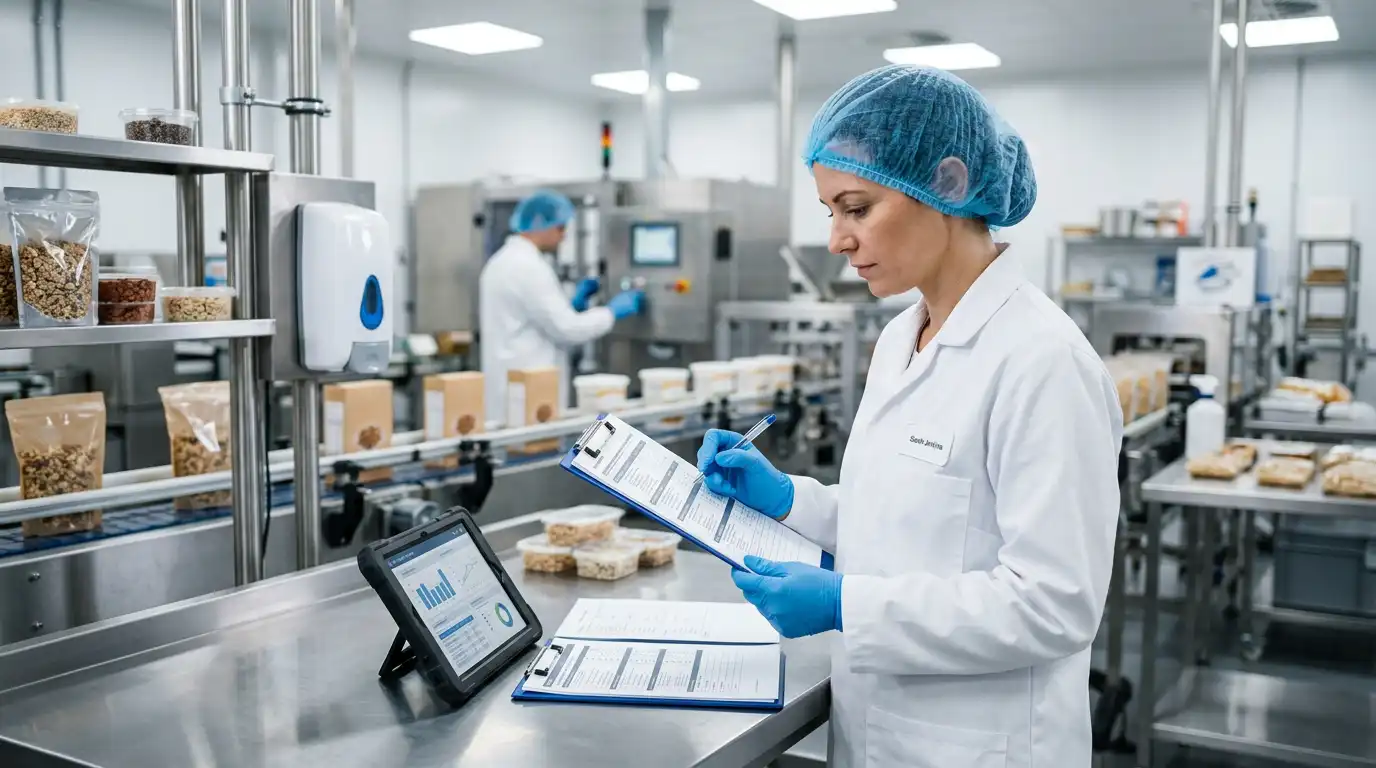
Operational monitoring logs (Tier 4) provide the daily objective evidence that your HACCP system lives on the production floor rather than sitting on a shelf. Under Clauses 4.6 to 4.10 of Section IV of Order No. 590, every operational log must carry unique document control IDs, record actual numerical measurements (never vague "OK" or checkmark symbols where a quantitative critical limit applies), capture the exact date and time of the check, and bear the signature of the person performing the measurement plus the verification signature of a supervisor.
Six Core Monitoring Logs Checked at Every Inspection and Audit
- Incoming Raw Material, Ingredient, and Packaging Inspection Log (LOG-01). Mandatory columns: delivery date and time, supplier name, product description, batch/lot code and production date, measured core temperature of chilled/frozen goods upon unloading, vehicle cargo box sanitary condition and driver medical book check, accompanying quality/safety certificate reference, packaging integrity check, accept/reject disposition, and receiver's signature.
- Cold-Chain Refrigeration, Freezer, and Dry Warehouse Temperature/Humidity Log (LOG-02). Maintained per numbered cold room or display case, listing the calibrated thermometer/hygrometer ID, target range (such as $+2,^\circ\text{C}$ to $+6,^\circ\text{C}$), actual readings at least twice per shift (or automated data-logger verification), defrost cycle flags, and operator signature.
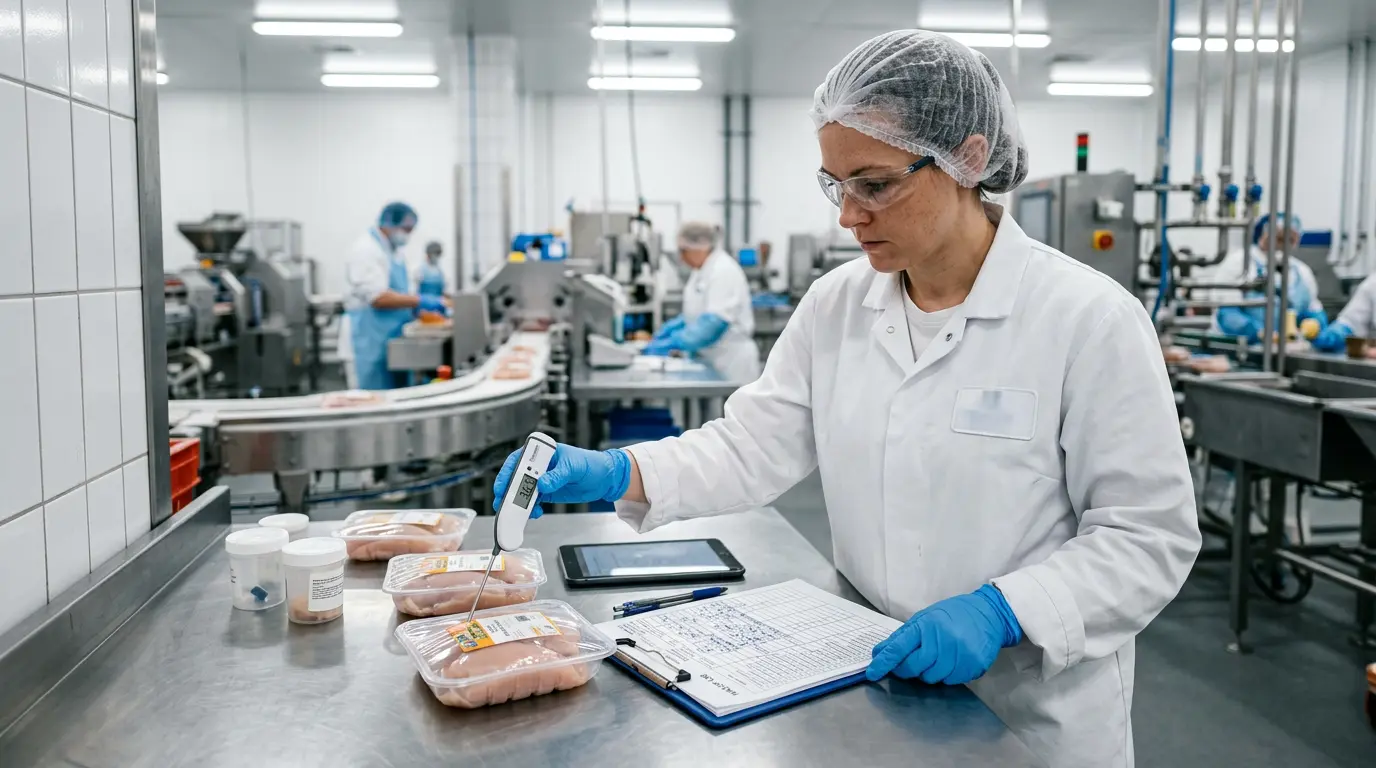
- Thermal Processing CCP and Post-Cook Chilling Monitoring Log (LOG-03). Captures batch/cook ID, product name, heating start and end times, measured core temperature at the thermal center, hold duration, blast-chilling start/end times and final core temperature, calibrated probe ID, operator signature, and technologist verification sign-off.
- Equipment Sanitation, CIP Cleaning, and Hygiene Verification Log (LOG-04). Records the cleaned line/zone, detergent and disinfectant names, titrated active concentration percentage, wash water temperature, exposure duration, neutral rinse verification (litmus/pH or conductivity check), visual and ATP bioluminescence RLU reading, and pre-start release signature.
- Daily Personnel Health Screening and Hygiene Clearance Log (LOG-05). Pre-shift check of all food handlers confirming absence of gastrointestinal illness, jaundice, infected skin lesions, or open cuts, verification of clean workwear and hairnets, absence of jewelry/watches, and logging of metal-detectable blue waterproof bandages where minor cuts are covered.
- Nonconforming Product Quarantine and Corrective Action Log (LOG-06). Logs every CCP deviation or raw material/finished product defect: quarantine hold-tag number, affected batch and weight, physical isolation location, 5-Whys root-cause investigation, disposition decision (reprocessing, downgrade to animal feed/technical use, or documented destruction), and QA verification sign-off.
Metrological Calibration and Thermometer Verification Log
No temperature or $\text{pH}$ entry in LOG-01, LOG-02, or LOG-03 holds legal weight if measured with an uncalibrated household thermometer. Under Clause 4.8 of Section IV of Order No. 590 and Clause 8.7 of ISO 22000, your facility must maintain a Measuring Equipment Calibration Register and Log covering handheld probe thermometers, stationary PT100 sensors, $\text{pH}$ meters, scales, and certified metal detector test pieces. Working digital probes undergo documented internal two-point verification in crushed melting ice ($0.0,^\circ\text{C} \pm 0.5,^\circ\text{C}$) and boiling distilled water ($100.0,^\circ\text{C} \pm 0.5,^\circ\text{C}$) or cross-comparison against a reference thermometer holding a valid metrological calibration certificate.
| Log Code & Form Title | Monitored Engineering Parameters | Recording Frequency | Minimum Archive Retention | Common Nonconformity Penalized by Inspectors |
|---|---|---|---|---|
| LOG-01 Incoming Raw Material & Packaging Log | Core product temp (°C), truck hygiene, packaging integrity, supplier lot code, COA/vet certificate ID | Every inbound delivery prior to warehouse put-away | 1 to 2 years (or shelf life + 6 months) | Accepting chilled meat, dairy, or fish without measuring core temperature or without logging supplier batch numbers |
| LOG-02 Cold-Chain Temperature & Humidity Log | Cold room air temperature (°C) and dry store relative humidity (%) | At least twice daily (start/end of shift) or hourly via data logger | Minimum 1 year after log completion | Identical numbers (+4.0 °C every day for a month) written in one sitting or missing a calibrated thermometer inside the chamber |
| LOG-03 Thermal Processing & Chilling CCP Log | Product core temperature (°C), hold time (sec/min), and chilling time curve | Every production batch / every oven or kettle load | Product shelf life + 12 months | Logging temperature without recording hold duration or omitting daily technologist verification signatures |
| LOG-04 Sanitation, CIP & Cleanliness Log | Sanitizer name, titrated concentration (%), solution temp, rinse neutrality, ATP RLU score | After every shift, between allergen runs, and on deep-clean days | Minimum 1 year | Logging a disinfectant that is out of stock in the chemical store or whose shelf life has expired |
| LOG-05 Personnel Health & Hygiene Screening Log | Absence of GI symptoms, skin infections, clean workwear, blue detectable bandage check | Daily before the start of every shift | Minimum 1 year | Signing off an employee as cleared for shift work on a day when payroll records show they were on vacation |
| LOG-06 Nonconforming Product & Corrective Action Log | Deviation description, quarantined batch weight, 5-Whys root cause, rework/disposal act | Upon every CCP breach, pest sighting, or product defect | 2 to 3 years (full certification cycle) | Presenting a completely blank deviation log after 12 months of operation, proving deviations go unrecorded |
Why Identical "Flatline" Numbers Trigger Immediate Inspector Penalties
If your cold-room or pasteurization log shows the exact same number (+4.0 °C or +72.0 °C) every single day for three months, written with the same pen and hand pressure on Friday afternoon, a Derzhprodspozhyvsluzhba inspector or GFSI auditor immediately flags falsified monitoring records. Real production equipment exhibits natural variance within tolerance (+3.2 °C, +4.5 °C, +3.7 °C), defrost spikes, and periodic corrective action entries.
How to Adapt HACCP Documentation for Food Manufacturing, HoReCa, Educational Canteens, and ISO 22000 / FSSC 22000
While the four-tier documentation pyramid applies across the entire food chain, the engineering depth inside each binder varies significantly depending on facility complexity and whether the simplified HACCP approach under Section V of Order No. 590 applies.
1. Industrial Food Manufacturing and Processing Plants
For meatpacking, dairy, bakery, confectionery, edible oil, beverage, and sauce factories, simplified procedures don't apply. You need a complete engineering package covering full allergen cross-matrices, thermal lethality validation reports, shelf-life challenge studies, environmental pathogen swabbing maps for Listeria monocytogenes and Salmonella across Zones 1 to 4, and batch testing schedules with laboratories accredited to ISO/IEC 17025. When scaling to ISO 22000, FSSC 22000, BRCGS, or IFS, the package integrates Food Fraud Vulnerability Assessments (VACCP), Food Defense threat plans (TACCP), Food Safety Culture plans, and positive-release quarantine procedures.
2. Restaurants, Cafes, Bakeries, Supermarket Delis, and Catering (HoReCa)
A commercial kitchen may serve 60 to 300 menu items that rotate every season. Drawing 200 individual flowcharts is pointless. Instead, HoReCa documentation uses process-group clustering: menu items are grouped into 6 to 8 homogeneous technological categories (unheated cold salads and appetizers, soups and broths, thermally processed meat/poultry/fish entrees, side dishes, sauces, pastries, and beverages). Operational controls focus on raw-vs-cooked shelf segregation inside reach-in chillers, date-and-hour secondary shelf-life stickers on prep containers, frying oil polar compound testing, hot-holding temperatures ($\ge 65,^\circ\text{C}$), and cold display case monitoring ($\le 4,^\circ\text{C}$).
3. School Canteens, Kindergartens, and Hospital Kitchens
For educational and medical catering units, HACCP documentation aligns with Section V of Order No. 590 and Ukraine's school nutrition regulations. Mandatory records include strict incoming verification of supplier safety documents, the daily Finished Meal Organoleptic Release Log (Бракеражний журнал) signed prior to serving each meal, daily collection and 48-hour sealed refrigeration ($+2,^\circ\text{C}$ to $+6,^\circ\text{C}$) of retention meal samples (добові проби), and dedicated utensils and prep windows for gluten-free and lactose-free dietary meals.
Turnkey HACCP Documentation Development and Inspection Preparation with Ekontrol
At Ekontrol, we never sell off-the-shelf "template zip archives" because unadapted templates leave food business operators exposed to statutory fines under Law No. 2042-VIII. Instead, our food safety technologists and lead auditors engineer and deploy a living Food Safety Management System in four structured steps:
- Facility Diagnostic Audit: we inspect your production site, warehouse, or kitchen on-site (or via detailed architectural layout and video walk-through). We map raw material, finished product, packaging, waste, and staff flows, identify cross-contamination bottlenecks, and deliver a practical engineering remediation list.
- Custom 4-Tier HACCP Documentation Engineering: we draft all four tiers of documentation around your actual equipment list, recipes, TU/DSTU standards, and staffing chart. You receive ready-to-use orders, 8 to 12 facility-specific Prerequisite Programs with zoning and pest maps, product specification cards, floor-verified flow diagrams, $L \times S$ hazard analysis worksheets, your CCP/OPRP Control Matrix, and ergonomic shift logs.
- Staff Training and Pilot Log Verification: we train your HACCP Team and line operators, set up thermometer calibration and sanitizer titration routines, and audit your first 2 to 3 weeks of completed monitoring logs to correct operator habits early.
- Inspection & Certification Audit Support and Annual Support: we run a pre-inspection mock audit against the official Derzhprodspozhyvsluzhba checklist or ISO 22000 / FSSC 22000 requirements, support your team during the audit, and maintain your system year-round.
Review our service details on the HACCP certification and implementation page or reach out via our contact page to get a fixed timeline and quote for your facility.
Cutting Operator Logging Time to 15 Minutes per Shift
Line workers resist HACCP logs when they're forced to sign ten overlapping clipboards. When Ekontrol engineers consolidate pre-op sanitation checks, glass/plastic inspections, and shift handover into a single Workstation Shift Sheet and pair cold rooms with automated temperature data loggers verified once daily, paperwork drops to 10-15 minutes per shift while keeping your facility 100% inspection-ready.

Need a certification consultation?
Free ConsultationOn This Page
- Why Downloaded Universal HACCP Document Templates Fail State Food Safety Inspections and GFSI Audits
- Four-Tier HACCP Documentation Architecture Under Order No. 590 and Codex Alimentarius
- Tier 1. Order Appointing the Multidisciplinary HACCP Team, Competence Matrix, and Food Safety Policy
- Tier 2. Prerequisite Programs (PRPs) Under Section II of Order No. 590 and ISO/TS 22002-1: Structure of 8 Core SOPs
- Tier 3. Core HACCP Plan Example: Product Description, Process Flow Diagram, Hazard Analysis (L x S), and CCP/OPRP Matrix
- Tier 4. Operational HACCP Monitoring Logs: Mandatory Fields and Engineering Specifications for 6 Core Forms
- How to Adapt HACCP Documentation for Food Manufacturing, HoReCa, Educational Canteens, and ISO 22000 / FSSC 22000
- Turnkey HACCP Documentation Development and Inspection Preparation with Ekontrol
- Frequently Asked Questions About HACCP Document Templates, Monitoring Logs, and Inspections
Why Downloaded Universal HACCP Document Templates Fail State Food Safety Inspections and GFSI Audits
When a food technologist, restaurant manager, or plant director searches online for "HACCP document templates download," the goal is practical: satisfy regulatory requirements before a state inspector or retail buyer auditor walks through the door. Yet buying a pre-packaged "universal HACCP binder on a flash drive" or downloading free templates from web forums always ends the same way. An inspector from the State Service of Ukraine on Food Safety and Consumer Protection (Derzhprodspozhyvsluzhba / DPSS) spots a copy-pasted template within the first five minutes of an audit.
Why does that happen? In Ukraine, the legal obligation to develop, implement, and continuously apply permanent procedures based on HACCP principles is mandated by Articles 20 and 21 of the Law of Ukraine "On Basic Principles and Requirements for Food Safety and Quality" No. 771/97-VR. The engineering blueprint for structuring all food safety documentation is defined in Ministry of Agrarian Policy and Food Order No. 590 of 01.10.2012, which is harmonized with the international Codex Alimentarius CXC 1-1969 code of practice. Meanwhile, state inspections and HACCP audits are executed under the Law of Ukraine "On State Control Over Compliance with Legislation on Food, Feed, Animal By-products, Animal Health and Welfare" No. 2042-VIII.
How State Inspectors and ISO 22000 Auditors Cross-Check Your Binders Against the Shop Floor
During an official audit or unannounced inspection, a state inspector works through the standardized Inspection Act and the dedicated HACCP Audit Act. The inspector doesn't grade your binder tabs or typography. Instead, they pick up your process flow diagram, HACCP plan, and prerequisite program instructions, walk straight onto the production floor or kitchen line, and compare your written text against physical reality:
- Mismatched equipment and floor layouts. A downloaded sanitation instruction references a CIP station, a vacuum bowl cutter, or a tunnel oven your facility has never owned, or your zoning map omits the freight elevator where dirty returnable crates cross paths with unwrapped ready-to-eat products.
- Fictitious critical limits and non-existent instruments. Your HACCP plan states "CCP 1: Pasteurization at $76,^\circ\text{C}$ for 20 seconds, monitored via automated chart recorder," while on the shop floor an operator stirs an open jacketed kettle and checks temperature once per batch with a handheld probe.
- Statutory financial penalties under Law No. 2042-VIII. Article 65 of Law No. 2042-VIII enforces strict fines for failing to implement permanent HACCP procedures: 30 minimum monthly wages for legal entities and 15 minimum monthly wages for sole proprietors (FOPs). If an inspector proves that your HACCP binder sits untouched in the director's office, monitoring logs are blank or backfilled in identical handwriting for an entire month, and critical limits were copied from another industry, the system is ruled non-existent. Worse still, if an inspector identifies a direct threat to human health, the Chief State Veterinary Inspector has statutory authority to suspend production and product circulation for up to 10 business days.
If your enterprise is preparing for export contracts or national supermarket tenders under ISO 22000, FSSC 22000, BRCGS, or IFS, auditor scrutiny is even tighter. Below, our food safety engineers at Ekontrol break down the complete four-tier HACCP documentation architecture and provide field-by-field engineering specifications for every mandatory procedure, worksheet, and operational monitoring log.
Four-Tier HACCP Documentation Architecture Under Order No. 590 and Codex Alimentarius
A working Food Safety Management System (FSMS) is never a random pile of disconnected instructions. Under the engineering logic of Ministry of Agrarian Policy Order No. 590 and ISO 22000, all food safety documentation is organized into a four-tier pyramid. Each upper tier sets the rules for the tier below it, while the bottom tier (operational monitoring logs) generates daily objective evidence that your controls work.
The Four Tiers of Food Safety Documentation
- Tier 1. Administrative Orders, HACCP Team Charter, and Food Safety Policy. Executive orders appointing and updating the multidisciplinary HACCP Team, team position descriptions, the competence and training matrix, the signed Food Safety Policy, measurable annual food safety objectives, and the order putting the system into operation.
- Tier 2. Prerequisite Programs (PRPs / Програми-передумови). Baseline sanitary, hygiene, and engineering Standard Operating Procedures (SOPs) governed by Section II of Order No. 590 and the ISO/TS 22002 series (ISO/TS 22002-1 for food manufacturing and ISO/TS 22002-2 for catering). PRPs control generic environmental hazards across the facility before raw materials ever reach critical processing steps.
- Tier 3. Core HACCP Plan and Hazard Analysis Worksheets. Raw material and finished product specifications, intended use definitions, on-site verified process flow diagrams, biological/chemical/physical/radiological hazard analysis worksheets scored by Likelihood and Severity ($L \times S$), decision-tree evaluations, validation protocols, and the master CCP / OPRP Control Matrix.
- Tier 4. Operational Monitoring Logs, Verification Records, and Corrective Action Forms. Daily shop-floor logs, temperature sheets, sanitation checklists, and calibration records filled out every shift by line operators, cooks, warehouse staff, shift supervisors, and QA technologists.
The master table below maps the four-tier HACCP documentation architecture against Order No. 590 and ISO 22000 clauses, listing the required engineering fields for each document group.
| Architecture Tier | Document Code & System Title | Statutory & Standard Basis (Order No. 590 / ISO 22000) | Mandatory Engineering Fields & Attributes | Process Owner & Review Frequency |
|---|---|---|---|---|
| Tier 1: Governance & Policy | ORD-01 Order Appointing the HACCP Team, Competence Matrix & Food Safety Policy | Section III Clauses 3.2-3.4 of Order No. 590; Clauses 5.2, 5.3, 7.2 of ISO 22000 | Full names, job titles, and roles of multidisciplinary team members, Team Leader, designated deputies, training matrix, signed Policy | Plant Director / HACCP Team Leader; reviewed annually and upon staff changes |
| Tier 2: Prerequisite Programs (PRPs) | PRP-01 to PRP-12 Prerequisite Program SOPs (sanitation, zoning, pest control, water, allergens, waste, traceability) | Section II Clauses 2.1-2.14 of Order No. 590; Clause 8.2 of ISO 22000 & ISO/TS 22002-1 | Color-coded zoning maps, Sinner's circle wash parameters (concentration, time, temp), bait station maps, glass register, 4-hour recall SOP | Chief Technologist, Chief Engineer, QA Manager; reviewed at least annually |
| Tier 3: Core HACCP Plan | HACCP-01 Product Specs, Verified Flow Diagrams, Hazard Analysis (L x S) & CCP/OPRP Matrix | Section III Clauses 3.5-3.13 & Section IV of Order No. 590; Clause 8.5 of ISO 22000 | Physico-chemical barriers (pH, aw), signed floor-verified flowcharts, risk scoring math, critical limits, monitoring, corrections | Multidisciplinary HACCP Team; reviewed annually and prior to any recipe or line change |
| Tier 4: Operational Logs & Records | LOG-01 to LOG-10 Shift Monitoring Logs for CCPs, cold chain, CIP sanitation, personal hygiene, receiving & quarantine | Section IV Clauses 4.6-4.10 of Order No. 590; Clauses 7.5, 8.5.4, 8.9 of ISO 22000 | Date, exact timestamp, batch/equipment ID, numerical measurement, operator signature, technologist verification sign-off, corrective action link | Line operators, cooks, warehouse receivers, shift QA; recorded every shift / every batch |
Scaling Order No. 590 Documentation to ISO 22000, FSSC 22000, BRCGS, and IFS
When you build your documentation around Ekontrol's 4-tier architecture from day one, upgrading for export or supermarket audits doesn't require rewriting your system. To scale from mandatory Ukrainian HACCP (Order No. 590) to ISO 22000 and FSSC 22000, you simply add organizational context and business risk registers (Clauses 4 and 6) to Tier 1, and expand Tier 2 with Food Defense (TACCP) and Food Fraud Vulnerability Assessment (VACCP) procedures.
Tier 1. Order Appointing the Multidisciplinary HACCP Team, Competence Matrix, and Food Safety Policy
Every state food safety inspection or certification audit starts by reviewing Tier 1 governance documents. Here the auditor checks whether the system is backed by cross-functional management authority or dumped entirely onto the shoulders of a single technologist.
Executive Order Appointing the Multidisciplinary HACCP Team
Under Clause 3.2 of Section III of Order No. 590, the HACCP Team must be multidisciplinary. If an appointment order at a meat plant, bakery, or dairy lists only a technologist and an accountant, the auditor logs a nonconformity right away. Why? Because a technologist alone doesn't control preventive maintenance schedules for refrigeration compressors, food-grade H1 lubricant purchasing, backflow preventers on water lines, or pest control contractor servicing.
An audit-proof Order Appointing the HACCP Team must contain:
- Named roster of team members with job titles and functional roles inside the FSMS: the HACCP Team Leader (typically the Chief Technologist or Quality Manager), the engineering lead (Chief Engineer or Maintenance Supervisor covering equipment reliability, metrology, HVAC, and water supply), the sanitation and hygiene lead (Production Supervisor or Sanitation Officer), the procurement and warehouse lead (controlling supplier approval, incoming inspection, and cold-chain storage), and a representative from your internal or contracted laboratory.
- Designated deputies for continuous shift coverage: naming a qualified backup for every key role so CCP verification, quarantine release, and deviation handling never stop during night shifts, weekends, or vacations.
- Explicit authority of the HACCP Team Leader: written authorization to halt production lines, quarantine nonconforming batches, block shipment of unsafe product, and convene unscheduled HACCP plan reviews.
Competence Matrix, Annual Training Plan, and Food Safety Policy
Attached to the appointment order is the HACCP Team and Staff Competence Matrix. Under Order No. 590 and Clause 7.2 of ISO 22000, the Team Leader and team members must hold documented proof of training in Codex Alimentarius principles, Ukrainian food safety regulations, hazard analysis methodology, and internal auditing. For shop-floor operators (cooks, deboners, pasteurizer operators, packers, sanitation crews), Tier 1 includes an Annual Training Schedule paired with short 10-question written comprehension tests. Auditors routinely cross-check a new hire's employment start date against their initial hygiene and CCP training sign-off: if an operator worked on the line before signing the training log, that's an audit finding.
Finally, your Food Safety Policy is issued as a concise one-page executive declaration signed by the CEO and translated into measurable annual objectives, such as zero pathogen detections in finished product, 100% on-time thermometer calibration, zero substantiated foreign-body complaints, and mock recall completion under 2 hours.
Tier 2. Prerequisite Programs (PRPs) Under Section II of Order No. 590 and ISO/TS 22002-1: Structure of 8 Core SOPs
Prerequisite Programs (PRPs) form the sanitary and engineering foundation of your facility. When baseline PRPs are weak, teams mistakenly turn routine cleaning or pest checks into dozens of unmanageable CCPs. Section II of Order No. 590 and ISO/TS 22002-1 define the mandatory scope of these procedures. Below is the field-by-field engineering structure for the eight core PRPs required in your documentation package.
1. Sanitation, Cleaning, Washing, and Disinfection Instruction (PRP-01)
A valid sanitation SOP never relies on vague instructions like "wash equipment after every shift." It contains equipment-specific Cleaning Cards built around Sinner's Circle parameters: chemical agent name, active titrated concentration percentage, solution temperature range, contact exposure time, and mechanical action (CIP spray ball pressure or manual scrubbing). It includes the register of approved food-grade detergents and disinfectants with Ukrainian state registration certificates and Safety Data Sheets (SDS), titration instructions, color-coding rules for cleaning tools (for instance, red for restrooms, yellow for raw handling zones, blue for high-care ready-to-eat packaging zones), and verification protocols using pH strip rinse checks, ATP bioluminescence swabs, and microbiological surface swabs.
2. Facility Zoning and Cross-Contamination Prevention (PRP-02)
This procedure contains a scaled architectural floor plan dividing the facility into hygienic zones (dirty receiving/washing zone, intermediate processing zone, and high-care/high-risk ready-to-eat zone). Color-coded directional arrows plot the exact movement paths of raw materials, work-in-progress, finished goods, clean and returnable packaging, food waste, and personnel. Where physical building constraints (especially in compact kitchens or older plants) prevent complete spatial separation, the SOP enforces strict time-segregation protocols: sequential scheduling of raw and ready-to-eat operations separated by validated full intermediate wash-downs and tool sanitization.
3. Pest Control Program: Rodent and Insect Management (PRP-03)
Your pest control SOP establishes a three-perimeter defense map (outer site perimeter bait stations, building envelope proofing with mesh screens, strip curtains, and sealed pipe penetrations, and interior monitoring traps). A strict rule under Order No. 590 and BRCGS / IFS audits: toxic chemical rodenticides are strictly prohibited inside production and open-food storage areas. Interior zones must use numbered mechanical snap/live traps or enclosed glue boards alongside shatterproof UV fly-traps with sticky catch boards (never high-voltage electric zappers that scatter insect fragments across work tables).
4. Water, Ice, and Culinary Steam Safety & Laboratory Testing Schedule (PRP-04)
Documents your water supply sources (municipal grid or on-site deep well), water treatment filtration/UV systems, a numbered schematic of all water outlets and ice machines, backflow preventer installations, and an annual sampling schedule for microbiological (E. coli, enterococci, total coliforms) and chemical drinking-water parameters tested by laboratories accredited to ISO/IEC 17025.
5. Food Waste and Animal By-Products Management (PRP-05)
Specifies foot-operated lidded waste bins color-coded and labeled by waste stream, maximum floor accumulation times (preventing fly breeding and microbial cross-contamination), dedicated chilled storage rooms for organic waste and animal by-products, non-intersecting waste removal routes, and disposal contracts with licensed operators aligned with the Law of Ukraine "On Waste Management" No. 2320-IX.
6. Allergen Control Matrix and Label Verification (PRP-06)
Covers the 14 regulated food allergens (cereals containing gluten, crustaceans, eggs, fish, peanuts, soybeans, milk/lactose, tree nuts, celery, mustard, sesame seeds, sulfur dioxide and sulfites above 10 mg/kg, lupin, and molluscs). The SOP includes a raw-material-to-finished-product Allergen Cross-Matrix, segregated allergen racking rules in warehouses, production scheduling rules (running allergen-containing recipes at the end of the production cycle prior to deep sanitation), validated allergen clean-down protocols using rapid protein swabs, and mandatory sign-off of label artwork and ingredient bolding.
7. Glass, Brittle Plastic, Ceramics, and Foreign-Body Control (PRP-07)
Enforces a strict "No Glass or Hard Brittle Plastic" policy inside processing areas, maintains a zoned Glass & Brittle Plastic Inventory Register (shatterproof light diffusers, sight glasses, pressure gauges, scale displays), defines shift inspection frequencies, and details the emergency line-stop, radius product quarantine, and clothing-change protocol if a breakage occurs.
8. Supplier Approval, Incoming Inspection, Traceability, and Recall SOP (PRP-08)
Defines risk-based supplier qualification criteria, required batch documentation (Certificates of Analysis, veterinary certificates, declarations of conformity), lot-coding rules achieving "One Step Back / One Step Forward" traceability, and the crisis Product Withdrawal and Recall Procedure. It includes mandatory notification templates for Derzhprodspozhyvsluzhba and customers, plus an annual Mock Recall and mass-balance reconciliation exercise (accounting for 99.5% to 100.5% of raw material input vs finished stock and waste) completed within 4 hours.
Tier 3. Core HACCP Plan Example: Product Description, Process Flow Diagram, Hazard Analysis (L x S), and CCP/OPRP Matrix
Tier 3 documentation executes the seven principles of Codex Alimentarius CXC 1-1969 and Sections III and IV of Order No. 590. This is the analytical core where your HACCP Team proves to state inspectors and certification auditors that every Critical Control Point was derived from engineering calculation rather than guesswork.
1. Product Description and Intended Use Specification Cards
For every individual product or homogeneous process group, the team prepares a formal Product Description Card containing:
- product name and governing technical standard (national DSTU standard or enterprise TU U specification);
- complete ingredient bill of materials with regulated allergens highlighted;
- intrinsic physico-chemical safety barriers controlling pathogen growth: acidity ($\text{pH}$), water activity ($a_w$), moisture content, salt-in-moisture phase, sugar concentration, or curing salts/preservatives;
- primary preservation technology (pasteurization, retorting, baking, blast freezing, fermentation, drying, smoking);
- primary food-contact packaging and secondary transport packaging specs (modified atmosphere gas mix $\text{CO}_2 / \text{N}_2$, vacuum level, film oxygen transmission rate, food-contact migration declarations);
- validated shelf life, storage temperature and relative humidity limits, and refrigerated transport conditions;
- intended preparation method (Ready-to-Eat RTE vs mandatory consumer cooking instructions) and target consumer group, explicitly noting vulnerable populations (infants, school children, pregnant women, elderly, or allergic consumers).
2. On-Site Verified Process Flow Diagrams
The process flow diagram maps every sequential step from "Step 1. Receiving Raw Materials" through "Step $N$. Dispatch of Finished Goods." Under Order No. 590 and ISO 22000, a valid flow diagram must show not only main processing steps, but also every point where water, culinary steam, compressed air, packaging materials, or rework loops enter the line, and where intermediate waste, by-products, and effluents exit. Every flow diagram must carry a verification stamp, date, and signatures of the HACCP Team confirming it was walked and verified on the shop floor across both day and night shifts.
3. Hazard Analysis Worksheets (L x S Scoring) and Decision Tree Application
For every numbered step on the flow diagram, the HACCP Team identifies specific hazards across four classes: Biological ($B$: vegetative pathogens Salmonella spp., Listeria monocytogenes, E. coli, spore-formers Clostridium botulinum, Bacillus cereus, Clostridium perfringens, enteric viruses, parasites), Chemical ($C$: mycotoxins, pesticide and veterinary antibiotic residues, heavy metals, CIP detergent/sanitizer carryover, non-food-grade lubricant leaks, undeclared cross-contact allergens, acrylamide, polycyclic aromatic hydrocarbons), Physical ($P$: metal fragments from blades, grinders, or sieves, glass splinters, brittle plastic, stones, bone/pit fragments), and Radiological ($R$: $^{137}\text{Cs}$ and $^{90}\text{Sr}$ radionuclides in wild berries, mushrooms, or raw milk).
Each identified hazard is evaluated using a two-dimensional risk matrix: Likelihood of occurrence $L$ (scored 1 to 5) multiplied by Severity of adverse health consequences $S$ (scored 1 to 5). Whenever the composite risk score $R = L \times S$ reaches the significance threshold (typically $R \ge 9$, or any hazard with critical severity $S = 5$), the hazard is classified as a Significant Food Safety Hazard and passed through the four-question Codex Decision Tree (Q1: Do preventive control measures exist at this step? Q2: Is this step specifically designed to eliminate or reduce the hazard to an acceptable level? Q3: Could contamination occur in excess of acceptable levels or increase to unacceptable levels? Q4: Will a subsequent step eliminate the hazard or reduce it to an acceptable level?). This step segregates true Critical Control Points (CCPs) from Operational Prerequisite Programs (OPRPs).
4. Control Measure Validation Protocol and the Master CCP / OPRP Matrix
Before putting the HACCP Plan into operation, the team compiles a Validation Record proving that the chosen critical limits (such as $72,^\circ\text{C}$ for 15 seconds or a $1.5,\text{mm}$ Fe metal detector threshold) scientifically achieve the required pathogen log-reduction or foreign-body rejection under worst-case line speeds. The table below illustrates an engineering excerpt from a production HACCP Plan showing how CCPs and OPRPs are structured.
| Process Step & Control Type (CCP / OPRP) | Significant Food Safety Hazard | Critical Limit (for CCP) or Action Criterion (for OPRP) | Monitoring Procedure (What, How, Frequency, Who) | Immediate Correction & Root-Cause Corrective Action | Verification & Operational Log Code |
|---|---|---|---|---|---|
| Step 8. Thermal Processing (Pasteurization / Cooking) [CCP 1B] | Biological: survival of vegetative pathogens (Salmonella, L. monocytogenes, E. coli) | Core product temperature >= 72 °C held for >= 15 sec (or >= 75 °C at thermal center of batch) | What: core temp & hold time. How: calibrated PT100 recorder / probe thermometer. Frequency: continuous / every batch. Who: thermal operator | Correction: divert/re-pasteurize batch or hold in quarantine. Corrective Action: inspect steam valve actuator, recalibrate temperature sensor | Daily chart review by technologist; monthly probe calibration; ISO/IEC 17025 lab pathogen testing. Record: LOG-03 |
| Step 9. Rapid Chilling Post-Heat Treatment [OPRP 1B] | Biological: outgrowth of heat-resistant spores (Bacillus cereus, Clostridium perfringens) during slow cooling | Chill product core from +60 °C down to +10 °C within <= 120 minutes, then to <= +4 °C | What: core temperature drop & cycle time. How: calibrated probe & blast-chiller timer. Frequency: every rack / batch. Who: chiller operator | Correction: transfer to backup blast chiller, hold batch for microbiological clearance. Corrective Action: service evaporator fans and defrost cycle | Weekly log audit by HACCP Team Leader; shelf-life microbiological swabbing. Record: LOG-03 |
| Step 12. Metal Detection (or Inline Magnet / Sieve) [CCP 2P] | Physical: contamination with ferrous, non-ferrous, or stainless-steel metal fragments >= 1.5 mm | Zero passage of test spheres >= Fe 1.5 mm, Non-Fe 2.0 mm, SUS316 2.5 mm; automatic reject arm functional | What: detector sensitivity & reject mechanism. How: pass certified test wands with product. Frequency: line start, hourly, line end. Who: packing operator | Correction: quarantine all product packed since last passed test, re-screen through verified detector. Corrective Action: inspect upstream blades/sieves | Shift supervisor sign-off; annual OEM engineer calibration certificate. Record: LOG-04 |
| Step 11. Allergen Product Packaging & Labeling [OPRP 2C] | Chemical (Allergen): undeclared allergen due to wrong film roll or residual protein from prior run | 100% match between label ingredient panel and batch recipe; negative rapid protein swab after allergen wash-down | What: label barcode/allergen text & line swab. How: visual check against master artwork + swab test. Frequency: every batch start & roll change. Who: line lead | Correction: halt packaging, quarantine and relabel affected units. Corrective Action: remove obsolete film rolls from packaging floor | Daily QA floor inspection; attach first and last label of every batch to shift log. Record: LOG-05 |
Need Audit-Proof HACCP or ISO 22000 Documentation Engineered for Your Facility?
Ekontrol's food safety technologists develop custom 4-tier HACCP documentation packages under Order No. 590 and ISO 22000 tailored to your exact equipment, floor layout, and recipes in 7 to 14 business days, train your staff, and prepare you for Derzhprodspozhyvsluzhba inspections.
Order HACCP DevelopmentTier 4. Operational HACCP Monitoring Logs: Mandatory Fields and Engineering Specifications for 6 Core Forms
Operational monitoring logs (Tier 4) provide the daily objective evidence that your HACCP system lives on the production floor rather than sitting on a shelf. Under Clauses 4.6 to 4.10 of Section IV of Order No. 590, every operational log must carry unique document control IDs, record actual numerical measurements (never vague "OK" or checkmark symbols where a quantitative critical limit applies), capture the exact date and time of the check, and bear the signature of the person performing the measurement plus the verification signature of a supervisor.
Six Core Monitoring Logs Checked at Every Inspection and Audit
- Incoming Raw Material, Ingredient, and Packaging Inspection Log (LOG-01). Mandatory columns: delivery date and time, supplier name, product description, batch/lot code and production date, measured core temperature of chilled/frozen goods upon unloading, vehicle cargo box sanitary condition and driver medical book check, accompanying quality/safety certificate reference, packaging integrity check, accept/reject disposition, and receiver's signature.
- Cold-Chain Refrigeration, Freezer, and Dry Warehouse Temperature/Humidity Log (LOG-02). Maintained per numbered cold room or display case, listing the calibrated thermometer/hygrometer ID, target range (such as $+2,^\circ\text{C}$ to $+6,^\circ\text{C}$), actual readings at least twice per shift (or automated data-logger verification), defrost cycle flags, and operator signature.
- Thermal Processing CCP and Post-Cook Chilling Monitoring Log (LOG-03). Captures batch/cook ID, product name, heating start and end times, measured core temperature at the thermal center, hold duration, blast-chilling start/end times and final core temperature, calibrated probe ID, operator signature, and technologist verification sign-off.
- Equipment Sanitation, CIP Cleaning, and Hygiene Verification Log (LOG-04). Records the cleaned line/zone, detergent and disinfectant names, titrated active concentration percentage, wash water temperature, exposure duration, neutral rinse verification (litmus/pH or conductivity check), visual and ATP bioluminescence RLU reading, and pre-start release signature.
- Daily Personnel Health Screening and Hygiene Clearance Log (LOG-05). Pre-shift check of all food handlers confirming absence of gastrointestinal illness, jaundice, infected skin lesions, or open cuts, verification of clean workwear and hairnets, absence of jewelry/watches, and logging of metal-detectable blue waterproof bandages where minor cuts are covered.
- Nonconforming Product Quarantine and Corrective Action Log (LOG-06). Logs every CCP deviation or raw material/finished product defect: quarantine hold-tag number, affected batch and weight, physical isolation location, 5-Whys root-cause investigation, disposition decision (reprocessing, downgrade to animal feed/technical use, or documented destruction), and QA verification sign-off.
Metrological Calibration and Thermometer Verification Log
No temperature or $\text{pH}$ entry in LOG-01, LOG-02, or LOG-03 holds legal weight if measured with an uncalibrated household thermometer. Under Clause 4.8 of Section IV of Order No. 590 and Clause 8.7 of ISO 22000, your facility must maintain a Measuring Equipment Calibration Register and Log covering handheld probe thermometers, stationary PT100 sensors, $\text{pH}$ meters, scales, and certified metal detector test pieces. Working digital probes undergo documented internal two-point verification in crushed melting ice ($0.0,^\circ\text{C} \pm 0.5,^\circ\text{C}$) and boiling distilled water ($100.0,^\circ\text{C} \pm 0.5,^\circ\text{C}$) or cross-comparison against a reference thermometer holding a valid metrological calibration certificate.
| Log Code & Form Title | Monitored Engineering Parameters | Recording Frequency | Minimum Archive Retention | Common Nonconformity Penalized by Inspectors |
|---|---|---|---|---|
| LOG-01 Incoming Raw Material & Packaging Log | Core product temp (°C), truck hygiene, packaging integrity, supplier lot code, COA/vet certificate ID | Every inbound delivery prior to warehouse put-away | 1 to 2 years (or shelf life + 6 months) | Accepting chilled meat, dairy, or fish without measuring core temperature or without logging supplier batch numbers |
| LOG-02 Cold-Chain Temperature & Humidity Log | Cold room air temperature (°C) and dry store relative humidity (%) | At least twice daily (start/end of shift) or hourly via data logger | Minimum 1 year after log completion | Identical numbers (+4.0 °C every day for a month) written in one sitting or missing a calibrated thermometer inside the chamber |
| LOG-03 Thermal Processing & Chilling CCP Log | Product core temperature (°C), hold time (sec/min), and chilling time curve | Every production batch / every oven or kettle load | Product shelf life + 12 months | Logging temperature without recording hold duration or omitting daily technologist verification signatures |
| LOG-04 Sanitation, CIP & Cleanliness Log | Sanitizer name, titrated concentration (%), solution temp, rinse neutrality, ATP RLU score | After every shift, between allergen runs, and on deep-clean days | Minimum 1 year | Logging a disinfectant that is out of stock in the chemical store or whose shelf life has expired |
| LOG-05 Personnel Health & Hygiene Screening Log | Absence of GI symptoms, skin infections, clean workwear, blue detectable bandage check | Daily before the start of every shift | Minimum 1 year | Signing off an employee as cleared for shift work on a day when payroll records show they were on vacation |
| LOG-06 Nonconforming Product & Corrective Action Log | Deviation description, quarantined batch weight, 5-Whys root cause, rework/disposal act | Upon every CCP breach, pest sighting, or product defect | 2 to 3 years (full certification cycle) | Presenting a completely blank deviation log after 12 months of operation, proving deviations go unrecorded |
Why Identical "Flatline" Numbers Trigger Immediate Inspector Penalties
If your cold-room or pasteurization log shows the exact same number (+4.0 °C or +72.0 °C) every single day for three months, written with the same pen and hand pressure on Friday afternoon, a Derzhprodspozhyvsluzhba inspector or GFSI auditor immediately flags falsified monitoring records. Real production equipment exhibits natural variance within tolerance (+3.2 °C, +4.5 °C, +3.7 °C), defrost spikes, and periodic corrective action entries.
How to Adapt HACCP Documentation for Food Manufacturing, HoReCa, Educational Canteens, and ISO 22000 / FSSC 22000
While the four-tier documentation pyramid applies across the entire food chain, the engineering depth inside each binder varies significantly depending on facility complexity and whether the simplified HACCP approach under Section V of Order No. 590 applies.
1. Industrial Food Manufacturing and Processing Plants
For meatpacking, dairy, bakery, confectionery, edible oil, beverage, and sauce factories, simplified procedures don't apply. You need a complete engineering package covering full allergen cross-matrices, thermal lethality validation reports, shelf-life challenge studies, environmental pathogen swabbing maps for Listeria monocytogenes and Salmonella across Zones 1 to 4, and batch testing schedules with laboratories accredited to ISO/IEC 17025. When scaling to ISO 22000, FSSC 22000, BRCGS, or IFS, the package integrates Food Fraud Vulnerability Assessments (VACCP), Food Defense threat plans (TACCP), Food Safety Culture plans, and positive-release quarantine procedures.
2. Restaurants, Cafes, Bakeries, Supermarket Delis, and Catering (HoReCa)
A commercial kitchen may serve 60 to 300 menu items that rotate every season. Drawing 200 individual flowcharts is pointless. Instead, HoReCa documentation uses process-group clustering: menu items are grouped into 6 to 8 homogeneous technological categories (unheated cold salads and appetizers, soups and broths, thermally processed meat/poultry/fish entrees, side dishes, sauces, pastries, and beverages). Operational controls focus on raw-vs-cooked shelf segregation inside reach-in chillers, date-and-hour secondary shelf-life stickers on prep containers, frying oil polar compound testing, hot-holding temperatures ($\ge 65,^\circ\text{C}$), and cold display case monitoring ($\le 4,^\circ\text{C}$).
3. School Canteens, Kindergartens, and Hospital Kitchens
For educational and medical catering units, HACCP documentation aligns with Section V of Order No. 590 and Ukraine's school nutrition regulations. Mandatory records include strict incoming verification of supplier safety documents, the daily Finished Meal Organoleptic Release Log (Бракеражний журнал) signed prior to serving each meal, daily collection and 48-hour sealed refrigeration ($+2,^\circ\text{C}$ to $+6,^\circ\text{C}$) of retention meal samples (добові проби), and dedicated utensils and prep windows for gluten-free and lactose-free dietary meals.
Turnkey HACCP Documentation Development and Inspection Preparation with Ekontrol
At Ekontrol, we never sell off-the-shelf "template zip archives" because unadapted templates leave food business operators exposed to statutory fines under Law No. 2042-VIII. Instead, our food safety technologists and lead auditors engineer and deploy a living Food Safety Management System in four structured steps:
- Facility Diagnostic Audit: we inspect your production site, warehouse, or kitchen on-site (or via detailed architectural layout and video walk-through). We map raw material, finished product, packaging, waste, and staff flows, identify cross-contamination bottlenecks, and deliver a practical engineering remediation list.
- Custom 4-Tier HACCP Documentation Engineering: we draft all four tiers of documentation around your actual equipment list, recipes, TU/DSTU standards, and staffing chart. You receive ready-to-use orders, 8 to 12 facility-specific Prerequisite Programs with zoning and pest maps, product specification cards, floor-verified flow diagrams, $L \times S$ hazard analysis worksheets, your CCP/OPRP Control Matrix, and ergonomic shift logs.
- Staff Training and Pilot Log Verification: we train your HACCP Team and line operators, set up thermometer calibration and sanitizer titration routines, and audit your first 2 to 3 weeks of completed monitoring logs to correct operator habits early.
- Inspection & Certification Audit Support and Annual Support: we run a pre-inspection mock audit against the official Derzhprodspozhyvsluzhba checklist or ISO 22000 / FSSC 22000 requirements, support your team during the audit, and maintain your system year-round.
Review our service details on the HACCP certification and implementation page or reach out via our contact page to get a fixed timeline and quote for your facility.
Cutting Operator Logging Time to 15 Minutes per Shift
Line workers resist HACCP logs when they're forced to sign ten overlapping clipboards. When Ekontrol engineers consolidate pre-op sanitation checks, glass/plastic inspections, and shift handover into a single Workstation Shift Sheet and pair cold rooms with automated temperature data loggers verified once daily, paperwork drops to 10-15 minutes per shift while keeping your facility 100% inspection-ready.