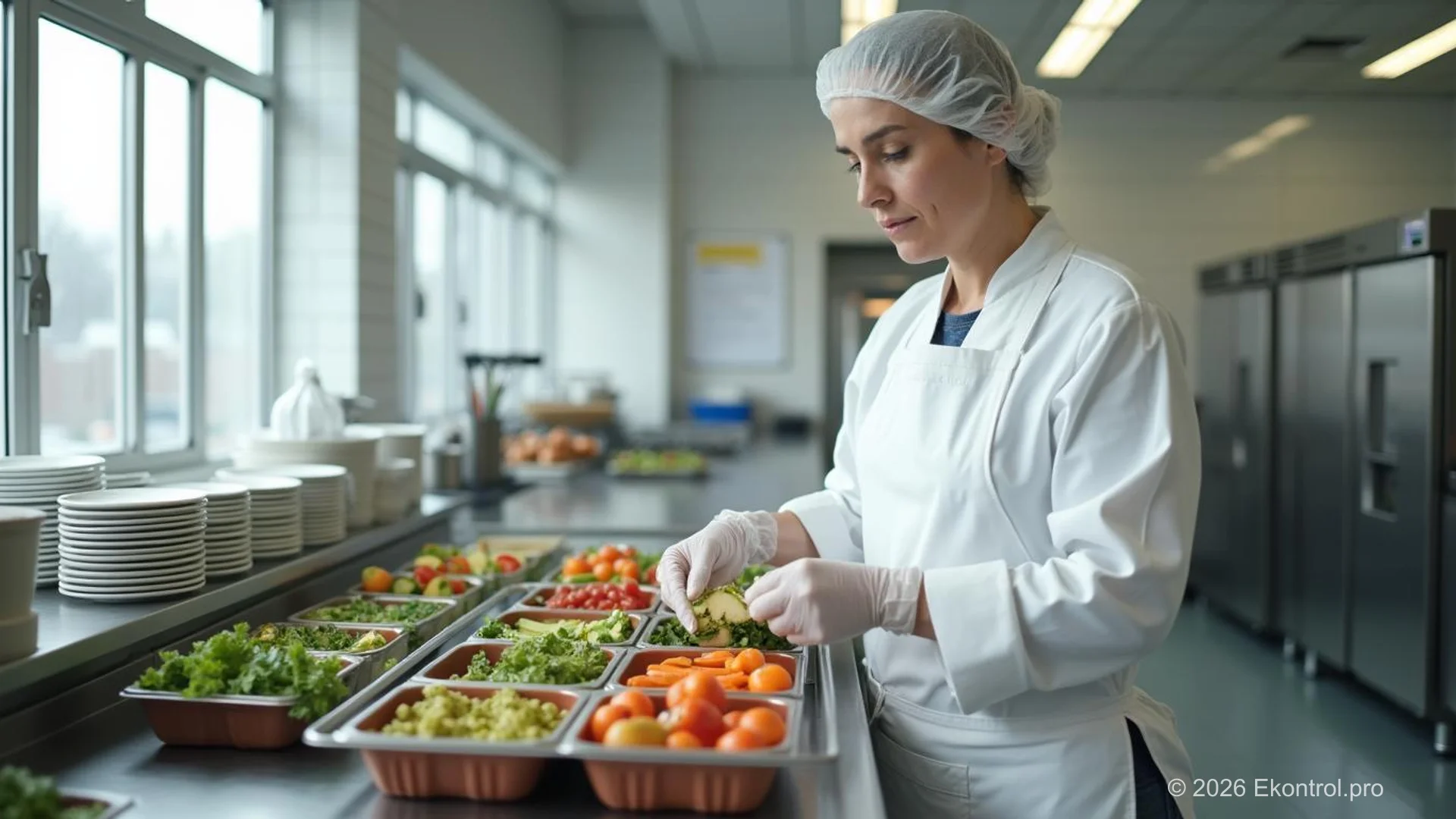
Statutory Framework for HACCP Implementation in Ukraine: Laws No. 771/97-VR, No. 2042-VIII, and Order No. 590
HACCP implementation (Hazard Analysis and Critical Control Points) in Ukraine isn't an optional badge for export-oriented conglomerates anymore. It's a binding legal obligation for every food business operator that manufactures, processes, packs, stores, transports, or sells food products. Unlike the legacy Soviet-era quality model, which relied on sampling finished batches in the warehouse after production was already over, the preventive HACCP system standardized by the FAO/WHO Codex Alimentarius Commission embeds hazard control directly into your live technological process. You identify biological, chemical, physical, and allergen hazards at every station on the production floor or kitchen line and block them before a contaminated unit ever reaches the consumer.
Ukrainian food safety regulation rests on three primary statutes that govern how a food safety management system is engineered, maintained, and audited by state inspectors:
- Law of Ukraine No. 771/97-VR "On Basic Principles and Requirements for Food Safety and Quality". Articles 20 and 21 of Law No. 771/97-VR explicitly obligate all market operators to develop, put into operation, and continuously apply permanent procedures based on HACCP principles, maintain "one step back, one step forward" lot traceability, and register every food facility with the state or obtain an operational permit.
- Order of the Ministry of Agrarian Policy and Food of Ukraine No. 590 dated 01.10.2012. This technical regulation establishes the official "Requirements for the Development, Implementation, and Application of Permanent Procedures Based on the Principles of the Food Safety Management System (HACCP)." State auditors use the exact clauses of Order No. 590 to verify your 13 prerequisite programs (Section II), the 12 implementation steps and 7 HACCP principles (Section III), decision tree logic, and eligibility for simplified procedures in low-risk small facilities (Section IV).
- Law of Ukraine No. 2042-VIII "On State Control over Compliance with Legislation on Food, Feed, Animal By-Products, Animal Health and Welfare". This law defines the powers of state inspectors during unannounced inspections and scheduled HACCP audits, risk-based inspection frequency, and strict financial penalties under Article 65.
State Control by SSFSCP and Financial Sanctions Under Article 65 of Law No. 2042-VIII
Regulatory enforcement is carried out by the State Service of Ukraine on Food Safety and Consumer Protection (SSFSCP / Derzhprodspozhyvsluzhba). During an inspection or HACCP audit, state inspectors hold statutory authority to enter production, cold-storage, and utility zones, record video evidence across the facility, collect surface swabs, water, and product samples for laboratory testing, and interview line operators directly at their workstations.
Plenty of business owners still assume that buying a generic binder of downloaded orders and templates will get them through a visit. In practice, that shortcut backfires fast. When a binder sits in the director's office while the shop floor lacks color-coded cleaning tools, pasteurizer and chiller logs are filled out in advance with identical numbers, and the cook or machine operator can't explain what happens when core temperature drops below the critical limit, the inspector records a failure to apply HACCP procedures. Under Article 65 of Law No. 2042-VIII, fines are calculated in multiples of the statutory minimum wage (MW) set on January 1 of the current year. Beyond monetary fines, if inspectors identify a direct threat to human life or health, the Chief State Inspector issues a mandatory decision suspending facility operations or product circulation for up to 10 business days, followed by administrative court proceedings if the violation isn't corrected.
| Offense Under Article 65 of Law No. 2042-VIII | Fine for Legal Entities | Fine for Sole Proprietors (FOP) | Operational and Commercial Consequence |
|---|---|---|---|
| Failure to implement and apply permanent procedures based on HACCP principles on food facilities (Art. 65, Part 1, Clause 4) | 30 minimum wages (MW) | 15 minimum wages (MW) | Mandatory corrective prescription, unscheduled follow-up inspection, disqualification from Prozorro public tenders and retail supply contracts |
| Violation of statutory hygiene requirements for food production or circulation that creates a threat to human life or health (Art. 65, Part 1, Clause 1) | 10 minimum wages (MW) | 6 minimum wages (MW) | Immediate suspension of the production line or entire facility up to 10 business days, mandatory deep sanitation and accredited lab swab testing |
| Food production or circulation at an unregistered food facility where state registration is mandatory (Art. 65, Part 1, Clause 2) | 20 minimum wages (MW) | 11 minimum wages (MW) | Ban on product sales and distribution, batch withdrawal until the facility is officially entered into the state register |
| Production or storage of food products of animal origin without a valid operational permit (Art. 65, Part 1, Clause 3) | 30 minimum wages (MW) | 20 minimum wages (MW) | Complete shutdown of facility operations, cancellation of B2B distribution agreements, and seizure or disposal of non-compliant batches |
| Violation of "one step back, one step forward" food traceability requirements (Art. 65, Part 1, Clause 5) | 8 minimum wages (MW) | 5 minimum wages (MW) | Stockpiled batches are classified as food of unknown origin and subjected to mandatory market recall and quarantine |
Who Must Implement HACCP in Ukraine: Food Manufacturing, Cold-Chain Logistics, Retail, and HoReCa
Law of Ukraine No. 771/97-VR defines a "food market operator" broadly. It covers any legal entity or sole proprietor (FOP) managing facilities that manufacture, process, package, store, transport, or sell food. Primary agricultural production (growing grain, vegetables, or fruit in the field without processing) is governed by Good Agricultural and Hygiene Practices, yet the moment an agribusiness washes, grades, packs, dries, freezes, or stores grain in an elevator for food use, HACCP implementation becomes mandatory.
The Ekontrol engineering team runs diagnostic audits across dozens of food sectors every month. If you want a general introduction to food safety terminology, check our complete guide to HACCP; below we break down how engineering controls differ across four core industry segments in Ukraine.
1. Industrial Food and Beverage Manufacturing (Meat, Dairy, Bakery, Confectionery, Beverages)
Industrial processors with multi-stage recipes and thermal or microbiological kill steps must implement all 12 steps and 7 principles of HACCP without shortcuts. Slaughterhouses, meat-processing plants, dairies, fish processors, and egg-packing stations must also pass an on-site SSFSCP inspection to obtain an operational permit before launching commercial production. Here, engineering controls center on validated pasteurization, sterilization, or core cooking curves, blast-chilling rates (moving product rapidly through the $+60\text{ }^\circ\text{C}$ to $+4\text{ }^\circ\text{C}$ spore-germination danger zone), automated Clean-in-Place (CIP) conductivity and temperature validation, antibiotic and mycotoxin screening at raw material intake, and inline X-ray or metal detection after packaging.
2. Cold-Chain Logistics Operators (3PL), Warehouses, Distributors, and Supermarkets
Distribution centers, refrigerated transport fleets, and grocery retailers don't alter the chemical composition of pre-packaged goods, yet they carry full legal responsibility for maintaining safety during storage and transit. In logistics and retail, hazard analysis targets cold-chain breaches during cross-docking on loading bays, improper commodity segregation (storing raw meat or unwashed root vegetables next to ready-to-eat dairy or bakery items), packaging damage from forklifts or pests, refrigerated trailer sanitation, and strict FEFO (First Expired, First Out) batch tracking.
3. HoReCa Establishments: Restaurants, Cafes, Hotels, Bakeries, Dark Kitchens, and Catering
A commercial restaurant or hotel kitchen prepares dozens of dishes simultaneously from raw poultry, beef, seafood, shell eggs, dairy, and fresh leafy greens within a tight footprint. The biggest engineering hurdle when implementing HACCP in HoReCa is preventing cross-contamination between dirty and clean flows when you can't build separate rooms for meat, fish, and vegetables. Where physical walls aren't feasible, Ekontrol engineers design time-separated prep schedules with mandatory intermediate surface disinfection, strict color-coded cutting boards and knives, dedicated shell-egg washing and disinfection stations, and practical single-page shift checklists.
4. Educational Facilities, School Canteens, Kindergartens, and Hospital Kitchens
School canteens, preschools, and hospital catering units serve high-risk vulnerable populations and face joint scrutiny from both the SSFSCP and public health authorities. Key controls include strict incoming verification of supplier declarations for every delivery, mandatory daily retention samples of finished meals stored in a sealed refrigerator at $+2\text{ }^\circ\text{C}$ to $+6\text{ }^\circ\text{C}$ for at least 48 hours, core cooking temperature verification, and daily staff health screening before kitchen entry.
When Simplified HACCP Procedures Are Permitted Under Section IV of Order No. 590
Section IV of Order No. 590 allows a simplified HACCP approach for small facilities with simple technological cycles, such as mobile street-food stalls, small coffee shops, neighborhood grocery stores, kiosks, or warehouses that only handle ambient or pre-packaged food. If a formal hazard analysis proves that all realistic food safety hazards are fully controlled by prerequisite programs alone, the operator isn't required to designate formal Critical Control Points (CCPs). However, your HACCP team must document the scientific rationale for this decision in the hazard analysis protocol, and all prerequisite programs, sanitation schedules, and temperature logs must still operate daily.

Why a Purchased Template HACCP Binder Guarantees a Fine Under Article 65 of Law No. 2042-VIII
A generic HACCP package downloaded online or bought for a few thousand hryvnias gets exposed by an SSFSCP inspector within the first ten minutes of a site walk-through. Template binders routinely list equipment your facility doesn't own, chemical sanitizers you don't buy, outdated Soviet sanitary rules, or critical limits that can't be measured with the thermometers on your floor. When your written procedures contradict the actual path of raw materials in the workshop, the inspector classifies the system as unimplemented and issues a fine of 30 or 15 minimum wages.
The Engineering Foundation: Rolling Out the 13 Mandatory Prerequisite Programs (PRPs) per Order No. 590
The most common engineering failure we see in self-built systems is jumping straight into Critical Control Point tables while basic hygiene on the shop floor is broken. A HACCP plan cannot operate in a vacuum. Under Section II of Order No. 590 and Codex Alimentarius guidelines, every food operator must first design, document, and implement Prerequisite Programs (PRPs). Well-engineered PRPs control 80% to 90% of general facility hazards so your HACCP plan stays focused on true critical points.
Below is the engineering breakdown of all 13 mandatory prerequisite programs that Ekontrol architects and rolls out during turnkey food safety implementation across Ukrainian facilities.
1. Facility Layout, Hygienic Zoning, and Cross-Contamination Prevention
Your layout must enforce forward-only unidirectional flow: raw materials enter through the dirty receiving zone, move through primary preparation and thermal processing, and exit through the high-care packaging and dispatch zone. Flows of raw ingredients, semi-finished goods, finished RTE products, packaging, waste, and personnel must never cross in space, or must be strictly segregated by time with validated intermediate sanitation. This PRP maps red, yellow, and green sanitary zones on architectural floor plans, sets positive air-pressure differentials in clean packaging rooms to stop dust migration, and specifies sloped epoxy floors, coved wall-to-floor joints, washable walls, and shatterproof light fixtures.
2. Condition of Premises, Equipment Maintenance, and Post-Repair Sanitation
Cracked conveyor belts, torn sieve meshes, corroded welds, and non-food-grade grease dripping from overhead gearboxes are major sources of physical and chemical contamination. This program establishes a Preventive Maintenance (PM) schedule, an approved register of food-contact materials (AISI 304 or AISI 316 stainless steel and food-grade polymers), mandatory use of NSF H1 food-grade lubricants on any bearing above open product lines, and a strict post-maintenance hygiene handover. No repair job is closed until the technician reconciles all bolts, washers, and tools and the shift supervisor signs off on post-repair cleaning and disinfection.
3. Safety of Water, Ice, and Culinary Steam
All water used as an ingredient, for generating direct-contact culinary steam, making ice, or washing food-contact surfaces and staff hands must comply with Ukrainian drinking water regulations (DSanPiN 2.2.4-171-10). The program includes a numbered schematic of all water intake and sampling taps, a schedule of microbiological and physico-chemical testing in independent accredited laboratories operating under ISO/IEC 17025, cartridge replacement logs, UV-sterilizer maintenance, and backflow prevention. Non-potable technical water pipes for fire suppression or compressor cooling must be painted a distinct color with zero cross-connections to potable lines.
4. Cleaning, Sanitation, Disinfection, and CIP Validation
This PRP replaces ad-hoc washing with standardized Sanitation Standard Operating Procedures (SSOPs) engineered around Sinner's Circle (chemical concentration, temperature, mechanical action, and contact time). Each machine and room gets a dedicated sanitation card listing approved detergents and disinfectants with Safety Data Sheets (SDS), exact dilution percentages, water temperatures, exposure times, and residual rinse verification (using pH test strips or conductivity sensors after final rinsing). Color-coded brushes, squeegees, buckets, and mops are segregated by sanitary zone so a floor drain brush never touches a food conveyor. For a deeper look at sanitation failures, read our guide on hygiene in food production.
5. Integrated Pest Management (IPM)
Rodents, cockroaches, flies, stored-product moths, and birds transmit Salmonella, Listeria, and E. coli. Under Order No. 590, placing open toxic rodenticide bait inside production or open-food storage rooms is strictly prohibited because bait blocks create a chemical hazard. Instead, engineers establish three defensive perimeters: external perimeter bait stations secured along the fence and building exterior, physical pest-proofing of the building envelope (door sweeps with gaps under 3 mm, window screens with 1.2-2.0 mm mesh, floor-drain water traps, air curtains), and internal monitoring using non-toxic mechanical traps, pheromone glue boards, and adhesive-board UV fly killers (never high-voltage zappers that scatter insect fragments across open product).
6. Personal Hygiene, Staff Health Screening, and Sanitary Lockers
Production staff are the primary vector for viral and bacterial contamination. This program regulates mandatory pre-employment and periodic medical examinations, daily pre-shift health checks for gastrointestinal symptoms, infected skin lesions, cuts, and burns (requiring blue metal-detectable waterproof bandages covered by gloves), handwashing and sanitizer protocols at sanitary entry locks, pocketless workwear without buttons, full hair and beard nets, and a strict ban on jewelry, wristwatches, false fingernails, eyelash extensions, and eating or smoking outside designated break rooms.
7. Safe Management and Removal of Food and Solid Waste
Accumulated organic trimmings, spoiled product, and wet cardboard rapidly breed pathogens and attract pests. This program defines foot-operated lidded waste bins inside processing rooms, removal frequencies (at least once per shift or whenever bins reach two-thirds capacity), waste transport routes that don't intersect clean product corridors, a paved and enclosed external waste compound with washable bins, and licensed contractor agreements for municipal waste, used frying oil, and Category 1-3 animal by-products.
8. Supplier Qualification and Incoming Raw Material Inspection
You can't manufacture safe food from contaminated ingredients or toxic packaging film. This PRP establishes risk-based supplier approval, verification of supplier SSFSCP facility registration or operational permits, signed raw material specifications, and batch certificates of analysis. At the receiving dock, warehouse staff inspect truck bed cleanliness, measure internal or between-pack temperatures with calibrated probe thermometers, check packaging integrity, shelf life, and labeling, and log every delivery.
9. Cold-Chain Management, Storage, and Transport Control
This program sets temperature and relative humidity targets for every cold room, freezer, and dry warehouse, pallet stacking rules (at least 15 cm off the floor and 30-50 cm away from walls and evaporators to ensure airflow and pest-trap inspection), commodity segregation between raw and ready-to-eat goods, FIFO/FEFO stock rotation, pre-cooling checks on refrigerated trailers prior to loading, and tamper-evident vehicle seals.
10. Allergen Segregation and Label Verification
Undeclared allergens are the leading cause of emergency food recalls worldwide. This program manages the 14 statutory regulated allergens (cereals containing gluten, crustaceans, eggs, fish, peanuts, soybeans, milk and lactose, tree nuts, celery, mustard, sesame seeds, sulfur dioxide and sulfites above 10 mg/kg, lupin, and molluscs). Engineers map allergen cross-contact points across shared equipment, enforce segregated locked or color-coded storage for allergenic powders, schedule allergen-containing runs at the end of the production cycle followed by validated deep cleaning and protein swab testing, and verify label artwork before every packaging run.
11. Foreign Body Control: Glass, Brittle Plastic, Wood, and Metal Policy
Glass shards, wooden pallet splinters, broken hard-plastic scrapers, and loose machine nuts cause severe consumer injury. This PRP bans glass containers, mercury thermometers, and wooden utensils from open processing areas and creates a numbered Glass and Brittle Plastic Register covering all unavoidable sight glasses, pressure gauges, scale screens, and light covers. Staff inspect registered items each shift or week. If a breakage occurs, a mandatory emergency protocol stops the line, quarantines and discards all exposed product within the shatter zone, and replaces operator workwear.
12. Traceability ("One Step Back, One Step Forward") and Recall Procedure
Your batch coding system must link every finished product lot back to the exact supplier batches of raw materials and primary packaging, shift processing logs, and forward to every B2B customer who received that lot within 2 to 4 hours. This program establishes the Crisis Recall Team, notification templates for buyers and the SSFSCP under Article 20 of Law No. 771/97-VR, quarantine rules, and annual mock recall exercises with full mass-balance reconciliation.
13. Metrological Calibration of Measuring Equipment and Staff Training
Pasteurization and cold-room logs are worthless if your thermometers drift by 3 degrees. This program maintains a master register of all measuring and test devices (probe thermometers, data loggers, pressure gauges, scales, pH meters, metal detectors), schedules annual state metrological verification or internal calibration against a certified reference thermometer (using the $0\text{ }^\circ\text{C}$ crushed-ice bath and $100\text{ }^\circ\text{C}$ boiling-water method), and pairs it with an annual HACCP training matrix for operators and supervisors.
Step-by-Step HACCP Rollout per Codex Alimentarius: The 5 Preliminary Engineering Steps (Steps 1 to 5)
Once your 13 prerequisite programs are running on the shop floor, you're ready to engineer the HACCP plan itself. Both the Codex Alimentarius standard (CXC 1-1969) and Section III of MapPC Order No. 590 mandate a logical sequence of 12 implementation steps, where Steps 1 through 5 build the engineering baseline and Steps 6 through 12 execute the 7 HACCP principles.
Skipping or rushing the five preliminary steps guarantees blind spots in your hazard analysis. Here's how Ekontrol engineers execute Steps 1 to 5 on site.
Step 1. Assemble a Multidisciplinary HACCP Team
No single quality manager knows every detail of boiler steam pressure, refrigeration compressors, raw material procurement, recipe formulation, and line sanitation. By formal company order, management appoints a permanent multidisciplinary HACCP Team. In a manufacturing plant, the team typically includes the HACCP Team Leader (Chief Technologist or QA Manager), Production Manager, Chief Engineer or Maintenance Lead, Warehouse or Purchasing Lead, and Microbiologist or Sanitation Supervisor.
In a small bakery, cafe, or warehouse, the team may consist of 2 to 3 internal staff members (such as the head chef, store manager, and receiving clerk) supported by an external food safety engineer. Under Order No. 590, team members must hold documented training in HACCP principles and understand the facility's actual equipment.
Step 2. Compile Technical Descriptions of Products and Raw Materials
For each product or grouped product family sharing identical processing steps and hazard profiles, the team writes a comprehensive technical specification. Quoting a generic state standard title isn't enough. The product description must specify:
- complete ingredient composition highlighting all regulated allergens and restricted food additives;
- intrinsic physico-chemical parameters that govern microbial survival and growth: water activity ($a_w$), acidity ($pH$), salt content, sugar concentration, moisture, and preservatives;
- preservation and lethal treatment technology (pasteurization, baking, retorting, blast freezing, fermentation, vacuum or Modified Atmosphere Packaging);
- primary food-contact packaging and secondary transport packaging materials;
- validated shelf life, storage temperature and humidity ranges, and distribution conditions.
Step 3. Identify Intended Use and Vulnerable Consumer Groups
Here the team defines how the end customer will handle and consume the product. Is it a Ready-to-Eat (RTE) food consumed directly from the pack without heating, or a raw semi-finished product requiring thorough cooking before consumption? How long does it stay safe in a domestic refrigerator after opening? The team also evaluates foreseeable consumer misuse (such as eating par-baked or frozen convenience foods without full thermal heating) and identifies whether the product serves vulnerable groups, including infants, schoolchildren, pregnant women, elderly people, or immunocompromised patients. Serving vulnerable groups requires stricter microbiological limits and zero tolerance for opportunistic pathogens.
Step 4. Construct Detailed Engineering Process Flow Diagrams
The HACCP team maps a step-by-step graphical flow diagram covering every operation under the facility's control, from raw material, water, gas, and packaging intake through storage, pre-treatment, dosing, mixing, thermal processing, cooling, slicing, packaging, and metal detection to final dispatch.
Beginners often draw a simplified straight line for the main product and forget side streams. A compliant engineering flow diagram must include:
- entry points for water, culinary steam, compressed air, ice, and packaging materials;
- rework loops where trimmings, broken biscuits, or off-weight packs re-enter the batch;
- exit streams for organic waste, animal by-products, and wastewater;
- buffer holding times between processing stages;
- any outsourced processing or transport steps.
Step 5. On-Site Verification of the Flow Diagram Across All Shifts
A flow diagram drafted in a conference room has zero legal validity until the HACCP team walks the production floor step by step to verify it against reality, including during night shifts and weekend peak runs. During on-site walk-throughs, we routinely discover unwritten practices: night-shift operators holding racks of warm minced meat in an unrefrigerated corridor before stuffing, or bakers tossing rework dough into a new batch without logging the lot number. Every discrepancy is corrected on the diagram, and the HACCP Team Leader signs and dates the on-site verification protocol.

The 7 HACCP Principles on the Shop Floor: Risk Matrices, Decision Trees, and Validation (Steps 6 to 12)
Once the process flow diagram is verified on the shop floor, the team executes Steps 6 through 12, which correspond directly to the 7 Principles of HACCP under Codex Alimentarius and Section III of Order No. 590.
Step 6 (Principle 1). Conduct a Hazard Analysis and Risk Assessment
For every numbered step on the flow diagram, the team identifies all reasonably expected hazards that may be introduced with raw materials, cross-contaminate the product, or survive and multiply during processing across four categories:
- Biological hazards: vegetative bacterial pathogens (Salmonella spp., Listeria monocytogenes, enterohemorrhagic Escherichia coli, Staphylococcus aureus, Campylobacter), spore-forming bacteria (Clostridium botulinum, Clostridium perfringens, Bacillus cereus), enteric viruses (Norovirus, Hepatitis A), parasites (Trichinella, Anisakis), and molds.
- Chemical hazards: naturally occurring toxins (mycotoxins such as aflatoxins, ochratoxin A, patulin, DON, and scombrotoxin/histamine in fish), pesticide and veterinary drug residues, heavy metals (lead, cadmium, mercury, arsenic), alkaline or acid CIP detergent residues, non-food-grade lubricants, plasticizer migration from packaging, and overdosing of regulated additives like sodium nitrite or sulfites.
- Physical hazards: hard or sharp foreign bodies capable of injuring the consumer, including glass shards, ferrous, non-ferrous, and stainless-steel fragments from blades or sieves, brittle plastic, wood splinters, stones, and bone fragments.
- Allergens (and radiological factors): cross-contact of allergen-free products on shared processing lines or mislabeling with the wrong packaging film.
Each hazard is scored using a two-dimensional risk matrix: Likelihood of Occurrence multiplied by Severity of Health Impact (typically on a 3x3 or 5x5 scale). Significant hazards that aren't fully eliminated by baseline PRPs are passed to the decision tree.
Step 7 (Principle 2). Determine Critical Control Points (CCPs)
To separate true Critical Control Points from Operational Prerequisite Programs (OPRPs) and baseline PRPs, the team applies the four-question Codex Decision Tree included in the annexes to Order No. 590:
- Question 1: Do preventive control measures exist at this step for the identified significant hazard?
- Question 2: Is this step specifically designed to eliminate the hazard or reduce its likely occurrence to an acceptable level (for example, pasteurization, baking, retorting, or metal detection)?
- Question 3: Could contamination with the identified hazard occur in excess of acceptable levels, or could it increase to unacceptable levels at this step?
- Question 4: Will a subsequent processing step eliminate the identified hazard or reduce its likely occurrence to an acceptable level?
If Question 2 answers "Yes," or Question 3 answers "Yes" and Question 4 answers "No," the step becomes a Critical Control Point (CCP). Across hundreds of Ukrainian plants audited by Ekontrol, a well-designed production line typically has between 1 and 4 genuine CCPs. Designating 15 or 20 CCPs paralyzes operators with paperwork.
Step 8 (Principle 3). Establish Scientifically Validated Critical Limits
Every CCP requires a measurable Critical Limit that separates a safe batch from an unsafe batch. Vague qualitative phrases like "cook thoroughly," "chill rapidly," or "clean visually" violate Order No. 590. Critical limits must be expressed in objective physical units that can be monitored in real time: temperature and holding time (such as $\ge +72\text{ }^\circ\text{C}$ for at least 15 seconds in an HTST milk pasteurizer or $\ge +75\text{ }^\circ\text{C}$ in the thermal center of poultry products), maximum $pH$ ($\le 4.2$ in acidified sauces), water activity ($a_w \le 0.85$), or metal detector test-piece sensitivity ($Fe \le 1.5\text{ mm}$, $Non\text{-}Fe \le 2.0\text{ mm}$, $SUS\text{ }316 \le 2.5\text{ mm}$).
Step 9 (Principle 4). Establish a CCP Monitoring System
Each CCP monitoring procedure answers four exact operational questions:
- What is measured? (Core product temperature exiting the oven, flow-diversion valve activation temperature, automatic reject-arm response to metal test wands).
- How is it measured? (By specifying the exact calibrated instrument and its inventory serial number).
- How often is it measured? (Continuously via an automated chart recorder/PLC, or at defined intervals: at line startup, every 60 minutes, and at the end of the batch).
- Who is responsible? (The specific line operator or cook stationed at the equipment who records the reading and signs the log in real time).
Step 10 (Principle 5). Establish Predefined Corrective Actions
When monitoring shows a critical limit breach, product safety is compromised. The HACCP plan provides a mandatory two-part action protocol that the operator executes immediately without waiting for a committee meeting:
- Process Correction and Root-Cause Elimination: immediately halt the line or divert product flow, adjust steam pressure or belt speed, repair the faulty sensor, and run a "5 Whys" root-cause investigation.
- Control of Potentially Non-Conforming Product: physically quarantine and tag all product manufactured since the last compliant monitoring check! The HACCP team then evaluates the quarantined lot and documents its disposition: thermal reprocessing, re-screening through a verified metal detector, downgrade to non-food animal feed, or supervised destruction with a disposal certificate.
Step 11 (Principle 6). Establish Verification and Validation Procedures
Verification proves to management, customers, and state inspectors that your HACCP system actually works in practice. Order No. 590 distinguishes between validation (proving scientifically before routine production that your critical limit kills the target pathogen) and verification (ongoing checks that the system runs as designed). Mandatory verification activities include:
- scheduled internal audits of all PRPs and CCPs across the year;
- supervisor review of daily CCP logs and corrective action reports;
- metrological calibration of thermometers, scales, and metal detector test cards;
- periodic microbiological, chemical, and water testing of environmental surface swabs, raw materials, and finished products in laboratories accredited by the National Accreditation Agency of Ukraine (NAAU) under ISO/IEC 17025.
Step 12 (Principle 7). Establish Documentation and Record-Keeping
In food safety auditing, if an action isn't recorded, it didn't happen. The company defines document control rules, retention periods (typically product shelf life plus 12 months, and never shorter than the interval between state inspections), and trace-back indexing.
Engineering Rule: Separating Critical Limits from Operational Limits at a CCP
To prevent constant line stoppages and costly batch quarantines whenever steam pressure fluctuates slightly, Ekontrol engineers build a buffer Operational Limit into every HACCP plan. For example, if the statutory Critical Limit for pasteurization is +72 °C, we set the operator's Operational Limit and audible PLC alarm at +74 °C. When temperature dips to +73.5 °C, the operator or automated valve boosts heat before the product ever crosses the +72 °C critical threshold, preventing non-conforming product altogether.
| Process Step and Sector | Target Food Safety Hazard | Control Classification (CCP / OPRP) | Critical or Operational Limit | Monitoring Method and Frequency | Mandatory Corrective Action on Breach |
|---|---|---|---|---|---|
| Continuous HTST Milk Pasteurization (Dairy Processing Plant) | Biological: survival of vegetative pathogens (Salmonella, L. monocytogenes, Coxiella burnetii) | Critical Control Point (CCP 1B) | Temperature >= +74 °C operational (>= +72 °C critical), holding tube time >= 15 seconds | Continuous automated thermograph recording plus daily pre-start verification of the flow-diversion valve | Automatic diversion of under-heated milk back to balance tank, quarantine of tank on valve failure, mandatory CIP cycle |
| Thermal Cooking of Meat and Poultry Products (HoReCa, Central Kitchen, Meat Plant) | Biological: survival of Salmonella spp., L. monocytogenes, E. coli O157:H7 | Critical Control Point (CCP 1B) | Core temperature in the thickest piece >= +75 °C for poultry and minced meat, >= +72 °C for whole-muscle pork and beef | Calibrated penetration probe thermometer check in the thermal center of every batch/rack prior to unloading | Continue thermal cooking until core temperature reaches >= +75 °C, inspect oven heating elements and fans |
| Blast Chilling of Cooked Meals and Sauces (Catering, Retail Commissary) | Biological: spore germination and toxin production by Clostridium perfringens and Bacillus cereus | Operational PRP (OPRP) or CCP depending on shelf life | Chill product core from +60 °C down to +10 °C within <= 120 minutes, then hold at <= +4 °C | Blast-chiller core probe log or manual probe check every 30-60 minutes for every batch | If chilling from +60 °C to +10 °C exceeds 2 hours, quarantine batch for immediate thermal reprocessing or disposal |
| Inline Metal Detection or X-Ray Inspection of Packed Goods (Bakery, Confectionery, Frozen Foods) | Physical: ferrous, non-ferrous, and stainless-steel metal fragments | Critical Control Point (CCP 2P) | Zero metal fragments >= Fe 1.5 mm, Non-Fe 2.0 mm, SUS 316 2.5 mm; 100% rejection of test wands into locked bin | Continuous scanning of 100% of packs; challenge test with certified test pieces at start of shift, hourly, and at batch end | Stop line immediately on failed test piece, quarantine and re-scan 100% of product packed since the last passed check |
| Flour Sifting and Magnetic Trap Filtration (Industrial Bakery and Mill) | Physical: ferromagnetic metal wear particles, twine, and foreign bodies from sacks | Operational Prerequisite Program (OPRP) | Intact sieve mesh (<= 1.2-1.5 mm aperture) with zero tears; magnetic grid strength >= 10,000 Gauss | Visual inspection of sieve integrity and cleaning of magnetic bars at the start and end of every shift | Quarantine all dough mixed since the previous intact check if mesh is torn, replace sieve, run finished loaves through metal detector |
Need turnkey HACCP implementation or a pre-inspection audit before an SSFSCP visit?
Ekontrol engineers inspect your facility, design custom Prerequisite Programs and HACCP plans per Order No. 590, train your crew, and defend your system during regulatory audits.
Book HACCP ImplementationHACCP Documentation Architecture and Monitoring Logs Without Paperwork Sabotage
The main reason HACCP systems collapse two months after launch is bureaucratic overload. When a line cook or pasteurizer operator is handed eighteen separate notebooks and told to copy the same numbers every hour, staff start backfilling logs on Friday afternoon right before going home. State inspectors and certification auditors spot fake logs immediately: identical handwriting across shifts, the same blue pen, zero smudges, and suspiciously flat temperature readings ($+4.0\text{ }^\circ\text{C}$ every single day for six months).
To keep documentation lean and audit-proof, Ekontrol structures the file system into four clear tiers:
- Tier 1. Executive Orders and Policy (3-4 documents): Order appointing the HACCP Team, Food Safety Policy signed by top management, job descriptions, and authority matrix.
- Tier 2. Prerequisite Programs (PRPs) and SSOPs (8-13 engineering procedures): Documented procedures covering all 13 categories of Section II of Order No. 590, accompanied by color-coded architectural flow plans, water tap maps, and pest-control bait layouts.
- Tier 3. The Core HACCP Plan (5-7 technical documents): Raw material and finished product specifications, on-site verified flow diagrams, hazard analysis and risk assessment worksheets, CCP decision tree records, the master HACCP Plan table, and the validation/verification schedule.
- Tier 4. Shop-Floor Monitoring Logs and Checklists (6-12 working forms): Daily operational records maintained directly at workstations.
Essential Shop-Floor Logs for Manufacturing, Logistics, and HoReCa
Instead of drowning operators in paperwork, we consolidate monitoring into practical shift sheets kept on clipboards or tablets right next to the equipment:
- Incoming Raw Material and Packaging Inspection Log (or waybill register recording delivery vehicle hygiene, product temperature, supplier lot code, and COA check).
- Daily Staff Health, Personal Hygiene, and Shift Entry Log (screening for gastrointestinal symptoms, skin cuts, and workwear cleanliness).
- Integrated Shift Sanitation, Cleaning, and Glass/Brittle Plastic Inspection Checklist (recording pre-op and post-op sanitation, sanitizer concentration checks, and intact glass/sieve verification).
- Cold Room, Freezer, and Dry Warehouse Temperature & Humidity Log (or automated Wi-Fi/USB data-logger exports).
- Critical Control Point (CCP) Monitoring Logs (pasteurization/cooking core temperatures, blast-chilling curves, metal detector challenge tests, frying oil polar compound checks).
- Non-Conformance, Quarantine, and Corrective Action Report Log.
- Equipment Calibration Log and Pest Control Service Folder.
Moving to Digital HACCP Monitoring Logs
Both Order No. 590 and international standards like ISO 22000 and FSSC 22000 permit electronic record-keeping on industrial tablets or cloud software. To pass an SSFSCP inspection or GFSI audit, your digital logs must enforce individual operator authentication (unique PIN, RFID badge, or digital signature), automatic unalterable timestamps on every entry, locked audit trails preventing retroactive tampering, automated cloud backups, and instant print or screen access during an inspection.
How Ekontrol Engineers Cut Daily HACCP Log Time Down to 15 Minutes per Shift
During implementation, we merge workstation sanitation checks, glass/sieve inspection, and shift handover into a single A4 visual checklist at the line, while automating cold-room temperature logging with wireless sensors that send instant Telegram alerts if a door stays open. Line staff spend no more than 10 to 15 minutes per shift on records, and management gets a bulletproof audit trail.
How SSFSCP (Derzhprodspozhyvsluzhba) Audits HACCP Systems and How to Prepare Your Facility
Law of Ukraine No. 2042-VIII separates state control into two distinct mechanisms: unannounced state inspection (verifying baseline hygiene, facility registration, and product safety) and state audit of permanent procedures based on HACCP principles. During a HACCP audit, the state inspector scores your facility against the standardized official audit act (checklist), testing whether your written system actually controls hazards on the floor.
Based on dozens of inspections accompanied by our audit support specialists, an SSFSCP audit unfolds across five critical stages:
- Verifying Inspector Credentials and Sanitary Entry Compliance. Before admitting inspectors into production areas, management verifies their official service IDs and the original inspection order issued by the regional SSFSCP directorate. The order must match your legal entity name, exact facility address, inspection type (scheduled or unscheduled), scope, and inspector names. Just as importantly, state inspectors must obey your facility's Prerequisite Program for visitors: they must put on clean protective coats, hairnets, beard covers, and shoe covers, remove jewelry, wash and sanitize their hands at the entry lock, and sign the visitor health log.
- Live Traceability and Mass-Balance Test. The auditor selects a finished product batch in the dispatch warehouse or kitchen chiller and asks the HACCP team to trace it backward and forward within a couple of hours: which raw material lots and packaging rolls went into that batch, where the incoming waybills and supplier declarations are filed, what CCP temperatures were logged on that production date, whether the thermometer used was calibrated, and which customers received shipments from that batch.
- Shop-Floor Interviews with Line Operators. The inspector walks up to a pasteurizer operator, baker, butcher, or line cook and asks three direct questions: "What critical limit do you control at this station?", "Show me how you measure core temperature with this probe and how you sanitize the probe before and after insertion," and "What exact steps do you take if the thermometer reads $+68\text{ }^\circ\text{C}$ instead of $+75\text{ }^\circ\text{C}$?" If the worker freezes or says they just write the number down, the inspector records a systemic failure in HACCP training and application.
- Physical Inspection of Infrastructure and PRPs. Auditors check for ceiling condensation above open food, worn door gaskets, hot and cold running water with liquid soap, sanitizer, paper towels, and handwashing instructions at every sink, sanitizer test strips, locked storage of cleaning chemicals, segregated allergen bins, and absence of personal phones or street clothes in production zones.
- Reviewing Corrective Action Reality and Lab Verification. A binder showing twelve months of zero deviations raises immediate red flags. Real food plants experience equipment fluctuations and minor non-conformities; inspectors look for documented corrective action reports, root-cause analysis, and accredited laboratory test reports for water, surface swabs, and finished goods.
Scaling Up: From Statutory HACCP to ISO 22000, FSSC 22000, BRCGS, and IFS Certification
Executives often ask us: "Can we get an internationally recognized certificate for our domestic HACCP system under Order No. 590 to supply European retail chains?" The technical answer is no. Codex Alimentarius HACCP and Ukrainian Order No. 590 define a mandatory operational methodology, not an accredited international management system standard.
When a Ukrainian food manufacturer scales into national supermarket Private Label contracts or exports to the European Union, the Middle East, North America, or Asia, domestic HACCP becomes the technical engine inside higher-level certified standards:
- DSTU ISO 22000:2019 / ISO 22000:2018. This international standard wraps the 12 Codex HACCP steps inside ISO's High-Level Structure (HLS): adding analysis of organizational context (Clause 4.1), stakeholder needs (Clause 4.2), business risk and opportunity management (Clause 6.1), internal and external communication channels, emergency preparedness (power blackouts, water supply disruption, cyber incidents, wartime logistics), and a rigorous three-tier distinction between baseline PRPs, Operational PRPs (OPRPs), and CCPs driven by a dual Plan-Do-Check-Act (PDCA) cycle.
- FSSC 22000 (Version 6). A Global Food Safety Initiative (GFSI) benchmarked certification scheme. It combines ISO 22000, sector-specific technical specifications for prerequisite programs from the ISO/TS 22002 series (such as ISO/TS 22002-1 for food manufacturing or ISO/TS 22002-4 for packaging), and FSSC Additional Requirements: Food Defense threat assessment (TACCP), Food Fraud vulnerability assessment (VACCP), Food Safety Culture, quality control, an Environmental Monitoring Program (EMP) for Listeria and Salmonella, and food loss and waste reduction.
- BRCGS Food Safety and IFS Food. The most prescriptive GFSI standards demanded by retail chains across the UK, Germany, France, Poland, and Scandinavia. They enforce hundreds of specific clauses covering High-Risk and High-Care zoning, product design, foreign-body detection, food safety culture plans, and mandatory unannounced audits.
Because Ekontrol architects every baseline HACCP system under Order No. 590 using risk matrices and document numbering already aligned with ISO 22000, our clients can upgrade to ISO 22000 or FSSC 22000 certification later without rewriting their core manuals.
| Engineering and Commercial Criterion | Statutory HACCP (Law No. 771/97-VR, Order No. 590) | ISO 22000 Management System (DSTU ISO 22000:2019) | GFSI Benchmarked Schemes (FSSC 22000 v6, BRCGS, IFS) |
|---|---|---|---|
| Legal Status in Ukraine | Mandatory by law for all food business operators across the supply chain | Voluntary certification, widely required in B2B contracts and public tenders | Voluntary international certification, mandatory for global retail and EU Private Label export |
| Prerequisite Program (PRP) Framework | 13 mandatory operational areas defined in Section II of MapPC Order No. 590 | Clause 8.2 framework (supported by ISO/TS 22002 technical specifications) | Strict sector-specific ISO/TS 22002-1 requirements plus prescriptive BRCGS/IFS facility rules |
| Hazard Control Classification | Two-tier structure: Prerequisite Programs (PRPs) and Critical Control Points (CCPs) | Three-tier structure: baseline PRPs, Operational PRPs (OPRPs), and CCPs | Full PRP + OPRP + CCP architecture plus mandatory pathogen Environmental Monitoring (EMP) |
| Food Fraud (VACCP) and Food Defense (TACCP) | Not required as standalone documented procedures under basic Order No. 590 | Addressed broadly under organizational risk assessment and emergency response | Mandatory standalone VACCP vulnerability and TACCP threat assessments with annual testing |
| External Verification and Certification Authority | Audited by state inspectors of the SSFSCP during scheduled and unscheduled inspections | Certified by accredited certification bodies (NAAU or international IAF MLA members) | Certified by international bodies licensed by FSSC, BRCGS, or IFS with public directory listing |
Common HACCP Implementation Mistakes, Cost, 90-Day Roadmap, and Turnkey Rollout with Ekontrol
Across more than two hundred food safety projects delivered in Ukraine, Ekontrol engineers consistently fix six costly mistakes that trigger regulatory fines or failed customer audits:
- Designating 15 to 25 CCPs "just to be safe." When a team turns every refrigerator, handwashing sink, and vegetable receiving check into a Critical Control Point, operators drown in redundant logs and lose focus on the 2 or 3 real CCPs (pasteurization, baking, metal detection) that actually prevent consumer illness.
- Setting unvalidated Critical Limits. Writing $+70\text{ }^\circ\text{C}$ into a HACCP plan without specifying holding time or mapping the coldest spot in the smokehouse or oven leaves Salmonella and Listeria alive inside the batch.
- Ignoring rework loops, allergen cross-contact, and label compliance. Returning broken cookies containing peanut or milk powder into a shared mixer without batch tracking creates an undeclared allergen hazard. Remember that labeling accuracy is enforced strictly too, as shown by the AMCU fine for misleading food labeling.
- Writing vague corrective actions that ignore affected product. Logging "had a talk with the shift cook" after a meat walk-in cooler sat at $+14\text{ }^\circ\text{C}$ overnight proves to an SSFSCP inspector that your system doesn't work. Every corrective action record must account for the exact weight and disposition of the affected batch.
- Using uncalibrated or inappropriate measuring tools. Pointing an infrared surface thermometer at a roast to check internal cooking temperature (IR thermometers only read surface temperature!) or using probe thermometers without calibration records invalidates your monitoring data.
- Failing to update the HACCP plan after operational changes. Installed a new packaging machine, switched spice suppliers, launched meal delivery, or registered a new site via the government's digital eFood registry without updating your flow diagrams and hazard analysis? Your system is immediately out of compliance.
60-to-90-Day Implementation Roadmap, Timelines, and Budgets in Ukraine
Realistic implementation timelines and budgets depend on your facility size, number of processing lines, product portfolio, and baseline structural hygiene:
- Small Food Businesses and HoReCa (cafes, restaurants, school canteens, craft bakeries, small ambient/cold warehouses): 3 to 6 weeks from initial audit to full launch. Turnkey consulting and documentation budgets typically range from 25,000 to 65,000 UAH.
- Mid-Sized Food Manufacturers and Logistics Hubs (meat processing, dairies, confectionery plants, grain elevators, packing stations, 3PL cold stores): 2 to 4 months (60 to 120 days), with investments ranging from 75,000 to 180,000 UAH depending on the number of lines and CCPs.
- Large Industrial Plants and Exporters Pairing HACCP with ISO 22000, FSSC 22000, BRCGS, or IFS: 4 to 8 months, scoped individually starting from 190,000 UAH following an on-site engineering assessment.
Ekontrol delivers the entire engineering lifecycle without copy-paste binders: we start with an on-site diagnostic audit of your floor layout and hygiene gaps, engineer unidirectional flows and tailored documentation through turnkey implementation, train your HACCP team and operators, coordinate accredited laboratory testing, provide hands-on audit support during SSFSCP inspections or certification audits, and keep your system updated year-round through annual support. To get an exact timeline and cost breakdown for your facility, reach out via the Ekontrol contact page.
Planning to implement HACCP or scale up to ISO 22000, FSSC 22000, BRCGS, or IFS?
Get an engineering gap assessment of your facility and a step-by-step implementation quote from Ekontrol's lead food safety auditors within 24 hours.
Contact an Ekontrol Expert
Need a certification consultation?
Free ConsultationOn This Page
- Statutory Framework for HACCP Implementation in Ukraine: Laws No. 771/97-VR, No. 2042-VIII, and Order No. 590
- Who Must Implement HACCP in Ukraine: Food Manufacturing, Cold-Chain Logistics, Retail, and HoReCa
- The Engineering Foundation: Rolling Out the 13 Mandatory Prerequisite Programs (PRPs) per Order No. 590
- Step-by-Step HACCP Rollout per Codex Alimentarius: The 5 Preliminary Engineering Steps (Steps 1 to 5)
- The 7 HACCP Principles on the Shop Floor: Risk Matrices, Decision Trees, and Validation (Steps 6 to 12)
- HACCP Documentation Architecture and Monitoring Logs Without Paperwork Sabotage
- How SSFSCP (Derzhprodspozhyvsluzhba) Audits HACCP Systems and How to Prepare Your Facility
- Scaling Up: From Statutory HACCP to ISO 22000, FSSC 22000, BRCGS, and IFS Certification
- Common HACCP Implementation Mistakes, Cost, 90-Day Roadmap, and Turnkey Rollout with Ekontrol
- Frequently Asked Questions About HACCP Implementation in Ukraine
Statutory Framework for HACCP Implementation in Ukraine: Laws No. 771/97-VR, No. 2042-VIII, and Order No. 590
HACCP implementation (Hazard Analysis and Critical Control Points) in Ukraine isn't an optional badge for export-oriented conglomerates anymore. It's a binding legal obligation for every food business operator that manufactures, processes, packs, stores, transports, or sells food products. Unlike the legacy Soviet-era quality model, which relied on sampling finished batches in the warehouse after production was already over, the preventive HACCP system standardized by the FAO/WHO Codex Alimentarius Commission embeds hazard control directly into your live technological process. You identify biological, chemical, physical, and allergen hazards at every station on the production floor or kitchen line and block them before a contaminated unit ever reaches the consumer.
Ukrainian food safety regulation rests on three primary statutes that govern how a food safety management system is engineered, maintained, and audited by state inspectors:
- Law of Ukraine No. 771/97-VR "On Basic Principles and Requirements for Food Safety and Quality". Articles 20 and 21 of Law No. 771/97-VR explicitly obligate all market operators to develop, put into operation, and continuously apply permanent procedures based on HACCP principles, maintain "one step back, one step forward" lot traceability, and register every food facility with the state or obtain an operational permit.
- Order of the Ministry of Agrarian Policy and Food of Ukraine No. 590 dated 01.10.2012. This technical regulation establishes the official "Requirements for the Development, Implementation, and Application of Permanent Procedures Based on the Principles of the Food Safety Management System (HACCP)." State auditors use the exact clauses of Order No. 590 to verify your 13 prerequisite programs (Section II), the 12 implementation steps and 7 HACCP principles (Section III), decision tree logic, and eligibility for simplified procedures in low-risk small facilities (Section IV).
- Law of Ukraine No. 2042-VIII "On State Control over Compliance with Legislation on Food, Feed, Animal By-Products, Animal Health and Welfare". This law defines the powers of state inspectors during unannounced inspections and scheduled HACCP audits, risk-based inspection frequency, and strict financial penalties under Article 65.
State Control by SSFSCP and Financial Sanctions Under Article 65 of Law No. 2042-VIII
Regulatory enforcement is carried out by the State Service of Ukraine on Food Safety and Consumer Protection (SSFSCP / Derzhprodspozhyvsluzhba). During an inspection or HACCP audit, state inspectors hold statutory authority to enter production, cold-storage, and utility zones, record video evidence across the facility, collect surface swabs, water, and product samples for laboratory testing, and interview line operators directly at their workstations.
Plenty of business owners still assume that buying a generic binder of downloaded orders and templates will get them through a visit. In practice, that shortcut backfires fast. When a binder sits in the director's office while the shop floor lacks color-coded cleaning tools, pasteurizer and chiller logs are filled out in advance with identical numbers, and the cook or machine operator can't explain what happens when core temperature drops below the critical limit, the inspector records a failure to apply HACCP procedures. Under Article 65 of Law No. 2042-VIII, fines are calculated in multiples of the statutory minimum wage (MW) set on January 1 of the current year. Beyond monetary fines, if inspectors identify a direct threat to human life or health, the Chief State Inspector issues a mandatory decision suspending facility operations or product circulation for up to 10 business days, followed by administrative court proceedings if the violation isn't corrected.
| Offense Under Article 65 of Law No. 2042-VIII | Fine for Legal Entities | Fine for Sole Proprietors (FOP) | Operational and Commercial Consequence |
|---|---|---|---|
| Failure to implement and apply permanent procedures based on HACCP principles on food facilities (Art. 65, Part 1, Clause 4) | 30 minimum wages (MW) | 15 minimum wages (MW) | Mandatory corrective prescription, unscheduled follow-up inspection, disqualification from Prozorro public tenders and retail supply contracts |
| Violation of statutory hygiene requirements for food production or circulation that creates a threat to human life or health (Art. 65, Part 1, Clause 1) | 10 minimum wages (MW) | 6 minimum wages (MW) | Immediate suspension of the production line or entire facility up to 10 business days, mandatory deep sanitation and accredited lab swab testing |
| Food production or circulation at an unregistered food facility where state registration is mandatory (Art. 65, Part 1, Clause 2) | 20 minimum wages (MW) | 11 minimum wages (MW) | Ban on product sales and distribution, batch withdrawal until the facility is officially entered into the state register |
| Production or storage of food products of animal origin without a valid operational permit (Art. 65, Part 1, Clause 3) | 30 minimum wages (MW) | 20 minimum wages (MW) | Complete shutdown of facility operations, cancellation of B2B distribution agreements, and seizure or disposal of non-compliant batches |
| Violation of "one step back, one step forward" food traceability requirements (Art. 65, Part 1, Clause 5) | 8 minimum wages (MW) | 5 minimum wages (MW) | Stockpiled batches are classified as food of unknown origin and subjected to mandatory market recall and quarantine |
Who Must Implement HACCP in Ukraine: Food Manufacturing, Cold-Chain Logistics, Retail, and HoReCa
Law of Ukraine No. 771/97-VR defines a "food market operator" broadly. It covers any legal entity or sole proprietor (FOP) managing facilities that manufacture, process, package, store, transport, or sell food. Primary agricultural production (growing grain, vegetables, or fruit in the field without processing) is governed by Good Agricultural and Hygiene Practices, yet the moment an agribusiness washes, grades, packs, dries, freezes, or stores grain in an elevator for food use, HACCP implementation becomes mandatory.
The Ekontrol engineering team runs diagnostic audits across dozens of food sectors every month. If you want a general introduction to food safety terminology, check our complete guide to HACCP; below we break down how engineering controls differ across four core industry segments in Ukraine.
1. Industrial Food and Beverage Manufacturing (Meat, Dairy, Bakery, Confectionery, Beverages)
Industrial processors with multi-stage recipes and thermal or microbiological kill steps must implement all 12 steps and 7 principles of HACCP without shortcuts. Slaughterhouses, meat-processing plants, dairies, fish processors, and egg-packing stations must also pass an on-site SSFSCP inspection to obtain an operational permit before launching commercial production. Here, engineering controls center on validated pasteurization, sterilization, or core cooking curves, blast-chilling rates (moving product rapidly through the $+60\text{ }^\circ\text{C}$ to $+4\text{ }^\circ\text{C}$ spore-germination danger zone), automated Clean-in-Place (CIP) conductivity and temperature validation, antibiotic and mycotoxin screening at raw material intake, and inline X-ray or metal detection after packaging.
2. Cold-Chain Logistics Operators (3PL), Warehouses, Distributors, and Supermarkets
Distribution centers, refrigerated transport fleets, and grocery retailers don't alter the chemical composition of pre-packaged goods, yet they carry full legal responsibility for maintaining safety during storage and transit. In logistics and retail, hazard analysis targets cold-chain breaches during cross-docking on loading bays, improper commodity segregation (storing raw meat or unwashed root vegetables next to ready-to-eat dairy or bakery items), packaging damage from forklifts or pests, refrigerated trailer sanitation, and strict FEFO (First Expired, First Out) batch tracking.
3. HoReCa Establishments: Restaurants, Cafes, Hotels, Bakeries, Dark Kitchens, and Catering
A commercial restaurant or hotel kitchen prepares dozens of dishes simultaneously from raw poultry, beef, seafood, shell eggs, dairy, and fresh leafy greens within a tight footprint. The biggest engineering hurdle when implementing HACCP in HoReCa is preventing cross-contamination between dirty and clean flows when you can't build separate rooms for meat, fish, and vegetables. Where physical walls aren't feasible, Ekontrol engineers design time-separated prep schedules with mandatory intermediate surface disinfection, strict color-coded cutting boards and knives, dedicated shell-egg washing and disinfection stations, and practical single-page shift checklists.
4. Educational Facilities, School Canteens, Kindergartens, and Hospital Kitchens
School canteens, preschools, and hospital catering units serve high-risk vulnerable populations and face joint scrutiny from both the SSFSCP and public health authorities. Key controls include strict incoming verification of supplier declarations for every delivery, mandatory daily retention samples of finished meals stored in a sealed refrigerator at $+2\text{ }^\circ\text{C}$ to $+6\text{ }^\circ\text{C}$ for at least 48 hours, core cooking temperature verification, and daily staff health screening before kitchen entry.
When Simplified HACCP Procedures Are Permitted Under Section IV of Order No. 590
Section IV of Order No. 590 allows a simplified HACCP approach for small facilities with simple technological cycles, such as mobile street-food stalls, small coffee shops, neighborhood grocery stores, kiosks, or warehouses that only handle ambient or pre-packaged food. If a formal hazard analysis proves that all realistic food safety hazards are fully controlled by prerequisite programs alone, the operator isn't required to designate formal Critical Control Points (CCPs). However, your HACCP team must document the scientific rationale for this decision in the hazard analysis protocol, and all prerequisite programs, sanitation schedules, and temperature logs must still operate daily.
Why a Purchased Template HACCP Binder Guarantees a Fine Under Article 65 of Law No. 2042-VIII
A generic HACCP package downloaded online or bought for a few thousand hryvnias gets exposed by an SSFSCP inspector within the first ten minutes of a site walk-through. Template binders routinely list equipment your facility doesn't own, chemical sanitizers you don't buy, outdated Soviet sanitary rules, or critical limits that can't be measured with the thermometers on your floor. When your written procedures contradict the actual path of raw materials in the workshop, the inspector classifies the system as unimplemented and issues a fine of 30 or 15 minimum wages.
The Engineering Foundation: Rolling Out the 13 Mandatory Prerequisite Programs (PRPs) per Order No. 590
The most common engineering failure we see in self-built systems is jumping straight into Critical Control Point tables while basic hygiene on the shop floor is broken. A HACCP plan cannot operate in a vacuum. Under Section II of Order No. 590 and Codex Alimentarius guidelines, every food operator must first design, document, and implement Prerequisite Programs (PRPs). Well-engineered PRPs control 80% to 90% of general facility hazards so your HACCP plan stays focused on true critical points.
Below is the engineering breakdown of all 13 mandatory prerequisite programs that Ekontrol architects and rolls out during turnkey food safety implementation across Ukrainian facilities.
1. Facility Layout, Hygienic Zoning, and Cross-Contamination Prevention
Your layout must enforce forward-only unidirectional flow: raw materials enter through the dirty receiving zone, move through primary preparation and thermal processing, and exit through the high-care packaging and dispatch zone. Flows of raw ingredients, semi-finished goods, finished RTE products, packaging, waste, and personnel must never cross in space, or must be strictly segregated by time with validated intermediate sanitation. This PRP maps red, yellow, and green sanitary zones on architectural floor plans, sets positive air-pressure differentials in clean packaging rooms to stop dust migration, and specifies sloped epoxy floors, coved wall-to-floor joints, washable walls, and shatterproof light fixtures.
2. Condition of Premises, Equipment Maintenance, and Post-Repair Sanitation
Cracked conveyor belts, torn sieve meshes, corroded welds, and non-food-grade grease dripping from overhead gearboxes are major sources of physical and chemical contamination. This program establishes a Preventive Maintenance (PM) schedule, an approved register of food-contact materials (AISI 304 or AISI 316 stainless steel and food-grade polymers), mandatory use of NSF H1 food-grade lubricants on any bearing above open product lines, and a strict post-maintenance hygiene handover. No repair job is closed until the technician reconciles all bolts, washers, and tools and the shift supervisor signs off on post-repair cleaning and disinfection.
3. Safety of Water, Ice, and Culinary Steam
All water used as an ingredient, for generating direct-contact culinary steam, making ice, or washing food-contact surfaces and staff hands must comply with Ukrainian drinking water regulations (DSanPiN 2.2.4-171-10). The program includes a numbered schematic of all water intake and sampling taps, a schedule of microbiological and physico-chemical testing in independent accredited laboratories operating under ISO/IEC 17025, cartridge replacement logs, UV-sterilizer maintenance, and backflow prevention. Non-potable technical water pipes for fire suppression or compressor cooling must be painted a distinct color with zero cross-connections to potable lines.
4. Cleaning, Sanitation, Disinfection, and CIP Validation
This PRP replaces ad-hoc washing with standardized Sanitation Standard Operating Procedures (SSOPs) engineered around Sinner's Circle (chemical concentration, temperature, mechanical action, and contact time). Each machine and room gets a dedicated sanitation card listing approved detergents and disinfectants with Safety Data Sheets (SDS), exact dilution percentages, water temperatures, exposure times, and residual rinse verification (using pH test strips or conductivity sensors after final rinsing). Color-coded brushes, squeegees, buckets, and mops are segregated by sanitary zone so a floor drain brush never touches a food conveyor. For a deeper look at sanitation failures, read our guide on hygiene in food production.
5. Integrated Pest Management (IPM)
Rodents, cockroaches, flies, stored-product moths, and birds transmit Salmonella, Listeria, and E. coli. Under Order No. 590, placing open toxic rodenticide bait inside production or open-food storage rooms is strictly prohibited because bait blocks create a chemical hazard. Instead, engineers establish three defensive perimeters: external perimeter bait stations secured along the fence and building exterior, physical pest-proofing of the building envelope (door sweeps with gaps under 3 mm, window screens with 1.2-2.0 mm mesh, floor-drain water traps, air curtains), and internal monitoring using non-toxic mechanical traps, pheromone glue boards, and adhesive-board UV fly killers (never high-voltage zappers that scatter insect fragments across open product).
6. Personal Hygiene, Staff Health Screening, and Sanitary Lockers
Production staff are the primary vector for viral and bacterial contamination. This program regulates mandatory pre-employment and periodic medical examinations, daily pre-shift health checks for gastrointestinal symptoms, infected skin lesions, cuts, and burns (requiring blue metal-detectable waterproof bandages covered by gloves), handwashing and sanitizer protocols at sanitary entry locks, pocketless workwear without buttons, full hair and beard nets, and a strict ban on jewelry, wristwatches, false fingernails, eyelash extensions, and eating or smoking outside designated break rooms.
7. Safe Management and Removal of Food and Solid Waste
Accumulated organic trimmings, spoiled product, and wet cardboard rapidly breed pathogens and attract pests. This program defines foot-operated lidded waste bins inside processing rooms, removal frequencies (at least once per shift or whenever bins reach two-thirds capacity), waste transport routes that don't intersect clean product corridors, a paved and enclosed external waste compound with washable bins, and licensed contractor agreements for municipal waste, used frying oil, and Category 1-3 animal by-products.
8. Supplier Qualification and Incoming Raw Material Inspection
You can't manufacture safe food from contaminated ingredients or toxic packaging film. This PRP establishes risk-based supplier approval, verification of supplier SSFSCP facility registration or operational permits, signed raw material specifications, and batch certificates of analysis. At the receiving dock, warehouse staff inspect truck bed cleanliness, measure internal or between-pack temperatures with calibrated probe thermometers, check packaging integrity, shelf life, and labeling, and log every delivery.
9. Cold-Chain Management, Storage, and Transport Control
This program sets temperature and relative humidity targets for every cold room, freezer, and dry warehouse, pallet stacking rules (at least 15 cm off the floor and 30-50 cm away from walls and evaporators to ensure airflow and pest-trap inspection), commodity segregation between raw and ready-to-eat goods, FIFO/FEFO stock rotation, pre-cooling checks on refrigerated trailers prior to loading, and tamper-evident vehicle seals.
10. Allergen Segregation and Label Verification
Undeclared allergens are the leading cause of emergency food recalls worldwide. This program manages the 14 statutory regulated allergens (cereals containing gluten, crustaceans, eggs, fish, peanuts, soybeans, milk and lactose, tree nuts, celery, mustard, sesame seeds, sulfur dioxide and sulfites above 10 mg/kg, lupin, and molluscs). Engineers map allergen cross-contact points across shared equipment, enforce segregated locked or color-coded storage for allergenic powders, schedule allergen-containing runs at the end of the production cycle followed by validated deep cleaning and protein swab testing, and verify label artwork before every packaging run.
11. Foreign Body Control: Glass, Brittle Plastic, Wood, and Metal Policy
Glass shards, wooden pallet splinters, broken hard-plastic scrapers, and loose machine nuts cause severe consumer injury. This PRP bans glass containers, mercury thermometers, and wooden utensils from open processing areas and creates a numbered Glass and Brittle Plastic Register covering all unavoidable sight glasses, pressure gauges, scale screens, and light covers. Staff inspect registered items each shift or week. If a breakage occurs, a mandatory emergency protocol stops the line, quarantines and discards all exposed product within the shatter zone, and replaces operator workwear.
12. Traceability ("One Step Back, One Step Forward") and Recall Procedure
Your batch coding system must link every finished product lot back to the exact supplier batches of raw materials and primary packaging, shift processing logs, and forward to every B2B customer who received that lot within 2 to 4 hours. This program establishes the Crisis Recall Team, notification templates for buyers and the SSFSCP under Article 20 of Law No. 771/97-VR, quarantine rules, and annual mock recall exercises with full mass-balance reconciliation.
13. Metrological Calibration of Measuring Equipment and Staff Training
Pasteurization and cold-room logs are worthless if your thermometers drift by 3 degrees. This program maintains a master register of all measuring and test devices (probe thermometers, data loggers, pressure gauges, scales, pH meters, metal detectors), schedules annual state metrological verification or internal calibration against a certified reference thermometer (using the $0\text{ }^\circ\text{C}$ crushed-ice bath and $100\text{ }^\circ\text{C}$ boiling-water method), and pairs it with an annual HACCP training matrix for operators and supervisors.
Step-by-Step HACCP Rollout per Codex Alimentarius: The 5 Preliminary Engineering Steps (Steps 1 to 5)
Once your 13 prerequisite programs are running on the shop floor, you're ready to engineer the HACCP plan itself. Both the Codex Alimentarius standard (CXC 1-1969) and Section III of MapPC Order No. 590 mandate a logical sequence of 12 implementation steps, where Steps 1 through 5 build the engineering baseline and Steps 6 through 12 execute the 7 HACCP principles.
Skipping or rushing the five preliminary steps guarantees blind spots in your hazard analysis. Here's how Ekontrol engineers execute Steps 1 to 5 on site.
Step 1. Assemble a Multidisciplinary HACCP Team
No single quality manager knows every detail of boiler steam pressure, refrigeration compressors, raw material procurement, recipe formulation, and line sanitation. By formal company order, management appoints a permanent multidisciplinary HACCP Team. In a manufacturing plant, the team typically includes the HACCP Team Leader (Chief Technologist or QA Manager), Production Manager, Chief Engineer or Maintenance Lead, Warehouse or Purchasing Lead, and Microbiologist or Sanitation Supervisor.
In a small bakery, cafe, or warehouse, the team may consist of 2 to 3 internal staff members (such as the head chef, store manager, and receiving clerk) supported by an external food safety engineer. Under Order No. 590, team members must hold documented training in HACCP principles and understand the facility's actual equipment.
Step 2. Compile Technical Descriptions of Products and Raw Materials
For each product or grouped product family sharing identical processing steps and hazard profiles, the team writes a comprehensive technical specification. Quoting a generic state standard title isn't enough. The product description must specify:
- complete ingredient composition highlighting all regulated allergens and restricted food additives;
- intrinsic physico-chemical parameters that govern microbial survival and growth: water activity ($a_w$), acidity ($pH$), salt content, sugar concentration, moisture, and preservatives;
- preservation and lethal treatment technology (pasteurization, baking, retorting, blast freezing, fermentation, vacuum or Modified Atmosphere Packaging);
- primary food-contact packaging and secondary transport packaging materials;
- validated shelf life, storage temperature and humidity ranges, and distribution conditions.
Step 3. Identify Intended Use and Vulnerable Consumer Groups
Here the team defines how the end customer will handle and consume the product. Is it a Ready-to-Eat (RTE) food consumed directly from the pack without heating, or a raw semi-finished product requiring thorough cooking before consumption? How long does it stay safe in a domestic refrigerator after opening? The team also evaluates foreseeable consumer misuse (such as eating par-baked or frozen convenience foods without full thermal heating) and identifies whether the product serves vulnerable groups, including infants, schoolchildren, pregnant women, elderly people, or immunocompromised patients. Serving vulnerable groups requires stricter microbiological limits and zero tolerance for opportunistic pathogens.
Step 4. Construct Detailed Engineering Process Flow Diagrams
The HACCP team maps a step-by-step graphical flow diagram covering every operation under the facility's control, from raw material, water, gas, and packaging intake through storage, pre-treatment, dosing, mixing, thermal processing, cooling, slicing, packaging, and metal detection to final dispatch.
Beginners often draw a simplified straight line for the main product and forget side streams. A compliant engineering flow diagram must include:
- entry points for water, culinary steam, compressed air, ice, and packaging materials;
- rework loops where trimmings, broken biscuits, or off-weight packs re-enter the batch;
- exit streams for organic waste, animal by-products, and wastewater;
- buffer holding times between processing stages;
- any outsourced processing or transport steps.
Step 5. On-Site Verification of the Flow Diagram Across All Shifts
A flow diagram drafted in a conference room has zero legal validity until the HACCP team walks the production floor step by step to verify it against reality, including during night shifts and weekend peak runs. During on-site walk-throughs, we routinely discover unwritten practices: night-shift operators holding racks of warm minced meat in an unrefrigerated corridor before stuffing, or bakers tossing rework dough into a new batch without logging the lot number. Every discrepancy is corrected on the diagram, and the HACCP Team Leader signs and dates the on-site verification protocol.
The 7 HACCP Principles on the Shop Floor: Risk Matrices, Decision Trees, and Validation (Steps 6 to 12)
Once the process flow diagram is verified on the shop floor, the team executes Steps 6 through 12, which correspond directly to the 7 Principles of HACCP under Codex Alimentarius and Section III of Order No. 590.
Step 6 (Principle 1). Conduct a Hazard Analysis and Risk Assessment
For every numbered step on the flow diagram, the team identifies all reasonably expected hazards that may be introduced with raw materials, cross-contaminate the product, or survive and multiply during processing across four categories:
- Biological hazards: vegetative bacterial pathogens (Salmonella spp., Listeria monocytogenes, enterohemorrhagic Escherichia coli, Staphylococcus aureus, Campylobacter), spore-forming bacteria (Clostridium botulinum, Clostridium perfringens, Bacillus cereus), enteric viruses (Norovirus, Hepatitis A), parasites (Trichinella, Anisakis), and molds.
- Chemical hazards: naturally occurring toxins (mycotoxins such as aflatoxins, ochratoxin A, patulin, DON, and scombrotoxin/histamine in fish), pesticide and veterinary drug residues, heavy metals (lead, cadmium, mercury, arsenic), alkaline or acid CIP detergent residues, non-food-grade lubricants, plasticizer migration from packaging, and overdosing of regulated additives like sodium nitrite or sulfites.
- Physical hazards: hard or sharp foreign bodies capable of injuring the consumer, including glass shards, ferrous, non-ferrous, and stainless-steel fragments from blades or sieves, brittle plastic, wood splinters, stones, and bone fragments.
- Allergens (and radiological factors): cross-contact of allergen-free products on shared processing lines or mislabeling with the wrong packaging film.
Each hazard is scored using a two-dimensional risk matrix: Likelihood of Occurrence multiplied by Severity of Health Impact (typically on a 3x3 or 5x5 scale). Significant hazards that aren't fully eliminated by baseline PRPs are passed to the decision tree.
Step 7 (Principle 2). Determine Critical Control Points (CCPs)
To separate true Critical Control Points from Operational Prerequisite Programs (OPRPs) and baseline PRPs, the team applies the four-question Codex Decision Tree included in the annexes to Order No. 590:
- Question 1: Do preventive control measures exist at this step for the identified significant hazard?
- Question 2: Is this step specifically designed to eliminate the hazard or reduce its likely occurrence to an acceptable level (for example, pasteurization, baking, retorting, or metal detection)?
- Question 3: Could contamination with the identified hazard occur in excess of acceptable levels, or could it increase to unacceptable levels at this step?
- Question 4: Will a subsequent processing step eliminate the identified hazard or reduce its likely occurrence to an acceptable level?
If Question 2 answers "Yes," or Question 3 answers "Yes" and Question 4 answers "No," the step becomes a Critical Control Point (CCP). Across hundreds of Ukrainian plants audited by Ekontrol, a well-designed production line typically has between 1 and 4 genuine CCPs. Designating 15 or 20 CCPs paralyzes operators with paperwork.
Step 8 (Principle 3). Establish Scientifically Validated Critical Limits
Every CCP requires a measurable Critical Limit that separates a safe batch from an unsafe batch. Vague qualitative phrases like "cook thoroughly," "chill rapidly," or "clean visually" violate Order No. 590. Critical limits must be expressed in objective physical units that can be monitored in real time: temperature and holding time (such as $\ge +72\text{ }^\circ\text{C}$ for at least 15 seconds in an HTST milk pasteurizer or $\ge +75\text{ }^\circ\text{C}$ in the thermal center of poultry products), maximum $pH$ ($\le 4.2$ in acidified sauces), water activity ($a_w \le 0.85$), or metal detector test-piece sensitivity ($Fe \le 1.5\text{ mm}$, $Non\text{-}Fe \le 2.0\text{ mm}$, $SUS\text{ }316 \le 2.5\text{ mm}$).
Step 9 (Principle 4). Establish a CCP Monitoring System
Each CCP monitoring procedure answers four exact operational questions:
- What is measured? (Core product temperature exiting the oven, flow-diversion valve activation temperature, automatic reject-arm response to metal test wands).
- How is it measured? (By specifying the exact calibrated instrument and its inventory serial number).
- How often is it measured? (Continuously via an automated chart recorder/PLC, or at defined intervals: at line startup, every 60 minutes, and at the end of the batch).
- Who is responsible? (The specific line operator or cook stationed at the equipment who records the reading and signs the log in real time).
Step 10 (Principle 5). Establish Predefined Corrective Actions
When monitoring shows a critical limit breach, product safety is compromised. The HACCP plan provides a mandatory two-part action protocol that the operator executes immediately without waiting for a committee meeting:
- Process Correction and Root-Cause Elimination: immediately halt the line or divert product flow, adjust steam pressure or belt speed, repair the faulty sensor, and run a "5 Whys" root-cause investigation.
- Control of Potentially Non-Conforming Product: physically quarantine and tag all product manufactured since the last compliant monitoring check! The HACCP team then evaluates the quarantined lot and documents its disposition: thermal reprocessing, re-screening through a verified metal detector, downgrade to non-food animal feed, or supervised destruction with a disposal certificate.
Step 11 (Principle 6). Establish Verification and Validation Procedures
Verification proves to management, customers, and state inspectors that your HACCP system actually works in practice. Order No. 590 distinguishes between validation (proving scientifically before routine production that your critical limit kills the target pathogen) and verification (ongoing checks that the system runs as designed). Mandatory verification activities include:
- scheduled internal audits of all PRPs and CCPs across the year;
- supervisor review of daily CCP logs and corrective action reports;
- metrological calibration of thermometers, scales, and metal detector test cards;
- periodic microbiological, chemical, and water testing of environmental surface swabs, raw materials, and finished products in laboratories accredited by the National Accreditation Agency of Ukraine (NAAU) under ISO/IEC 17025.
Step 12 (Principle 7). Establish Documentation and Record-Keeping
In food safety auditing, if an action isn't recorded, it didn't happen. The company defines document control rules, retention periods (typically product shelf life plus 12 months, and never shorter than the interval between state inspections), and trace-back indexing.
Engineering Rule: Separating Critical Limits from Operational Limits at a CCP
To prevent constant line stoppages and costly batch quarantines whenever steam pressure fluctuates slightly, Ekontrol engineers build a buffer Operational Limit into every HACCP plan. For example, if the statutory Critical Limit for pasteurization is +72 °C, we set the operator's Operational Limit and audible PLC alarm at +74 °C. When temperature dips to +73.5 °C, the operator or automated valve boosts heat before the product ever crosses the +72 °C critical threshold, preventing non-conforming product altogether.
| Process Step and Sector | Target Food Safety Hazard | Control Classification (CCP / OPRP) | Critical or Operational Limit | Monitoring Method and Frequency | Mandatory Corrective Action on Breach |
|---|---|---|---|---|---|
| Continuous HTST Milk Pasteurization (Dairy Processing Plant) | Biological: survival of vegetative pathogens (Salmonella, L. monocytogenes, Coxiella burnetii) | Critical Control Point (CCP 1B) | Temperature >= +74 °C operational (>= +72 °C critical), holding tube time >= 15 seconds | Continuous automated thermograph recording plus daily pre-start verification of the flow-diversion valve | Automatic diversion of under-heated milk back to balance tank, quarantine of tank on valve failure, mandatory CIP cycle |
| Thermal Cooking of Meat and Poultry Products (HoReCa, Central Kitchen, Meat Plant) | Biological: survival of Salmonella spp., L. monocytogenes, E. coli O157:H7 | Critical Control Point (CCP 1B) | Core temperature in the thickest piece >= +75 °C for poultry and minced meat, >= +72 °C for whole-muscle pork and beef | Calibrated penetration probe thermometer check in the thermal center of every batch/rack prior to unloading | Continue thermal cooking until core temperature reaches >= +75 °C, inspect oven heating elements and fans |
| Blast Chilling of Cooked Meals and Sauces (Catering, Retail Commissary) | Biological: spore germination and toxin production by Clostridium perfringens and Bacillus cereus | Operational PRP (OPRP) or CCP depending on shelf life | Chill product core from +60 °C down to +10 °C within <= 120 minutes, then hold at <= +4 °C | Blast-chiller core probe log or manual probe check every 30-60 minutes for every batch | If chilling from +60 °C to +10 °C exceeds 2 hours, quarantine batch for immediate thermal reprocessing or disposal |
| Inline Metal Detection or X-Ray Inspection of Packed Goods (Bakery, Confectionery, Frozen Foods) | Physical: ferrous, non-ferrous, and stainless-steel metal fragments | Critical Control Point (CCP 2P) | Zero metal fragments >= Fe 1.5 mm, Non-Fe 2.0 mm, SUS 316 2.5 mm; 100% rejection of test wands into locked bin | Continuous scanning of 100% of packs; challenge test with certified test pieces at start of shift, hourly, and at batch end | Stop line immediately on failed test piece, quarantine and re-scan 100% of product packed since the last passed check |
| Flour Sifting and Magnetic Trap Filtration (Industrial Bakery and Mill) | Physical: ferromagnetic metal wear particles, twine, and foreign bodies from sacks | Operational Prerequisite Program (OPRP) | Intact sieve mesh (<= 1.2-1.5 mm aperture) with zero tears; magnetic grid strength >= 10,000 Gauss | Visual inspection of sieve integrity and cleaning of magnetic bars at the start and end of every shift | Quarantine all dough mixed since the previous intact check if mesh is torn, replace sieve, run finished loaves through metal detector |
Need turnkey HACCP implementation or a pre-inspection audit before an SSFSCP visit?
Ekontrol engineers inspect your facility, design custom Prerequisite Programs and HACCP plans per Order No. 590, train your crew, and defend your system during regulatory audits.
Book HACCP ImplementationHACCP Documentation Architecture and Monitoring Logs Without Paperwork Sabotage
The main reason HACCP systems collapse two months after launch is bureaucratic overload. When a line cook or pasteurizer operator is handed eighteen separate notebooks and told to copy the same numbers every hour, staff start backfilling logs on Friday afternoon right before going home. State inspectors and certification auditors spot fake logs immediately: identical handwriting across shifts, the same blue pen, zero smudges, and suspiciously flat temperature readings ($+4.0\text{ }^\circ\text{C}$ every single day for six months).
To keep documentation lean and audit-proof, Ekontrol structures the file system into four clear tiers:
- Tier 1. Executive Orders and Policy (3-4 documents): Order appointing the HACCP Team, Food Safety Policy signed by top management, job descriptions, and authority matrix.
- Tier 2. Prerequisite Programs (PRPs) and SSOPs (8-13 engineering procedures): Documented procedures covering all 13 categories of Section II of Order No. 590, accompanied by color-coded architectural flow plans, water tap maps, and pest-control bait layouts.
- Tier 3. The Core HACCP Plan (5-7 technical documents): Raw material and finished product specifications, on-site verified flow diagrams, hazard analysis and risk assessment worksheets, CCP decision tree records, the master HACCP Plan table, and the validation/verification schedule.
- Tier 4. Shop-Floor Monitoring Logs and Checklists (6-12 working forms): Daily operational records maintained directly at workstations.
Essential Shop-Floor Logs for Manufacturing, Logistics, and HoReCa
Instead of drowning operators in paperwork, we consolidate monitoring into practical shift sheets kept on clipboards or tablets right next to the equipment:
- Incoming Raw Material and Packaging Inspection Log (or waybill register recording delivery vehicle hygiene, product temperature, supplier lot code, and COA check).
- Daily Staff Health, Personal Hygiene, and Shift Entry Log (screening for gastrointestinal symptoms, skin cuts, and workwear cleanliness).
- Integrated Shift Sanitation, Cleaning, and Glass/Brittle Plastic Inspection Checklist (recording pre-op and post-op sanitation, sanitizer concentration checks, and intact glass/sieve verification).
- Cold Room, Freezer, and Dry Warehouse Temperature & Humidity Log (or automated Wi-Fi/USB data-logger exports).
- Critical Control Point (CCP) Monitoring Logs (pasteurization/cooking core temperatures, blast-chilling curves, metal detector challenge tests, frying oil polar compound checks).
- Non-Conformance, Quarantine, and Corrective Action Report Log.
- Equipment Calibration Log and Pest Control Service Folder.
Moving to Digital HACCP Monitoring Logs
Both Order No. 590 and international standards like ISO 22000 and FSSC 22000 permit electronic record-keeping on industrial tablets or cloud software. To pass an SSFSCP inspection or GFSI audit, your digital logs must enforce individual operator authentication (unique PIN, RFID badge, or digital signature), automatic unalterable timestamps on every entry, locked audit trails preventing retroactive tampering, automated cloud backups, and instant print or screen access during an inspection.
How Ekontrol Engineers Cut Daily HACCP Log Time Down to 15 Minutes per Shift
During implementation, we merge workstation sanitation checks, glass/sieve inspection, and shift handover into a single A4 visual checklist at the line, while automating cold-room temperature logging with wireless sensors that send instant Telegram alerts if a door stays open. Line staff spend no more than 10 to 15 minutes per shift on records, and management gets a bulletproof audit trail.
How SSFSCP (Derzhprodspozhyvsluzhba) Audits HACCP Systems and How to Prepare Your Facility
Law of Ukraine No. 2042-VIII separates state control into two distinct mechanisms: unannounced state inspection (verifying baseline hygiene, facility registration, and product safety) and state audit of permanent procedures based on HACCP principles. During a HACCP audit, the state inspector scores your facility against the standardized official audit act (checklist), testing whether your written system actually controls hazards on the floor.
Based on dozens of inspections accompanied by our audit support specialists, an SSFSCP audit unfolds across five critical stages:
- Verifying Inspector Credentials and Sanitary Entry Compliance. Before admitting inspectors into production areas, management verifies their official service IDs and the original inspection order issued by the regional SSFSCP directorate. The order must match your legal entity name, exact facility address, inspection type (scheduled or unscheduled), scope, and inspector names. Just as importantly, state inspectors must obey your facility's Prerequisite Program for visitors: they must put on clean protective coats, hairnets, beard covers, and shoe covers, remove jewelry, wash and sanitize their hands at the entry lock, and sign the visitor health log.
- Live Traceability and Mass-Balance Test. The auditor selects a finished product batch in the dispatch warehouse or kitchen chiller and asks the HACCP team to trace it backward and forward within a couple of hours: which raw material lots and packaging rolls went into that batch, where the incoming waybills and supplier declarations are filed, what CCP temperatures were logged on that production date, whether the thermometer used was calibrated, and which customers received shipments from that batch.
- Shop-Floor Interviews with Line Operators. The inspector walks up to a pasteurizer operator, baker, butcher, or line cook and asks three direct questions: "What critical limit do you control at this station?", "Show me how you measure core temperature with this probe and how you sanitize the probe before and after insertion," and "What exact steps do you take if the thermometer reads $+68\text{ }^\circ\text{C}$ instead of $+75\text{ }^\circ\text{C}$?" If the worker freezes or says they just write the number down, the inspector records a systemic failure in HACCP training and application.
- Physical Inspection of Infrastructure and PRPs. Auditors check for ceiling condensation above open food, worn door gaskets, hot and cold running water with liquid soap, sanitizer, paper towels, and handwashing instructions at every sink, sanitizer test strips, locked storage of cleaning chemicals, segregated allergen bins, and absence of personal phones or street clothes in production zones.
- Reviewing Corrective Action Reality and Lab Verification. A binder showing twelve months of zero deviations raises immediate red flags. Real food plants experience equipment fluctuations and minor non-conformities; inspectors look for documented corrective action reports, root-cause analysis, and accredited laboratory test reports for water, surface swabs, and finished goods.
Scaling Up: From Statutory HACCP to ISO 22000, FSSC 22000, BRCGS, and IFS Certification
Executives often ask us: "Can we get an internationally recognized certificate for our domestic HACCP system under Order No. 590 to supply European retail chains?" The technical answer is no. Codex Alimentarius HACCP and Ukrainian Order No. 590 define a mandatory operational methodology, not an accredited international management system standard.
When a Ukrainian food manufacturer scales into national supermarket Private Label contracts or exports to the European Union, the Middle East, North America, or Asia, domestic HACCP becomes the technical engine inside higher-level certified standards:
- DSTU ISO 22000:2019 / ISO 22000:2018. This international standard wraps the 12 Codex HACCP steps inside ISO's High-Level Structure (HLS): adding analysis of organizational context (Clause 4.1), stakeholder needs (Clause 4.2), business risk and opportunity management (Clause 6.1), internal and external communication channels, emergency preparedness (power blackouts, water supply disruption, cyber incidents, wartime logistics), and a rigorous three-tier distinction between baseline PRPs, Operational PRPs (OPRPs), and CCPs driven by a dual Plan-Do-Check-Act (PDCA) cycle.
- FSSC 22000 (Version 6). A Global Food Safety Initiative (GFSI) benchmarked certification scheme. It combines ISO 22000, sector-specific technical specifications for prerequisite programs from the ISO/TS 22002 series (such as ISO/TS 22002-1 for food manufacturing or ISO/TS 22002-4 for packaging), and FSSC Additional Requirements: Food Defense threat assessment (TACCP), Food Fraud vulnerability assessment (VACCP), Food Safety Culture, quality control, an Environmental Monitoring Program (EMP) for Listeria and Salmonella, and food loss and waste reduction.
- BRCGS Food Safety and IFS Food. The most prescriptive GFSI standards demanded by retail chains across the UK, Germany, France, Poland, and Scandinavia. They enforce hundreds of specific clauses covering High-Risk and High-Care zoning, product design, foreign-body detection, food safety culture plans, and mandatory unannounced audits.
Because Ekontrol architects every baseline HACCP system under Order No. 590 using risk matrices and document numbering already aligned with ISO 22000, our clients can upgrade to ISO 22000 or FSSC 22000 certification later without rewriting their core manuals.
| Engineering and Commercial Criterion | Statutory HACCP (Law No. 771/97-VR, Order No. 590) | ISO 22000 Management System (DSTU ISO 22000:2019) | GFSI Benchmarked Schemes (FSSC 22000 v6, BRCGS, IFS) |
|---|---|---|---|
| Legal Status in Ukraine | Mandatory by law for all food business operators across the supply chain | Voluntary certification, widely required in B2B contracts and public tenders | Voluntary international certification, mandatory for global retail and EU Private Label export |
| Prerequisite Program (PRP) Framework | 13 mandatory operational areas defined in Section II of MapPC Order No. 590 | Clause 8.2 framework (supported by ISO/TS 22002 technical specifications) | Strict sector-specific ISO/TS 22002-1 requirements plus prescriptive BRCGS/IFS facility rules |
| Hazard Control Classification | Two-tier structure: Prerequisite Programs (PRPs) and Critical Control Points (CCPs) | Three-tier structure: baseline PRPs, Operational PRPs (OPRPs), and CCPs | Full PRP + OPRP + CCP architecture plus mandatory pathogen Environmental Monitoring (EMP) |
| Food Fraud (VACCP) and Food Defense (TACCP) | Not required as standalone documented procedures under basic Order No. 590 | Addressed broadly under organizational risk assessment and emergency response | Mandatory standalone VACCP vulnerability and TACCP threat assessments with annual testing |
| External Verification and Certification Authority | Audited by state inspectors of the SSFSCP during scheduled and unscheduled inspections | Certified by accredited certification bodies (NAAU or international IAF MLA members) | Certified by international bodies licensed by FSSC, BRCGS, or IFS with public directory listing |
Common HACCP Implementation Mistakes, Cost, 90-Day Roadmap, and Turnkey Rollout with Ekontrol
Across more than two hundred food safety projects delivered in Ukraine, Ekontrol engineers consistently fix six costly mistakes that trigger regulatory fines or failed customer audits:
- Designating 15 to 25 CCPs "just to be safe." When a team turns every refrigerator, handwashing sink, and vegetable receiving check into a Critical Control Point, operators drown in redundant logs and lose focus on the 2 or 3 real CCPs (pasteurization, baking, metal detection) that actually prevent consumer illness.
- Setting unvalidated Critical Limits. Writing $+70\text{ }^\circ\text{C}$ into a HACCP plan without specifying holding time or mapping the coldest spot in the smokehouse or oven leaves Salmonella and Listeria alive inside the batch.
- Ignoring rework loops, allergen cross-contact, and label compliance. Returning broken cookies containing peanut or milk powder into a shared mixer without batch tracking creates an undeclared allergen hazard. Remember that labeling accuracy is enforced strictly too, as shown by the AMCU fine for misleading food labeling.
- Writing vague corrective actions that ignore affected product. Logging "had a talk with the shift cook" after a meat walk-in cooler sat at $+14\text{ }^\circ\text{C}$ overnight proves to an SSFSCP inspector that your system doesn't work. Every corrective action record must account for the exact weight and disposition of the affected batch.
- Using uncalibrated or inappropriate measuring tools. Pointing an infrared surface thermometer at a roast to check internal cooking temperature (IR thermometers only read surface temperature!) or using probe thermometers without calibration records invalidates your monitoring data.
- Failing to update the HACCP plan after operational changes. Installed a new packaging machine, switched spice suppliers, launched meal delivery, or registered a new site via the government's digital eFood registry without updating your flow diagrams and hazard analysis? Your system is immediately out of compliance.
60-to-90-Day Implementation Roadmap, Timelines, and Budgets in Ukraine
Realistic implementation timelines and budgets depend on your facility size, number of processing lines, product portfolio, and baseline structural hygiene:
- Small Food Businesses and HoReCa (cafes, restaurants, school canteens, craft bakeries, small ambient/cold warehouses): 3 to 6 weeks from initial audit to full launch. Turnkey consulting and documentation budgets typically range from 25,000 to 65,000 UAH.
- Mid-Sized Food Manufacturers and Logistics Hubs (meat processing, dairies, confectionery plants, grain elevators, packing stations, 3PL cold stores): 2 to 4 months (60 to 120 days), with investments ranging from 75,000 to 180,000 UAH depending on the number of lines and CCPs.
- Large Industrial Plants and Exporters Pairing HACCP with ISO 22000, FSSC 22000, BRCGS, or IFS: 4 to 8 months, scoped individually starting from 190,000 UAH following an on-site engineering assessment.
Ekontrol delivers the entire engineering lifecycle without copy-paste binders: we start with an on-site diagnostic audit of your floor layout and hygiene gaps, engineer unidirectional flows and tailored documentation through turnkey implementation, train your HACCP team and operators, coordinate accredited laboratory testing, provide hands-on audit support during SSFSCP inspections or certification audits, and keep your system updated year-round through annual support. To get an exact timeline and cost breakdown for your facility, reach out via the Ekontrol contact page.
Planning to implement HACCP or scale up to ISO 22000, FSSC 22000, BRCGS, or IFS?
Get an engineering gap assessment of your facility and a step-by-step implementation quote from Ekontrol's lead food safety auditors within 24 hours.
Contact an Ekontrol Expert