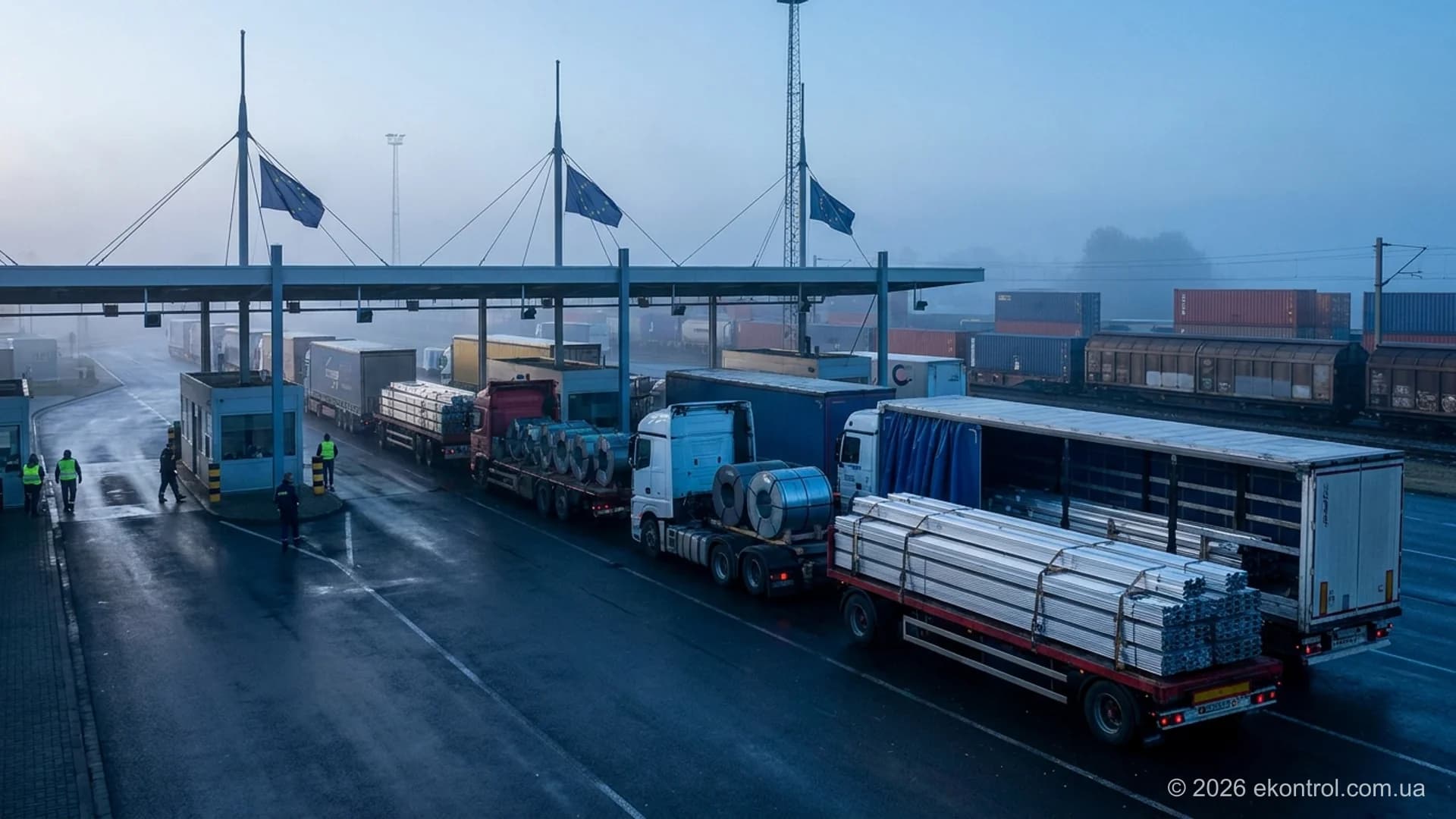

RED III and the Union Database in 2026: New EU Market-Access Rules for Agri-Feedstock and Biofuels
RED III and the Union Database have turned Ukrainian and Eastern European exports of rapeseed, corn, soybeans, crude vegetable oils, Used Cooking Oil (UCO), FAME biodiesel, bioethanol, and biomethane into a fully digital clearing process in 2026. A few years ago, an elevator or trader could issue a PDF Sustainability Declaration (SD) and email it to the European buyer days after the train or vessel crossed the border. Today, a standalone PDF without a matching, accepted transaction inside the European Commission's Union Database (UDB) carries zero legal value for EU renewable energy targets.
The commercial consequence is immediate. If a consignment isn't logged and accepted in the UDB through an active economic operator profile, it loses its sustainable status under Directive (EU) 2023/2413. Your European buyer can't count that volume toward national transport decarbonization mandates such as Germany's THG-Quote (38. BImSchV), the Netherlands' HBE/ERE registry, or France's TIRUERT quota system. In practice, that means your cargo either gets rejected at discharge or gets downgraded to conventional feed or technical grade at a price discount ranging from EUR 25 to EUR 90 per metric ton.
Regulatory Linkage Between Directive (EU) 2023/2413 and Implementing Regulation (EU) 2022/996
Two pieces of EU legislation lock this mechanism together. First, Directive (EU) 2023/2413 (RED III), which entered into force on 20 November 2023 with a primary member-state transposition deadline of 20 May 2025, requires all liquid and gaseous renewable fuels and their raw materials to be tracked end to end through the Union Database under Article 31a. Second, Commission Implementing Regulation (EU) 2022/996 establishes strict auditing, accreditation, and mass-balance rules for European Commission-recognized voluntary schemes, led by ISCC EU alongside REDcert, KZR INiG, and 2BSvs.
The Union Database doesn't certify companies on its own. It operates as a central clearinghouse that pulls master data exclusively from recognized voluntary schemes such as ISCC System. Every night, the scheme hub synchronizes your certificate status, certified operational roles, and physical storage sites with the UDB registry. If your certificate expires for even twenty-four hours, or if you ship grain from a leased port silo that wasn't listed on your certificate annex, the UDB blocks you from generating an outbound transaction.
Why European Buyers Block Unlinked Consignments at Ports and Border Terminals
In 2026, compliance desks at European oilseed crushers, biofuel refineries across the Amsterdam-Rotterdam-Antwerp (ARA) hub, and biomethane off-takers tie invoice settlement directly to UDB clearing. When a coaster or panamax vessel loaded with Ukrainian rapeseed arrives in Constanta, Gdansk, Brake, or Ghent, or when rail tank cars carrying crude sunflower oil cross the Polish or Slovak border, the buyer's trade execution team verifies three data points before releasing payment: an active sender certificate on the exact dispatch date, a pending inbound UDB transaction notification, and a 100% match on net metric weight and CN/TARIC customs codes. Any mismatch freezes final settlement until the upstream chain corrects the UDB record.
RED III Mandates, the 80% GHG Emission-Saving Threshold, and Batch Carbon Footprint Accounting
RED III reshaped the quota mathematics of the European bioenergy market. The binding EU-wide target for renewable energy in gross final energy consumption by 2030 jumped from 32% under RED II to 42.5%, paired with an indicative 2.5% top-up to reach 45%. In the transport sector, Article 25 of RED III gives member states two binding 2030 benchmark options: achieve at least a 29% renewable energy share in transport final energy consumption, or deliver at least a 14.5% reduction in transport fuel greenhouse gas (GHG) intensity.
At the same time, conventional first-generation biofuels produced from food and feed crops (rapeseed, corn, soybeans, sunflower seed, wheat) remain capped at a maximum of 7% of transport energy consumption and no more than 1 percentage point above a member state's 2020 share. Meanwhile, advanced biofuels derived from Annex IX Part A feedstocks (straw, sunflower husks, corn cobs, animal manure, sewage sludge, POME, tall oil pitch) combined with renewable fuels of non-biological origin (RFNBOs) face a binding 5.5% minimum mandate by 2030 (including at least 1% RFNBOs). Because food-crop volume is capped while GHG reduction mandates keep rising, European crushers and fuel blenders prioritize Ukrainian batches that carry low actual lifecycle carbon intensity.
The ISCC EU 205 Lifecycle GHG Formula From Field to Fuel
Under system standard ISCC EU 205 (Greenhouse Gas Emissions) and Article 29(10) of RED III, every batch of feedstock, intermediate oil, or finished biofuel moves through the supply chain with a documented GHG emission figure. The complete lifecycle formula is expressed as:
$$E = e_{ec} + e_l + e_p + e_{td} + e_u - e_{sca} - e_{ccs} - e_{ccr}$$
Each variable in this equation represents a physical emission stream that auditors test against primary accounting records:
- $e_{ec}$ (extraction or cultivation of raw materials): emissions from synthetic nitrogen, phosphorus, and potassium fertilizers, soil nitrous oxide ($\text{N}2\text{O}$) field emissions, agricultural diesel burned during tillage and harvesting, seeds, crop protection products, and on-farm grain drying energy. For wastes and processing residues (UCO, animal fats, manure, husks) at their Point of Origin, $e{ec}$ is set to zero.
- $e_l$ (annualized emissions from carbon stock changes caused by land-use change): calculated if land status changed after the 1 January 2008 cut-off date, subject to the strict ban on converting high-carbon-stock or high-biodiversity land under
ISCC EU 202. - $e_p$ (processing): emissions generated at grain elevators during drying and cleaning (if not already captured in $e_{ec}$), at oilseed crushing plants (hexane extraction, steam boilers fired by natural gas or biomass, grid electricity), and at esterification, fermentation, or biogas upgrading plants.
- $e_{td}$ (transport and distribution): emissions from hauling grain or liquids via road trucks, rail hoppers or tank cars, river barges, and ocean vessels, accounting for loaded and empty return distances and fuel consumption.
- $e_u$ (emissions from the fuel in use): taken as zero for biogenic $\text{CO}_2$ in biofuels and bioliquids.
- $e_{sca}, e_{ccs}, e_{ccr}$ (emission credits): verified deductions for soil carbon accumulation via improved agricultural management ($e_{sca}$), carbon capture and geological storage ($e_{ccs}$), and carbon capture and replacement ($e_{ccr}$).
The finished fuel's total emission intensity $E$ (expressed in $\text{gCO}_2\text{eq/MJ}$) is measured against the Fossil Fuel Comparator ($E_F$). Under RED III, $E_F$ equals $94\text{ gCO}_2\text{eq/MJ}$ for transport biofuels ($183\text{ gCO}_2\text{eq/MJ}$ for electricity generation and $80\text{ gCO}_2\text{eq/MJ}$ for useful heat). Percentage GHG savings are calculated as $(E_F - E) / E_F \times 100%$.
For transport biofuels and biogas, minimum statutory GHG savings are 50% for installations operating on or before 5 October 2015, 60% for installations starting between 6 October 2015 and 31 December 2020, and 65% for installations starting from 1 January 2021 onward. For electricity, heating, and cooling installations running on biomass or biomethane fuels under RED III Article 29(10), the required saving threshold rose from 70% (through 31 December 2025) to 80% starting 1 January 2026. Even more importantly, commercial buyers in Germany's GHG-quota market pay a direct premium per metric ton of $\text{CO}_2\text{eq}$ saved, frequently demanding 75% to 85% total savings. Ukrainian suppliers can rarely hit those commercial numbers using conservative Default Values alone; they need actual calculation models grounded in GHG Protocol accounting rules and FAO agronomic emission factors.
Energy Allocation Between Crude Vegetable Oil (ISCC EU) and Protein Meal (GMP+)
When a Ukrainian oilseed crushing plant processes rapeseed or sunflower seed, one input stream splits into two commercial outputs: crude vegetable oil (destined for biodiesel or HVO under ISCC EU and logged in the UDB) and protein-rich oilseed meal or cake (exported into European compound feed chains under GMP+ feed safety certification). Under ISCC EU 205, splitting emissions between oil and meal by weight or economic value is prohibited. Crushers must apply energy allocation based on the Lower Heating Value (LHV) of dry matter. Because crude vegetable oil has an energy content of roughly $37\text{ MJ/kg}$ compared to $17-18\text{ MJ/kg}$ for defatted meal, a much higher proportion of upstream cultivation ($e_{ec}$) and crushing ($e_p$) emissions attaches to every ton of crude oil in the UDB. Using mass allocation instead of LHV energy allocation in a plant's calculation sheet invalidates every outbound Sustainability Declaration issued from that run.
Union Database Onboarding: Operational Roles for First Gathering Points, Traders with Storage, Crushers, and Biomethane Plants
Onboarding onto the Union Database starts inside your voluntary scheme portal, not on the European Commission website. An operator first registers in the ISCC System client portal (ISCC Hub), where each legal entity, operational scope, and physical storage or processing facility receives a unique system ID. Once the certification body issues the certificate and uploads the audit report to ISCC, the hub pushes your master data through an automated data bridge to the UDB.
Next, your appointed UDB Administrator sets up an EU Login account with two-factor authentication, validates the company's legal identity using its National Trade Register (NTR / EDRPOU code for Ukrainian entities or EORI/VAT number for EU trading subsidiaries), and verifies all linked physical facilities. The single biggest onboarding mistake we fix in the field is when a trading group registers only its head office in Kyiv, Warsaw, or Geneva while omitting the inland grain elevators, port terminals, and tank farms where physical cargo is actually weighed and loaded.
Five-Step Technical Onboarding Sequence from ISCC Hub to Active UDB Status
To complete onboarding without getting stuck in pending validation loops, engineering and compliance teams follow five sequential steps:
- Synchronize ISCC Hub scope and site annexes: check that your active ISCC EU certificate explicitly lists the right scope codes (
FGP,CP,Trader with Storage,Processing Unit) and includes exact street addresses and GPS coordinates for every owned and leased Dependent Warehouse. - Register the Economic Operator in the UDB web portal: sign in via EU Login, enter your NTR identifier, upload corporate registration extracts, and confirm the automated link to your scheme certificate number.
- Configure physical sites and storage units: verify that every elevator, tank farm, or plant listed on your certificate annex appears as an active site inside your UDB profile. Each site maintains its own independent mass-balance ledger.
- Enter auditor-verified Initial Stock: before logging your first outbound sale, input your opening certified inventory by CN code, batch reference, country of origin, and GHG value as verified at your most recent audit.
- Select your transaction reporting channel: operators handling fewer than 15 to 20 shipments per month usually work directly in the UDB web interface or upload structured CSV/XML batch files. High-volume grain traders, multi-elevator holdings, and crushers connect their ERP and weighbridge software directly to the UDB via the system-to-system API gateway.
Role-Specific UDB Responsibilities Across the Ukrainian Export Chain
What you enter into the Union Database depends entirely on your certified role in the physical chain:
- First Gathering Point (FGP, inland elevator or agro-holding): buys rapeseed, corn, soybeans, or sunflower seed directly from farms (Points of Origin). The FGP carries the heaviest data-entry workload in the UDB: it must register every supplying farm, verify signed farmer Self-Declarations prior to intake, upload field polygons or GPS coordinates, and create the initial certified raw-material batch in the database.
- Trader with Storage (inland or port terminal trader): buys material that is already certified from FGPs or upstream traders, stores it in owned or leased silos or liquid tank farms, and exports to EU buyers. A Trader with Storage accepts inbound UDB transactions, manages site-by-site mass balance ledgers, adds inland or maritime transport emissions ($e_{td}$), and issues outbound SDs matched to export customs declarations.
- Oilseed Crusher / Processing Unit (extraction plant, biodiesel or bioethanol refinery): accepts certified seed or grain in the UDB, executes a conversion step (transformation) in the database, applies its verified conversion factor ($CF$), adds processing emissions ($e_p$), performs LHV energy allocation between main products and co-products, and registers the newly created product under its corresponding CN code (such as crude rapeseed oil
CN 1514 11 10or FAMECN 3826 00 10). - Biomethane Producer (anaerobic digestion and biogas upgrading plant): gaseous fuels have been subject to UDB tracking since the 21 November 2024 cut-off, with full enforcement across member-state registries in 2026. A biomethane producer logs incoming agricultural residues, manure, silage, or food waste from Points of Origin, records upgraded biomethane injected into the gas transmission grid or liquefied as Bio-LNG, and links outbound UDB Sustainability Declarations (in MWh or MJ) with national Guarantees of Origin (GoO) and periodic customs declarations.
ISCC EU 203 Three-Month Mass Balance Rules and Material Accounting in the Union Database
The operational backbone of ISCC EU and the Union Database lives in system document ISCC EU 203 (Traceability and Chain of Custody). Unlike physical segregation (which requires keeping certified grain in dedicated silos completely isolated from conventional grain), mass balance permits physically commingling certified and non-certified batches, or certified batches with different GHG figures, inside the same silo or storage tank. However, your digital and accounting records for each physical site must balance to the kilogram.
Four non-negotiable ISCC EU 203 mass-balance rules are now enforced automatically by UDB validation logic:
- Strict site-specific ledgers: mass balance is maintained individually for each physical site (each elevator, port terminal, or processing plant). Transferring virtual sustainability credits between an elevator in Vinnytsia and an elevator in Poltava without physically shipping the grain between those two sites is strictly prohibited and triggers an immediate Major Non-Conformity.
- Maximum three-month (90-day) balancing period: every mass-balance cycle lasts a maximum of three calendar months. You can close periods monthly if you prefer, but at the close of every 90-day window, total certified outputs (adjusted for conversion factors and physical processing losses) cannot exceed total certified inputs.
- Zero negative balance at period close: while temporary bookkeeping deficits within an active balancing window are tightly restricted and require physical stock on site, ending a three-month balancing period with a negative mass balance (selling more certified tonnage than you received) is a critical breach of RED III rules.
- Credit carry-over capped by physical inventory: at the end of a three-month balancing period, you may carry forward unused sustainability credit into the next period only up to the amount of equivalent physical stock (certified plus conventional combined) physically sitting in that site's silos or tanks on the closing date. If your ledger shows 5,000 tons of certified corn credit on paper, but physical silo measurements show only 3,200 tons of corn on site, 1,800 tons of virtual credit are permanently wiped out.
Accounting for Drying Shrinkage, Cleaning Dockage, and Conversion Factors via ISO/IEC 17025 Laboratories
The most common numerical mismatch between an elevator's ERP and the Union Database comes from post-harvest drying and cleaning losses. Suppose a First Gathering Point receives 1,000 metric tons of wet rapeseed from farms at 12% moisture and 4% foreign matter, and after drying and screening obtains 920 metric tons of export-grade rapeseed at 7% moisture and 1.5% dockage. Those 80 tons of moisture evaporation and non-usable screenings must be deducted from the certified mass-balance ledger. If the operator attempts to issue an outbound UDB declaration for the full 1,000 tons, the customs and bill-of-lading reconciliation will flag an 80-ton phantom balance.
To make these adjustments defensible during an audit, moisture, oil content, free fatty acids (FFA), and impurity measurements must come from test reports issued by laboratories accredited under ISO/IEC 17025 by the National Accreditation Agency of Ukraine (NAAU) or an equivalent ILAC-MRA body. When every elevator conditioning act is backed by calibrated weighbridge tickets and accredited laboratory protocols, the UDB administrator applies the exact conversion factor ($CF = \text{Output} / \text{Input}$) in the database, keeping digital stock aligned with physical silo soundings.
Mixing Batches with Different GHG Intensities Inside the UDB
In daily elevator operations, a single silo often receives both batches carrying regional NUTS2 (or Ukrainian national) Default Values and batches carrying actual farm-specific GHG calculations. Under ISCC EU 203 and ISCC EU 205, you cannot average GHG emission values across commingled batches if you want to preserve the lower GHG figure on part of the volume. Instead, you track each GHG cohort as a separate sub-entry in your mass-balance ledger and withdraw the corresponding tonnage with its original GHG attribute upon dispatch. If you choose to merge multiple certified batches with different GHG values into one single consolidated batch record inside the UDB, the system automatically assigns the highest (worst) GHG emission intensity among all merged inputs to the entire combined tonnage. Knowing this rule protects your low-carbon price premium: never merge a low-emission batch ($18\text{ gCO}_2\text{eq/MJ}$) with a high-emission default batch ($31\text{ gCO}_2\text{eq/MJ}$) into a single UDB line item.
Critical Three-Month Period Close Rule under ISCC EU 203 and UDB
If your physical stock in an elevator or storage tank drops to zero metric tons at the end of a three-month mass-balance period (for example, during end-of-season silo cleanouts), any remaining virtual sustainability credits in the Union Database expire immediately. Carrying over paper sustainability credits into a new quarter without matching physical product on the exact same site is strictly forbidden.
| Certified Role in ISCC EU | Inbound Evidence Required for UDB | Mass-Balance Operations (ISCC EU 203) | Key Outbound UDB Transaction Fields | Primary Audit Failure Risk |
|---|---|---|---|---|
| First Gathering Point (FGP, grain elevator / agro-holding) | Signed farmer Self-Declaration, field polygons/GPS coordinates, weighbridge tickets, laboratory moisture reports | Intake from farms, deduction of drying shrinkage and cleaning dockage, 3-month site-specific balance closure | Crop type, CN code, net weight, country of origin (UA), land-use compliance, GHG (default or actual $e_{ec}$) | Missing field polygons or farmer Self-Declarations signed after the first physical grain delivery date |
| Collecting Point (CP, waste and residue collector) | Signed Point of Origin Self-Declaration, collection contracts, weigh tickets for UCO, soapstock, or animal fats | Verification of plausible waste generation limits per supplier, deduction of water and sediment filtration losses | Annex IX waste category, CN 1518 code, net weight, $e_{ec} = 0$, collection transport emissions $e_{td}$ | Suspected adulteration of UCO with virgin vegetable oil or volumes exceeding restaurant/plant capacity |
| Trader with Storage (inland or port terminal trader) | Inbound electronic SD in UDB from certified FGP or trader, bills of lading, warehouse receipts | Acceptance of inbound UDB transactions, separate ledger per port or inland terminal, physical stock reconciliation | Pass-through of upstream sustainability attributes, addition of transport leg $e_{td}$, link to customs declaration | Dispatching cargo from a leased port silo not listed on the certificate annex or UDB site profile |
| Oilseed Crusher / Processing Unit (extraction plant) | Inbound UDB SDs for rapeseed, soybeans, or sunflower seed, daily pressing and solvent extraction production logs | Raw material transformation step, application of actual oil yield conversion factor ($CF$), LHV energy allocation | New product code (crude oil CN 1514/1512), cumulative GHG $e_{ec} + e_p + e_{td}$ in $\text{kgCO}_2\text{eq/t}$ | Applying mass or financial allocation instead of LHV energy allocation between crude oil (ISCC EU) and meal (GMP+) |
| Biodiesel, Bioethanol, or Biomethane Producer | Inbound UDB SDs for vegetable oil, grain, or agricultural waste/manure, flowmeter logs, fuel quality certificates | Conversion of feedstock into final fuel, mass-to-energy conversion (MJ or MWh), reconciliation with national GoO | Final fuel (CN 3826, 2207, 2711), full lifecycle GHG $E$, percentage GHG saving vs $94\text{ gCO}_2\text{eq/MJ}$ | Failing the 65-80% GHG saving threshold due to high fossil steam boiler or grid electricity emissions ($e_p$) |
Reconciling Sustainability Declarations (SDs) with Customs CN/TARIC Codes and Shipping Documents
When sustainability declarations were exchanged on paper, operators frequently typed generic product descriptions like "Rapeseed" or "Crude Vegetable Oil", and minor discrepancies with customs paperwork rarely surfaced until the annual surveillance audit. Inside the Union Database, every material category is hard-coded to the European Union's Combined Nomenclature (8-digit CN code) and 10-digit TARIC classification (which aligns with Ukrainian UKTZED customs codes at the 6-to-8-digit heading level).
If your customs broker files an export declaration (EX-1 / MD-2) under one tariff subheading while your sustainability coordinator logs the transaction in the UDB under a neighboring subheading, the automated customs-to-UDB cross-check on the European buyer's side flags a mismatch. This happens frequently with technical-grade vs food-grade crude vegetable oils, oil-refining residues (soapstock, acid oils, fatty acid distillates), and denatured vs undenatured bioethanol.
Managing Weight Tolerances, Moisture Recalculations, and Split-Lot Shipments
A second engineering checkpoint involves net weight reconciliation. The Union Database records batch mass in metric tons to two or three decimal places. When an inland elevator loads a block train of 54 hopper cars or a port terminal loads a river barge in Izmail or a bulk carrier in Chornomorsk, operational teams routinely face two discrepancies: the difference between loading weight and discharge outturn weight, and the difference between actual physical weight and commercial accounting weight adjusted to standard basis moisture.
The core UDB reconciliation rule is straightforward: the net weight entered on the outbound Sustainability Declaration must match the actual physical net weight stated on the transport document (CMR road consignment note, CIM/SMGS rail waybill, or maritime Bill of Lading) and the export customs declaration. When minor transit loss occurs during ocean or barge transport within normal charter-party tolerances (typically 0.2% to 0.5%), the buyer logs the actual outturn weight verified by the independent surveyor upon accepting the UDB transaction. However, if the seller mistakenly inputs commercial "dry-basis" accounting weight into the UDB instead of actual physical Bill of Lading weight, the resulting 1.5% to 3.0% gap exceeds tolerance and forces transaction cancellation and re-issuance.
The 72-Hour UDB Transaction Lifecycle from Dispatch to Buyer Acceptance
Under ISCC EU 203 and UDB operating procedures, an outbound Sustainability Declaration must be generated and transmitted in the database no later than the physical dispatch date, or within the narrow operational window before the buyer takes delivery. Across European grain and biofuel trade contracts, buyers now enforce a strict 72-hour clause: the seller must initiate the UDB transaction within 72 hours of the Bill of Lading date or customs clearance.
Each UDB transaction moves through four states: (1) the seller selects the certified input batch from its site mass-balance ledger and drafts the outbound transaction; (2) the UDB validates that sufficient certified volume exists under that exact CN code and confirms both parties hold valid certificates on the dispatch date; (3) the seller submits the transaction, which locks that volume in the seller's ledger; and (4) the buyer receives an inbox alert in the UDB portal, checks the CN code, net weight, country of origin, land-use status, and GHG numbers against shipping documents, and clicks Accept (or Reject with a correction note). Until the buyer clicks Accept, the compliance chain remains open.
| Feedstock or Fuel Product | CN / TARIC Code (UKTZED) | ISCC EU & UDB Material Category | Typical Conversion Factor (CF) & GHG Unit | Customs & Laboratory Verification Checkpoint |
|---|---|---|---|---|
| Rapeseed / colza seed (winter and spring varieties) | CN 1205 10 90 / 1205 90 00 | Crop / Oilseed (Rapeseed / Colza) | Cleaning & drying: CF 0.94-0.98; GHG in $\text{kgCO}_2\text{eq/dry t}$ or $\text{t}$ | Match moisture (7-8% basis) and oil content via ISO/IEC 17025 lab report; verify farm polygon coordinates |
| Feed / industrial corn (maize) for bioethanol | CN 1005 90 00 | Crop / Cereal (Corn / Maize) | Drying from 20-24% to 14%: CF 0.86-0.92; GHG in $\text{kgCO}_2\text{eq/t}$ | Verify natural gas or biomass fuel burned in elevator dryers is included in $e_{ec}$ or $e_p$ |
| Crude rapeseed oil & crude sunflower oil (for technical/biofuel use) | CN 1514 11 10 / CN 1512 11 10 | Intermediate / Crude Vegetable Oil | Pressing + solvent extraction: CF 0.40-0.45 from seed; LHV energy-allocated GHG | Distinguish technical vs food-grade tariff codes on EX-1/MD-2; verify LHV energy allocation with GMP+ meal |
| Used Cooking Oil (UCO) | CN 1518 00 95 / 1518 00 99 | Waste / Residue (Annex IX Part B) | Settling & filtration: CF 0.95-0.99; $e_{ec} = 0$, only $e_p + e_{td}$ | Lab testing of FFA, iodine value, and fatty acid profile to rule out blending with virgin vegetable oil |
| FAME biodiesel (fatty acid methyl esters) | CN 3826 00 10 / 3826 00 90 | Final Fuel / Biodiesel (FAME) | Esterification of oil: CF 0.96-0.99; GHG in $\text{gCO}_2\text{eq/MJ}$ (vs 94 comparator) | EN 14214 quality certificate, mass-to-energy conversion (LHV $37\text{ MJ/kg}$), UDB acceptance prior to EU customs release |
| Bioethanol (undenatured and denatured) | CN 2207 10 00 / 2207 20 00 | Final Fuel / Bioethanol | Grain fermentation & distillation: CF 0.29-0.32; GHG in $\text{gCO}_2\text{eq/MJ}$ | Exact CN code match for denaturing status; energy allocation between ethanol and DDGS feed co-product |
| Biomethane (grid-injected gaseous or liquefied Bio-LNG) | CN 2711 21 00 / 2711 11 00 | Gaseous Renewable Fuel / Biomethane | Anaerobic digestion + biogas upgrading; tracked in MWh or MJ | Reconcile UDB energy volumes with Guarantees of Origin (GoO), gas metering acts, and periodic customs filings |
Preventing Double Counting, Blocked Shipments, and ISCC EU Certificate Suspension
The European Commission built the Union Database and Implementing Regulation (EU) 2022/996 to eliminate double counting and fraudulent feedstock relabeling across member borders. Before the UDB went live, a dishonest operator could theoretically sell a single physical cargo of rapeseed or UCO using two separate paper declarations under two different voluntary schemes (for example, issuing one declaration under ISCC EU and a second declaration on the same tonnage under REDcert or 2BSvs), or misdeclare virgin vegetable oil as an Annex IX residue to claim double quota credits.
Today, the UDB cross-checks unique batch numbers, transport document references, CN code volumes, and site mass-balance ceilings across all connected schemes and national biofuel registries (such as Germany's Nabisy, the Netherlands' REV, and France's CarbuRe). If an operator attempts to ship more volume than its three-month mass balance holds, or tries to reuse an already consumed inbound SD, the database blocks the entry and dispatches an automated compliance alert to the certification body.
Geolocation Polygons, Farmer Self-Declarations, and Annex IX Waste Origin Audits
For agricultural crops, the primary compliance barrier is ISCC EU 202 (Sustainability Requirements). Not a single metric ton of grain or oilseed qualifies as sustainable if it was harvested from land that held forest, peatland, wetland, or high-biodiversity grassland status after 1 January 2008. During an FGP audit, the auditor samples signed farmer Self-Declarations alongside field polygon files (KML, GeoJSON, or Shapefile boundaries) and verifies them against satellite remote-sensing databases.
For Annex IX wastes and residues (UCO, animal fats, manure, husks, soapstock), scrutiny centers on verifying Points of Origin. Under Regulation (EU) 2022/996, a Collecting Point must prove that collected volumes match the physical generation capacity of the source: if a small restaurant or food processor signs a declaration claiming 15 tons of UCO per month while purchasing only 2 tons of fresh frying oil, auditors classify the chain as high-risk for fraud and suspend certification.
Seven Operational Failure Modes That Freeze Batches in the UDB
Based on our field audits across 2025 and 2026, blocked UDB shipments and certificate suspensions almost always trace back to seven specific operational errors:
- Backdated farmer Self-Declarations: if a farmer delivers rapeseed to the elevator on 10 August but signs the ISCC Self-Declaration on 25 August, every ton delivered before 25 August is legally non-certified. The farmer's signature date must precede or match the first physical intake date.
- Unregistered Dependent Warehouses: a trader leases extra silo space in Reni, Izmail, or Chornomorsk during harvest peak and loads a barge without first adding that storage site to its certificate annex and UDB profile.
- One-day certificate gap on dispatch date: an ISCC EU certificate is valid for exactly 12 months. If recertification is delayed and a 24-hour gap opens between the old and new certificates, any cargo dispatched on that gap day permanently loses its sustainable status.
- Ignoring drying shrinkage in UDB stock: accounting writes off moisture loss using commercial formulas while the UDB administrator leaves the raw wet intake weight untouched in the database.
- Unverified weighbridges and non-accredited lab data: failing to back up moisture, oil content, and dockage deductions with calibrated scale certificates and test protocols from an ISO/IEC 17025 accredited laboratory.
- Missing the 40-day corrective action window: under
ISCC EU 201 (System Basics), every non-conformity raised at an audit must be closed with verified root-cause evidence within 40 calendar days. Missing that deadline results in refusal of recertification or immediate suspension published on the ISCC System suspended-certificates list. - Holding a paper certificate with an empty UDB ledger: operating as an active exporter while failing to log inbound and outbound transactions in the Union Database is treated at surveillance and recertification audits as a direct breach of RED III Article 31a.
Mandatory Counterparty Certificate Check Before Every Dispatch
Before loading any truck, rail car, barge, or vessel and creating a transaction in the Union Database, verify both your supplier's and your buyer's certificate status in the public ISCC or scheme registry on the exact date of physical dispatch. Certificates run for 12 months with no automatic grace period, and logging a transaction with an Expired or Suspended counterparty locks the batch.
Comparing ISCC EU, REDcert-EU, KZR INiG, and 2BSvs: Mutual Recognition and UDB Integration
To demonstrate compliance with RED III sustainability and GHG criteria, the European Commission officially recognizes several voluntary certification schemes. For Ukrainian and Eastern European grain traders, elevators, oilseed crushers, and biofuel producers, four schemes dominate commercial contracts: ISCC EU, REDcert EU, the Polish KZR INiG system, and the French 2BSvs scheme. While all four satisfy Article 29 of RED III and connect to the Union Database, their commercial reach, fee models, and regional buyer preferences differ sharply.
Article 30(9) of RED III enforces mutual recognition among all EC-recognized voluntary schemes within their approved recognition scopes (agricultural biomass, forest biomass, wastes and residues, and actual GHG calculations). In legal terms, an oilseed crusher or refinery certified under ISCC EU can accept into its mass balance and UDB account a consignment of rapeseed, corn, or UCO supplied by an elevator certified under REDcert EU, KZR INiG, or 2BSvs.
Multi-Scheme Certification Strategies for Land Corridors and Deep-Sea Ports
Despite legal mutual recognition under RED III, commercial procurement teams often write scheme-specific requirements into tenders. When a Ukrainian exporter ships rapeseed, corn, or bioethanol by rail or truck directly to Polish or Baltic crushers and fuel blenders (such as Orlen Południe or Bunge Poland), local buyers frequently request KZR INiG because their domestic Polish supply chains run on KZR templates and benefit from KZR's fee structure without per-ton scheme quantity fees across many operations. Conversely, when cargo moves by Danube barge or rail into Germany and Austria, German oil mills and biogas/biomethane plants often favor REDcert EU.
However, for deep-sea coasters, handysize, and panamax vessels loading out of Greater Odesa ports or Constanta for discharge in Rotterdam, Amsterdam, Antwerp, Ghent, Italy, or Spain, as well as for contracts with global ABCD trading houses, ISCC EU remains the universal benchmark. Furthermore, if a processing plant also sells technical vegetable oils, glycerine, or bio-attributed chemical feedstocks outside the biofuel sector, only ISCC allows combining an ISCC EU audit with an ISCC PLUS audit during the same auditor visit.
Operational Rules for Accepting Cross-Scheme Batches in the UDB
When an ISCC EU certified operator purchases feedstock certified under KZR INiG, REDcert EU, or 2BSvs, its compliance team must complete three verification steps before accepting the cargo:
- check the supplier's certificate validity and scope on the exact dispatch date in that specific scheme's public registry (REDcert, KZR INiG, or 2BS website) rather than only in the ISCC database;
- verify that the European Commission's recognition decision for that scheme covers the exact material category being traded (especially critical for specialized Annex IX waste streams and gaseous fuels);
- confirm that the upstream supplier initiates the outbound transaction in the Union Database so the cross-scheme transfer clears digitally inside the central UDB ledger.
| Comparison Parameter | ISCC EU | REDcert-EU | KZR INiG | 2BSvs |
|---|---|---|---|---|
| Scheme Owner & Headquarters | ISCC System GmbH (Cologne, Germany) | REDcert GmbH (Bonn, Germany) | Oil and Gas Institute INiG-PIB (Krakow, Poland) | 2BS Association Consortium (Paris, France) |
| EC Recognition under RED III & UDB Link | Full EC recognition; automated sync between ISCC Hub and UDB | Full EC recognition; direct database synchronization with UDB | Full EC recognition; certified operator registry synced with UDB | Full EC recognition; certified operators connected to UDB |
| Primary Export Corridors for Ukrainian Suppliers | All EU member states, deep-sea ports (ARA, Italy, Spain, Germany), global trading houses | Germany, Austria (DACH region), German oilseed crushers and biogas/biomethane plants | Poland, Baltic states, Czechia, Slovakia, overland rail and road corridors | France, Belgium, Southern Europe, French agricultural cooperatives |
| Material Scope Coverage (Crops, Annex IX Waste, Biomethane) | Broadest scope: all crops, full Annex IX Part A/B wastes, biomethane, RFNBOs | Strong focus on agricultural crops, biogas/biomethane substrates, and major waste streams | Grains, oilseeds, vegetable oils, UCO, technical fats, agricultural and forest biomass | Primarily grains, oilseeds, vegetable oils, and standard agricultural crop residues |
| Scheme Fee Structure (excluding certification body audit fees) | Annual registration fee plus per-ton quantity fee on certified transaction volumes | Fixed certificate fee plus tiered system fees based on operator role and size | No standard per-ton scheme quantity fees across many roles; registration and audit fees apply | Fixed annual membership/scheme fee scaled by company turnover and operational role |
| Best Fit Among Ukrainian Exporters | Maritime and Danube traders, large agro-holdings, crushers, biodiesel/bioethanol/biomethane plants | Rapeseed, corn, silage, and biomethane exporters holding direct German supply contracts | Traders, inland elevators, and UCO/oil suppliers shipping overland into Poland and Central Europe | Grain and oilseed traders executing direct contracts with French crushing and biofuel groups |
Engineering Roadmap to Prepare an Elevator, Trader, or Processor for ISCC EU and UDB Audits
Trying to pass an ISCC EU audit by downloading generic procedure templates two weeks before the auditor arrives is a recipe for suspended shipments. In 2026, auditors test live ERP batch traceability, verify farm polygon coordinates against satellite imagery, and inspect how your administrator reconciles CN/TARIC codes inside the Union Database. A reliable implementation follows six structured engineering stages.
Stage 1. Scope Definition and Supply-Chain Diagnostics (Weeks 1-2). Start with a structured diagnostic audit to map every legal entity and physical site in your group: which entities act as a First Gathering Point, which operate as a Trader with Storage, and which third-party inland elevators or port silos must be covered as Dependent Warehouses. At this stage, align your target CN/TARIC product codes and check interfaces with existing standards such as GMP+ for feed meals.
Stage 2. Farmer and Point-of-Origin Onboarding Campaign (Weeks 2-5). For an FGP, supplier onboarding is the critical path. Collect signed Self-Declarations from every farm whose grain will enter the certified pool, extract field polygons (KML, Shapefile, or GPS coordinates), screen all plots against post-2008 deforestation or peatland conversion under ISCC EU 202, and gather primary agronomic data (nitrogen fertilizer rates, diesel fuel per hectare, seed rates, yield, and drying energy) if you plan to calculate actual $e_{ec}$ emissions.
Stage 3. ISCC EU 203 Mass-Balance Architecture and Laboratory Integration (Weeks 4-7). During system implementation, configure site-specific mass-balance ledgers locked to three-month balancing windows for every elevator, terminal, and processing plant. Define exact formulas for drying shrinkage, cleaning dockage, and processing conversion factors ($CF$), and connect batch quality records to test reports from an ISO/IEC 17025 accredited laboratory.
Stage 4. Actual Lifecycle GHG Calculation under ISCC EU 205 (Weeks 5-8). Environmental engineers build the lifecycle GHG model ($e_{ec}, e_p, e_{td}$) using current ISCC, GHG Protocol, and FAO emission factors, incorporating LHV energy allocation for oilseed crushers and ethanol plants. The calculation workbook is stress-tested against the 65% to 80% GHG saving thresholds required by EU buyers.
Stage 5. ISCC Hub Registration, UDB Profile Setup, and Mock Traceability Test (Weeks 7-9). Sign the audit agreement with an EC-recognized certification body, register in the ISCC Hub, prepare site and initial-stock templates for UDB synchronization, and run a full internal traceability test: trace a real batch from farm weighbridge ticket through silo conditioning to export customs declaration.
Stage 6. Certification Audit and Live UDB Transaction Governance (Weeks 9-10). With hands-on certification audit support, complete the external audit, close any findings within the mandatory 40-day window, activate the synchronized UDB profile, and enforce the 72-hour outbound transaction SOP across your logistics and customs teams.
Pre-Audit Verification Checklist for UDB Administrators and Quality Managers
Before the external auditor opens the opening meeting, verify six operational checkpoints where first-year applicants most often stumble:
- Every storage contract with leased inland elevators and port terminals includes an explicit clause granting physical access to ISCC/REDcert/KZR auditors and mandating segregated batch accounting.
- Not a single farmer Self-Declaration bears a signature date later than the first physical weighbridge delivery ticket from that farm in the current harvest year.
- Conversion factors ($CF$) in the mass-balance ledger derive from actual production logs and laboratory moisture/impurity records over the past 12 months rather than theoretical textbook numbers.
- Weighbridge operators, elevator managers, accountants, and export logistics coordinators have completed practical walkthroughs and can demonstrate live batch tracking in the ERP without prompting.
- Primary and backup Union Database Administrators are formally appointed, hold active EU Login credentials, and follow a written SOP for matching CN/TARIC codes to customs declarations.
- Automated calendar alerts are set 60 days prior to the 12-month expiry date of your own certificate and the certificates of all certified suppliers.
Project Timeline and Cost Drivers for Single-Site vs Multi-Elevator Holdings
For a trading company or a single inland elevator onboarding up to 30 supplying farms, the complete cycle from diagnostic gap analysis to ISCC EU 203 mass-balance launch and UDB readiness takes 6 to 9 weeks. For a vertically integrated agro-holding operating 5 to 10 elevators, hundreds of supplying farms, an oilseed crushing or biofuel plant, and port transshipment facilities, full implementation requires 10 to 14 weeks. Always anchor your project kick-off 2.5 to 3 months ahead of harvest intake rather than waiting until the first export vessel is nominated.
Operational Payoff of Linking Mass Balance and UDB with Laboratory Protocols
Exporters that link their ISCC EU 203 mass-balance ledger directly to ISO/IEC 17025 laboratory test protocols and carry a single batch ID across weighbridge tickets, warehouse receipts, commercial invoices, and customs declarations cut Union Database transaction clearing time to 20-30 minutes per shipment and pass annual recertification audits with zero major non-conformities.
How Ekontrol Engineers Configure ISCC EU, Mass Balance Ledgers, and Union Database Workflows
At Ekontrol (Еконтроль), we deliver sustainability certification and Union Database integration for grain elevators, international traders, oilseed crushers, UCO collectors, and biodiesel, bioethanol, and biomethane producers as a structured engineering project. Instead of handing over generic translated manuals, our consultants build RED III and UDB controls directly into your ERP, weighbridge, and customs workflows:
- Readiness diagnostics and scheme selection: we conduct a comprehensive diagnostic audit of your trade corridors and buyer contracts to determine whether standalone ISCC EU is optimal or whether you should combine it with KZR INiG for Polish overland routes, REDcert for German buyers, or 2BSvs for French cooperatives.
- Mass-balance engineering and actual GHG modeling: we execute full system implementation, building automated
ISCC EU 203three-month mass-balance ledgers, customISCC EU 205lifecycle GHG calculators ($e_{ec}, e_p, e_{td}$), and compliant LHV energy allocation models synchronized with GMP+ feed safety systems. - Laboratory and metrological alignment: we align moisture, oil content, dockage, and fuel quality testing workflows with ISO/IEC 17025 requirements across in-house and contracted laboratories.
- Turnkey Union Database onboarding: we configure and synchronize your ISCC Hub and UDB profiles, map CN/TARIC codes, verify opening stock balances, and train your administrators to execute transformations and resolve border weight discrepancies.
- End-to-end audit representation: we provide hands-on certification audit support during Stage 1 and Stage 2 external audits with accredited certification bodies until your certificate is active in the public registry.
Regulatory Framework and Verified Primary Sources
This engineering briefing and its compliance matrices are based on current European Union sustainability regulations and verified international methodological standards:
- ISCC System GmbH: official ISCC EU System Documents (ISCC EU 201, 202, 203, 204, 205) and Union Database (UDB) technical implementation updates
- Greenhouse Gas Protocol: Corporate Accounting and Reporting Standard and value-chain emission calculation methodologies
- Food and Agriculture Organization of the United Nations (FAO): agronomic emission factors, crop statistics, and land-use datasets
- National Accreditation Agency of Ukraine (NAAU): official registry of testing laboratories accredited to ISO/IEC 17025
Need a tailored implementation roadmap for ISCC EU certification and Union Database transaction management across your export chain? Visit the Ekontrol contact page to schedule a technical scoping session with our lead auditor.
Need a certification consultation?
Free ConsultationOn This Page
- RED III and the Union Database in 2026: New EU Market-Access Rules for Agri-Feedstock and Biofuels
- RED III Mandates, the 80% GHG Emission-Saving Threshold, and Batch Carbon Footprint Accounting
- Union Database Onboarding: Operational Roles for First Gathering Points, Traders with Storage, Crushers, and Biomethane Plants
- ISCC EU 203 Three-Month Mass Balance Rules and Material Accounting in the Union Database
- Reconciling Sustainability Declarations (SDs) with Customs CN/TARIC Codes and Shipping Documents
- Preventing Double Counting, Blocked Shipments, and ISCC EU Certificate Suspension
- Comparing ISCC EU, REDcert-EU, KZR INiG, and 2BSvs: Mutual Recognition and UDB Integration
- Engineering Roadmap to Prepare an Elevator, Trader, or Processor for ISCC EU and UDB Audits
- How Ekontrol Engineers Configure ISCC EU, Mass Balance Ledgers, and Union Database Workflows
- Regulatory Framework and Verified Primary Sources
RED III and the Union Database in 2026: New EU Market-Access Rules for Agri-Feedstock and Biofuels
RED III and the Union Database have turned Ukrainian and Eastern European exports of rapeseed, corn, soybeans, crude vegetable oils, Used Cooking Oil (UCO), FAME biodiesel, bioethanol, and biomethane into a fully digital clearing process in 2026. A few years ago, an elevator or trader could issue a PDF Sustainability Declaration (SD) and email it to the European buyer days after the train or vessel crossed the border. Today, a standalone PDF without a matching, accepted transaction inside the European Commission's Union Database (UDB) carries zero legal value for EU renewable energy targets.
The commercial consequence is immediate. If a consignment isn't logged and accepted in the UDB through an active economic operator profile, it loses its sustainable status under Directive (EU) 2023/2413. Your European buyer can't count that volume toward national transport decarbonization mandates such as Germany's THG-Quote (38. BImSchV), the Netherlands' HBE/ERE registry, or France's TIRUERT quota system. In practice, that means your cargo either gets rejected at discharge or gets downgraded to conventional feed or technical grade at a price discount ranging from EUR 25 to EUR 90 per metric ton.
Regulatory Linkage Between Directive (EU) 2023/2413 and Implementing Regulation (EU) 2022/996
Two pieces of EU legislation lock this mechanism together. First, Directive (EU) 2023/2413 (RED III), which entered into force on 20 November 2023 with a primary member-state transposition deadline of 20 May 2025, requires all liquid and gaseous renewable fuels and their raw materials to be tracked end to end through the Union Database under Article 31a. Second, Commission Implementing Regulation (EU) 2022/996 establishes strict auditing, accreditation, and mass-balance rules for European Commission-recognized voluntary schemes, led by ISCC EU alongside REDcert, KZR INiG, and 2BSvs.
The Union Database doesn't certify companies on its own. It operates as a central clearinghouse that pulls master data exclusively from recognized voluntary schemes such as ISCC System. Every night, the scheme hub synchronizes your certificate status, certified operational roles, and physical storage sites with the UDB registry. If your certificate expires for even twenty-four hours, or if you ship grain from a leased port silo that wasn't listed on your certificate annex, the UDB blocks you from generating an outbound transaction.
Why European Buyers Block Unlinked Consignments at Ports and Border Terminals
In 2026, compliance desks at European oilseed crushers, biofuel refineries across the Amsterdam-Rotterdam-Antwerp (ARA) hub, and biomethane off-takers tie invoice settlement directly to UDB clearing. When a coaster or panamax vessel loaded with Ukrainian rapeseed arrives in Constanta, Gdansk, Brake, or Ghent, or when rail tank cars carrying crude sunflower oil cross the Polish or Slovak border, the buyer's trade execution team verifies three data points before releasing payment: an active sender certificate on the exact dispatch date, a pending inbound UDB transaction notification, and a 100% match on net metric weight and CN/TARIC customs codes. Any mismatch freezes final settlement until the upstream chain corrects the UDB record.
RED III Mandates, the 80% GHG Emission-Saving Threshold, and Batch Carbon Footprint Accounting
RED III reshaped the quota mathematics of the European bioenergy market. The binding EU-wide target for renewable energy in gross final energy consumption by 2030 jumped from 32% under RED II to 42.5%, paired with an indicative 2.5% top-up to reach 45%. In the transport sector, Article 25 of RED III gives member states two binding 2030 benchmark options: achieve at least a 29% renewable energy share in transport final energy consumption, or deliver at least a 14.5% reduction in transport fuel greenhouse gas (GHG) intensity.
At the same time, conventional first-generation biofuels produced from food and feed crops (rapeseed, corn, soybeans, sunflower seed, wheat) remain capped at a maximum of 7% of transport energy consumption and no more than 1 percentage point above a member state's 2020 share. Meanwhile, advanced biofuels derived from Annex IX Part A feedstocks (straw, sunflower husks, corn cobs, animal manure, sewage sludge, POME, tall oil pitch) combined with renewable fuels of non-biological origin (RFNBOs) face a binding 5.5% minimum mandate by 2030 (including at least 1% RFNBOs). Because food-crop volume is capped while GHG reduction mandates keep rising, European crushers and fuel blenders prioritize Ukrainian batches that carry low actual lifecycle carbon intensity.
The ISCC EU 205 Lifecycle GHG Formula From Field to Fuel
Under system standard ISCC EU 205 (Greenhouse Gas Emissions) and Article 29(10) of RED III, every batch of feedstock, intermediate oil, or finished biofuel moves through the supply chain with a documented GHG emission figure. The complete lifecycle formula is expressed as:
$$E = e_{ec} + e_l + e_p + e_{td} + e_u - e_{sca} - e_{ccs} - e_{ccr}$$
Each variable in this equation represents a physical emission stream that auditors test against primary accounting records:
- $e_{ec}$ (extraction or cultivation of raw materials): emissions from synthetic nitrogen, phosphorus, and potassium fertilizers, soil nitrous oxide ($\text{N}2\text{O}$) field emissions, agricultural diesel burned during tillage and harvesting, seeds, crop protection products, and on-farm grain drying energy. For wastes and processing residues (UCO, animal fats, manure, husks) at their Point of Origin, $e{ec}$ is set to zero.
- $e_l$ (annualized emissions from carbon stock changes caused by land-use change): calculated if land status changed after the 1 January 2008 cut-off date, subject to the strict ban on converting high-carbon-stock or high-biodiversity land under
ISCC EU 202. - $e_p$ (processing): emissions generated at grain elevators during drying and cleaning (if not already captured in $e_{ec}$), at oilseed crushing plants (hexane extraction, steam boilers fired by natural gas or biomass, grid electricity), and at esterification, fermentation, or biogas upgrading plants.
- $e_{td}$ (transport and distribution): emissions from hauling grain or liquids via road trucks, rail hoppers or tank cars, river barges, and ocean vessels, accounting for loaded and empty return distances and fuel consumption.
- $e_u$ (emissions from the fuel in use): taken as zero for biogenic $\text{CO}_2$ in biofuels and bioliquids.
- $e_{sca}, e_{ccs}, e_{ccr}$ (emission credits): verified deductions for soil carbon accumulation via improved agricultural management ($e_{sca}$), carbon capture and geological storage ($e_{ccs}$), and carbon capture and replacement ($e_{ccr}$).
The finished fuel's total emission intensity $E$ (expressed in $\text{gCO}_2\text{eq/MJ}$) is measured against the Fossil Fuel Comparator ($E_F$). Under RED III, $E_F$ equals $94\text{ gCO}_2\text{eq/MJ}$ for transport biofuels ($183\text{ gCO}_2\text{eq/MJ}$ for electricity generation and $80\text{ gCO}_2\text{eq/MJ}$ for useful heat). Percentage GHG savings are calculated as $(E_F - E) / E_F \times 100%$.
For transport biofuels and biogas, minimum statutory GHG savings are 50% for installations operating on or before 5 October 2015, 60% for installations starting between 6 October 2015 and 31 December 2020, and 65% for installations starting from 1 January 2021 onward. For electricity, heating, and cooling installations running on biomass or biomethane fuels under RED III Article 29(10), the required saving threshold rose from 70% (through 31 December 2025) to 80% starting 1 January 2026. Even more importantly, commercial buyers in Germany's GHG-quota market pay a direct premium per metric ton of $\text{CO}_2\text{eq}$ saved, frequently demanding 75% to 85% total savings. Ukrainian suppliers can rarely hit those commercial numbers using conservative Default Values alone; they need actual calculation models grounded in GHG Protocol accounting rules and FAO agronomic emission factors.
Energy Allocation Between Crude Vegetable Oil (ISCC EU) and Protein Meal (GMP+)
When a Ukrainian oilseed crushing plant processes rapeseed or sunflower seed, one input stream splits into two commercial outputs: crude vegetable oil (destined for biodiesel or HVO under ISCC EU and logged in the UDB) and protein-rich oilseed meal or cake (exported into European compound feed chains under GMP+ feed safety certification). Under ISCC EU 205, splitting emissions between oil and meal by weight or economic value is prohibited. Crushers must apply energy allocation based on the Lower Heating Value (LHV) of dry matter. Because crude vegetable oil has an energy content of roughly $37\text{ MJ/kg}$ compared to $17-18\text{ MJ/kg}$ for defatted meal, a much higher proportion of upstream cultivation ($e_{ec}$) and crushing ($e_p$) emissions attaches to every ton of crude oil in the UDB. Using mass allocation instead of LHV energy allocation in a plant's calculation sheet invalidates every outbound Sustainability Declaration issued from that run.
Union Database Onboarding: Operational Roles for First Gathering Points, Traders with Storage, Crushers, and Biomethane Plants
Onboarding onto the Union Database starts inside your voluntary scheme portal, not on the European Commission website. An operator first registers in the ISCC System client portal (ISCC Hub), where each legal entity, operational scope, and physical storage or processing facility receives a unique system ID. Once the certification body issues the certificate and uploads the audit report to ISCC, the hub pushes your master data through an automated data bridge to the UDB.
Next, your appointed UDB Administrator sets up an EU Login account with two-factor authentication, validates the company's legal identity using its National Trade Register (NTR / EDRPOU code for Ukrainian entities or EORI/VAT number for EU trading subsidiaries), and verifies all linked physical facilities. The single biggest onboarding mistake we fix in the field is when a trading group registers only its head office in Kyiv, Warsaw, or Geneva while omitting the inland grain elevators, port terminals, and tank farms where physical cargo is actually weighed and loaded.
Five-Step Technical Onboarding Sequence from ISCC Hub to Active UDB Status
To complete onboarding without getting stuck in pending validation loops, engineering and compliance teams follow five sequential steps:
- Synchronize ISCC Hub scope and site annexes: check that your active ISCC EU certificate explicitly lists the right scope codes (
FGP,CP,Trader with Storage,Processing Unit) and includes exact street addresses and GPS coordinates for every owned and leased Dependent Warehouse. - Register the Economic Operator in the UDB web portal: sign in via EU Login, enter your NTR identifier, upload corporate registration extracts, and confirm the automated link to your scheme certificate number.
- Configure physical sites and storage units: verify that every elevator, tank farm, or plant listed on your certificate annex appears as an active site inside your UDB profile. Each site maintains its own independent mass-balance ledger.
- Enter auditor-verified Initial Stock: before logging your first outbound sale, input your opening certified inventory by CN code, batch reference, country of origin, and GHG value as verified at your most recent audit.
- Select your transaction reporting channel: operators handling fewer than 15 to 20 shipments per month usually work directly in the UDB web interface or upload structured CSV/XML batch files. High-volume grain traders, multi-elevator holdings, and crushers connect their ERP and weighbridge software directly to the UDB via the system-to-system API gateway.
Role-Specific UDB Responsibilities Across the Ukrainian Export Chain
What you enter into the Union Database depends entirely on your certified role in the physical chain:
- First Gathering Point (FGP, inland elevator or agro-holding): buys rapeseed, corn, soybeans, or sunflower seed directly from farms (Points of Origin). The FGP carries the heaviest data-entry workload in the UDB: it must register every supplying farm, verify signed farmer Self-Declarations prior to intake, upload field polygons or GPS coordinates, and create the initial certified raw-material batch in the database.
- Trader with Storage (inland or port terminal trader): buys material that is already certified from FGPs or upstream traders, stores it in owned or leased silos or liquid tank farms, and exports to EU buyers. A Trader with Storage accepts inbound UDB transactions, manages site-by-site mass balance ledgers, adds inland or maritime transport emissions ($e_{td}$), and issues outbound SDs matched to export customs declarations.
- Oilseed Crusher / Processing Unit (extraction plant, biodiesel or bioethanol refinery): accepts certified seed or grain in the UDB, executes a conversion step (transformation) in the database, applies its verified conversion factor ($CF$), adds processing emissions ($e_p$), performs LHV energy allocation between main products and co-products, and registers the newly created product under its corresponding CN code (such as crude rapeseed oil
CN 1514 11 10or FAMECN 3826 00 10). - Biomethane Producer (anaerobic digestion and biogas upgrading plant): gaseous fuels have been subject to UDB tracking since the 21 November 2024 cut-off, with full enforcement across member-state registries in 2026. A biomethane producer logs incoming agricultural residues, manure, silage, or food waste from Points of Origin, records upgraded biomethane injected into the gas transmission grid or liquefied as Bio-LNG, and links outbound UDB Sustainability Declarations (in MWh or MJ) with national Guarantees of Origin (GoO) and periodic customs declarations.
ISCC EU 203 Three-Month Mass Balance Rules and Material Accounting in the Union Database
The operational backbone of ISCC EU and the Union Database lives in system document ISCC EU 203 (Traceability and Chain of Custody). Unlike physical segregation (which requires keeping certified grain in dedicated silos completely isolated from conventional grain), mass balance permits physically commingling certified and non-certified batches, or certified batches with different GHG figures, inside the same silo or storage tank. However, your digital and accounting records for each physical site must balance to the kilogram.
Four non-negotiable ISCC EU 203 mass-balance rules are now enforced automatically by UDB validation logic:
- Strict site-specific ledgers: mass balance is maintained individually for each physical site (each elevator, port terminal, or processing plant). Transferring virtual sustainability credits between an elevator in Vinnytsia and an elevator in Poltava without physically shipping the grain between those two sites is strictly prohibited and triggers an immediate Major Non-Conformity.
- Maximum three-month (90-day) balancing period: every mass-balance cycle lasts a maximum of three calendar months. You can close periods monthly if you prefer, but at the close of every 90-day window, total certified outputs (adjusted for conversion factors and physical processing losses) cannot exceed total certified inputs.
- Zero negative balance at period close: while temporary bookkeeping deficits within an active balancing window are tightly restricted and require physical stock on site, ending a three-month balancing period with a negative mass balance (selling more certified tonnage than you received) is a critical breach of RED III rules.
- Credit carry-over capped by physical inventory: at the end of a three-month balancing period, you may carry forward unused sustainability credit into the next period only up to the amount of equivalent physical stock (certified plus conventional combined) physically sitting in that site's silos or tanks on the closing date. If your ledger shows 5,000 tons of certified corn credit on paper, but physical silo measurements show only 3,200 tons of corn on site, 1,800 tons of virtual credit are permanently wiped out.
Accounting for Drying Shrinkage, Cleaning Dockage, and Conversion Factors via ISO/IEC 17025 Laboratories
The most common numerical mismatch between an elevator's ERP and the Union Database comes from post-harvest drying and cleaning losses. Suppose a First Gathering Point receives 1,000 metric tons of wet rapeseed from farms at 12% moisture and 4% foreign matter, and after drying and screening obtains 920 metric tons of export-grade rapeseed at 7% moisture and 1.5% dockage. Those 80 tons of moisture evaporation and non-usable screenings must be deducted from the certified mass-balance ledger. If the operator attempts to issue an outbound UDB declaration for the full 1,000 tons, the customs and bill-of-lading reconciliation will flag an 80-ton phantom balance.
To make these adjustments defensible during an audit, moisture, oil content, free fatty acids (FFA), and impurity measurements must come from test reports issued by laboratories accredited under ISO/IEC 17025 by the National Accreditation Agency of Ukraine (NAAU) or an equivalent ILAC-MRA body. When every elevator conditioning act is backed by calibrated weighbridge tickets and accredited laboratory protocols, the UDB administrator applies the exact conversion factor ($CF = \text{Output} / \text{Input}$) in the database, keeping digital stock aligned with physical silo soundings.
Mixing Batches with Different GHG Intensities Inside the UDB
In daily elevator operations, a single silo often receives both batches carrying regional NUTS2 (or Ukrainian national) Default Values and batches carrying actual farm-specific GHG calculations. Under ISCC EU 203 and ISCC EU 205, you cannot average GHG emission values across commingled batches if you want to preserve the lower GHG figure on part of the volume. Instead, you track each GHG cohort as a separate sub-entry in your mass-balance ledger and withdraw the corresponding tonnage with its original GHG attribute upon dispatch. If you choose to merge multiple certified batches with different GHG values into one single consolidated batch record inside the UDB, the system automatically assigns the highest (worst) GHG emission intensity among all merged inputs to the entire combined tonnage. Knowing this rule protects your low-carbon price premium: never merge a low-emission batch ($18\text{ gCO}_2\text{eq/MJ}$) with a high-emission default batch ($31\text{ gCO}_2\text{eq/MJ}$) into a single UDB line item.
Critical Three-Month Period Close Rule under ISCC EU 203 and UDB
If your physical stock in an elevator or storage tank drops to zero metric tons at the end of a three-month mass-balance period (for example, during end-of-season silo cleanouts), any remaining virtual sustainability credits in the Union Database expire immediately. Carrying over paper sustainability credits into a new quarter without matching physical product on the exact same site is strictly forbidden.
| Certified Role in ISCC EU | Inbound Evidence Required for UDB | Mass-Balance Operations (ISCC EU 203) | Key Outbound UDB Transaction Fields | Primary Audit Failure Risk |
|---|---|---|---|---|
| First Gathering Point (FGP, grain elevator / agro-holding) | Signed farmer Self-Declaration, field polygons/GPS coordinates, weighbridge tickets, laboratory moisture reports | Intake from farms, deduction of drying shrinkage and cleaning dockage, 3-month site-specific balance closure | Crop type, CN code, net weight, country of origin (UA), land-use compliance, GHG (default or actual $e_{ec}$) | Missing field polygons or farmer Self-Declarations signed after the first physical grain delivery date |
| Collecting Point (CP, waste and residue collector) | Signed Point of Origin Self-Declaration, collection contracts, weigh tickets for UCO, soapstock, or animal fats | Verification of plausible waste generation limits per supplier, deduction of water and sediment filtration losses | Annex IX waste category, CN 1518 code, net weight, $e_{ec} = 0$, collection transport emissions $e_{td}$ | Suspected adulteration of UCO with virgin vegetable oil or volumes exceeding restaurant/plant capacity |
| Trader with Storage (inland or port terminal trader) | Inbound electronic SD in UDB from certified FGP or trader, bills of lading, warehouse receipts | Acceptance of inbound UDB transactions, separate ledger per port or inland terminal, physical stock reconciliation | Pass-through of upstream sustainability attributes, addition of transport leg $e_{td}$, link to customs declaration | Dispatching cargo from a leased port silo not listed on the certificate annex or UDB site profile |
| Oilseed Crusher / Processing Unit (extraction plant) | Inbound UDB SDs for rapeseed, soybeans, or sunflower seed, daily pressing and solvent extraction production logs | Raw material transformation step, application of actual oil yield conversion factor ($CF$), LHV energy allocation | New product code (crude oil CN 1514/1512), cumulative GHG $e_{ec} + e_p + e_{td}$ in $\text{kgCO}_2\text{eq/t}$ | Applying mass or financial allocation instead of LHV energy allocation between crude oil (ISCC EU) and meal (GMP+) |
| Biodiesel, Bioethanol, or Biomethane Producer | Inbound UDB SDs for vegetable oil, grain, or agricultural waste/manure, flowmeter logs, fuel quality certificates | Conversion of feedstock into final fuel, mass-to-energy conversion (MJ or MWh), reconciliation with national GoO | Final fuel (CN 3826, 2207, 2711), full lifecycle GHG $E$, percentage GHG saving vs $94\text{ gCO}_2\text{eq/MJ}$ | Failing the 65-80% GHG saving threshold due to high fossil steam boiler or grid electricity emissions ($e_p$) |
Reconciling Sustainability Declarations (SDs) with Customs CN/TARIC Codes and Shipping Documents
When sustainability declarations were exchanged on paper, operators frequently typed generic product descriptions like "Rapeseed" or "Crude Vegetable Oil", and minor discrepancies with customs paperwork rarely surfaced until the annual surveillance audit. Inside the Union Database, every material category is hard-coded to the European Union's Combined Nomenclature (8-digit CN code) and 10-digit TARIC classification (which aligns with Ukrainian UKTZED customs codes at the 6-to-8-digit heading level).
If your customs broker files an export declaration (EX-1 / MD-2) under one tariff subheading while your sustainability coordinator logs the transaction in the UDB under a neighboring subheading, the automated customs-to-UDB cross-check on the European buyer's side flags a mismatch. This happens frequently with technical-grade vs food-grade crude vegetable oils, oil-refining residues (soapstock, acid oils, fatty acid distillates), and denatured vs undenatured bioethanol.
Managing Weight Tolerances, Moisture Recalculations, and Split-Lot Shipments
A second engineering checkpoint involves net weight reconciliation. The Union Database records batch mass in metric tons to two or three decimal places. When an inland elevator loads a block train of 54 hopper cars or a port terminal loads a river barge in Izmail or a bulk carrier in Chornomorsk, operational teams routinely face two discrepancies: the difference between loading weight and discharge outturn weight, and the difference between actual physical weight and commercial accounting weight adjusted to standard basis moisture.
The core UDB reconciliation rule is straightforward: the net weight entered on the outbound Sustainability Declaration must match the actual physical net weight stated on the transport document (CMR road consignment note, CIM/SMGS rail waybill, or maritime Bill of Lading) and the export customs declaration. When minor transit loss occurs during ocean or barge transport within normal charter-party tolerances (typically 0.2% to 0.5%), the buyer logs the actual outturn weight verified by the independent surveyor upon accepting the UDB transaction. However, if the seller mistakenly inputs commercial "dry-basis" accounting weight into the UDB instead of actual physical Bill of Lading weight, the resulting 1.5% to 3.0% gap exceeds tolerance and forces transaction cancellation and re-issuance.
The 72-Hour UDB Transaction Lifecycle from Dispatch to Buyer Acceptance
Under ISCC EU 203 and UDB operating procedures, an outbound Sustainability Declaration must be generated and transmitted in the database no later than the physical dispatch date, or within the narrow operational window before the buyer takes delivery. Across European grain and biofuel trade contracts, buyers now enforce a strict 72-hour clause: the seller must initiate the UDB transaction within 72 hours of the Bill of Lading date or customs clearance.
Each UDB transaction moves through four states: (1) the seller selects the certified input batch from its site mass-balance ledger and drafts the outbound transaction; (2) the UDB validates that sufficient certified volume exists under that exact CN code and confirms both parties hold valid certificates on the dispatch date; (3) the seller submits the transaction, which locks that volume in the seller's ledger; and (4) the buyer receives an inbox alert in the UDB portal, checks the CN code, net weight, country of origin, land-use status, and GHG numbers against shipping documents, and clicks Accept (or Reject with a correction note). Until the buyer clicks Accept, the compliance chain remains open.
| Feedstock or Fuel Product | CN / TARIC Code (UKTZED) | ISCC EU & UDB Material Category | Typical Conversion Factor (CF) & GHG Unit | Customs & Laboratory Verification Checkpoint |
|---|---|---|---|---|
| Rapeseed / colza seed (winter and spring varieties) | CN 1205 10 90 / 1205 90 00 | Crop / Oilseed (Rapeseed / Colza) | Cleaning & drying: CF 0.94-0.98; GHG in $\text{kgCO}_2\text{eq/dry t}$ or $\text{t}$ | Match moisture (7-8% basis) and oil content via ISO/IEC 17025 lab report; verify farm polygon coordinates |
| Feed / industrial corn (maize) for bioethanol | CN 1005 90 00 | Crop / Cereal (Corn / Maize) | Drying from 20-24% to 14%: CF 0.86-0.92; GHG in $\text{kgCO}_2\text{eq/t}$ | Verify natural gas or biomass fuel burned in elevator dryers is included in $e_{ec}$ or $e_p$ |
| Crude rapeseed oil & crude sunflower oil (for technical/biofuel use) | CN 1514 11 10 / CN 1512 11 10 | Intermediate / Crude Vegetable Oil | Pressing + solvent extraction: CF 0.40-0.45 from seed; LHV energy-allocated GHG | Distinguish technical vs food-grade tariff codes on EX-1/MD-2; verify LHV energy allocation with GMP+ meal |
| Used Cooking Oil (UCO) | CN 1518 00 95 / 1518 00 99 | Waste / Residue (Annex IX Part B) | Settling & filtration: CF 0.95-0.99; $e_{ec} = 0$, only $e_p + e_{td}$ | Lab testing of FFA, iodine value, and fatty acid profile to rule out blending with virgin vegetable oil |
| FAME biodiesel (fatty acid methyl esters) | CN 3826 00 10 / 3826 00 90 | Final Fuel / Biodiesel (FAME) | Esterification of oil: CF 0.96-0.99; GHG in $\text{gCO}_2\text{eq/MJ}$ (vs 94 comparator) | EN 14214 quality certificate, mass-to-energy conversion (LHV $37\text{ MJ/kg}$), UDB acceptance prior to EU customs release |
| Bioethanol (undenatured and denatured) | CN 2207 10 00 / 2207 20 00 | Final Fuel / Bioethanol | Grain fermentation & distillation: CF 0.29-0.32; GHG in $\text{gCO}_2\text{eq/MJ}$ | Exact CN code match for denaturing status; energy allocation between ethanol and DDGS feed co-product |
| Biomethane (grid-injected gaseous or liquefied Bio-LNG) | CN 2711 21 00 / 2711 11 00 | Gaseous Renewable Fuel / Biomethane | Anaerobic digestion + biogas upgrading; tracked in MWh or MJ | Reconcile UDB energy volumes with Guarantees of Origin (GoO), gas metering acts, and periodic customs filings |
Preventing Double Counting, Blocked Shipments, and ISCC EU Certificate Suspension
The European Commission built the Union Database and Implementing Regulation (EU) 2022/996 to eliminate double counting and fraudulent feedstock relabeling across member borders. Before the UDB went live, a dishonest operator could theoretically sell a single physical cargo of rapeseed or UCO using two separate paper declarations under two different voluntary schemes (for example, issuing one declaration under ISCC EU and a second declaration on the same tonnage under REDcert or 2BSvs), or misdeclare virgin vegetable oil as an Annex IX residue to claim double quota credits.
Today, the UDB cross-checks unique batch numbers, transport document references, CN code volumes, and site mass-balance ceilings across all connected schemes and national biofuel registries (such as Germany's Nabisy, the Netherlands' REV, and France's CarbuRe). If an operator attempts to ship more volume than its three-month mass balance holds, or tries to reuse an already consumed inbound SD, the database blocks the entry and dispatches an automated compliance alert to the certification body.
Geolocation Polygons, Farmer Self-Declarations, and Annex IX Waste Origin Audits
For agricultural crops, the primary compliance barrier is ISCC EU 202 (Sustainability Requirements). Not a single metric ton of grain or oilseed qualifies as sustainable if it was harvested from land that held forest, peatland, wetland, or high-biodiversity grassland status after 1 January 2008. During an FGP audit, the auditor samples signed farmer Self-Declarations alongside field polygon files (KML, GeoJSON, or Shapefile boundaries) and verifies them against satellite remote-sensing databases.
For Annex IX wastes and residues (UCO, animal fats, manure, husks, soapstock), scrutiny centers on verifying Points of Origin. Under Regulation (EU) 2022/996, a Collecting Point must prove that collected volumes match the physical generation capacity of the source: if a small restaurant or food processor signs a declaration claiming 15 tons of UCO per month while purchasing only 2 tons of fresh frying oil, auditors classify the chain as high-risk for fraud and suspend certification.
Seven Operational Failure Modes That Freeze Batches in the UDB
Based on our field audits across 2025 and 2026, blocked UDB shipments and certificate suspensions almost always trace back to seven specific operational errors:
- Backdated farmer Self-Declarations: if a farmer delivers rapeseed to the elevator on 10 August but signs the ISCC Self-Declaration on 25 August, every ton delivered before 25 August is legally non-certified. The farmer's signature date must precede or match the first physical intake date.
- Unregistered Dependent Warehouses: a trader leases extra silo space in Reni, Izmail, or Chornomorsk during harvest peak and loads a barge without first adding that storage site to its certificate annex and UDB profile.
- One-day certificate gap on dispatch date: an ISCC EU certificate is valid for exactly 12 months. If recertification is delayed and a 24-hour gap opens between the old and new certificates, any cargo dispatched on that gap day permanently loses its sustainable status.
- Ignoring drying shrinkage in UDB stock: accounting writes off moisture loss using commercial formulas while the UDB administrator leaves the raw wet intake weight untouched in the database.
- Unverified weighbridges and non-accredited lab data: failing to back up moisture, oil content, and dockage deductions with calibrated scale certificates and test protocols from an ISO/IEC 17025 accredited laboratory.
- Missing the 40-day corrective action window: under
ISCC EU 201 (System Basics), every non-conformity raised at an audit must be closed with verified root-cause evidence within 40 calendar days. Missing that deadline results in refusal of recertification or immediate suspension published on the ISCC System suspended-certificates list. - Holding a paper certificate with an empty UDB ledger: operating as an active exporter while failing to log inbound and outbound transactions in the Union Database is treated at surveillance and recertification audits as a direct breach of RED III Article 31a.
Mandatory Counterparty Certificate Check Before Every Dispatch
Before loading any truck, rail car, barge, or vessel and creating a transaction in the Union Database, verify both your supplier's and your buyer's certificate status in the public ISCC or scheme registry on the exact date of physical dispatch. Certificates run for 12 months with no automatic grace period, and logging a transaction with an Expired or Suspended counterparty locks the batch.
Comparing ISCC EU, REDcert-EU, KZR INiG, and 2BSvs: Mutual Recognition and UDB Integration
To demonstrate compliance with RED III sustainability and GHG criteria, the European Commission officially recognizes several voluntary certification schemes. For Ukrainian and Eastern European grain traders, elevators, oilseed crushers, and biofuel producers, four schemes dominate commercial contracts: ISCC EU, REDcert EU, the Polish KZR INiG system, and the French 2BSvs scheme. While all four satisfy Article 29 of RED III and connect to the Union Database, their commercial reach, fee models, and regional buyer preferences differ sharply.
Article 30(9) of RED III enforces mutual recognition among all EC-recognized voluntary schemes within their approved recognition scopes (agricultural biomass, forest biomass, wastes and residues, and actual GHG calculations). In legal terms, an oilseed crusher or refinery certified under ISCC EU can accept into its mass balance and UDB account a consignment of rapeseed, corn, or UCO supplied by an elevator certified under REDcert EU, KZR INiG, or 2BSvs.
Multi-Scheme Certification Strategies for Land Corridors and Deep-Sea Ports
Despite legal mutual recognition under RED III, commercial procurement teams often write scheme-specific requirements into tenders. When a Ukrainian exporter ships rapeseed, corn, or bioethanol by rail or truck directly to Polish or Baltic crushers and fuel blenders (such as Orlen Południe or Bunge Poland), local buyers frequently request KZR INiG because their domestic Polish supply chains run on KZR templates and benefit from KZR's fee structure without per-ton scheme quantity fees across many operations. Conversely, when cargo moves by Danube barge or rail into Germany and Austria, German oil mills and biogas/biomethane plants often favor REDcert EU.
However, for deep-sea coasters, handysize, and panamax vessels loading out of Greater Odesa ports or Constanta for discharge in Rotterdam, Amsterdam, Antwerp, Ghent, Italy, or Spain, as well as for contracts with global ABCD trading houses, ISCC EU remains the universal benchmark. Furthermore, if a processing plant also sells technical vegetable oils, glycerine, or bio-attributed chemical feedstocks outside the biofuel sector, only ISCC allows combining an ISCC EU audit with an ISCC PLUS audit during the same auditor visit.
Operational Rules for Accepting Cross-Scheme Batches in the UDB
When an ISCC EU certified operator purchases feedstock certified under KZR INiG, REDcert EU, or 2BSvs, its compliance team must complete three verification steps before accepting the cargo:
- check the supplier's certificate validity and scope on the exact dispatch date in that specific scheme's public registry (REDcert, KZR INiG, or 2BS website) rather than only in the ISCC database;
- verify that the European Commission's recognition decision for that scheme covers the exact material category being traded (especially critical for specialized Annex IX waste streams and gaseous fuels);
- confirm that the upstream supplier initiates the outbound transaction in the Union Database so the cross-scheme transfer clears digitally inside the central UDB ledger.
| Comparison Parameter | ISCC EU | REDcert-EU | KZR INiG | 2BSvs |
|---|---|---|---|---|
| Scheme Owner & Headquarters | ISCC System GmbH (Cologne, Germany) | REDcert GmbH (Bonn, Germany) | Oil and Gas Institute INiG-PIB (Krakow, Poland) | 2BS Association Consortium (Paris, France) |
| EC Recognition under RED III & UDB Link | Full EC recognition; automated sync between ISCC Hub and UDB | Full EC recognition; direct database synchronization with UDB | Full EC recognition; certified operator registry synced with UDB | Full EC recognition; certified operators connected to UDB |
| Primary Export Corridors for Ukrainian Suppliers | All EU member states, deep-sea ports (ARA, Italy, Spain, Germany), global trading houses | Germany, Austria (DACH region), German oilseed crushers and biogas/biomethane plants | Poland, Baltic states, Czechia, Slovakia, overland rail and road corridors | France, Belgium, Southern Europe, French agricultural cooperatives |
| Material Scope Coverage (Crops, Annex IX Waste, Biomethane) | Broadest scope: all crops, full Annex IX Part A/B wastes, biomethane, RFNBOs | Strong focus on agricultural crops, biogas/biomethane substrates, and major waste streams | Grains, oilseeds, vegetable oils, UCO, technical fats, agricultural and forest biomass | Primarily grains, oilseeds, vegetable oils, and standard agricultural crop residues |
| Scheme Fee Structure (excluding certification body audit fees) | Annual registration fee plus per-ton quantity fee on certified transaction volumes | Fixed certificate fee plus tiered system fees based on operator role and size | No standard per-ton scheme quantity fees across many roles; registration and audit fees apply | Fixed annual membership/scheme fee scaled by company turnover and operational role |
| Best Fit Among Ukrainian Exporters | Maritime and Danube traders, large agro-holdings, crushers, biodiesel/bioethanol/biomethane plants | Rapeseed, corn, silage, and biomethane exporters holding direct German supply contracts | Traders, inland elevators, and UCO/oil suppliers shipping overland into Poland and Central Europe | Grain and oilseed traders executing direct contracts with French crushing and biofuel groups |
Engineering Roadmap to Prepare an Elevator, Trader, or Processor for ISCC EU and UDB Audits
Trying to pass an ISCC EU audit by downloading generic procedure templates two weeks before the auditor arrives is a recipe for suspended shipments. In 2026, auditors test live ERP batch traceability, verify farm polygon coordinates against satellite imagery, and inspect how your administrator reconciles CN/TARIC codes inside the Union Database. A reliable implementation follows six structured engineering stages.
Stage 1. Scope Definition and Supply-Chain Diagnostics (Weeks 1-2). Start with a structured diagnostic audit to map every legal entity and physical site in your group: which entities act as a First Gathering Point, which operate as a Trader with Storage, and which third-party inland elevators or port silos must be covered as Dependent Warehouses. At this stage, align your target CN/TARIC product codes and check interfaces with existing standards such as GMP+ for feed meals.
Stage 2. Farmer and Point-of-Origin Onboarding Campaign (Weeks 2-5). For an FGP, supplier onboarding is the critical path. Collect signed Self-Declarations from every farm whose grain will enter the certified pool, extract field polygons (KML, Shapefile, or GPS coordinates), screen all plots against post-2008 deforestation or peatland conversion under ISCC EU 202, and gather primary agronomic data (nitrogen fertilizer rates, diesel fuel per hectare, seed rates, yield, and drying energy) if you plan to calculate actual $e_{ec}$ emissions.
Stage 3. ISCC EU 203 Mass-Balance Architecture and Laboratory Integration (Weeks 4-7). During system implementation, configure site-specific mass-balance ledgers locked to three-month balancing windows for every elevator, terminal, and processing plant. Define exact formulas for drying shrinkage, cleaning dockage, and processing conversion factors ($CF$), and connect batch quality records to test reports from an ISO/IEC 17025 accredited laboratory.
Stage 4. Actual Lifecycle GHG Calculation under ISCC EU 205 (Weeks 5-8). Environmental engineers build the lifecycle GHG model ($e_{ec}, e_p, e_{td}$) using current ISCC, GHG Protocol, and FAO emission factors, incorporating LHV energy allocation for oilseed crushers and ethanol plants. The calculation workbook is stress-tested against the 65% to 80% GHG saving thresholds required by EU buyers.
Stage 5. ISCC Hub Registration, UDB Profile Setup, and Mock Traceability Test (Weeks 7-9). Sign the audit agreement with an EC-recognized certification body, register in the ISCC Hub, prepare site and initial-stock templates for UDB synchronization, and run a full internal traceability test: trace a real batch from farm weighbridge ticket through silo conditioning to export customs declaration.
Stage 6. Certification Audit and Live UDB Transaction Governance (Weeks 9-10). With hands-on certification audit support, complete the external audit, close any findings within the mandatory 40-day window, activate the synchronized UDB profile, and enforce the 72-hour outbound transaction SOP across your logistics and customs teams.
Pre-Audit Verification Checklist for UDB Administrators and Quality Managers
Before the external auditor opens the opening meeting, verify six operational checkpoints where first-year applicants most often stumble:
- Every storage contract with leased inland elevators and port terminals includes an explicit clause granting physical access to ISCC/REDcert/KZR auditors and mandating segregated batch accounting.
- Not a single farmer Self-Declaration bears a signature date later than the first physical weighbridge delivery ticket from that farm in the current harvest year.
- Conversion factors ($CF$) in the mass-balance ledger derive from actual production logs and laboratory moisture/impurity records over the past 12 months rather than theoretical textbook numbers.
- Weighbridge operators, elevator managers, accountants, and export logistics coordinators have completed practical walkthroughs and can demonstrate live batch tracking in the ERP without prompting.
- Primary and backup Union Database Administrators are formally appointed, hold active EU Login credentials, and follow a written SOP for matching CN/TARIC codes to customs declarations.
- Automated calendar alerts are set 60 days prior to the 12-month expiry date of your own certificate and the certificates of all certified suppliers.
Project Timeline and Cost Drivers for Single-Site vs Multi-Elevator Holdings
For a trading company or a single inland elevator onboarding up to 30 supplying farms, the complete cycle from diagnostic gap analysis to ISCC EU 203 mass-balance launch and UDB readiness takes 6 to 9 weeks. For a vertically integrated agro-holding operating 5 to 10 elevators, hundreds of supplying farms, an oilseed crushing or biofuel plant, and port transshipment facilities, full implementation requires 10 to 14 weeks. Always anchor your project kick-off 2.5 to 3 months ahead of harvest intake rather than waiting until the first export vessel is nominated.
Operational Payoff of Linking Mass Balance and UDB with Laboratory Protocols
Exporters that link their ISCC EU 203 mass-balance ledger directly to ISO/IEC 17025 laboratory test protocols and carry a single batch ID across weighbridge tickets, warehouse receipts, commercial invoices, and customs declarations cut Union Database transaction clearing time to 20-30 minutes per shipment and pass annual recertification audits with zero major non-conformities.
How Ekontrol Engineers Configure ISCC EU, Mass Balance Ledgers, and Union Database Workflows
At Ekontrol (Еконтроль), we deliver sustainability certification and Union Database integration for grain elevators, international traders, oilseed crushers, UCO collectors, and biodiesel, bioethanol, and biomethane producers as a structured engineering project. Instead of handing over generic translated manuals, our consultants build RED III and UDB controls directly into your ERP, weighbridge, and customs workflows:
- Readiness diagnostics and scheme selection: we conduct a comprehensive diagnostic audit of your trade corridors and buyer contracts to determine whether standalone ISCC EU is optimal or whether you should combine it with KZR INiG for Polish overland routes, REDcert for German buyers, or 2BSvs for French cooperatives.
- Mass-balance engineering and actual GHG modeling: we execute full system implementation, building automated
ISCC EU 203three-month mass-balance ledgers, customISCC EU 205lifecycle GHG calculators ($e_{ec}, e_p, e_{td}$), and compliant LHV energy allocation models synchronized with GMP+ feed safety systems. - Laboratory and metrological alignment: we align moisture, oil content, dockage, and fuel quality testing workflows with ISO/IEC 17025 requirements across in-house and contracted laboratories.
- Turnkey Union Database onboarding: we configure and synchronize your ISCC Hub and UDB profiles, map CN/TARIC codes, verify opening stock balances, and train your administrators to execute transformations and resolve border weight discrepancies.
- End-to-end audit representation: we provide hands-on certification audit support during Stage 1 and Stage 2 external audits with accredited certification bodies until your certificate is active in the public registry.
Regulatory Framework and Verified Primary Sources
This engineering briefing and its compliance matrices are based on current European Union sustainability regulations and verified international methodological standards:
- ISCC System GmbH: official ISCC EU System Documents (ISCC EU 201, 202, 203, 204, 205) and Union Database (UDB) technical implementation updates
- Greenhouse Gas Protocol: Corporate Accounting and Reporting Standard and value-chain emission calculation methodologies
- Food and Agriculture Organization of the United Nations (FAO): agronomic emission factors, crop statistics, and land-use datasets
- National Accreditation Agency of Ukraine (NAAU): official registry of testing laboratories accredited to ISO/IEC 17025
Need a tailored implementation roadmap for ISCC EU certification and Union Database transaction management across your export chain? Visit the Ekontrol contact page to schedule a technical scoping session with our lead auditor.