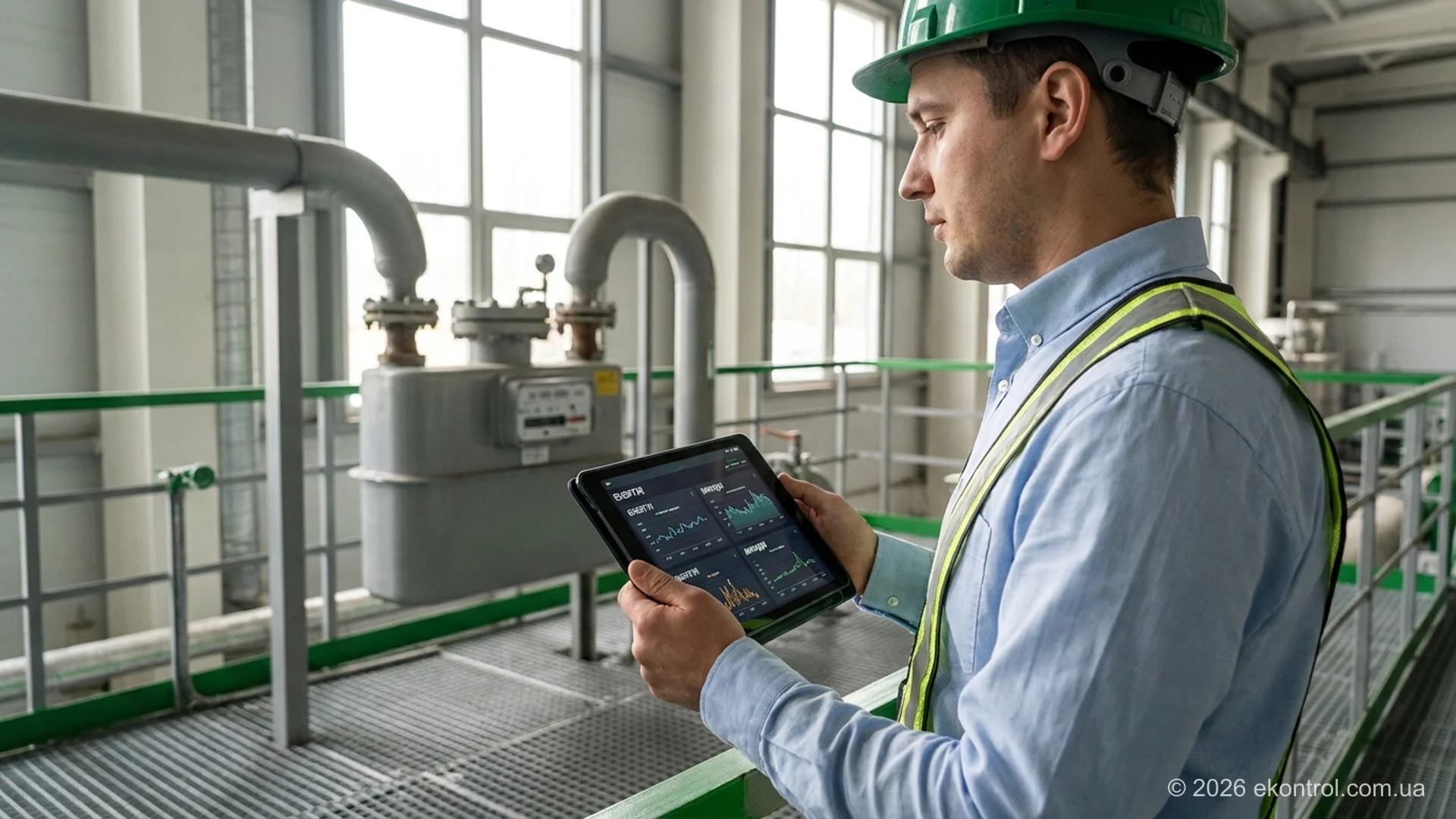
What Business Decarbonization in Ukraine Means and Why It Controls EU Market Access in 2026
Business decarbonization in Ukraine is the structured engineering and management process of quantifying, monitoring, and systematically reducing direct and indirect greenhouse gas (GHG) emissions ($\text{CO}_2$, $\text{CH}_4$, $\text{N}_2\text{O}$, hydrofluorocarbons $\text{HFCs}$, perfluorocarbons $\text{PFCs}$, sulfur hexafluoride $\text{SF}_6$, and nitrogen trifluoride $\text{NF}_3$) expressed either in absolute metric tons of $\text{CO}_2$ equivalent ($\text{tCO}_2\text{e/year}$) or in specific emission intensity per metric ton of finished product. On the factory floor and across agricultural holdings, decarbonization translates into concrete physical actions: eliminating thermal and electrical energy losses, converting natural gas and coal boilers or grain dryers to certified solid biomass and biomethane, optimizing synthetic nitrogen fertilizer rates in crop production, and locking climate KPIs into an environmental management system under ISO 14001.
Five years ago, most Ukrainian industrial and agricultural enterprises treated carbon accounting as an optional public-relations exercise. In 2026, carbon intensity operates as a direct commercial tariff and supplier qualification filter across four distinct channels:
- Full Financial Operation of the EU Carbon Border Adjustment Mechanism (CBAM): since January 1, 2026, European Union importers purchasing Ukrainian pig iron, crude steel, rolled steel, ferroalloys, pipes, fasteners, aluminum, cement clinker, Portland cement, nitrogen and NPK fertilizers, electricity, or hydrogen must declare verified Specific Embedded Emissions (SEE) and surrender paid CBAM certificates linked directly to the weekly auction price of EU ETS allowances. If a Ukrainian plant can't supply verified actual emission data, the EU importer is forced to apply punitive Default Values, wiping out your price competitiveness overnight. We unpacked the exact calculation rules in our guide to CBAM reporting for Ukrainian exporters.
- CSRD / ESRS E1 Supply-Chain Questionnaires from European B2B Buyers: multinational manufacturers, retail chains, chemical groups, and automotive tier-1 suppliers reporting under the EU Corporate Sustainability Reporting Directive (CSRD) and European Sustainability Reporting Standard ESRS E1 (Climate Change) are legally required to disclose their Scope 3 value-chain emissions and climate transition plans. Because raw materials, packaging, grains, vegetable oils, and machined components sourced from Ukraine sit inside the European buyer's Scope 3 (Category 1: Purchased Goods and Services), procurement teams across the EU now demand verified corporate inventories under the GHG Protocol or batch-level GHG calculations under ISCC.
- Statutory Ukrainian MRV (МЗВ) Compliance Under Law No. 377-IX: under the Law of Ukraine No. 377-IX "On Principles of Monitoring, Reporting and Verification of Greenhouse Gas Emissions", operators of covered industrial and energy installations must register their facilities, execute approved Monitoring Plans, and submit annual Operator Emissions Reports verified by NAAU-accredited verification bodies.
- Green Financing Criteria of IFIs and Commercial Banks: securing CAPEX loans or reconstruction grants from the European Bank for Reconstruction and Development (EBRD), the International Finance Corporation (IFC), the World Bank, the EU Ukraine Facility, or Ukraine's state Decarbonization Fund requires a quantified GHG baseline and an engineered abatement calculation proving reductions in energy and carbon intensity.
The Engineering Standards Stack Behind Corporate Decarbonization
A defensible corporate decarbonization program relies on four interconnected standards layers: 1) GHG Protocol Corporate Standard and ISO 14064-1 (ДСТУ ISO 14064-1:2021) govern corporate-level accounting across Scope 1, Scope 2, and Scope 3; 2) Law of Ukraine No. 377-IX regulates mandatory state Monitoring, Reporting, and Verification (MRV / МЗВ) at the industrial installation level; 3) ISCC EU / PLUS, REDcert, KZR INiG, and 2BSvs govern supply-chain GHG calculations and mass balance for agricultural commodities, biomass, and biofuels under the EU RED III Directive; and 4) ISO 14001 and ISO 50001 lock operational controls and reduction targets into daily production.
Corporate Carbon Accounting Under GHG Protocol and ISO 14064-1: Scope 1, Scope 2, and 15 Scope 3 Categories
You can't engineer a cost-effective reduction pathway without first building a mathematically rigorous Base Year Inventory. The global reference framework for corporate carbon accounting is the GHG Protocol Corporate Accounting and Reporting Standard, paired with the international verification standard ISO 14064-1 (adopted in Ukraine as ДСТУ ISO 14064-1:2021).
Your first engineering step is defining organizational boundaries (choosing the Operational Control, Financial Control, or Equity Share consolidation approach) and operational boundaries across three emission scopes. We covered primary data collection workflows in our article on greenhouse gas accounting under the GHG Protocol; below is the complete engineering breakdown of emission sources across Ukrainian industry and agriculture.
Scope 1: Direct Greenhouse Gas Emissions (Category 1 in ISO 14064-1)
Scope 1 covers direct GHG emissions from physical sources owned or operationally controlled by your company. In industrial and agricultural enterprises, Scope 1 spans five distinct source groups:
- Stationary Combustion: burning natural gas, hard coal, fuel oil, LPG (propane-butane), or diesel in steam and hot-water boilers, industrial melting and reheating furnaces, rotary kilns, agricultural grain dryers at elevators, and stationary backup diesel generator sets (gensets).
- Mobile Combustion: fuel burned in company-owned or leased vehicles and mobile machinery under your operational control (long-haul grain trucks, delivery vans, agricultural tractors, combine harvesters, self-propelled sprayers, shunting locomotives on plant rail sidings, and diesel or LPG forklifts).
- Industrial Process Emissions: non-combustion chemical transformations where greenhouse gases are released directly from raw materials. Classic examples include calcination of limestone, chalk, and dolomite ($\text{CaCO}_3 \rightarrow \text{CaO} + \text{CO}_2$ and $\text{MgCO}_3 \rightarrow \text{MgO} + \text{CO}_2$) in cement kilns, lime shaft kilns, glass furnaces, and sugar factory lime kilns; steam methane reforming in ammonia production; and carbon anode or graphite electrode oxidation in electric arc furnaces (EAF) and metallurgical reduction.
- Fugitive Emissions: unintentional leaks and recharge top-ups of fluorinated refrigerants (HFCs such as R-404A, R-134a, R-410A, and R-507) from industrial chillers, meat and dairy cold-storage warehouses, data center CRAC units, and refrigerated trucks. Because R-404A carries a 100-year Global Warming Potential ($\text{GWP}_{100}$) of 3,922, losing just 50 kg of R-404A refrigerant over a year equals $196.1\text{ tCO}_2\text{e}$, roughly equivalent to burning 100,000 cubic meters of natural gas. Fugitive sources also include natural gas methane ($\text{CH}_4$) leaks at pressure regulation stations and sulfur hexafluoride ($\text{SF}6$, $\text{GWP}{100} = 23,500\text{-}25,200$) leaks from high-voltage substation switchgear.
- Agricultural Soil and Livestock Emissions: direct and indirect (via volatilization of $\text{NH}_3/\text{NO}_x$ and nitrate leaching) soil emissions of nitrous oxide ($\text{N}2\text{O}$, with $\text{GWP}{100} = 273$ under IPCC AR6 or $298$ under IPCC AR4) driven by application of synthetic nitrogen fertilizers (ammonium nitrate, urea, UAN liquid fertilizer, anhydrous ammonia), manure application, and crop residue decomposition; direct $\text{CO}_2$ release from soil hydrolysis of urea and agricultural liming; plus enteric fermentation methane ($\text{CH}_4$) and manure storage emissions in livestock operations.
Scope 2: Indirect Emissions From Purchased Energy (Location-Based vs. Market-Based)
Scope 2 (Category 2 in ISO 14064-1) accounts for indirect GHG emissions from the generation of purchased electricity, steam, district heating, or cooling consumed by your facility. Under the GHG Protocol Scope 2 Guidance, companies must calculate and disclose Scope 2 using two parallel methods:
- Location-Based Method: multiplies your metered grid electricity consumption ($\text{MWh}$) by the official average grid emission factor of the Integrated Power System of Ukraine (ОЕС України, expressed in $\text{tCO}_2\text{e/MWh}$). This reflects the physical carbon intensity of the regional grid supplying your site.
- Market-Based Method: derives emissions from the specific contractual instruments your company has purchased. If your plant signs a bilateral corporate Power Purchase Agreement (PPA) with a renewable electricity producer or purchases and retires verified Guarantees of Origin (Гарантії походження електроенергії з ВДЕ) matching its MWh consumption, that renewable electricity carries a $0.0\text{ tCO}_2\text{e/MWh}$ emission factor under the Market-Based calculation. This dual mechanism is how Ukrainian exporters legally cut Scope 2 emissions for CDP, EcoVadis, and CSRD / ESRS E1 reporting.
Scope 3: Value-Chain Indirect Emissions Across All 15 Categories (Categories 3-6 in ISO 14064-1)
Scope 3 captures all other indirect emissions occurring Upstream (Categories 1 to 8) and Downstream (Categories 9 to 15) across your value chain outside your facility's utility meters. For most manufacturing, food processing, agricultural, and trading businesses, Scope 3 represents 65% to 90% of total corporate emissions:
- Upstream Value Chain (Categories 1-8): Category 1 Purchased goods and services (cradle-to-gate embedded carbon footprint of purchased steel, chemicals, synthetic mineral fertilizers, seeds, crop protection products, corrugated cardboard, glass, and plastic packaging), Category 2 Capital goods (new production machinery, building construction), Category 3 Fuel- and energy-related activities not included in Scope 1 or Scope 2 (upstream Well-to-Tank / WTT extraction and refining of fuels plus electrical grid Transmission and Distribution / T&D losses), Category 4 Upstream transportation and distribution (third-party freight and logistics paid by your company, corresponding to $e_{td}$ in biofuel schemes), Category 5 Waste generated in operations (off-site landfilling, incineration, or recycling of operational waste), Category 6 Business travel, Category 7 Employee commuting, and Category 8 Upstream leased assets.
- Downstream Value Chain (Categories 9-15): Category 9 Downstream transportation and distribution (transport of sold goods paid by the buyer), Category 10 Processing of sold products (further industrial processing of Ukrainian steel billets, crude vegetable oil, or grain at customer plants in the EU), Category 11 Use of sold products (lifetime emissions from energy-consuming machinery, boilers, vehicles, fuels, or fertilizers sold by your company), Category 12 End-of-life treatment of sold products (consumer disposal or recycling of your products and packaging), Category 13 Downstream leased assets, Category 14 Franchises, and Category 15 Investments.
| GHG Protocol Scope / ISO 14064-1 Category | Primary Engineering Sources in Ukrainian Facilities | Greenhouse Gases & Calculation Formula | Primary Audit Evidence Verified by Auditors |
|---|---|---|---|
| Scope 1: Direct Stationary & Mobile Combustion (Category 1 ISO 14064-1) | Natural gas, coal, and pellet boilers, grain dryers, industrial furnaces, backup diesel gensets, company trucks, tractors, harvesters, forklifts | CO2, CH4, N2O: Fuel Activity Data (t or 1000 m3) x Net Calorific Value (NCV) x Emission Factor (EF) x Oxidation Factor (OF) | Monthly gas utility acts with laboratory gas composition certificates, calibrated flowmeter logs, fleet fuel write-off ledgers, GPS records |
| Scope 1: Process, Fugitive & Agricultural Soil Emissions (Category 1 ISO 14064-1) | Carbonate calcination in kilns, ammonia synthesis, HFC refrigerant leaks in chillers, field N2O emissions from nitrogen fertilizers and crop residues | CO2, HFCs, SF6, N2O: Recharged refrigerant mass (kg) x GWP100; Applied synthetic N mass (kg) x EF(N2O-N) x 44/28 x GWP100 | HVAC/chiller service acts and F-gas recharge logs, field agronomic logs, warehouse write-off acts for ammonium nitrate, urea, and UAN |
| Scope 2: Indirect Emissions from Purchased Energy (Category 2 ISO 14064-1) | Purchased grid electricity, externally supplied process steam, district heating, and chilled water | CO2e: Location-Based (MWh x Ukraine IPS grid EF) and Market-Based (MWh x supplier EF or 0.0 for retired Renewable Guarantees of Origin) | Monthly commercial electricity invoices backed by automated metering (ASKOE), registry extracts for retired Guarantees of Origin / PPAs |
| Scope 3 Upstream: Purchased Inputs & Inbound Logistics (Cats 1, 3, 4 GHG / Cats 3, 4 ISO 14064-1) | Cradle-to-gate production of purchased metals, mineral fertilizers, chemicals, packaging; rail, truck, river barge, and maritime freight (etd) | CO2e: Purchased input mass (t) x Supplier Product Carbon Footprint (PCF) or database EF; Freight ton-kilometers (t-km) x modal EF | ERP material receipt ledgers, supplier CBAM / ISCC Sustainability Declarations, bills of lading (CMR, railway waybills, ocean B/Ls) |
| Scope 3 Downstream: Processing, Use & End-of-Life (Cats 9, 10, 11, 12 GHG / Cat 5 ISO 14064-1) | Buyer-paid outbound transport, downstream conversion of semi-finished goods, customer use of sold machinery/fuels, packaging disposal | CO2e: Sold product mass by CN/HS code x downstream processing energy factor; Packaging mass by material type x national recycling/landfill rate | Customs export declarations, packaging component weight specifications, technical energy-consumption datasheets of manufactured equipment |
Statutory Ukrainian MRV (Law No. 377-IX), EU CBAM, CSRD / ESRS E1 Questionnaires, and IFI Green Financing
Chief Engineers and Sustainability Managers often face three or four overlapping carbon data requests in the same quarter. Understanding how Ukraine's national MRV statute, EU CBAM rules, CSRD supply-chain questionnaires, and IFI lending criteria differ in system boundaries prevents costly double calculation.
1. Statutory Ukrainian MRV (МЗВ) Under Law of Ukraine No. 377-IX
Ukraine's mandatory facility-level greenhouse gas accounting regime is governed by the Law of Ukraine No. 377-IX "On Principles of Monitoring, Reporting and Verification of Greenhouse Gas Emissions" alongside Cabinet of Ministers Resolutions No. 880 (defining covered activities) and No. 960 (monitoring and reporting rules).
Unlike the corporate-wide GHG Protocol (which consolidates an entire legal entity including offices and vehicle fleets), statutory Ukrainian MRV (МЗВ) operates strictly at the stationary industrial installation level:
- Covered Installations: combustion of fuels in installations with a total rated thermal input exceeding 20 MW (industrial boiler houses, CHP plants, thermal power stations, large drying and calcining complexes), oil refining, coke ovens, metal ore roasting and sintering, pig iron and steel production, cement clinker, lime, glass, ceramic bricks, pulp and paper, ammonia, nitric acid, and carbon black manufacturing.
- The Annual MRV Compliance Loop: the operator registers the installation in the Unified MRV Register, develops and approves a Monitoring Plan (standard or simplified form) specifying either the calculation-based or measurement-based methodology and defining accuracy Tiers (Tier 1 to Tier 4) for activity data, Net Calorific Value ($NCV$), Emission Factor ($EF$), and Oxidation/Conversion Factor ($OF/CF$). Throughout the reporting year, the operator executes calibrated metering and fuel testing, compiles the annual Operator's Emissions Report, and submits it for independent verification by a verification body accredited by the National Accreditation Agency of Ukraine (NAAU) under ISO/IEC 17029 and ISO 14065 within the European co-operation for Accreditation (EA MLA) framework.
2. EU Carbon Border Adjustment Mechanism (CBAM) in the Definitive Period
For Ukrainian exporters of iron and steel, aluminum, cement, fertilizers, electricity, and hydrogen, CBAM requires calculating Specific Embedded Emissions ($SEE_g$) in metric tons of $\text{CO}2\text{e}$ per metric ton of exported product under Regulation (EU) 2023/956: $$SEE_g = \frac{AttrEm_g}{AL_g} + EE{\text{inpMat}}$$ where $AttrEm_g$ represents the attributed direct (and indirect, where applicable) emissions of the production process yielding good $g$, $AL_g$ is the total activity level (metric tons of good $g$ produced during the reporting period), and $EE_{\text{inpMat}}$ captures the embedded emissions of CBAM-regulated precursors (such as purchased pig iron, ferroalloys, lime, ammonia, or clinker consumed in production). Because of this boundary rule, your accounting system must partition plant-wide fuel and electricity meters into specific CBAM production processes.
3. European B2B Buyer Questionnaires: CSRD / ESRS E1, CDP, and EcoVadis
Even if your company manufactures machinery, electrical equipment, packaging, food products, or IT services outside the six CBAM sectors, European customers cascade decarbonization mandates through procurement contracts. Under ESRS E1 (Climate Change), EU buyers evaluate Ukrainian suppliers on three concrete deliverables: 1) a documented Scope 1, Scope 2, and material Scope 3 inventory under the GHG Protocol or ISO 14064-1, 2) a time-bound Climate Transition Plan with science-aligned reduction targets (SBTi logic), and 3) an active environmental or energy management system certified to ISO 14001 or ISO 50001.
4. International Financial Institutions (EBRD, IFC, World Bank, and Ukraine's Decarbonization Fund)
When evaluating industrial modernization or agribusiness expansion loans, international lenders conduct Paris Alignment assessments and apply shadow carbon pricing to project cash flows. Having an ISO 14064-1 baseline inventory and an engineered Marginal Abatement Cost Curve (MACC) accelerates bank technical due diligence and opens access to concessional green credit lines.
| Comparison Parameter | Ukrainian Statutory MRV (Law No. 377-IX) | EU CBAM (Regulation EU 2023/956) | CSRD / ESRS E1, CDP & EcoVadis | Agri-Biomass & Biofuel Schemes (ISCC EU / RED III) |
|---|---|---|---|---|
| Accounting Boundary | Stationary industrial installation (boiler >20 MW, furnace, kiln) | Production process of specific CN-code goods + CBAM precursors | Entire corporate legal entity or group (Scope 1 + Scope 2 + Scope 3) | Certified batch mass balance across cultivation, processing, and transport |
| Primary Output Metric | Absolute installation direct emissions (tCO2e / year) | Specific Embedded Emissions per ton of product (tCO2e / t good) | Total corporate inventory (tCO2e / year) & revenue/output intensity | Product carbon footprint in kgCO2e / dry ton or gCO2e / MJ biofuel |
| Treatment of Mobile Fleet & Scope 3 | Excluded (covers stationary combustion and process emissions inside the installation) | Off-site transport excluded, but upstream CBAM precursors are included | Mandatory: company fleet in Scope 1 plus all 15 Scope 3 categories | Mandatory: includes cultivation inputs (eec), processing (ep), and all transport (etd) |
| Third-Party Verification / Audit Rule | Mandatory annual verification by an NAAU-accredited verifier (ISO 14065) | Mandatory verification of actual embedded emissions from 2026 onward | ISO 14064-3 verification + ISO 14001 / ISO 50001 system certification | Mandatory annual surveillance audit by an ISCC / EC-recognized body |
Industrial Decarbonization Levers: ISO 50001, ISO 14001, and Switching Boilers and Dryers to Certified Biomass
Once your baseline inventory reveals where emissions concentrate, the engineering focus shifts to physical abatement with positive financial return. Across Ukrainian manufacturing and agro-processing plants, two operational levers deliver the fastest reductions in Scope 1 and Scope 2 emissions.
1. Systematic Energy Management Under ISO 50001 and Operational Controls Under ISO 14001
Because 75% to 85% of an industrial plant's Scope 1 and Scope 2 footprint comes from fuel combustion and electricity draw, eliminating energy waste is the most profitable decarbonization step you can take. Implementing an energy management system under ISO 50001 integrated with your ISO 14001 EMS forces your engineering team to meter Significant Energy Uses (SEUs), establish statistical Energy Baselines (EnB), and execute high-ROI technical retrofits:
- Flue-Gas and Air Compressor Waste Heat Recovery: installing condensing economizers on steam boiler stacks and oil-to-water plate heat exchangers on rotary screw air compressors (recovering 75-80% of compressor electrical input as $+65\text{ to }+75,^\circ\text{C}$ hot water for boiler feedwater preheating or CIP washing, directly cutting natural gas combustion in Scope 1).
- Variable Frequency Drives (VFDs) and Compressed Air Leak Elimination: retrofitting VFDs onto centrifugal pumps, induced-draft fans, cooling tower fans, and elevator aspiration blowers (cutting electricity draw by 20-35% under partial load), paired with ultrasonic leak audits on factory compressed-air rings where plants routinely lose 20-30% of compressor output.
- Steam Loop and Condensate Recovery Optimization: auditing and replacing failed steam traps, returning clean high-temperature condensate to the boiler deaerator, and fitting removable thermal insulation jackets onto valves and flanges.
2. Switching Grain Dryers and Industrial Boilers to Certified Sustainable Biomass and Biomethane
The single largest Scope 1 abatement lever for Ukrainian grain elevators, oilseed crushing plants, feed mills, food processors, and district heating boilers is fuel switching: replacing fossil natural gas ($EF \approx 56.1\text{ kgCO}_2\text{/GJ}$) or LPG ($EF \approx 63.1\text{ kgCO}_2\text{/GJ}$) with solid biomass (sunflower husk pellets, wood chips, wood pellets, corn cob or straw agro-pellets) or biomethane.
Here's the critical compliance catch for EU exporters: you can't just burn uncertified pellets and claim zero emissions in European supply-chain audits. Under the EU Renewable Energy Directive RED III (Directive (EU) 2023/2413), solid biomass or biomethane only qualifies for a zero fossil $\text{CO}_2$ combustion factor ($e_u = 0$) if its sustainable origin, mass balance, and life-cycle GHG savings are certified under one of the voluntary schemes recognized by the European Commission:
- ISCC (International Sustainability and Carbon Certification): the global benchmark (ISCC EU and ISCC PLUS) used by Ukrainian agro-holdings, elevators, oilseed crushers, and biomethane plants;
- REDcert: the European certification scheme (REDcert-EU) for sustainable agricultural raw materials, biomass, and biofuels;
- KZR INiG: the certification system of Poland's Oil and Gas Institute, widely used by Ukrainian grain, oilseed, and biomass exporters supplying Central European buyers;
- 2BSvs: the French Biomass Biofuel Sustainability voluntary scheme.
Under RED III and these four certification schemes, total life-cycle greenhouse gas emissions ($E$) of biomass or biofuel are governed by the statutory engineering equation: $$E = e_{ec} + e_l + e_p + e_{td} + e_u - e_{sca} - e_{ccs} - e_{ccr}$$ where $e_{ec}$ captures emissions from feedstock extraction or cultivation, $e_l$ represents annualized emissions from carbon stock changes caused by land-use change, $e_p$ covers processing emissions (drying, pelletizing, crushing), $e_{td}$ accounts for transport and distribution, $e_u$ represents emissions from fuel in use (where biogenic $\text{CO}2$ is zero), and $e{sca}$, $e_{ccs}$, and $e_{ccr}$ represent negative emission credits from soil carbon accumulation via improved agricultural management, carbon capture and geological storage, and carbon capture and replacement.
Need a Verified Scope 1-3 Inventory, CBAM Calculation, or ISCC & ISO 14001 Certification?
Ekontrol's engineers and lead auditors calculate corporate GHG inventories under the GHG Protocol and ISO 14064-1, verify specific embedded emissions for CBAM and ISCC EU, and implement ISO 14001 and ISO 50001 management systems.
Book a Consultation With an Ekontrol ExpertAgricultural Decarbonization: Precision Farming Under GLOBALG.A.P., Field N2O Cuts, and Soil Carbon (esca)
In Ukrainian agriculture, decarbonization carries an immediate per-ton price premium. European bioethanol and biodiesel refineries, oilseed crushers, and multinational grain traders pay a EUR 5 to EUR 18 per metric ton premium for Ukrainian rapeseed, maize, soybeans, and wheat accompanied by an ISCC, REDcert, KZR INiG, or 2BSvs Sustainability Declaration showing individually calculated low cultivation and transport GHG figures ($e_{ec} + e_{td}$).
Why Synthetic Nitrogen Fertilizers and Soil $\text{N}_2\text{O}$ Drive 70% of Crop Carbon Footprints
When an agronomist or environmental engineer calculates the cultivation footprint ($e_{ec}$) of 1 hectare of maize or winter rapeseed for the first time, the breakdown often surprises management. Tractor and combine diesel consumption (typically 70 to 95 liters per hectare, generating roughly $220\text{ to }300\text{ kgCO}_2\text{e/ha}$) accounts for only about 25% of field emissions. Fully 65% to 75% of crop cultivation emissions come from synthetic nitrogen fertilizers through a dual mechanism:
- High Upstream Manufacturing Emissions (Scope 3, Category 1): producing 1 kg of active nitrogen ($\text{N}$) in conventional ammonium nitrate or urea plants releases between $3.5$ and $6.8\text{ kgCO}_2\text{e}$ before the fertilizer bag ever reaches the farm.
- Direct and Indirect Soil Nitrous Oxide ($\text{N}_2\text{O}$) Emissions (Scope 1): once nitrogen fertilizer is applied to soil, microbial nitrification and denitrification convert a fraction of the applied nitrogen into nitrous oxide gas ($\text{N}_2\text{O}$), while volatilized ammonia ($\text{NH}_3$) and leached nitrates ($\text{NO}_3^-$) generate secondary indirect $\text{N}_2\text{O}$ emissions. Because 1 metric ton of $\text{N}_2\text{O}$ traps nearly 273 to 298 times as much heat over 100 years as 1 metric ton of $\text{CO}_2$, over-applying synthetic nitrogen inflates the carbon footprint of every harvested ton of grain. In addition, applying urea or UAN liquid fertilizer triggers direct chemical hydrolysis in soil, releasing an additional $0.733\text{ kgCO}_2$ per kilogram of urea applied.
Precision Agriculture Under GLOBALG.A.P. and Soil Organic Carbon Credits ($e_{sca}$)
To drive down specific cultivation emissions ($e_{ec}$) per metric ton of harvested crop, leading Ukrainian agribusinesses pair GLOBALG.A.P. Integrated Farm Assurance (IFA v6) practices with precision agronomy and regenerative soil management:
- Variable Rate Application (VRA) and Nitrification Inhibitors: combining satellite NDVI vegetation mapping, grid soil testing, split root-zone liquid fertilizer placement (4R Nutrient Stewardship), and urease or nitrification inhibitors cuts synthetic nitrogen application rates by 12-20% per hectare while preserving or boosting crop yields.
- Capturing the Soil Carbon Accumulation Credit ($e_{sca}$) Under RED III / ISCC EU: European RED III accounting rules allow farms certified under ISCC EU to deduct a verified emission credit ($e_{sca}$) when they adopt documented Improved Agricultural Management practices that build soil organic carbon: replacing inversion moldboard plowing with No-Till, Strip-Till, or Mini-Till conservation tillage, planting winter cover crops, integrating nitrogen-fixing legumes into crop rotations, incorporating chopped crop residues into the topsoil (strictly prohibiting stubble burning), and applying organic compost or biogas digestate.
- Decarbonizing Elevator Drying and Outbound Logistics ($e_p$ and $e_{td}$): converting elevator grain dryers from natural gas or LPG to certified sunflower husk pellets and shifting long-haul grain transport from older road trucks to electrified rail unit trains and river barges cuts the delivered carbon footprint of export grain by an additional 15-25%.
Testing Fuels, Raw Materials, and Stack Emissions in ISO/IEC 17025 Accredited Laboratories
One of the fastest ways to lower your reported greenhouse gas emissions without spending millions on new furnaces is upgrading your data accuracy Tier. Across Ukraine's statutory MRV system (Law No. 377-IX), EU CBAM verification, and ISO 14064-1 audits, calculation rules enforce a strict Tier Hierarchy:
- if an operator doesn't test its fuels and raw materials in an accredited laboratory, it must apply conservative default factors (Tier 1), which are intentionally set at the upper end of carbon intensity;
- when an operator performs batch-specific laboratory analysis (Tier 2b / Tier 3), it can substitute actual measured Net Calorific Values ($NCV$), carbon content ($C$, %), and conversion factors directly into its emission equations.
Mandatory Role of ISO/IEC 17025 Accredited Testing Laboratories
Under Ukrainian MRV regulations and EU CBAM verification rules (Implementing Regulation (EU) 2023/1773), third-party verifiers only accept laboratory test results for fuels, carbonate raw materials, biomass, and stack gases if the analyses were performed by a testing laboratory accredited by the National Accreditation Agency of Ukraine (NAAU) under ISO/IEC 17025 (ДСТУ EN ISO/IEC 17025:2019).
Four categories of laboratory testing directly support industrial and agricultural decarbonization:
- Solid, Liquid, and Gaseous Fuel Characterization: bomb calorimeter testing of lower heating value / Net Calorific Value ($NCV$, MJ/kg or GJ/t), as-received moisture ($W^r$, %), ash content ($A^d$, %), and elemental carbon content ($C^r$, %) in hard coal, coke, fuel oil, diesel, solid biomass pellets, and natural gas (via gas chromatography under ISO 6974).
- Biomass Sustainability and Soil Carbon Testing: laboratory verification of moisture, calorific value, and biogenic fraction in sunflower husk and wood pellets burned in boilers and grain dryers, alongside agrochemical soil testing for Soil Organic Carbon (SOC / humus), mineral nitrogen profiles, and pH to substantiate GLOBALG.A.P. fertilizer plans and ISCC soil carbon models.
- Carbonate and Process Material Analysis (for steel, cement, lime, glass, and sugar plants): stoichiometric and instrumental determination of $\text{CaCO}_3$ and $\text{MgCO}_3$ content in limestone, dolomite, marl, and clay, plus residual unburned carbon in fly ash, slag, and clinker to calculate exact process Conversion Factors ($CF$).
- Meter Calibration and Measurement Uncertainty Budgets: MRV and CBAM verifiers audit the combined measurement uncertainty of commercial gas custody-transfer meters, truck and rail weighbridges, belt scales, and Continuous Emission Monitoring Systems (CEMS) to confirm compliance with permitted Tier uncertainty thresholds (e.g., $\pm 1.5%$, $\pm 2.5%$, or $\pm 5.0%$).
The Commercial Cost of Relying on Default Emission Values in CBAM and ISCC
Both the EU CBAM regime and ISCC EU biofuel accounting penalize missing data by design: statutory Default Values are pegged to the worst-performing installations plus a punitive mark-up. If a Ukrainian manufacturer or agricultural exporter lacks a verified actual GHG calculation backed by primary metering and ISO/IEC 17025 laboratory test protocols, European buyers automatically deduct the inflated CBAM certificate cost or uncertified feed-grade discount directly from your contract price.
Step-by-Step Corporate Decarbonization Roadmap: 6 Engineering Stages From Baseline to Verification
To replace ad-hoc spreadsheet scrambling with a single auditable system, Ekontrol (Еконтроль) engineers deploy corporate decarbonization programs across six sequential stages. This architecture ensures that one unified primary dataset (fuels, electricity, raw materials, fertilizers, freight, and waste) simultaneously satisfies Ukrainian MRV reports, EU CBAM declarations, CSRD / EcoVadis / CDP buyer questionnaires, and ISO 14001 and ISCC audits.
The table below outlines the 6-stage engineering roadmap for industrial and agricultural enterprises.
| Roadmap Stage & Timeline | Engineering & Accounting Actions on Site | Governing Standards & Statutes | Verified Deliverables & Commercial Outcome |
|---|---|---|---|
| Stage 1. Diagnostic Climate & Regulatory Gap Audit (Weeks 1-3) | Mapping export buyer mandates (CBAM, CSRD/ESRS E1, ISCC), checking Law No. 377-IX MRV thresholds, inspecting fuel/electricity metering, boilers, dryers, chillers, and fleet records | Law of Ukraine No. 377-IX, EU CBAM Reg. 2023/956, GHG Protocol, ISO 14064-1 | Diagnostic Gap Analysis Report; defined organizational and operational GHG boundaries; complete Emission Source Register |
| Stage 2. Base Year Inventory Across Scope 1, 2 & Material Scope 3 (Weeks 4-8) | Collecting 12 months of primary activity data (gas, coal, diesel, HFCs, nitrogen fertilizers, electricity, raw materials, transport etd); fuel testing in ISO/IEC 17025 labs; emission modeling | GHG Protocol Corporate Standard, Scope 2 Guidance, DSTU ISO 14064-1:2021, ISO/IEC 17025 | Auditable GHG Calculation Model & Base Year Inventory Report; Specific Embedded Emissions (SEE / PCF) per ton of output |
| Stage 3. Marginal Abatement Cost Curve (MACC) & Target Setting (Weeks 9-11) | Ranking technical abatement projects by CAPEX, energy payback, and abatement cost (EUR / tCO2e avoided); setting absolute and intensity reduction targets through 2030 | Science Based Targets (SBTi), Law of Ukraine No. 3991-IX, EBRD / IFC / Decarbonization Fund criteria | Corporate Climate Transition Plan; quantified decarbonization KPIs ready for bank due diligence and CDP / EcoVadis submissions |
| Stage 4. Engineering Abatement Rollout in Plants & Farms (Months 3-6) | Implementing energy management and operational controls; waste heat recovery, VFDs, biomass boiler/dryer conversion; VRA nitrogen optimization and No-Till/Strip-Till in crop farming | DSTU ISO 14001:2015, DSTU ISO 50001:2020, GLOBALG.A.P. IFA v6 | Measurable cuts in specific gas, electricity, and fertilizer consumption; lower production cost and reduced carbon intensity |
| Stage 5. Supply-Chain Biomass & Agri-Commodity Certification (Months 4-5) | Deploying Mass Balance traceability procedures and calculating actual batch GHG values (eec, ep, etd, esca) across farms, grain elevators, and crushing plants | ISCC EU / ISCC PLUS, REDcert-EU, KZR INiG, 2BSvs (EU RED III Directive) | Accredited sustainability certificate and authority to issue Sustainability Declarations with low actual GHG figures |
| Stage 6. Internal Audit, Third-Party Verification & System Certification (Month 6) | Cross-auditing primary accounting ledgers and meter uncertainty budgets; supporting independent verification of MRV / CBAM / ISO 14064-1 reports and ISO 14001 / ISO 50001 certification | ISO 19011, ISO 14064-3, ISO 14065, ISO/IEC 17021-1 | Verified MRV / CBAM Emissions Report; accredited ISO 14001, ISO 50001, and ISCC certificates; defensible EU buyer questionnaires |
Five Critical Engineering Mistakes in Carbon Footprint Accounting and Climate Programs
Across carbon audits and export compliance projects conducted between 2024 and 2026, Ekontrol lead auditors consistently see five technical errors that cause third-party verifiers to reject emission reports or cost exporters money at the EU border:
- Publishing Emission Reduction Targets Without a Verified Baseline Inventory. Stating "We will cut emissions by 30% by 2030" in a corporate presentation or ESG questionnaire without a documented GHG Protocol or ISO 14064-1 base-year calculation falls apart at the first question from a buyer's auditor or EBRD credit officer. Under tightened European anti-greenwashing rules, unsubstantiated climate claims carry direct commercial and legal risk.
- Mixing Up Location-Based and Market-Based Scope 2 Rules or Double-Counting Solar Power. Many companies install a small 200 kW rooftop solar array, feed power into the grid or fail to retire Guarantees of Origin, and then claim a zero emission factor across their entire factory electricity draw. Under the GHG Protocol Scope 2 Guidance, any grid-supplied electricity not backed by retired contractual instruments must be calculated using the national grid factor.
- Omitting Soil $\text{N}2\text{O}$ Emissions, Urea Hydrolysis, and Transport ($e{td}$) in Agricultural Calculations. When calculating the carbon footprint of grain, oilseeds, or food ingredients internally, teams frequently count tractor diesel and elevator electricity while forgetting direct and indirect nitrous oxide ($\text{N}_2\text{O}$) soil emissions from synthetic nitrogen fertilizers and crop residues. During an ISCC, REDcert, KZR INiG, or 2BSvs audit, omitting soil $\text{N}_2\text{O}$ triggers an immediate major nonconformity and forces retrospective recalculation of shipped batches.
- Burning Uncertified Biomass Without Mass-Balance Traceability and Laboratory Calorific Certificates. Switching a grain dryer or steam boiler from natural gas to sunflower husk pellets or wood chips isn't enough on its own. If your pellet supplier cannot prove sustainable origin under RED III criteria and you lack ISO/IEC 17025 laboratory test protocols for Net Calorific Value ($NCV$), CBAM and MRV verifiers cannot assign a zero fossil $\text{CO}_2$ factor ($e_u = 0$) to that fuel.
- Treating Carbon Accounting as a One-Off Spreadsheet Instead of Embedding It in an ISO 14001 System. When a company builds a one-time GHG calculation in an isolated Excel file for an urgent customer inquiry without documented data-collection SOPs, meter calibration schedules, internal audits, and named process owners across engineering, procurement, and accounting, the model breaks down the following year.
Ekontrol Field Result: Cutting Specific Embedded Emissions by 25-40% With Actual GHG Modeling and ISCC + ISO 14001
In Ekontrol (Еконтроль) projects for Ukrainian agro-industrial groups, grain elevators, and processing plants, replacing punitive European default values with verified actual GHG calculations ($e_{ec}, e_p, e_{td}$), switching grain dryers to certified sunflower husk pellets, and optimizing nitrogen fertilizer regimes reduces the verified carbon footprint of exported maize and rapeseed by 25-40%. That reduction secures premium supply contracts with European biorefineries under ISCC EU / KZR INiG and satisfies EBRD and IFC green lending criteria.
How Ekontrol Supports Business Decarbonization, GHG Inventories, and ISO 14001 & ISCC Certification
Since 2014, Ekontrol (Еконтроль) has provided end-to-end engineering, carbon accounting, and certification consulting for Ukrainian industrial manufacturers, steel and metalworking plants, chemical and building-material producers, agricultural holdings, grain elevators, oilseed crushers, and food processors. We connect primary shop-floor metering, accredited laboratory testing, and international management systems into a single defensible compliance architecture accepted by European verifiers, CBAM importers, and international development banks.
Our engineering team supports your decarbonization roadmap across four core areas:
- Diagnostic Climate & Regulatory Gap Audit: comprehensive assessment of your facility's readiness for Ukrainian statutory MRV (Law No. 377-IX), EU CBAM embedded emissions reporting, CSRD / ESRS E1 supply-chain disclosures, and CDP or EcoVadis questionnaires;
- Corporate & Product Carbon Footprint Accounting Under GHG Protocol and ISO 14064-1: building auditable engineering models across Scope 1 (boilers, kilns, grain dryers, mobile fleet, HFC refrigerants, agricultural soil $\text{N}_2\text{O}$), Scope 2 (Location-Based and Market-Based), and all 15 Scope 3 categories, plus Specific Embedded Emissions (SEE) and Product Carbon Footprint (PCF) calculations;
- Turnkey Management System and Sustainability Certification Implementation: full engineering deployment of ISO 14001 environmental management and ISO 50001 energy management systems, sustainable biomass and agri-commodity certification under ISCC (ISCC EU / ISCC PLUS), REDcert, KZR INiG, and 2BSvs, precision agriculture certification under GLOBALG.A.P., and preparation of fuel and environmental testing laboratories for NAAU accreditation under ISO/IEC 17025;
- Verification and Certification Audit Support: technical representation and defense of your GHG calculation models, MRV Monitoring Plans, CBAM communication templates, and management systems during third-party verification and certification audits.
If you've received a CBAM embedded-emissions questionnaire from an EU importer, a Scope 3 data request from a multinational customer, or are preparing a capital project for EBRD, IFC, or Ukraine Decarbonization Fund financing, reach out via the Ekontrol contact page to review your project with our lead engineers.
Need a certification consultation?
Free ConsultationOn This Page
- What Business Decarbonization in Ukraine Means and Why It Controls EU Market Access in 2026
- Corporate Carbon Accounting Under GHG Protocol and ISO 14064-1: Scope 1, Scope 2, and 15 Scope 3 Categories
- Statutory Ukrainian MRV (Law No. 377-IX), EU CBAM, CSRD / ESRS E1 Questionnaires, and IFI Green Financing
- Industrial Decarbonization Levers: ISO 50001, ISO 14001, and Switching Boilers and Dryers to Certified Biomass
- Agricultural Decarbonization: Precision Farming Under GLOBALG.A.P., Field N2O Cuts, and Soil Carbon (esca)
- Testing Fuels, Raw Materials, and Stack Emissions in ISO/IEC 17025 Accredited Laboratories
- Step-by-Step Corporate Decarbonization Roadmap: 6 Engineering Stages From Baseline to Verification
- Five Critical Engineering Mistakes in Carbon Footprint Accounting and Climate Programs
- How Ekontrol Supports Business Decarbonization, GHG Inventories, and ISO 14001 & ISCC Certification
What Business Decarbonization in Ukraine Means and Why It Controls EU Market Access in 2026
Business decarbonization in Ukraine is the structured engineering and management process of quantifying, monitoring, and systematically reducing direct and indirect greenhouse gas (GHG) emissions ($\text{CO}_2$, $\text{CH}_4$, $\text{N}_2\text{O}$, hydrofluorocarbons $\text{HFCs}$, perfluorocarbons $\text{PFCs}$, sulfur hexafluoride $\text{SF}_6$, and nitrogen trifluoride $\text{NF}_3$) expressed either in absolute metric tons of $\text{CO}_2$ equivalent ($\text{tCO}_2\text{e/year}$) or in specific emission intensity per metric ton of finished product. On the factory floor and across agricultural holdings, decarbonization translates into concrete physical actions: eliminating thermal and electrical energy losses, converting natural gas and coal boilers or grain dryers to certified solid biomass and biomethane, optimizing synthetic nitrogen fertilizer rates in crop production, and locking climate KPIs into an environmental management system under ISO 14001.
Five years ago, most Ukrainian industrial and agricultural enterprises treated carbon accounting as an optional public-relations exercise. In 2026, carbon intensity operates as a direct commercial tariff and supplier qualification filter across four distinct channels:
- Full Financial Operation of the EU Carbon Border Adjustment Mechanism (CBAM): since January 1, 2026, European Union importers purchasing Ukrainian pig iron, crude steel, rolled steel, ferroalloys, pipes, fasteners, aluminum, cement clinker, Portland cement, nitrogen and NPK fertilizers, electricity, or hydrogen must declare verified Specific Embedded Emissions (SEE) and surrender paid CBAM certificates linked directly to the weekly auction price of EU ETS allowances. If a Ukrainian plant can't supply verified actual emission data, the EU importer is forced to apply punitive Default Values, wiping out your price competitiveness overnight. We unpacked the exact calculation rules in our guide to CBAM reporting for Ukrainian exporters.
- CSRD / ESRS E1 Supply-Chain Questionnaires from European B2B Buyers: multinational manufacturers, retail chains, chemical groups, and automotive tier-1 suppliers reporting under the EU Corporate Sustainability Reporting Directive (CSRD) and European Sustainability Reporting Standard ESRS E1 (Climate Change) are legally required to disclose their Scope 3 value-chain emissions and climate transition plans. Because raw materials, packaging, grains, vegetable oils, and machined components sourced from Ukraine sit inside the European buyer's Scope 3 (Category 1: Purchased Goods and Services), procurement teams across the EU now demand verified corporate inventories under the GHG Protocol or batch-level GHG calculations under ISCC.
- Statutory Ukrainian MRV (МЗВ) Compliance Under Law No. 377-IX: under the Law of Ukraine No. 377-IX "On Principles of Monitoring, Reporting and Verification of Greenhouse Gas Emissions", operators of covered industrial and energy installations must register their facilities, execute approved Monitoring Plans, and submit annual Operator Emissions Reports verified by NAAU-accredited verification bodies.
- Green Financing Criteria of IFIs and Commercial Banks: securing CAPEX loans or reconstruction grants from the European Bank for Reconstruction and Development (EBRD), the International Finance Corporation (IFC), the World Bank, the EU Ukraine Facility, or Ukraine's state Decarbonization Fund requires a quantified GHG baseline and an engineered abatement calculation proving reductions in energy and carbon intensity.
The Engineering Standards Stack Behind Corporate Decarbonization
A defensible corporate decarbonization program relies on four interconnected standards layers: 1) GHG Protocol Corporate Standard and ISO 14064-1 (ДСТУ ISO 14064-1:2021) govern corporate-level accounting across Scope 1, Scope 2, and Scope 3; 2) Law of Ukraine No. 377-IX regulates mandatory state Monitoring, Reporting, and Verification (MRV / МЗВ) at the industrial installation level; 3) ISCC EU / PLUS, REDcert, KZR INiG, and 2BSvs govern supply-chain GHG calculations and mass balance for agricultural commodities, biomass, and biofuels under the EU RED III Directive; and 4) ISO 14001 and ISO 50001 lock operational controls and reduction targets into daily production.
Corporate Carbon Accounting Under GHG Protocol and ISO 14064-1: Scope 1, Scope 2, and 15 Scope 3 Categories
You can't engineer a cost-effective reduction pathway without first building a mathematically rigorous Base Year Inventory. The global reference framework for corporate carbon accounting is the GHG Protocol Corporate Accounting and Reporting Standard, paired with the international verification standard ISO 14064-1 (adopted in Ukraine as ДСТУ ISO 14064-1:2021).
Your first engineering step is defining organizational boundaries (choosing the Operational Control, Financial Control, or Equity Share consolidation approach) and operational boundaries across three emission scopes. We covered primary data collection workflows in our article on greenhouse gas accounting under the GHG Protocol; below is the complete engineering breakdown of emission sources across Ukrainian industry and agriculture.
Scope 1: Direct Greenhouse Gas Emissions (Category 1 in ISO 14064-1)
Scope 1 covers direct GHG emissions from physical sources owned or operationally controlled by your company. In industrial and agricultural enterprises, Scope 1 spans five distinct source groups:
- Stationary Combustion: burning natural gas, hard coal, fuel oil, LPG (propane-butane), or diesel in steam and hot-water boilers, industrial melting and reheating furnaces, rotary kilns, agricultural grain dryers at elevators, and stationary backup diesel generator sets (gensets).
- Mobile Combustion: fuel burned in company-owned or leased vehicles and mobile machinery under your operational control (long-haul grain trucks, delivery vans, agricultural tractors, combine harvesters, self-propelled sprayers, shunting locomotives on plant rail sidings, and diesel or LPG forklifts).
- Industrial Process Emissions: non-combustion chemical transformations where greenhouse gases are released directly from raw materials. Classic examples include calcination of limestone, chalk, and dolomite ($\text{CaCO}_3 \rightarrow \text{CaO} + \text{CO}_2$ and $\text{MgCO}_3 \rightarrow \text{MgO} + \text{CO}_2$) in cement kilns, lime shaft kilns, glass furnaces, and sugar factory lime kilns; steam methane reforming in ammonia production; and carbon anode or graphite electrode oxidation in electric arc furnaces (EAF) and metallurgical reduction.
- Fugitive Emissions: unintentional leaks and recharge top-ups of fluorinated refrigerants (HFCs such as R-404A, R-134a, R-410A, and R-507) from industrial chillers, meat and dairy cold-storage warehouses, data center CRAC units, and refrigerated trucks. Because R-404A carries a 100-year Global Warming Potential ($\text{GWP}_{100}$) of 3,922, losing just 50 kg of R-404A refrigerant over a year equals $196.1\text{ tCO}_2\text{e}$, roughly equivalent to burning 100,000 cubic meters of natural gas. Fugitive sources also include natural gas methane ($\text{CH}_4$) leaks at pressure regulation stations and sulfur hexafluoride ($\text{SF}6$, $\text{GWP}{100} = 23,500\text{-}25,200$) leaks from high-voltage substation switchgear.
- Agricultural Soil and Livestock Emissions: direct and indirect (via volatilization of $\text{NH}_3/\text{NO}_x$ and nitrate leaching) soil emissions of nitrous oxide ($\text{N}2\text{O}$, with $\text{GWP}{100} = 273$ under IPCC AR6 or $298$ under IPCC AR4) driven by application of synthetic nitrogen fertilizers (ammonium nitrate, urea, UAN liquid fertilizer, anhydrous ammonia), manure application, and crop residue decomposition; direct $\text{CO}_2$ release from soil hydrolysis of urea and agricultural liming; plus enteric fermentation methane ($\text{CH}_4$) and manure storage emissions in livestock operations.
Scope 2: Indirect Emissions From Purchased Energy (Location-Based vs. Market-Based)
Scope 2 (Category 2 in ISO 14064-1) accounts for indirect GHG emissions from the generation of purchased electricity, steam, district heating, or cooling consumed by your facility. Under the GHG Protocol Scope 2 Guidance, companies must calculate and disclose Scope 2 using two parallel methods:
- Location-Based Method: multiplies your metered grid electricity consumption ($\text{MWh}$) by the official average grid emission factor of the Integrated Power System of Ukraine (ОЕС України, expressed in $\text{tCO}_2\text{e/MWh}$). This reflects the physical carbon intensity of the regional grid supplying your site.
- Market-Based Method: derives emissions from the specific contractual instruments your company has purchased. If your plant signs a bilateral corporate Power Purchase Agreement (PPA) with a renewable electricity producer or purchases and retires verified Guarantees of Origin (Гарантії походження електроенергії з ВДЕ) matching its MWh consumption, that renewable electricity carries a $0.0\text{ tCO}_2\text{e/MWh}$ emission factor under the Market-Based calculation. This dual mechanism is how Ukrainian exporters legally cut Scope 2 emissions for CDP, EcoVadis, and CSRD / ESRS E1 reporting.
Scope 3: Value-Chain Indirect Emissions Across All 15 Categories (Categories 3-6 in ISO 14064-1)
Scope 3 captures all other indirect emissions occurring Upstream (Categories 1 to 8) and Downstream (Categories 9 to 15) across your value chain outside your facility's utility meters. For most manufacturing, food processing, agricultural, and trading businesses, Scope 3 represents 65% to 90% of total corporate emissions:
- Upstream Value Chain (Categories 1-8): Category 1 Purchased goods and services (cradle-to-gate embedded carbon footprint of purchased steel, chemicals, synthetic mineral fertilizers, seeds, crop protection products, corrugated cardboard, glass, and plastic packaging), Category 2 Capital goods (new production machinery, building construction), Category 3 Fuel- and energy-related activities not included in Scope 1 or Scope 2 (upstream Well-to-Tank / WTT extraction and refining of fuels plus electrical grid Transmission and Distribution / T&D losses), Category 4 Upstream transportation and distribution (third-party freight and logistics paid by your company, corresponding to $e_{td}$ in biofuel schemes), Category 5 Waste generated in operations (off-site landfilling, incineration, or recycling of operational waste), Category 6 Business travel, Category 7 Employee commuting, and Category 8 Upstream leased assets.
- Downstream Value Chain (Categories 9-15): Category 9 Downstream transportation and distribution (transport of sold goods paid by the buyer), Category 10 Processing of sold products (further industrial processing of Ukrainian steel billets, crude vegetable oil, or grain at customer plants in the EU), Category 11 Use of sold products (lifetime emissions from energy-consuming machinery, boilers, vehicles, fuels, or fertilizers sold by your company), Category 12 End-of-life treatment of sold products (consumer disposal or recycling of your products and packaging), Category 13 Downstream leased assets, Category 14 Franchises, and Category 15 Investments.
| GHG Protocol Scope / ISO 14064-1 Category | Primary Engineering Sources in Ukrainian Facilities | Greenhouse Gases & Calculation Formula | Primary Audit Evidence Verified by Auditors |
|---|---|---|---|
| Scope 1: Direct Stationary & Mobile Combustion (Category 1 ISO 14064-1) | Natural gas, coal, and pellet boilers, grain dryers, industrial furnaces, backup diesel gensets, company trucks, tractors, harvesters, forklifts | CO2, CH4, N2O: Fuel Activity Data (t or 1000 m3) x Net Calorific Value (NCV) x Emission Factor (EF) x Oxidation Factor (OF) | Monthly gas utility acts with laboratory gas composition certificates, calibrated flowmeter logs, fleet fuel write-off ledgers, GPS records |
| Scope 1: Process, Fugitive & Agricultural Soil Emissions (Category 1 ISO 14064-1) | Carbonate calcination in kilns, ammonia synthesis, HFC refrigerant leaks in chillers, field N2O emissions from nitrogen fertilizers and crop residues | CO2, HFCs, SF6, N2O: Recharged refrigerant mass (kg) x GWP100; Applied synthetic N mass (kg) x EF(N2O-N) x 44/28 x GWP100 | HVAC/chiller service acts and F-gas recharge logs, field agronomic logs, warehouse write-off acts for ammonium nitrate, urea, and UAN |
| Scope 2: Indirect Emissions from Purchased Energy (Category 2 ISO 14064-1) | Purchased grid electricity, externally supplied process steam, district heating, and chilled water | CO2e: Location-Based (MWh x Ukraine IPS grid EF) and Market-Based (MWh x supplier EF or 0.0 for retired Renewable Guarantees of Origin) | Monthly commercial electricity invoices backed by automated metering (ASKOE), registry extracts for retired Guarantees of Origin / PPAs |
| Scope 3 Upstream: Purchased Inputs & Inbound Logistics (Cats 1, 3, 4 GHG / Cats 3, 4 ISO 14064-1) | Cradle-to-gate production of purchased metals, mineral fertilizers, chemicals, packaging; rail, truck, river barge, and maritime freight (etd) | CO2e: Purchased input mass (t) x Supplier Product Carbon Footprint (PCF) or database EF; Freight ton-kilometers (t-km) x modal EF | ERP material receipt ledgers, supplier CBAM / ISCC Sustainability Declarations, bills of lading (CMR, railway waybills, ocean B/Ls) |
| Scope 3 Downstream: Processing, Use & End-of-Life (Cats 9, 10, 11, 12 GHG / Cat 5 ISO 14064-1) | Buyer-paid outbound transport, downstream conversion of semi-finished goods, customer use of sold machinery/fuels, packaging disposal | CO2e: Sold product mass by CN/HS code x downstream processing energy factor; Packaging mass by material type x national recycling/landfill rate | Customs export declarations, packaging component weight specifications, technical energy-consumption datasheets of manufactured equipment |
Statutory Ukrainian MRV (Law No. 377-IX), EU CBAM, CSRD / ESRS E1 Questionnaires, and IFI Green Financing
Chief Engineers and Sustainability Managers often face three or four overlapping carbon data requests in the same quarter. Understanding how Ukraine's national MRV statute, EU CBAM rules, CSRD supply-chain questionnaires, and IFI lending criteria differ in system boundaries prevents costly double calculation.
1. Statutory Ukrainian MRV (МЗВ) Under Law of Ukraine No. 377-IX
Ukraine's mandatory facility-level greenhouse gas accounting regime is governed by the Law of Ukraine No. 377-IX "On Principles of Monitoring, Reporting and Verification of Greenhouse Gas Emissions" alongside Cabinet of Ministers Resolutions No. 880 (defining covered activities) and No. 960 (monitoring and reporting rules).
Unlike the corporate-wide GHG Protocol (which consolidates an entire legal entity including offices and vehicle fleets), statutory Ukrainian MRV (МЗВ) operates strictly at the stationary industrial installation level:
- Covered Installations: combustion of fuels in installations with a total rated thermal input exceeding 20 MW (industrial boiler houses, CHP plants, thermal power stations, large drying and calcining complexes), oil refining, coke ovens, metal ore roasting and sintering, pig iron and steel production, cement clinker, lime, glass, ceramic bricks, pulp and paper, ammonia, nitric acid, and carbon black manufacturing.
- The Annual MRV Compliance Loop: the operator registers the installation in the Unified MRV Register, develops and approves a Monitoring Plan (standard or simplified form) specifying either the calculation-based or measurement-based methodology and defining accuracy Tiers (Tier 1 to Tier 4) for activity data, Net Calorific Value ($NCV$), Emission Factor ($EF$), and Oxidation/Conversion Factor ($OF/CF$). Throughout the reporting year, the operator executes calibrated metering and fuel testing, compiles the annual Operator's Emissions Report, and submits it for independent verification by a verification body accredited by the National Accreditation Agency of Ukraine (NAAU) under ISO/IEC 17029 and ISO 14065 within the European co-operation for Accreditation (EA MLA) framework.
2. EU Carbon Border Adjustment Mechanism (CBAM) in the Definitive Period
For Ukrainian exporters of iron and steel, aluminum, cement, fertilizers, electricity, and hydrogen, CBAM requires calculating Specific Embedded Emissions ($SEE_g$) in metric tons of $\text{CO}2\text{e}$ per metric ton of exported product under Regulation (EU) 2023/956: $$SEE_g = \frac{AttrEm_g}{AL_g} + EE{\text{inpMat}}$$ where $AttrEm_g$ represents the attributed direct (and indirect, where applicable) emissions of the production process yielding good $g$, $AL_g$ is the total activity level (metric tons of good $g$ produced during the reporting period), and $EE_{\text{inpMat}}$ captures the embedded emissions of CBAM-regulated precursors (such as purchased pig iron, ferroalloys, lime, ammonia, or clinker consumed in production). Because of this boundary rule, your accounting system must partition plant-wide fuel and electricity meters into specific CBAM production processes.
3. European B2B Buyer Questionnaires: CSRD / ESRS E1, CDP, and EcoVadis
Even if your company manufactures machinery, electrical equipment, packaging, food products, or IT services outside the six CBAM sectors, European customers cascade decarbonization mandates through procurement contracts. Under ESRS E1 (Climate Change), EU buyers evaluate Ukrainian suppliers on three concrete deliverables: 1) a documented Scope 1, Scope 2, and material Scope 3 inventory under the GHG Protocol or ISO 14064-1, 2) a time-bound Climate Transition Plan with science-aligned reduction targets (SBTi logic), and 3) an active environmental or energy management system certified to ISO 14001 or ISO 50001.
4. International Financial Institutions (EBRD, IFC, World Bank, and Ukraine's Decarbonization Fund)
When evaluating industrial modernization or agribusiness expansion loans, international lenders conduct Paris Alignment assessments and apply shadow carbon pricing to project cash flows. Having an ISO 14064-1 baseline inventory and an engineered Marginal Abatement Cost Curve (MACC) accelerates bank technical due diligence and opens access to concessional green credit lines.
| Comparison Parameter | Ukrainian Statutory MRV (Law No. 377-IX) | EU CBAM (Regulation EU 2023/956) | CSRD / ESRS E1, CDP & EcoVadis | Agri-Biomass & Biofuel Schemes (ISCC EU / RED III) |
|---|---|---|---|---|
| Accounting Boundary | Stationary industrial installation (boiler >20 MW, furnace, kiln) | Production process of specific CN-code goods + CBAM precursors | Entire corporate legal entity or group (Scope 1 + Scope 2 + Scope 3) | Certified batch mass balance across cultivation, processing, and transport |
| Primary Output Metric | Absolute installation direct emissions (tCO2e / year) | Specific Embedded Emissions per ton of product (tCO2e / t good) | Total corporate inventory (tCO2e / year) & revenue/output intensity | Product carbon footprint in kgCO2e / dry ton or gCO2e / MJ biofuel |
| Treatment of Mobile Fleet & Scope 3 | Excluded (covers stationary combustion and process emissions inside the installation) | Off-site transport excluded, but upstream CBAM precursors are included | Mandatory: company fleet in Scope 1 plus all 15 Scope 3 categories | Mandatory: includes cultivation inputs (eec), processing (ep), and all transport (etd) |
| Third-Party Verification / Audit Rule | Mandatory annual verification by an NAAU-accredited verifier (ISO 14065) | Mandatory verification of actual embedded emissions from 2026 onward | ISO 14064-3 verification + ISO 14001 / ISO 50001 system certification | Mandatory annual surveillance audit by an ISCC / EC-recognized body |
Industrial Decarbonization Levers: ISO 50001, ISO 14001, and Switching Boilers and Dryers to Certified Biomass
Once your baseline inventory reveals where emissions concentrate, the engineering focus shifts to physical abatement with positive financial return. Across Ukrainian manufacturing and agro-processing plants, two operational levers deliver the fastest reductions in Scope 1 and Scope 2 emissions.
1. Systematic Energy Management Under ISO 50001 and Operational Controls Under ISO 14001
Because 75% to 85% of an industrial plant's Scope 1 and Scope 2 footprint comes from fuel combustion and electricity draw, eliminating energy waste is the most profitable decarbonization step you can take. Implementing an energy management system under ISO 50001 integrated with your ISO 14001 EMS forces your engineering team to meter Significant Energy Uses (SEUs), establish statistical Energy Baselines (EnB), and execute high-ROI technical retrofits:
- Flue-Gas and Air Compressor Waste Heat Recovery: installing condensing economizers on steam boiler stacks and oil-to-water plate heat exchangers on rotary screw air compressors (recovering 75-80% of compressor electrical input as $+65\text{ to }+75,^\circ\text{C}$ hot water for boiler feedwater preheating or CIP washing, directly cutting natural gas combustion in Scope 1).
- Variable Frequency Drives (VFDs) and Compressed Air Leak Elimination: retrofitting VFDs onto centrifugal pumps, induced-draft fans, cooling tower fans, and elevator aspiration blowers (cutting electricity draw by 20-35% under partial load), paired with ultrasonic leak audits on factory compressed-air rings where plants routinely lose 20-30% of compressor output.
- Steam Loop and Condensate Recovery Optimization: auditing and replacing failed steam traps, returning clean high-temperature condensate to the boiler deaerator, and fitting removable thermal insulation jackets onto valves and flanges.
2. Switching Grain Dryers and Industrial Boilers to Certified Sustainable Biomass and Biomethane
The single largest Scope 1 abatement lever for Ukrainian grain elevators, oilseed crushing plants, feed mills, food processors, and district heating boilers is fuel switching: replacing fossil natural gas ($EF \approx 56.1\text{ kgCO}_2\text{/GJ}$) or LPG ($EF \approx 63.1\text{ kgCO}_2\text{/GJ}$) with solid biomass (sunflower husk pellets, wood chips, wood pellets, corn cob or straw agro-pellets) or biomethane.
Here's the critical compliance catch for EU exporters: you can't just burn uncertified pellets and claim zero emissions in European supply-chain audits. Under the EU Renewable Energy Directive RED III (Directive (EU) 2023/2413), solid biomass or biomethane only qualifies for a zero fossil $\text{CO}_2$ combustion factor ($e_u = 0$) if its sustainable origin, mass balance, and life-cycle GHG savings are certified under one of the voluntary schemes recognized by the European Commission:
- ISCC (International Sustainability and Carbon Certification): the global benchmark (ISCC EU and ISCC PLUS) used by Ukrainian agro-holdings, elevators, oilseed crushers, and biomethane plants;
- REDcert: the European certification scheme (REDcert-EU) for sustainable agricultural raw materials, biomass, and biofuels;
- KZR INiG: the certification system of Poland's Oil and Gas Institute, widely used by Ukrainian grain, oilseed, and biomass exporters supplying Central European buyers;
- 2BSvs: the French Biomass Biofuel Sustainability voluntary scheme.
Under RED III and these four certification schemes, total life-cycle greenhouse gas emissions ($E$) of biomass or biofuel are governed by the statutory engineering equation: $$E = e_{ec} + e_l + e_p + e_{td} + e_u - e_{sca} - e_{ccs} - e_{ccr}$$ where $e_{ec}$ captures emissions from feedstock extraction or cultivation, $e_l$ represents annualized emissions from carbon stock changes caused by land-use change, $e_p$ covers processing emissions (drying, pelletizing, crushing), $e_{td}$ accounts for transport and distribution, $e_u$ represents emissions from fuel in use (where biogenic $\text{CO}2$ is zero), and $e{sca}$, $e_{ccs}$, and $e_{ccr}$ represent negative emission credits from soil carbon accumulation via improved agricultural management, carbon capture and geological storage, and carbon capture and replacement.
Need a Verified Scope 1-3 Inventory, CBAM Calculation, or ISCC & ISO 14001 Certification?
Ekontrol's engineers and lead auditors calculate corporate GHG inventories under the GHG Protocol and ISO 14064-1, verify specific embedded emissions for CBAM and ISCC EU, and implement ISO 14001 and ISO 50001 management systems.
Book a Consultation With an Ekontrol ExpertAgricultural Decarbonization: Precision Farming Under GLOBALG.A.P., Field N2O Cuts, and Soil Carbon (esca)
In Ukrainian agriculture, decarbonization carries an immediate per-ton price premium. European bioethanol and biodiesel refineries, oilseed crushers, and multinational grain traders pay a EUR 5 to EUR 18 per metric ton premium for Ukrainian rapeseed, maize, soybeans, and wheat accompanied by an ISCC, REDcert, KZR INiG, or 2BSvs Sustainability Declaration showing individually calculated low cultivation and transport GHG figures ($e_{ec} + e_{td}$).
Why Synthetic Nitrogen Fertilizers and Soil $\text{N}_2\text{O}$ Drive 70% of Crop Carbon Footprints
When an agronomist or environmental engineer calculates the cultivation footprint ($e_{ec}$) of 1 hectare of maize or winter rapeseed for the first time, the breakdown often surprises management. Tractor and combine diesel consumption (typically 70 to 95 liters per hectare, generating roughly $220\text{ to }300\text{ kgCO}_2\text{e/ha}$) accounts for only about 25% of field emissions. Fully 65% to 75% of crop cultivation emissions come from synthetic nitrogen fertilizers through a dual mechanism:
- High Upstream Manufacturing Emissions (Scope 3, Category 1): producing 1 kg of active nitrogen ($\text{N}$) in conventional ammonium nitrate or urea plants releases between $3.5$ and $6.8\text{ kgCO}_2\text{e}$ before the fertilizer bag ever reaches the farm.
- Direct and Indirect Soil Nitrous Oxide ($\text{N}_2\text{O}$) Emissions (Scope 1): once nitrogen fertilizer is applied to soil, microbial nitrification and denitrification convert a fraction of the applied nitrogen into nitrous oxide gas ($\text{N}_2\text{O}$), while volatilized ammonia ($\text{NH}_3$) and leached nitrates ($\text{NO}_3^-$) generate secondary indirect $\text{N}_2\text{O}$ emissions. Because 1 metric ton of $\text{N}_2\text{O}$ traps nearly 273 to 298 times as much heat over 100 years as 1 metric ton of $\text{CO}_2$, over-applying synthetic nitrogen inflates the carbon footprint of every harvested ton of grain. In addition, applying urea or UAN liquid fertilizer triggers direct chemical hydrolysis in soil, releasing an additional $0.733\text{ kgCO}_2$ per kilogram of urea applied.
Precision Agriculture Under GLOBALG.A.P. and Soil Organic Carbon Credits ($e_{sca}$)
To drive down specific cultivation emissions ($e_{ec}$) per metric ton of harvested crop, leading Ukrainian agribusinesses pair GLOBALG.A.P. Integrated Farm Assurance (IFA v6) practices with precision agronomy and regenerative soil management:
- Variable Rate Application (VRA) and Nitrification Inhibitors: combining satellite NDVI vegetation mapping, grid soil testing, split root-zone liquid fertilizer placement (4R Nutrient Stewardship), and urease or nitrification inhibitors cuts synthetic nitrogen application rates by 12-20% per hectare while preserving or boosting crop yields.
- Capturing the Soil Carbon Accumulation Credit ($e_{sca}$) Under RED III / ISCC EU: European RED III accounting rules allow farms certified under ISCC EU to deduct a verified emission credit ($e_{sca}$) when they adopt documented Improved Agricultural Management practices that build soil organic carbon: replacing inversion moldboard plowing with No-Till, Strip-Till, or Mini-Till conservation tillage, planting winter cover crops, integrating nitrogen-fixing legumes into crop rotations, incorporating chopped crop residues into the topsoil (strictly prohibiting stubble burning), and applying organic compost or biogas digestate.
- Decarbonizing Elevator Drying and Outbound Logistics ($e_p$ and $e_{td}$): converting elevator grain dryers from natural gas or LPG to certified sunflower husk pellets and shifting long-haul grain transport from older road trucks to electrified rail unit trains and river barges cuts the delivered carbon footprint of export grain by an additional 15-25%.
Testing Fuels, Raw Materials, and Stack Emissions in ISO/IEC 17025 Accredited Laboratories
One of the fastest ways to lower your reported greenhouse gas emissions without spending millions on new furnaces is upgrading your data accuracy Tier. Across Ukraine's statutory MRV system (Law No. 377-IX), EU CBAM verification, and ISO 14064-1 audits, calculation rules enforce a strict Tier Hierarchy:
- if an operator doesn't test its fuels and raw materials in an accredited laboratory, it must apply conservative default factors (Tier 1), which are intentionally set at the upper end of carbon intensity;
- when an operator performs batch-specific laboratory analysis (Tier 2b / Tier 3), it can substitute actual measured Net Calorific Values ($NCV$), carbon content ($C$, %), and conversion factors directly into its emission equations.
Mandatory Role of ISO/IEC 17025 Accredited Testing Laboratories
Under Ukrainian MRV regulations and EU CBAM verification rules (Implementing Regulation (EU) 2023/1773), third-party verifiers only accept laboratory test results for fuels, carbonate raw materials, biomass, and stack gases if the analyses were performed by a testing laboratory accredited by the National Accreditation Agency of Ukraine (NAAU) under ISO/IEC 17025 (ДСТУ EN ISO/IEC 17025:2019).
Four categories of laboratory testing directly support industrial and agricultural decarbonization:
- Solid, Liquid, and Gaseous Fuel Characterization: bomb calorimeter testing of lower heating value / Net Calorific Value ($NCV$, MJ/kg or GJ/t), as-received moisture ($W^r$, %), ash content ($A^d$, %), and elemental carbon content ($C^r$, %) in hard coal, coke, fuel oil, diesel, solid biomass pellets, and natural gas (via gas chromatography under ISO 6974).
- Biomass Sustainability and Soil Carbon Testing: laboratory verification of moisture, calorific value, and biogenic fraction in sunflower husk and wood pellets burned in boilers and grain dryers, alongside agrochemical soil testing for Soil Organic Carbon (SOC / humus), mineral nitrogen profiles, and pH to substantiate GLOBALG.A.P. fertilizer plans and ISCC soil carbon models.
- Carbonate and Process Material Analysis (for steel, cement, lime, glass, and sugar plants): stoichiometric and instrumental determination of $\text{CaCO}_3$ and $\text{MgCO}_3$ content in limestone, dolomite, marl, and clay, plus residual unburned carbon in fly ash, slag, and clinker to calculate exact process Conversion Factors ($CF$).
- Meter Calibration and Measurement Uncertainty Budgets: MRV and CBAM verifiers audit the combined measurement uncertainty of commercial gas custody-transfer meters, truck and rail weighbridges, belt scales, and Continuous Emission Monitoring Systems (CEMS) to confirm compliance with permitted Tier uncertainty thresholds (e.g., $\pm 1.5%$, $\pm 2.5%$, or $\pm 5.0%$).
The Commercial Cost of Relying on Default Emission Values in CBAM and ISCC
Both the EU CBAM regime and ISCC EU biofuel accounting penalize missing data by design: statutory Default Values are pegged to the worst-performing installations plus a punitive mark-up. If a Ukrainian manufacturer or agricultural exporter lacks a verified actual GHG calculation backed by primary metering and ISO/IEC 17025 laboratory test protocols, European buyers automatically deduct the inflated CBAM certificate cost or uncertified feed-grade discount directly from your contract price.
Step-by-Step Corporate Decarbonization Roadmap: 6 Engineering Stages From Baseline to Verification
To replace ad-hoc spreadsheet scrambling with a single auditable system, Ekontrol (Еконтроль) engineers deploy corporate decarbonization programs across six sequential stages. This architecture ensures that one unified primary dataset (fuels, electricity, raw materials, fertilizers, freight, and waste) simultaneously satisfies Ukrainian MRV reports, EU CBAM declarations, CSRD / EcoVadis / CDP buyer questionnaires, and ISO 14001 and ISCC audits.
The table below outlines the 6-stage engineering roadmap for industrial and agricultural enterprises.
| Roadmap Stage & Timeline | Engineering & Accounting Actions on Site | Governing Standards & Statutes | Verified Deliverables & Commercial Outcome |
|---|---|---|---|
| Stage 1. Diagnostic Climate & Regulatory Gap Audit (Weeks 1-3) | Mapping export buyer mandates (CBAM, CSRD/ESRS E1, ISCC), checking Law No. 377-IX MRV thresholds, inspecting fuel/electricity metering, boilers, dryers, chillers, and fleet records | Law of Ukraine No. 377-IX, EU CBAM Reg. 2023/956, GHG Protocol, ISO 14064-1 | Diagnostic Gap Analysis Report; defined organizational and operational GHG boundaries; complete Emission Source Register |
| Stage 2. Base Year Inventory Across Scope 1, 2 & Material Scope 3 (Weeks 4-8) | Collecting 12 months of primary activity data (gas, coal, diesel, HFCs, nitrogen fertilizers, electricity, raw materials, transport etd); fuel testing in ISO/IEC 17025 labs; emission modeling | GHG Protocol Corporate Standard, Scope 2 Guidance, DSTU ISO 14064-1:2021, ISO/IEC 17025 | Auditable GHG Calculation Model & Base Year Inventory Report; Specific Embedded Emissions (SEE / PCF) per ton of output |
| Stage 3. Marginal Abatement Cost Curve (MACC) & Target Setting (Weeks 9-11) | Ranking technical abatement projects by CAPEX, energy payback, and abatement cost (EUR / tCO2e avoided); setting absolute and intensity reduction targets through 2030 | Science Based Targets (SBTi), Law of Ukraine No. 3991-IX, EBRD / IFC / Decarbonization Fund criteria | Corporate Climate Transition Plan; quantified decarbonization KPIs ready for bank due diligence and CDP / EcoVadis submissions |
| Stage 4. Engineering Abatement Rollout in Plants & Farms (Months 3-6) | Implementing energy management and operational controls; waste heat recovery, VFDs, biomass boiler/dryer conversion; VRA nitrogen optimization and No-Till/Strip-Till in crop farming | DSTU ISO 14001:2015, DSTU ISO 50001:2020, GLOBALG.A.P. IFA v6 | Measurable cuts in specific gas, electricity, and fertilizer consumption; lower production cost and reduced carbon intensity |
| Stage 5. Supply-Chain Biomass & Agri-Commodity Certification (Months 4-5) | Deploying Mass Balance traceability procedures and calculating actual batch GHG values (eec, ep, etd, esca) across farms, grain elevators, and crushing plants | ISCC EU / ISCC PLUS, REDcert-EU, KZR INiG, 2BSvs (EU RED III Directive) | Accredited sustainability certificate and authority to issue Sustainability Declarations with low actual GHG figures |
| Stage 6. Internal Audit, Third-Party Verification & System Certification (Month 6) | Cross-auditing primary accounting ledgers and meter uncertainty budgets; supporting independent verification of MRV / CBAM / ISO 14064-1 reports and ISO 14001 / ISO 50001 certification | ISO 19011, ISO 14064-3, ISO 14065, ISO/IEC 17021-1 | Verified MRV / CBAM Emissions Report; accredited ISO 14001, ISO 50001, and ISCC certificates; defensible EU buyer questionnaires |
Five Critical Engineering Mistakes in Carbon Footprint Accounting and Climate Programs
Across carbon audits and export compliance projects conducted between 2024 and 2026, Ekontrol lead auditors consistently see five technical errors that cause third-party verifiers to reject emission reports or cost exporters money at the EU border:
- Publishing Emission Reduction Targets Without a Verified Baseline Inventory. Stating "We will cut emissions by 30% by 2030" in a corporate presentation or ESG questionnaire without a documented GHG Protocol or ISO 14064-1 base-year calculation falls apart at the first question from a buyer's auditor or EBRD credit officer. Under tightened European anti-greenwashing rules, unsubstantiated climate claims carry direct commercial and legal risk.
- Mixing Up Location-Based and Market-Based Scope 2 Rules or Double-Counting Solar Power. Many companies install a small 200 kW rooftop solar array, feed power into the grid or fail to retire Guarantees of Origin, and then claim a zero emission factor across their entire factory electricity draw. Under the GHG Protocol Scope 2 Guidance, any grid-supplied electricity not backed by retired contractual instruments must be calculated using the national grid factor.
- Omitting Soil $\text{N}2\text{O}$ Emissions, Urea Hydrolysis, and Transport ($e{td}$) in Agricultural Calculations. When calculating the carbon footprint of grain, oilseeds, or food ingredients internally, teams frequently count tractor diesel and elevator electricity while forgetting direct and indirect nitrous oxide ($\text{N}_2\text{O}$) soil emissions from synthetic nitrogen fertilizers and crop residues. During an ISCC, REDcert, KZR INiG, or 2BSvs audit, omitting soil $\text{N}_2\text{O}$ triggers an immediate major nonconformity and forces retrospective recalculation of shipped batches.
- Burning Uncertified Biomass Without Mass-Balance Traceability and Laboratory Calorific Certificates. Switching a grain dryer or steam boiler from natural gas to sunflower husk pellets or wood chips isn't enough on its own. If your pellet supplier cannot prove sustainable origin under RED III criteria and you lack ISO/IEC 17025 laboratory test protocols for Net Calorific Value ($NCV$), CBAM and MRV verifiers cannot assign a zero fossil $\text{CO}_2$ factor ($e_u = 0$) to that fuel.
- Treating Carbon Accounting as a One-Off Spreadsheet Instead of Embedding It in an ISO 14001 System. When a company builds a one-time GHG calculation in an isolated Excel file for an urgent customer inquiry without documented data-collection SOPs, meter calibration schedules, internal audits, and named process owners across engineering, procurement, and accounting, the model breaks down the following year.
Ekontrol Field Result: Cutting Specific Embedded Emissions by 25-40% With Actual GHG Modeling and ISCC + ISO 14001
In Ekontrol (Еконтроль) projects for Ukrainian agro-industrial groups, grain elevators, and processing plants, replacing punitive European default values with verified actual GHG calculations ($e_{ec}, e_p, e_{td}$), switching grain dryers to certified sunflower husk pellets, and optimizing nitrogen fertilizer regimes reduces the verified carbon footprint of exported maize and rapeseed by 25-40%. That reduction secures premium supply contracts with European biorefineries under ISCC EU / KZR INiG and satisfies EBRD and IFC green lending criteria.
How Ekontrol Supports Business Decarbonization, GHG Inventories, and ISO 14001 & ISCC Certification
Since 2014, Ekontrol (Еконтроль) has provided end-to-end engineering, carbon accounting, and certification consulting for Ukrainian industrial manufacturers, steel and metalworking plants, chemical and building-material producers, agricultural holdings, grain elevators, oilseed crushers, and food processors. We connect primary shop-floor metering, accredited laboratory testing, and international management systems into a single defensible compliance architecture accepted by European verifiers, CBAM importers, and international development banks.
Our engineering team supports your decarbonization roadmap across four core areas:
- Diagnostic Climate & Regulatory Gap Audit: comprehensive assessment of your facility's readiness for Ukrainian statutory MRV (Law No. 377-IX), EU CBAM embedded emissions reporting, CSRD / ESRS E1 supply-chain disclosures, and CDP or EcoVadis questionnaires;
- Corporate & Product Carbon Footprint Accounting Under GHG Protocol and ISO 14064-1: building auditable engineering models across Scope 1 (boilers, kilns, grain dryers, mobile fleet, HFC refrigerants, agricultural soil $\text{N}_2\text{O}$), Scope 2 (Location-Based and Market-Based), and all 15 Scope 3 categories, plus Specific Embedded Emissions (SEE) and Product Carbon Footprint (PCF) calculations;
- Turnkey Management System and Sustainability Certification Implementation: full engineering deployment of ISO 14001 environmental management and ISO 50001 energy management systems, sustainable biomass and agri-commodity certification under ISCC (ISCC EU / ISCC PLUS), REDcert, KZR INiG, and 2BSvs, precision agriculture certification under GLOBALG.A.P., and preparation of fuel and environmental testing laboratories for NAAU accreditation under ISO/IEC 17025;
- Verification and Certification Audit Support: technical representation and defense of your GHG calculation models, MRV Monitoring Plans, CBAM communication templates, and management systems during third-party verification and certification audits.
If you've received a CBAM embedded-emissions questionnaire from an EU importer, a Scope 3 data request from a multinational customer, or are preparing a capital project for EBRD, IFC, or Ukraine Decarbonization Fund financing, reach out via the Ekontrol contact page to review your project with our lead engineers.