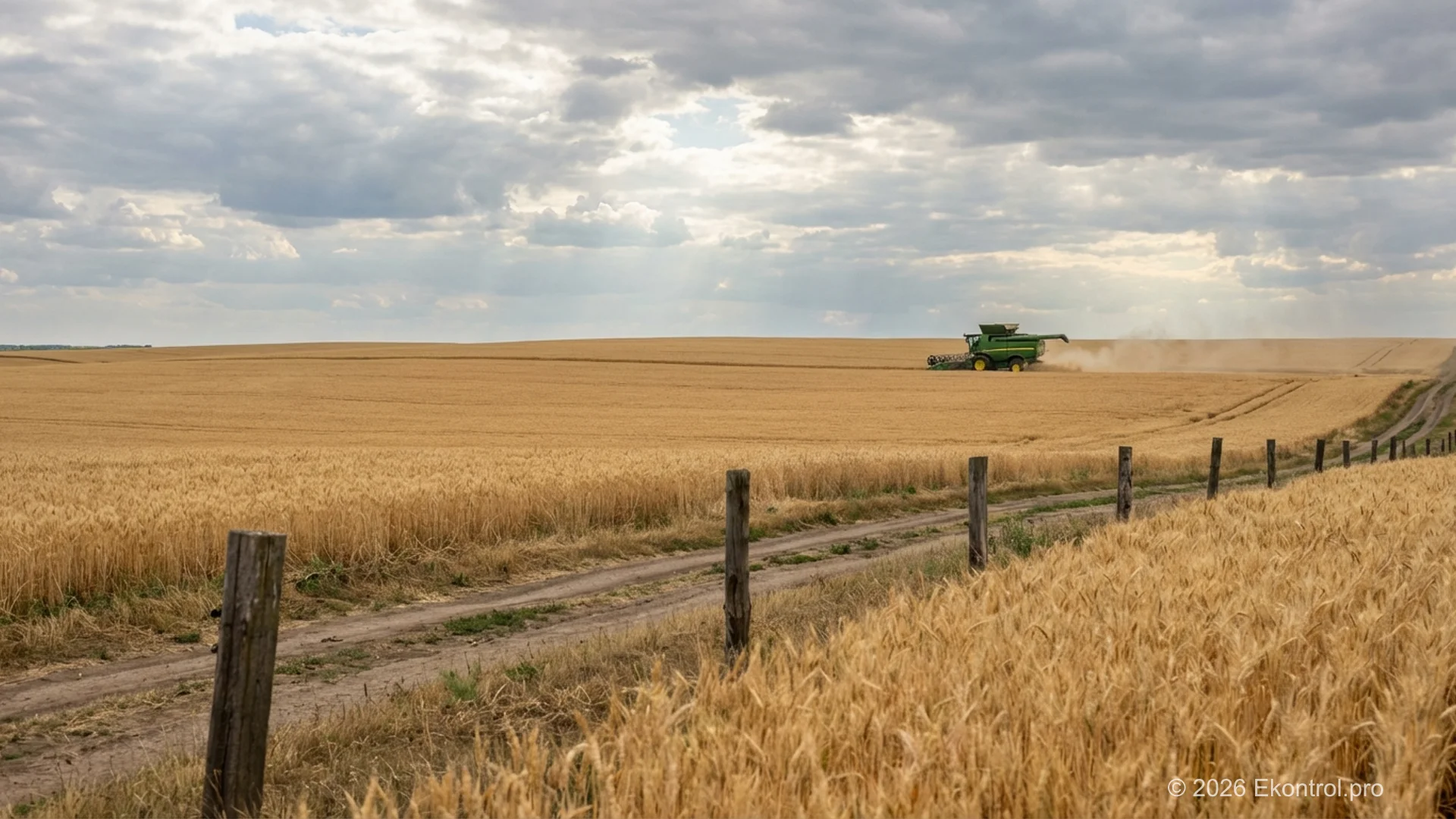

Grain Logistics in Ukraine 2026: Multimodal Architecture and Export Margins
Grain logistics in Ukraine determines the net profitability of an export contract more directly than daily futures swings on CBOT or MATIF. For operators in agriculture and commodity trading, the spread between CPT-port and EXW-silo prices comes down to how efficiently you manage inland haulage, elevator drying, rail wagon turnaround, and port fobbing. By early 2026, Ukraine's Black Sea maritime corridor through the deep-sea ports of Greater Odesa (Pivdennyi, Chornomorsk, and Odesa) surpassed 100 million tons of agricultural cargo transported since its launch, handling roughly 80% of the country's grain and oilseed export volume.
Yet booking trucks, rail hoppers, and vessels is only half the equation in 2026. European feed mills, food processors, and biofuel refineries buy Ukrainian corn, wheat, rapeseed, soybeans, and sunflower meal under strict Chain of Custody and food safety conditions:
- a certified sustainable rapeseed or corn lot loses its 15 to 25 EUR/ton market premium if the exporter uses an overly long diesel trucking leg that pushes lifecycle greenhouse gas emissions above the statutory EU cap;
- loading bulk grain or meal into a compartment that previously carried a prohibited cargo without a documented
LCIinspection immediately invalidates feed safety compliance under GMP+ International rules; - uncoordinated wagon arrivals at port terminals trigger vessel laytime overruns and five-figure daily demurrage penalties.
Moving from reactive vehicle dispatching to an engineered multimodal supply chain requires accurate ton-kilometer cost modeling, moisture and shrinkage control, and integrated compliance standards. For a detailed look at how these logistics factors shape oilseed processing and export routes, see our analysis of the Ukrainian soybean market 2026.
Road Grain Carriers and Rail Hopper Wagons: 1520 mm vs. 1435 mm Gauge Engineering
Inland grain logistics in Ukraine relies on balancing road tipping trucks with main-line rail hopper trains. Each transport mode operates within strict physical, payload, and distance boundaries.
1. Road Grain Carriers and Weight-in-Motion (WIM) Enforcement
Road transport delivers maximum flexibility on the first mile from field to inland silo and on short-to-medium direct hauls to river or sea terminals (within a 50 to 250 km radius). Grain moves by road in two primary formats: bulk (in aluminum or steel tipping semi-trailers with 45 to 60 m³ bodies) and bagged (in 1-ton polypropylene big bags).
Every road freight calculation is governed by Ukraine's automated Weight-in-Motion (WIM) axle-load enforcement. Under the statutory 40-ton maximum gross vehicle weight limit, a standard road grain carrier achieves a net payload of 22 to 26 tons, depending on tractor and trailer tare weight. Although average road haulage legs stretched from 400 km up to 1,000 km during earlier route disruptions, high diesel consumption (32 to 38 liters per 100 km under load) makes long-haul trucking in 2026 economical mainly for high-margin oilseeds or urgent spot lots.
2. Rail Hopper Wagons and the 1520 mm / 1435 mm Gauge Transition
For distances above 300 to 400 km and high consignment volumes, rail remains the structural backbone of Ukrainian grain exports. Before 2022, approximately 65% of export grain reached Black Sea port terminals by rail. In the first 7 months of 2024 alone, state operator Ukrzaliznytsia (UZ) transported 24.3 million tons of grain cargo, an increase of 6.15 million tons (or +33%) compared to the same period of the previous year.
Unit rail economics depend heavily on the relationship between hopper wagon cubic volume and crop bulk density (test weight):
- for heavy grains (wheat at $0.75-0.79\ \text{t/m}^3$, corn at $0.72-0.75\ \text{t/m}^3$, soybeans at $0.70-0.74\ \text{t/m}^3$), a standard grain hopper with a $94-104\ \text{m}^3$ body loads right up to its 65 to 70-ton weight limit;
- for low-density oilseeds (sunflower seed at $0.38-0.42\ \text{t/m}^3$), a $94\ \text{m}^3$ wagon cubes out at just 36 to 40 tons, inflating the per-ton freight rate unless you book high-cube hoppers ($116-120\ \text{m}^3$).
When exporting overland into the European Union via western border crossings (Yahodyn-Dorohusk, Izov-Hrubieszow, Mostyska-Medyka, Chop-Cierna nad Tisou / Zahony, or Vadul-Siret-Vicsani), engineers must overcome the track gauge break between Ukraine's broad gauge (1520 mm) and the European standard gauge (1435 mm). Three technical methods are used:
- Dry-bulk terminal transshipment (1520 mm wagon -> buffer silo -> 1435 mm wagon): Grain discharges through bottom hopper gates into receiving pits and moves via bucket elevators into European Tadns/Tagnpps wagons at 150 to 400 tons/hour. While fast, every mechanical transfer increases kernel breakage by 0.5% to 1.5% and introduces cross-contamination risks.
- Bogie exchange: The wagon body is lifted on synchronized jacks while 1520 mm bogies are rolled out and replaced with 1435 mm bogies. This preserves cargo seals and lot identity but is constrained by bogie inventory and braking compatibility.
- Dual-gauge grain hopper wagons (Model 19-8005-U): Engineered and built by Ukrzaliznytsia using domestic components, the model 19-8005-U grain hopper is designed specifically to operate on both 1520 mm and 1435 mm tracks. It carries a 70-ton payload in a 104 m³ body with 5 top loading hatches, 6 bottom discharge gates, and a 120 km/h design speed, cutting border transit delays.
Benchmark rates vs. contract tariffs. Published UAH/km road benchmarks and baseline daily rail wagon lease rates are starting points for budgeting, not final contract prices. Your actual 2026 freight cost depends on whether you ship 54-wagon block trains or single-wagon groups, terminal turnaround speed, empty return mileage, and seasonal port queues.
River Barges and Deep-Sea Ports in Grain Logistics in Ukraine: Handysize and Panamax
Maritime and river routes connect Ukrainian grain to destination markets across North Africa, the Middle East, Europe, and Asia. In 2026, waterborne exports operate across two complementary channels: the Greater Odesa deep-sea ports and the Danube river cluster.
1. Deep-Sea Ports of Greater Odesa (Pivdennyi, Chornomorsk, Odesa)
Deep-water berths (11.5 to 16.0 meters draft) allow Ukrainian exporters to capture maximum ocean freight economies of scale. During the initial phase of the Ukrainian sea corridor starting in August 2023, 1,140 vessels departed carrying 33.8 million tons of cargo to 40 countries (surpassing the earlier grain deal benchmark of nearly 33 million tons total exports, including 23.1 million tons of agricultural goods). By early 2026, cumulative agricultural shipments through the corridor exceeded 100 million tons.
Exporters match vessel size to destination port draft and contract volume:
- Handysize bulkers (
25,000 to 35,000 DWT) serve Mediterranean, North African, and European ports (Spain, Italy, Egypt, Turkey, Netherlands); - Supramax / Ultramax (
50,000 to 64,000 DWT) and Panamax / Kamsarmax (65,000 to 82,000 DWT) vessels deliver the lowest per-ton ocean freight on long-haul routes to China, Indonesia, Bangladesh, and Vietnam.
2. River Transport and the Danube Cluster (Izmail, Reni, Ust-Dunaisk)
River logistics and the Danube ports provide regional export capacity and essential contingency routing while Mykolaiv and Kherson port terminals remain restricted by security conditions. Non-self-propelled river barges (1,500 to 3,000 tons, 2.5 to 3.8 m draft) and shallow-draft coasters (3,000 to 7,000 DWT) transit the Bystre and Sulina channels either directly to Mediterranean buyers or to the Port of Constanta (Romania) for ship-to-ship transshipment onto Panamax vessels.
How Grain Logistics Costs Are Formed in Ukraine: Ton-Kilometer Rates and Demurrage
How do you calculate delivery costs accurately so hidden fees don't wipe out your trading margin? You have to model Total Landed Logistics Cost across every link in the chain.
For road transport budgeting, the market uses a baseline distance benchmark of roughly UAH 200 per 100 km alongside indicative per-kilometer brackets by vehicle payload capacity:
- up to 5 tons: from UAH 28/km;
- up to 10 tons: from UAH 30/km;
- up to 20 tons: from UAH 40/km;
- up to 40 tons gross vehicle weight: from UAH 60/km.
When engineering the full per-ton cost of a rail-to-sea export shipment, five operational cost drivers determine your final margin:
- Rail infrastructure tariff and daily wagon lease: Total rail freight equals Ukrzaliznytsia's regulated infrastructure and traction tariff plus the daily lease rate of the hopper wagon multiplied by total turnaround days (loading, loaded transit, port queue, discharge, and empty return run). Shipping a scheduled 54-wagon block train (
маршрутна відправка) from a single step-loading elevator to a single port terminal achieves speeds above 320 km/day and cuts per-ton rail costs compared to fragmented single-wagon dispatches. - Port transshipment tariff (Fobbing): Covers railcar or truck intake, weighing, rapid laboratory testing, silo buffering (typically 10 to 15 days of free accumulation storage), customs/phytosanitary clearance, and ship loading.
- Laytime, Demurrage, and Despatch optimization: Maritime voyage charters (under
SYNACOMEXorGRAINCONcharter parties) specify an agreed daily loading rate (for example, 8,000 to 12,000 metric tons per Weather Working Day,WWD SHINC). If rail delays or moisture rework cause the vessel to exceed allowed laytime, the exporter pays the shipowner daily demurrage. Conversely, if high-capacity ship loaders finish loading ahead of laytime, the exporter earns despatch (typically 50% of the demurrage rate). - Truck and wagon detention control: Using electronic slot-booking queues at port gates prevents trucks and leased hopper wagons from sitting idle and racking up daily detention penalties.
- Marine war risk insurance: Stabilized navigation along the Black Sea corridor has substantially lowered war risk insurance premiums compared to 2022 and 2023 levels, improving netback prices for Ukrainian farmers.
| Transport Mode and Rolling Stock | Optimal Distance and Consignment Size | Primary Engineering Advantage | Main Operational and Compliance Risk |
|---|---|---|---|
| Road grain carriers (tipping semi-trailers, 22-26 t net payload under 40 t WIM limit) | 50 to 300 km; flexible lots from 25 to 1,000 tons | Fast farm pickup, direct door-to-terminal routing, zero rail siding dependency | High diesel cost sensitivity (32-38 L/100 km), WIM fines, and high GHG emissions per ton-km |
| Broad-gauge rail hoppers (1520 mm, 65-70 t payload, 94-120 m³ volume) | 350+ km; 54-wagon block trains (3,500 to 3,800 tons per train) | Low ton-km cost, backbone feed to Greater Odesa ports (65% historical share) | Requires block-train loading speed; low-density sunflower seed cubes out in 94 m³ cars |
| Dual-gauge rail hoppers Model 19-8005-U (1520 mm / 1435 mm, 70 t, 104 m³) | Cross-border overland routes Ukraine to EU (600 to 1,500 km) | Eliminates grain-to-grain transshipment at EU border, preserving seal integrity and kernel quality | Constrained by border bogie-swapping slot capacity and European rail path allocation |
| River barges and Danube coasters (1,500 to 7,000 DWT) | Regional river basins and Danube ports to Constanta roadstead | Alternative export route and ship-to-ship Panamax topping-off capability | Capital-intensive; sensitive to water levels and Bystre/Sulina canal draft limits |
| Deep-sea bulkers Handysize, Supramax, Panamax (25,000 to 82,000 DWT) | International ocean routes to 40+ countries (80% of Ukrainian grain exports) | Lowest ocean freight per ton and direct access to global importers | High daily vessel demurrage exposure if port cargo accumulation stalls |
Elevator Tariff Engineering: Drying, Cleaning, and the Duvall Shrinkage Formula
Safe grain logistics starts at the inland elevator before a single wagon is loaded. Loading grain with excess moisture or elevated temperature into a sealed steel hopper wagon or ship hold triggers biological respiration, self-heating, rapid mycotoxin synthesis, and costly cargo rejection at destination.
Strict technological moisture ceilings apply to bulk grain transport in Ukraine:
- for wheat, barley, and standard small grains, moisture during transit must not exceed 14.0% to 15.0%;
- for corn (maize), the critical upper moisture limit for long-distance rail and sea export is 13.0% to 14.0%;
- for oilseeds: soybeans max 12.0%, rapeseed and sunflower seed max 7.0% to 8.0%.
When freshly harvested corn arrives from the field at 22% to 26% moisture, the elevator charges a drying tariff per ton-percent (t·%) of moisture removed. The physical weight loss (moisture shrinkage) of the consignment is governed by the Duvall formula:
$$\Delta M = 100 \times \frac{W_{\text{in}} - W_{\text{out}}}{100 - W_{\text{out}}}$$
where $\Delta M$ is the percentage weight shrinkage from drying ($%$), $W_{\text{in}}$ is the initial incoming moisture ($%$), and $W_{\text{out}}$ is the final dried moisture ($%$). For example, drying a 1,000-ton lot of corn from $22.0%$ down to a safe export moisture of $13.0%$ yields a physical mass reduction of:
$$\Delta M = 100 \times \frac{22.0 - 13.0}{100 - 13.0} = 10.34% \quad (103.4\ \text{metric tons})$$
That means 1,000 tons of wet field corn leaves you with 896.6 tons of dry shippable cargo (before mechanical cleaning losses), which directly determines how many hopper wagons you should book.
There's also a major food safety hazard in elevator drying that every exporter to the EU must control: Polycyclic Aromatic Hydrocarbons (PAHs), including benzo(a)pyrene. If an elevator uses solid-fuel biomass burners (wood chips, sunflower husk pellets, or straw) with direct flue-gas contact instead of an indirect heat exchanger, smoke particulates coat the grain and oilseeds. EU border laboratories routinely test sunflower oil, meal, and corn for PAHs, and a positive test triggers a border rejection. During an elevator diagnostic audit, Ekontrol engineers inspect dryer heat exchangers to eliminate PAH contamination risks.
Moisture control prevents transit spoilage. Grain moisture during transport must not exceed 15% (corn: 13%). Exceeding these limits accelerates mold growth and mycotoxin formation inside rail hoppers and vessel holds. If you need assistance setting up grain quality control and HACCP monitoring across your storage and transport network, our experts are ready to help.
Feed Safety in Grain Logistics in Ukraine: GMP+ FSA Transport (TS 1.9), IDTF, and Cleaning Regimes
Over 60% of Ukraine's corn, feed wheat, barley, soybean, and oilseed meal exports to the European Union enter the animal feed supply chain. Under EU feed industry rules, GMP+-certified compound feed manufacturers can only purchase and transport feed materials using suppliers and carriers certified under GMP+ (specifically the former GMP+ B4 Transport standard, replaced under the GMP+ FC scheme 2020 by the Road transport of feed scope together with Technical Specification TS 1.9 Transport).
The operational backbone of GMP+ International transport compliance is the IDTF (International Database Transport for Feed), jointly maintained by the International Committee for Road Transport (ICRT: GMP+, OVOCOM, QS, Qualimat, and EFISC-GTP). The IDTF database assigns a mandatory minimum cleaning and disinfection regime for thousands of bulk products to prevent chemical, physical, or microbiological cross-contamination from previous loads.
Before loading any bulk truck, container, rail hopper, or river barge with feed grain or oilseed meal, the dispatcher and loading inspector must verify the sequence of at least the 3 preceding loads in the IDTF database and execute the required cleaning regime (A, B, C, or D):
- Regime A (Dry Cleaning): Thorough sweeping, brushing, vacuuming, or compressed-air cleaning. Used after benign dry agricultural goods (such as dry grains or oilseeds) where residues are easily removed without water and introducing moisture into the compartment is undesirable.
- Regime B (Cleaning with Water): Washing and rinsing the loading compartment with potable-quality water, followed by complete drying. Required after damp, sticky, or dusty feed ingredients whose residues dissolve in water.
- Regime C (Cleaning with Water and a Cleansing Agent): Wet washing (typically with hot water above $+55,^\circ\text{C}$) combined with an approved food/feed-grade alkaline or acidic detergent, followed by clean water rinsing and complete drying. Mandatory after cargoes that leave greasy, oily, or chemically adherent films.
- Regime D (Disinfection): Applying an officially approved disinfectant after completing base cleaning regime A, B, or C, followed by rinsing and drying. Mandated when the previous cargo carries microbiological or animal-health risks (such as specific animal by-products or moist organic materials).
What if a truck or railcar previously carried a product that is not listed in the IDTF with an A, B, C, or D regime, or is classified on the Forbidden Loads list (such as mineral oils, toxic chemicals, household waste, untreated manure, asbestos, or banned animal proteins)? That compartment is strictly barred from carrying animal feed unless it undergoes a formal GMP+ release procedure at a certified cleaning station (with an EFTCO cleaning certificate) and is signed off by an independent inspector.
Every loading operation concludes with a mandatory physical visual check: the LCI (Load Compartment Inspection). Before a single ton of grain flows into the vehicle, the inspector verifies and signs the LCI log confirming that the compartment is completely empty, clean, dry, free of foreign odors, rust flakes, or pest infestation, and fitted with intact waterproof tarpaulins and gate seals.
ISO/TS 22002-5 and FSSC 22000 Category G Requirements for Grain Transport and Storage
When grain, food-grade soybeans, milling wheat, groats, flour, or refined vegetable oils are destined for human consumption, logistics operators and port terminals certify their management systems under ISO 22000 or the GFSI-benchmarked FSSC 22000 Category G (Transport and Storage) scheme, which incorporates the prerequisite program standard ISO/TS 22002-5:2019 (Prerequisite programmes on food safety - Part 5: Transport and storage).
During the implementation of FSSC 22000 and ISO/TS 22002-5, grain logistics teams must engineer four critical food safety controls:
- Allergen Cross-Contact Prevention: Under Regulation (EU) No 1169/2011, soybeans, gluten-containing cereals (wheat, rye, barley, oats), and mustard are regulated food allergens. Hauling gluten-free corn, buckwheat, or hulled sunflower kernels in a truck or through an elevator leg that previously handled wheat, barley, or mustard seed without validated flushing and cleaning causes allergen cross-contact and triggers rapid alert notifications (
RASFF) at EU borders. - In-Transit Fumigation Safety and Phosphine ($\text{PH}_3$) Degassing: Fumigating grain in railcars or ship holds with aluminum or magnesium phosphide tablets requires documented dosage logs, gas-tight sealing, exposure monitoring based on grain temperature, and mandatory instrumental gas clearance testing prior to discharge in line with the rules of the State Service of Ukraine on Food Safety and Consumer Protection and the Law of Ukraine No. 2042-VIII.
- Tamper-Evident Seal Traceability: All 5 top loading hatches and 6 bottom discharge gates on a rail hopper wagon, as well as truck discharge chutes and container doors, must be secured with uniquely numbered high-security seals recorded on the CMR, SMGS/CIM rail waybill, or Bill of Lading.
- Pre-Shipment Testing Under ISO/IEC 17025: Representative sampling under
ISO 24333orGAFTA No. 124and testing in an accredited laboratory verify moisture, foreign matter, protein, oil content, falling number, and mycotoxin compliance at every custody transfer point. For a deep engineering look at mycotoxin sampling in grain chains, see our guide on the GMP+ protocol for aflatoxin B1 monitoring in maize.
| IDTF Cleaning Regime | Sanitary Treatment Method for Truck / Hopper | Typical Preceding Loads (Pre-Cargo) | Mandatory Documentary Verification Prior to Loading |
|---|---|---|---|
| Regime A (Dry Cleaning) | Dry mechanical cleaning: sweeping, brushing, industrial vacuuming, or compressed air without water | Dry grains (wheat, corn, barley), dry oilseeds free of grease or mold residues | Signed LCI (Load Compartment Inspection) record, 3-prior-load log, and allergen cross-contact check |
| Regime B (Cleaning with Water) | High-pressure washing with potable-quality water followed by complete compartment drying | Damp plant feed materials, pelleted beet pulp, dusty feed ingredients leaving water-soluble residues | Washing station record and visual LCI inspection confirming zero standing moisture in corners or seals |
| Regime C (Water + Cleansing Agent) | Hot-water washing with an approved food/feed-grade alkaline or acidic detergent, rinsing, and drying | Vegetable oils, fats, molasses, feed additives, and fertilizers assigned Regime C in the IDTF | Official washing certificate specifying detergent name and concentration, plus signed LCI checklist |
| Regime D (Disinfection) | Base cleaning (A, B, or C) followed by chemical disinfection with an approved agent, rinsing, and drying | Cargoes carrying microbiological risks or sensitive by-products assigned Regime D in the IDTF | Certified disinfection certificate (EFTCO or approved wash bay), swab verification if required, and LCI sign-off |
| Forbidden Loads | Standard washing prohibited; compartment locked out from feed transport without formal release | Animal proteins (MBM), manure, toxic chemicals, mineral lubricants, municipal waste, asbestos | Loading strictly prohibited; release requires specialized decontamination and independent inspector sign-off |
Transport GHG Emissions (e_td) Under ISCC EU, REDcert, KZR INiG, and 2BSvs
If you export Ukrainian rapeseed, corn, or soybeans to European biodiesel (FAME/HVO) or bioethanol producers, your logistics route directly affects your cargo's carbon intensity and market price. Under Directive (EU) 2018/2001 (RED II) and Directive (EU) 2023/2413 (RED III), biofuels produced in installations starting operation from January 1, 2021 onward must achieve at least a 65% greenhouse gas (GHG) emissions saving compared to the fossil fuel comparator ($EF_f = 94\ \text{g CO}_2\text{eq/MJ}$). To clear that 65% bar, total lifecycle emissions ($E$) cannot exceed $32.9\ \text{g CO}_2\text{eq/MJ}$ (with newer RED III categories tightening to 70% and 80%).
Exporters prove compliance through European Commission-recognized voluntary schemes: ISCC (ISCC EU), REDcert (REDcert-EU), Poland's KZR INiG system, or France's 2BSvs scheme. Under ISCC EU System Document 205, total lifecycle emissions ($E$) are calculated as:
$$E = e_{ec} + e_l + e_p + e_{td} + e_u - e_{sca} - e_{ccs} - e_{ccr}$$
where $e_{ec}$ covers cultivation emissions, $e_l$ covers land-use change, $e_p$ covers processing, and $e_{td}$ represents emissions from transport and distribution across every leg from the Ukrainian farm to the European refinery.
From ISCC EU Document 205 version 4.2 onward, ISCC no longer publishes standalone emission factor tables in its document annexes; economic operators must apply the standard emission factors anchored in Commission Implementing Regulation (EU) 2022/996 (Annex IX). For each transport leg, specific transport emissions per metric ton of dry feedstock ($e_{td,\text{leg}}$) are calculated from actual fuel or energy consumption:
$$e_{td,\text{leg}} = \frac{(d_{\text{loaded}} \times FC_{\text{loaded}} + d_{\text{empty}} \times FC_{\text{empty}}) \times EF_{\text{fuel}}}{M_{\text{cargo}}}$$
where $d_{\text{loaded}}$ is the loaded haul distance ($\text{km}$), $d_{\text{empty}}$ is the empty return run distance ($\text{km}$), $FC_{\text{loaded}}$ and $FC_{\text{empty}}$ are specific diesel ($\text{L/km}$) or electric traction consumption rates, $EF_{\text{fuel}}$ is the statutory fuel emission factor from Implementing Regulation (EU) 2022/996, and $M_{\text{cargo}}$ is the net tonnage transported.
This mathematical reality makes modal choice a major commercial driver:
- hauling rapeseed or corn 1,000 km by road in diesel trucks (including the empty return leg) inflates $e_{td}$ and can push a consignment over the $32.9\ \text{g CO}_2\text{eq/MJ}$ ceiling, stripping away its sustainability certification;
- combining a short farm-to-silo road leg (under 80 km) with electrified Ukrzaliznytsia rail haulage and a deep-sea Panamax vessel cuts $e_{td}$ dramatically, preserving the full sustainability premium.
Note that traders with or without storage don't calculate GHG values themselves, but they are legally required to pass on exact transport modes and distances on the Sustainability Declaration (SD) to the next supply chain actor. Missing CMR notes or inconsistent mileage records during an audit result in major nonconformities.
| Certification Standard | Target Market and Commodity Scope | Core Logistics and Elevator Requirement | Primary Audit Evidence Verified |
|---|---|---|---|
| GMP+ FSA / TS 1.9 Transport | EU compound feed sector (corn, feed wheat, barley, soybeans, meal, vegetable oil) | 3-preceding-load verification in IDTF, Regime A/B/C/D cleaning execution, and pre-loading LCI check | Signed LCI logs, EFTCO washing/disinfection certificates, and CMR notes with cleanliness sign-off |
| FSSC 22000 Cat. G (ISO/TS 22002-5) | Human food supply chain (milling wheat, food-grade soy, groats, flour, edible oils) | Allergen cross-contact flushing (soy/gluten/mustard), phosphine degassing safety, and seal logs | Documented PRPs, equipment flushing logs, PH3 gas-clearance records, and seal number registries |
| ISCC EU (Doc 205) and REDcert-EU | EU biofuel feedstock market (rapeseed, corn, soy, technical oils) under RED II / RED III | Site-level Mass Balance accounting and exact transport mode/distance reporting using (EU) 2022/996 | Sustainability Declarations (SD), quarterly mass-balance ledgers, waybills, and Bills of Lading |
| KZR INiG and 2BSvs | Biofuel and renewable energy processors in Poland, France, and Central Europe | Traceability to point of origin, elevator drying fuel/electricity tracking, and transport leg documentation | KZR / 2BSvs declarations, elevator drying shrinkage records (Duvall formula), and scale tickets |
| ISO/IEC 17025 (Testing Laboratories) | All GAFTA / FOSFA export contracts and statutory veterinary/phytosanitary border control | Representative sampling per ISO 24333, testing for moisture, mycotoxins, PAHs, pesticides, and GMOs | Accredited pre-shipment Certificate of Analysis (CoA), sampling act, and sealed arbitration sample |
Grain Logistics Readiness Checklist in Ukraine: Certification and Season Preparation
To stabilize your grain logistics model in 2026 and protect your export margins against demurrage, quality claims, and audit nonconformities, run through this seven-step operational checklist before peak season:
- Build a full multimodal route cost model. Calculate total landed cost per ton from each inland silo to vessel rail (
FOB) or EU border (DAP), incorporating Duvall moisture shrinkage, wagon turnaround days, port fobbing tariffs, and queue buffers. - Match hopper wagon cubic capacity to crop bulk density. Book high-cube hoppers ($116-120\ \text{m}^3$) for low-density sunflower seed and meal, standard hoppers ($94-104\ \text{m}^3$) for wheat and corn, and dual-gauge
19-8005-Uwagons for direct 1435 mm rail shipments into the EU. - Enforce mandatory IDTF cargo-history screening across all carriers. Require every road carrier and rail operator to submit documented records of their last 3 loads under GMP+ rules and complete a signed
LCIinspection before loading. - Audit elevator grain dryers and conveyor flushing under FSSC 22000. Verify that solid-fuel grain dryers use intact indirect heat exchangers to prevent PAH (benzo(a)pyrene) contamination, and validate cleaning protocols between soy, gluten grains, and rapeseed.
- Optimize transport GHG emissions ($e_{td}$) for ISCC, REDcert, KZR INiG, and 2BSvs. Shift long-distance hauls from diesel trucks to electrified rail and sea vessels so your biofuel feedstocks easily clear the 65% GHG savings threshold under Implementing Regulation (EU) 2022/996.
- Anchor pre-shipment quality release in ISO/IEC 17025 accredited labs. Test every accumulated batch for moisture, mycotoxins, and pesticide residues prior to vessel loading or block-train dispatch.
- Align export contracts with EU buyer protection rules. Synchronize charter-party laytime clauses with terminal loading rates and review your EU buyer contracts in light of the new EU rules protecting farmers from unfair trading practices.
2026 Season Readiness Checklist: Route cost models updated with Duvall shrinkage, elevator dryers verified PAH-free, carrier contracts aligned with GMP+ IDTF and FSSC 22000 LCI protocols, and ISCC e_td transport distances mapped under Regulation (EU) 2022/996. Want an expert review of your supply chain before harvest or audit? Book a diagnostic audit with Ekontrol.
Summary: Grain Logistics in Ukraine as an Engineered Cost and Compliance System
In 2026, grain logistics in Ukraine operates as an integrated multimodal system where the Black Sea corridor (having surpassed 100 million tons of agricultural exports and handling roughly 80% of outbound flows) works alongside main-line rail block trains, dual-gauge 19-8005-U hopper wagons, and the Danube river cluster. The exporters capturing the highest netback margins are those who manage logistics through rigorous engineering: controlling moisture shrinkage via the Duvall formula, eliminating vessel demurrage, and optimizing wagon turnaround.
At the same time, physical transport is inseparable from international certification compliance. Maintaining verified controls under GMP+, FSSC 22000, ISO 22000, accredited pre-shipment testing under ISO/IEC 17025, and accurate transport GHG reporting under ISCC, REDcert, KZR INiG, and 2BSvs protects Ukrainian cargoes from border rejections and locks in premium European pricing.
To explore how these export flows fit into global trade shifts, read our analysis of the world agricultural map after the full-scale war: 8 facts. If your organization needs certification preparation for an elevator, transport fleet, or trading desk, or ongoing compliance management through our annual support program, contact the Ekontrol team.
Need a certification consultation?
Free ConsultationOn This Page
- Grain Logistics in Ukraine 2026: Multimodal Architecture and Export Margins
- Road Grain Carriers and Rail Hopper Wagons: 1520 mm vs. 1435 mm Gauge Engineering
- River Barges and Deep-Sea Ports in Grain Logistics in Ukraine: Handysize and Panamax
- How Grain Logistics Costs Are Formed in Ukraine: Ton-Kilometer Rates and Demurrage
- Elevator Tariff Engineering: Drying, Cleaning, and the Duvall Shrinkage Formula
- Feed Safety in Grain Logistics in Ukraine: GMP+ FSA Transport (TS 1.9), IDTF, and Cleaning Regimes
- ISO/TS 22002-5 and FSSC 22000 Category G Requirements for Grain Transport and Storage
- Transport GHG Emissions (e_td) Under ISCC EU, REDcert, KZR INiG, and 2BSvs
- Grain Logistics Readiness Checklist in Ukraine: Certification and Season Preparation
- Summary: Grain Logistics in Ukraine as an Engineered Cost and Compliance System
Grain Logistics in Ukraine 2026: Multimodal Architecture and Export Margins
Grain logistics in Ukraine determines the net profitability of an export contract more directly than daily futures swings on CBOT or MATIF. For operators in agriculture and commodity trading, the spread between CPT-port and EXW-silo prices comes down to how efficiently you manage inland haulage, elevator drying, rail wagon turnaround, and port fobbing. By early 2026, Ukraine's Black Sea maritime corridor through the deep-sea ports of Greater Odesa (Pivdennyi, Chornomorsk, and Odesa) surpassed 100 million tons of agricultural cargo transported since its launch, handling roughly 80% of the country's grain and oilseed export volume.
Yet booking trucks, rail hoppers, and vessels is only half the equation in 2026. European feed mills, food processors, and biofuel refineries buy Ukrainian corn, wheat, rapeseed, soybeans, and sunflower meal under strict Chain of Custody and food safety conditions:
- a certified sustainable rapeseed or corn lot loses its 15 to 25 EUR/ton market premium if the exporter uses an overly long diesel trucking leg that pushes lifecycle greenhouse gas emissions above the statutory EU cap;
- loading bulk grain or meal into a compartment that previously carried a prohibited cargo without a documented
LCIinspection immediately invalidates feed safety compliance under GMP+ International rules; - uncoordinated wagon arrivals at port terminals trigger vessel laytime overruns and five-figure daily demurrage penalties.
Moving from reactive vehicle dispatching to an engineered multimodal supply chain requires accurate ton-kilometer cost modeling, moisture and shrinkage control, and integrated compliance standards. For a detailed look at how these logistics factors shape oilseed processing and export routes, see our analysis of the Ukrainian soybean market 2026.
Road Grain Carriers and Rail Hopper Wagons: 1520 mm vs. 1435 mm Gauge Engineering
Inland grain logistics in Ukraine relies on balancing road tipping trucks with main-line rail hopper trains. Each transport mode operates within strict physical, payload, and distance boundaries.
1. Road Grain Carriers and Weight-in-Motion (WIM) Enforcement
Road transport delivers maximum flexibility on the first mile from field to inland silo and on short-to-medium direct hauls to river or sea terminals (within a 50 to 250 km radius). Grain moves by road in two primary formats: bulk (in aluminum or steel tipping semi-trailers with 45 to 60 m³ bodies) and bagged (in 1-ton polypropylene big bags).
Every road freight calculation is governed by Ukraine's automated Weight-in-Motion (WIM) axle-load enforcement. Under the statutory 40-ton maximum gross vehicle weight limit, a standard road grain carrier achieves a net payload of 22 to 26 tons, depending on tractor and trailer tare weight. Although average road haulage legs stretched from 400 km up to 1,000 km during earlier route disruptions, high diesel consumption (32 to 38 liters per 100 km under load) makes long-haul trucking in 2026 economical mainly for high-margin oilseeds or urgent spot lots.
2. Rail Hopper Wagons and the 1520 mm / 1435 mm Gauge Transition
For distances above 300 to 400 km and high consignment volumes, rail remains the structural backbone of Ukrainian grain exports. Before 2022, approximately 65% of export grain reached Black Sea port terminals by rail. In the first 7 months of 2024 alone, state operator Ukrzaliznytsia (UZ) transported 24.3 million tons of grain cargo, an increase of 6.15 million tons (or +33%) compared to the same period of the previous year.
Unit rail economics depend heavily on the relationship between hopper wagon cubic volume and crop bulk density (test weight):
- for heavy grains (wheat at $0.75-0.79\ \text{t/m}^3$, corn at $0.72-0.75\ \text{t/m}^3$, soybeans at $0.70-0.74\ \text{t/m}^3$), a standard grain hopper with a $94-104\ \text{m}^3$ body loads right up to its 65 to 70-ton weight limit;
- for low-density oilseeds (sunflower seed at $0.38-0.42\ \text{t/m}^3$), a $94\ \text{m}^3$ wagon cubes out at just 36 to 40 tons, inflating the per-ton freight rate unless you book high-cube hoppers ($116-120\ \text{m}^3$).
When exporting overland into the European Union via western border crossings (Yahodyn-Dorohusk, Izov-Hrubieszow, Mostyska-Medyka, Chop-Cierna nad Tisou / Zahony, or Vadul-Siret-Vicsani), engineers must overcome the track gauge break between Ukraine's broad gauge (1520 mm) and the European standard gauge (1435 mm). Three technical methods are used:
- Dry-bulk terminal transshipment (1520 mm wagon -> buffer silo -> 1435 mm wagon): Grain discharges through bottom hopper gates into receiving pits and moves via bucket elevators into European Tadns/Tagnpps wagons at 150 to 400 tons/hour. While fast, every mechanical transfer increases kernel breakage by 0.5% to 1.5% and introduces cross-contamination risks.
- Bogie exchange: The wagon body is lifted on synchronized jacks while 1520 mm bogies are rolled out and replaced with 1435 mm bogies. This preserves cargo seals and lot identity but is constrained by bogie inventory and braking compatibility.
- Dual-gauge grain hopper wagons (Model 19-8005-U): Engineered and built by Ukrzaliznytsia using domestic components, the model 19-8005-U grain hopper is designed specifically to operate on both 1520 mm and 1435 mm tracks. It carries a 70-ton payload in a 104 m³ body with 5 top loading hatches, 6 bottom discharge gates, and a 120 km/h design speed, cutting border transit delays.
Benchmark rates vs. contract tariffs. Published UAH/km road benchmarks and baseline daily rail wagon lease rates are starting points for budgeting, not final contract prices. Your actual 2026 freight cost depends on whether you ship 54-wagon block trains or single-wagon groups, terminal turnaround speed, empty return mileage, and seasonal port queues.
River Barges and Deep-Sea Ports in Grain Logistics in Ukraine: Handysize and Panamax
Maritime and river routes connect Ukrainian grain to destination markets across North Africa, the Middle East, Europe, and Asia. In 2026, waterborne exports operate across two complementary channels: the Greater Odesa deep-sea ports and the Danube river cluster.
1. Deep-Sea Ports of Greater Odesa (Pivdennyi, Chornomorsk, Odesa)
Deep-water berths (11.5 to 16.0 meters draft) allow Ukrainian exporters to capture maximum ocean freight economies of scale. During the initial phase of the Ukrainian sea corridor starting in August 2023, 1,140 vessels departed carrying 33.8 million tons of cargo to 40 countries (surpassing the earlier grain deal benchmark of nearly 33 million tons total exports, including 23.1 million tons of agricultural goods). By early 2026, cumulative agricultural shipments through the corridor exceeded 100 million tons.
Exporters match vessel size to destination port draft and contract volume:
- Handysize bulkers (
25,000 to 35,000 DWT) serve Mediterranean, North African, and European ports (Spain, Italy, Egypt, Turkey, Netherlands); - Supramax / Ultramax (
50,000 to 64,000 DWT) and Panamax / Kamsarmax (65,000 to 82,000 DWT) vessels deliver the lowest per-ton ocean freight on long-haul routes to China, Indonesia, Bangladesh, and Vietnam.
2. River Transport and the Danube Cluster (Izmail, Reni, Ust-Dunaisk)
River logistics and the Danube ports provide regional export capacity and essential contingency routing while Mykolaiv and Kherson port terminals remain restricted by security conditions. Non-self-propelled river barges (1,500 to 3,000 tons, 2.5 to 3.8 m draft) and shallow-draft coasters (3,000 to 7,000 DWT) transit the Bystre and Sulina channels either directly to Mediterranean buyers or to the Port of Constanta (Romania) for ship-to-ship transshipment onto Panamax vessels.
How Grain Logistics Costs Are Formed in Ukraine: Ton-Kilometer Rates and Demurrage
How do you calculate delivery costs accurately so hidden fees don't wipe out your trading margin? You have to model Total Landed Logistics Cost across every link in the chain.
For road transport budgeting, the market uses a baseline distance benchmark of roughly UAH 200 per 100 km alongside indicative per-kilometer brackets by vehicle payload capacity:
- up to 5 tons: from UAH 28/km;
- up to 10 tons: from UAH 30/km;
- up to 20 tons: from UAH 40/km;
- up to 40 tons gross vehicle weight: from UAH 60/km.
When engineering the full per-ton cost of a rail-to-sea export shipment, five operational cost drivers determine your final margin:
- Rail infrastructure tariff and daily wagon lease: Total rail freight equals Ukrzaliznytsia's regulated infrastructure and traction tariff plus the daily lease rate of the hopper wagon multiplied by total turnaround days (loading, loaded transit, port queue, discharge, and empty return run). Shipping a scheduled 54-wagon block train (
маршрутна відправка) from a single step-loading elevator to a single port terminal achieves speeds above 320 km/day and cuts per-ton rail costs compared to fragmented single-wagon dispatches. - Port transshipment tariff (Fobbing): Covers railcar or truck intake, weighing, rapid laboratory testing, silo buffering (typically 10 to 15 days of free accumulation storage), customs/phytosanitary clearance, and ship loading.
- Laytime, Demurrage, and Despatch optimization: Maritime voyage charters (under
SYNACOMEXorGRAINCONcharter parties) specify an agreed daily loading rate (for example, 8,000 to 12,000 metric tons per Weather Working Day,WWD SHINC). If rail delays or moisture rework cause the vessel to exceed allowed laytime, the exporter pays the shipowner daily demurrage. Conversely, if high-capacity ship loaders finish loading ahead of laytime, the exporter earns despatch (typically 50% of the demurrage rate). - Truck and wagon detention control: Using electronic slot-booking queues at port gates prevents trucks and leased hopper wagons from sitting idle and racking up daily detention penalties.
- Marine war risk insurance: Stabilized navigation along the Black Sea corridor has substantially lowered war risk insurance premiums compared to 2022 and 2023 levels, improving netback prices for Ukrainian farmers.
| Transport Mode and Rolling Stock | Optimal Distance and Consignment Size | Primary Engineering Advantage | Main Operational and Compliance Risk |
|---|---|---|---|
| Road grain carriers (tipping semi-trailers, 22-26 t net payload under 40 t WIM limit) | 50 to 300 km; flexible lots from 25 to 1,000 tons | Fast farm pickup, direct door-to-terminal routing, zero rail siding dependency | High diesel cost sensitivity (32-38 L/100 km), WIM fines, and high GHG emissions per ton-km |
| Broad-gauge rail hoppers (1520 mm, 65-70 t payload, 94-120 m³ volume) | 350+ km; 54-wagon block trains (3,500 to 3,800 tons per train) | Low ton-km cost, backbone feed to Greater Odesa ports (65% historical share) | Requires block-train loading speed; low-density sunflower seed cubes out in 94 m³ cars |
| Dual-gauge rail hoppers Model 19-8005-U (1520 mm / 1435 mm, 70 t, 104 m³) | Cross-border overland routes Ukraine to EU (600 to 1,500 km) | Eliminates grain-to-grain transshipment at EU border, preserving seal integrity and kernel quality | Constrained by border bogie-swapping slot capacity and European rail path allocation |
| River barges and Danube coasters (1,500 to 7,000 DWT) | Regional river basins and Danube ports to Constanta roadstead | Alternative export route and ship-to-ship Panamax topping-off capability | Capital-intensive; sensitive to water levels and Bystre/Sulina canal draft limits |
| Deep-sea bulkers Handysize, Supramax, Panamax (25,000 to 82,000 DWT) | International ocean routes to 40+ countries (80% of Ukrainian grain exports) | Lowest ocean freight per ton and direct access to global importers | High daily vessel demurrage exposure if port cargo accumulation stalls |
Elevator Tariff Engineering: Drying, Cleaning, and the Duvall Shrinkage Formula
Safe grain logistics starts at the inland elevator before a single wagon is loaded. Loading grain with excess moisture or elevated temperature into a sealed steel hopper wagon or ship hold triggers biological respiration, self-heating, rapid mycotoxin synthesis, and costly cargo rejection at destination.
Strict technological moisture ceilings apply to bulk grain transport in Ukraine:
- for wheat, barley, and standard small grains, moisture during transit must not exceed 14.0% to 15.0%;
- for corn (maize), the critical upper moisture limit for long-distance rail and sea export is 13.0% to 14.0%;
- for oilseeds: soybeans max 12.0%, rapeseed and sunflower seed max 7.0% to 8.0%.
When freshly harvested corn arrives from the field at 22% to 26% moisture, the elevator charges a drying tariff per ton-percent (t·%) of moisture removed. The physical weight loss (moisture shrinkage) of the consignment is governed by the Duvall formula:
$$\Delta M = 100 \times \frac{W_{\text{in}} - W_{\text{out}}}{100 - W_{\text{out}}}$$
where $\Delta M$ is the percentage weight shrinkage from drying ($%$), $W_{\text{in}}$ is the initial incoming moisture ($%$), and $W_{\text{out}}$ is the final dried moisture ($%$). For example, drying a 1,000-ton lot of corn from $22.0%$ down to a safe export moisture of $13.0%$ yields a physical mass reduction of:
$$\Delta M = 100 \times \frac{22.0 - 13.0}{100 - 13.0} = 10.34% \quad (103.4\ \text{metric tons})$$
That means 1,000 tons of wet field corn leaves you with 896.6 tons of dry shippable cargo (before mechanical cleaning losses), which directly determines how many hopper wagons you should book.
There's also a major food safety hazard in elevator drying that every exporter to the EU must control: Polycyclic Aromatic Hydrocarbons (PAHs), including benzo(a)pyrene. If an elevator uses solid-fuel biomass burners (wood chips, sunflower husk pellets, or straw) with direct flue-gas contact instead of an indirect heat exchanger, smoke particulates coat the grain and oilseeds. EU border laboratories routinely test sunflower oil, meal, and corn for PAHs, and a positive test triggers a border rejection. During an elevator diagnostic audit, Ekontrol engineers inspect dryer heat exchangers to eliminate PAH contamination risks.
Moisture control prevents transit spoilage. Grain moisture during transport must not exceed 15% (corn: 13%). Exceeding these limits accelerates mold growth and mycotoxin formation inside rail hoppers and vessel holds. If you need assistance setting up grain quality control and HACCP monitoring across your storage and transport network, our experts are ready to help.
Feed Safety in Grain Logistics in Ukraine: GMP+ FSA Transport (TS 1.9), IDTF, and Cleaning Regimes
Over 60% of Ukraine's corn, feed wheat, barley, soybean, and oilseed meal exports to the European Union enter the animal feed supply chain. Under EU feed industry rules, GMP+-certified compound feed manufacturers can only purchase and transport feed materials using suppliers and carriers certified under GMP+ (specifically the former GMP+ B4 Transport standard, replaced under the GMP+ FC scheme 2020 by the Road transport of feed scope together with Technical Specification TS 1.9 Transport).
The operational backbone of GMP+ International transport compliance is the IDTF (International Database Transport for Feed), jointly maintained by the International Committee for Road Transport (ICRT: GMP+, OVOCOM, QS, Qualimat, and EFISC-GTP). The IDTF database assigns a mandatory minimum cleaning and disinfection regime for thousands of bulk products to prevent chemical, physical, or microbiological cross-contamination from previous loads.
Before loading any bulk truck, container, rail hopper, or river barge with feed grain or oilseed meal, the dispatcher and loading inspector must verify the sequence of at least the 3 preceding loads in the IDTF database and execute the required cleaning regime (A, B, C, or D):
- Regime A (Dry Cleaning): Thorough sweeping, brushing, vacuuming, or compressed-air cleaning. Used after benign dry agricultural goods (such as dry grains or oilseeds) where residues are easily removed without water and introducing moisture into the compartment is undesirable.
- Regime B (Cleaning with Water): Washing and rinsing the loading compartment with potable-quality water, followed by complete drying. Required after damp, sticky, or dusty feed ingredients whose residues dissolve in water.
- Regime C (Cleaning with Water and a Cleansing Agent): Wet washing (typically with hot water above $+55,^\circ\text{C}$) combined with an approved food/feed-grade alkaline or acidic detergent, followed by clean water rinsing and complete drying. Mandatory after cargoes that leave greasy, oily, or chemically adherent films.
- Regime D (Disinfection): Applying an officially approved disinfectant after completing base cleaning regime A, B, or C, followed by rinsing and drying. Mandated when the previous cargo carries microbiological or animal-health risks (such as specific animal by-products or moist organic materials).
What if a truck or railcar previously carried a product that is not listed in the IDTF with an A, B, C, or D regime, or is classified on the Forbidden Loads list (such as mineral oils, toxic chemicals, household waste, untreated manure, asbestos, or banned animal proteins)? That compartment is strictly barred from carrying animal feed unless it undergoes a formal GMP+ release procedure at a certified cleaning station (with an EFTCO cleaning certificate) and is signed off by an independent inspector.
Every loading operation concludes with a mandatory physical visual check: the LCI (Load Compartment Inspection). Before a single ton of grain flows into the vehicle, the inspector verifies and signs the LCI log confirming that the compartment is completely empty, clean, dry, free of foreign odors, rust flakes, or pest infestation, and fitted with intact waterproof tarpaulins and gate seals.
ISO/TS 22002-5 and FSSC 22000 Category G Requirements for Grain Transport and Storage
When grain, food-grade soybeans, milling wheat, groats, flour, or refined vegetable oils are destined for human consumption, logistics operators and port terminals certify their management systems under ISO 22000 or the GFSI-benchmarked FSSC 22000 Category G (Transport and Storage) scheme, which incorporates the prerequisite program standard ISO/TS 22002-5:2019 (Prerequisite programmes on food safety - Part 5: Transport and storage).
During the implementation of FSSC 22000 and ISO/TS 22002-5, grain logistics teams must engineer four critical food safety controls:
- Allergen Cross-Contact Prevention: Under Regulation (EU) No 1169/2011, soybeans, gluten-containing cereals (wheat, rye, barley, oats), and mustard are regulated food allergens. Hauling gluten-free corn, buckwheat, or hulled sunflower kernels in a truck or through an elevator leg that previously handled wheat, barley, or mustard seed without validated flushing and cleaning causes allergen cross-contact and triggers rapid alert notifications (
RASFF) at EU borders. - In-Transit Fumigation Safety and Phosphine ($\text{PH}_3$) Degassing: Fumigating grain in railcars or ship holds with aluminum or magnesium phosphide tablets requires documented dosage logs, gas-tight sealing, exposure monitoring based on grain temperature, and mandatory instrumental gas clearance testing prior to discharge in line with the rules of the State Service of Ukraine on Food Safety and Consumer Protection and the Law of Ukraine No. 2042-VIII.
- Tamper-Evident Seal Traceability: All 5 top loading hatches and 6 bottom discharge gates on a rail hopper wagon, as well as truck discharge chutes and container doors, must be secured with uniquely numbered high-security seals recorded on the CMR, SMGS/CIM rail waybill, or Bill of Lading.
- Pre-Shipment Testing Under ISO/IEC 17025: Representative sampling under
ISO 24333orGAFTA No. 124and testing in an accredited laboratory verify moisture, foreign matter, protein, oil content, falling number, and mycotoxin compliance at every custody transfer point. For a deep engineering look at mycotoxin sampling in grain chains, see our guide on the GMP+ protocol for aflatoxin B1 monitoring in maize.
| IDTF Cleaning Regime | Sanitary Treatment Method for Truck / Hopper | Typical Preceding Loads (Pre-Cargo) | Mandatory Documentary Verification Prior to Loading |
|---|---|---|---|
| Regime A (Dry Cleaning) | Dry mechanical cleaning: sweeping, brushing, industrial vacuuming, or compressed air without water | Dry grains (wheat, corn, barley), dry oilseeds free of grease or mold residues | Signed LCI (Load Compartment Inspection) record, 3-prior-load log, and allergen cross-contact check |
| Regime B (Cleaning with Water) | High-pressure washing with potable-quality water followed by complete compartment drying | Damp plant feed materials, pelleted beet pulp, dusty feed ingredients leaving water-soluble residues | Washing station record and visual LCI inspection confirming zero standing moisture in corners or seals |
| Regime C (Water + Cleansing Agent) | Hot-water washing with an approved food/feed-grade alkaline or acidic detergent, rinsing, and drying | Vegetable oils, fats, molasses, feed additives, and fertilizers assigned Regime C in the IDTF | Official washing certificate specifying detergent name and concentration, plus signed LCI checklist |
| Regime D (Disinfection) | Base cleaning (A, B, or C) followed by chemical disinfection with an approved agent, rinsing, and drying | Cargoes carrying microbiological risks or sensitive by-products assigned Regime D in the IDTF | Certified disinfection certificate (EFTCO or approved wash bay), swab verification if required, and LCI sign-off |
| Forbidden Loads | Standard washing prohibited; compartment locked out from feed transport without formal release | Animal proteins (MBM), manure, toxic chemicals, mineral lubricants, municipal waste, asbestos | Loading strictly prohibited; release requires specialized decontamination and independent inspector sign-off |
Transport GHG Emissions (e_td) Under ISCC EU, REDcert, KZR INiG, and 2BSvs
If you export Ukrainian rapeseed, corn, or soybeans to European biodiesel (FAME/HVO) or bioethanol producers, your logistics route directly affects your cargo's carbon intensity and market price. Under Directive (EU) 2018/2001 (RED II) and Directive (EU) 2023/2413 (RED III), biofuels produced in installations starting operation from January 1, 2021 onward must achieve at least a 65% greenhouse gas (GHG) emissions saving compared to the fossil fuel comparator ($EF_f = 94\ \text{g CO}_2\text{eq/MJ}$). To clear that 65% bar, total lifecycle emissions ($E$) cannot exceed $32.9\ \text{g CO}_2\text{eq/MJ}$ (with newer RED III categories tightening to 70% and 80%).
Exporters prove compliance through European Commission-recognized voluntary schemes: ISCC (ISCC EU), REDcert (REDcert-EU), Poland's KZR INiG system, or France's 2BSvs scheme. Under ISCC EU System Document 205, total lifecycle emissions ($E$) are calculated as:
$$E = e_{ec} + e_l + e_p + e_{td} + e_u - e_{sca} - e_{ccs} - e_{ccr}$$
where $e_{ec}$ covers cultivation emissions, $e_l$ covers land-use change, $e_p$ covers processing, and $e_{td}$ represents emissions from transport and distribution across every leg from the Ukrainian farm to the European refinery.
From ISCC EU Document 205 version 4.2 onward, ISCC no longer publishes standalone emission factor tables in its document annexes; economic operators must apply the standard emission factors anchored in Commission Implementing Regulation (EU) 2022/996 (Annex IX). For each transport leg, specific transport emissions per metric ton of dry feedstock ($e_{td,\text{leg}}$) are calculated from actual fuel or energy consumption:
$$e_{td,\text{leg}} = \frac{(d_{\text{loaded}} \times FC_{\text{loaded}} + d_{\text{empty}} \times FC_{\text{empty}}) \times EF_{\text{fuel}}}{M_{\text{cargo}}}$$
where $d_{\text{loaded}}$ is the loaded haul distance ($\text{km}$), $d_{\text{empty}}$ is the empty return run distance ($\text{km}$), $FC_{\text{loaded}}$ and $FC_{\text{empty}}$ are specific diesel ($\text{L/km}$) or electric traction consumption rates, $EF_{\text{fuel}}$ is the statutory fuel emission factor from Implementing Regulation (EU) 2022/996, and $M_{\text{cargo}}$ is the net tonnage transported.
This mathematical reality makes modal choice a major commercial driver:
- hauling rapeseed or corn 1,000 km by road in diesel trucks (including the empty return leg) inflates $e_{td}$ and can push a consignment over the $32.9\ \text{g CO}_2\text{eq/MJ}$ ceiling, stripping away its sustainability certification;
- combining a short farm-to-silo road leg (under 80 km) with electrified Ukrzaliznytsia rail haulage and a deep-sea Panamax vessel cuts $e_{td}$ dramatically, preserving the full sustainability premium.
Note that traders with or without storage don't calculate GHG values themselves, but they are legally required to pass on exact transport modes and distances on the Sustainability Declaration (SD) to the next supply chain actor. Missing CMR notes or inconsistent mileage records during an audit result in major nonconformities.
| Certification Standard | Target Market and Commodity Scope | Core Logistics and Elevator Requirement | Primary Audit Evidence Verified |
|---|---|---|---|
| GMP+ FSA / TS 1.9 Transport | EU compound feed sector (corn, feed wheat, barley, soybeans, meal, vegetable oil) | 3-preceding-load verification in IDTF, Regime A/B/C/D cleaning execution, and pre-loading LCI check | Signed LCI logs, EFTCO washing/disinfection certificates, and CMR notes with cleanliness sign-off |
| FSSC 22000 Cat. G (ISO/TS 22002-5) | Human food supply chain (milling wheat, food-grade soy, groats, flour, edible oils) | Allergen cross-contact flushing (soy/gluten/mustard), phosphine degassing safety, and seal logs | Documented PRPs, equipment flushing logs, PH3 gas-clearance records, and seal number registries |
| ISCC EU (Doc 205) and REDcert-EU | EU biofuel feedstock market (rapeseed, corn, soy, technical oils) under RED II / RED III | Site-level Mass Balance accounting and exact transport mode/distance reporting using (EU) 2022/996 | Sustainability Declarations (SD), quarterly mass-balance ledgers, waybills, and Bills of Lading |
| KZR INiG and 2BSvs | Biofuel and renewable energy processors in Poland, France, and Central Europe | Traceability to point of origin, elevator drying fuel/electricity tracking, and transport leg documentation | KZR / 2BSvs declarations, elevator drying shrinkage records (Duvall formula), and scale tickets |
| ISO/IEC 17025 (Testing Laboratories) | All GAFTA / FOSFA export contracts and statutory veterinary/phytosanitary border control | Representative sampling per ISO 24333, testing for moisture, mycotoxins, PAHs, pesticides, and GMOs | Accredited pre-shipment Certificate of Analysis (CoA), sampling act, and sealed arbitration sample |
Grain Logistics Readiness Checklist in Ukraine: Certification and Season Preparation
To stabilize your grain logistics model in 2026 and protect your export margins against demurrage, quality claims, and audit nonconformities, run through this seven-step operational checklist before peak season:
- Build a full multimodal route cost model. Calculate total landed cost per ton from each inland silo to vessel rail (
FOB) or EU border (DAP), incorporating Duvall moisture shrinkage, wagon turnaround days, port fobbing tariffs, and queue buffers. - Match hopper wagon cubic capacity to crop bulk density. Book high-cube hoppers ($116-120\ \text{m}^3$) for low-density sunflower seed and meal, standard hoppers ($94-104\ \text{m}^3$) for wheat and corn, and dual-gauge
19-8005-Uwagons for direct 1435 mm rail shipments into the EU. - Enforce mandatory IDTF cargo-history screening across all carriers. Require every road carrier and rail operator to submit documented records of their last 3 loads under GMP+ rules and complete a signed
LCIinspection before loading. - Audit elevator grain dryers and conveyor flushing under FSSC 22000. Verify that solid-fuel grain dryers use intact indirect heat exchangers to prevent PAH (benzo(a)pyrene) contamination, and validate cleaning protocols between soy, gluten grains, and rapeseed.
- Optimize transport GHG emissions ($e_{td}$) for ISCC, REDcert, KZR INiG, and 2BSvs. Shift long-distance hauls from diesel trucks to electrified rail and sea vessels so your biofuel feedstocks easily clear the 65% GHG savings threshold under Implementing Regulation (EU) 2022/996.
- Anchor pre-shipment quality release in ISO/IEC 17025 accredited labs. Test every accumulated batch for moisture, mycotoxins, and pesticide residues prior to vessel loading or block-train dispatch.
- Align export contracts with EU buyer protection rules. Synchronize charter-party laytime clauses with terminal loading rates and review your EU buyer contracts in light of the new EU rules protecting farmers from unfair trading practices.
2026 Season Readiness Checklist: Route cost models updated with Duvall shrinkage, elevator dryers verified PAH-free, carrier contracts aligned with GMP+ IDTF and FSSC 22000 LCI protocols, and ISCC e_td transport distances mapped under Regulation (EU) 2022/996. Want an expert review of your supply chain before harvest or audit? Book a diagnostic audit with Ekontrol.
Summary: Grain Logistics in Ukraine as an Engineered Cost and Compliance System
In 2026, grain logistics in Ukraine operates as an integrated multimodal system where the Black Sea corridor (having surpassed 100 million tons of agricultural exports and handling roughly 80% of outbound flows) works alongside main-line rail block trains, dual-gauge 19-8005-U hopper wagons, and the Danube river cluster. The exporters capturing the highest netback margins are those who manage logistics through rigorous engineering: controlling moisture shrinkage via the Duvall formula, eliminating vessel demurrage, and optimizing wagon turnaround.
At the same time, physical transport is inseparable from international certification compliance. Maintaining verified controls under GMP+, FSSC 22000, ISO 22000, accredited pre-shipment testing under ISO/IEC 17025, and accurate transport GHG reporting under ISCC, REDcert, KZR INiG, and 2BSvs protects Ukrainian cargoes from border rejections and locks in premium European pricing.
To explore how these export flows fit into global trade shifts, read our analysis of the world agricultural map after the full-scale war: 8 facts. If your organization needs certification preparation for an elevator, transport fleet, or trading desk, or ongoing compliance management through our annual support program, contact the Ekontrol team.