
HACCP in kindergartens: the rules in force in 2026
HACCP in a kindergarten is the set of mandatory food safety procedures, built on the seven HACCP principles, that a preschool kitchen unit runs every day: documents, logs, menus and temperature checks. Inspectors judge it by whether the records match the kitchen, not by how thick the binder is. An officer from Derzhprodspozhyvsluzhba (Ukraine's State Service for Food Safety and Consumer Protection) opens the daily menu schedule and the brakerazh log, looks into the fridge, and within ten minutes knows whether the system is alive. Below is a step-by-step guide for the head of a preschool (a ZDO, still often called a DNZ in Ukraine): which documents you need, which logs to keep and how often, which nutrition norms apply to each age group, and what inspectors find most often.
Four acts behind HACCP in a kindergarten
Law No. 771/97-VR requires every food business operator, in Article 21, to run permanent procedures based on HACCP principles, and it states plainly that certifying those procedures isn't mandatory. How to build them is set out in Ministry of Agrarian Policy Order No. 590, with prerequisite programmes and the seven principles. Meal organisation, norms, menus and brakerazh (the acceptance and tasting check of food and dishes) are governed by CMU Resolution No. 305 of 24.03.2021, current version dated 07.07.2026. Clause 13 of its Procedure requires dishes to be cooked under HACCP procedures, so HACCP in education institutions is a direct legal requirement, not a methodologist's wish.
The fourth document is only a recommendation, but it's the most practical one: the HACCP Guidelines for Education Institutions approved by Ministry of Economy Order No. 2347 of 17.11.2020. Its annexes contain ready-made templates for logs, schedules and training records. They're a good place to start if you already know the general logic of the system from our complete HACCP guide.
Who counts as the food business operator
This is where people get confused most. If the kindergarten cooks for itself, it's the operator, and penalties under Article 65 of Law No. 2042-VIII are addressed to the kindergarten as a legal entity. If meals are outsourced or delivered by a caterer, the supplier develops the HACCP procedures for the kitchen, but the kindergarten still runs brakerazh and keeps the logs under Resolution 305. Clause 11 of the Procedure splits responsibility between the founder, the head of the institution and the supplier, so you can't hand all of it to the contractor.
The kindergarten sanitary regulation now points to Resolution 305
A new version of the Sanitary Regulation for Preschool Education Institutions has applied since 05.12.2025: MoH Order No. 234 as restated by Order No. 1604 of 21.10.2025 (amended by Order No. 1714 of 12.11.2025). The current text has no separate requirements on menus, norms or food processing; clauses 4 and 5 of Section I simply refer to the Procedure and Norms of Resolution 305. If your binder still holds extracts from earlier versions of the regulation, check them against the current text, because that's what the inspector will ask about.
Who does what in a kindergarten: head, nurse, cook and brakerazh committee
There's no such thing as a general "person responsible for HACCP" in a kindergarten. Resolution 305 spells out the roles quite precisely, and inspectors will ask about exactly those.
- The head of the kindergarten agrees the meal schedule and catering method with the founder, appoints the responsible person and the brakerazh committee by order, and approves the seasonal menu and the daily menu schedule (Procedure, cl. 19).
- The medical worker draws up the four-week seasonal menu, prepares the daily menu schedule together with the kitchen manager, keeps the nutrition-norm log every day and checks staff medicals and hygiene (cl. 11 and 21).
- The kitchen manager or cook answers for ingredient loading, dish yield, cooking technique, daily retained samples and the sanitary condition of the kitchen unit (cl. 28).
- The brakerazh committee includes at least the storekeeper, the cook, the responsible person and the medical worker (cl. 19, subcl. 2). It accepts deliveries and clears dishes for serving.
What if there's no nurse
It's a common situation: the current sanitary regulation allows medical services under a contract with a healthcare provider instead of a nurse on staff (Section X, cl. 3). The Procedure covers this. Without a medical worker, the responsible person draws up the seasonal menu and the daily menu schedule, checks staff medicals and tastes the finished dishes (cl. 20, subcl. 2). I'd write this into the meal organisation order as a separate line. Otherwise, on inspection day it turns out that everyone and no one did the tasting.
Kindergarten meal schedule: how many meals for how many hours
How many meals a kindergarten serves depends on its opening hours, and clause 17 of the Procedure sets clear thresholds:
- Up to 4 hours: meals can be skipped at the parents' request.
- Over 4 hours: meals are mandatory, once or twice a day (breakfast and/or lunch).
- Over 8 and up to 12 hours inclusive: three meals a day. The indicative schedule for nursery groups is breakfast 8:00–8:20, lunch 11:30–12:00, supper 15:30–16:00; for preschool groups it's 8:30–8:50, 12:30–13:00 and 16:30–16:50.
- Over 12 hours: four meals a day are mandatory, with supper at 18:30–19:00.
- Round-the-clock groups: five meals a day, at least three of them hot.
Meals should be 3–4 hours apart. In state and municipal kindergartens, breakfast, second breakfast, afternoon snack and supper get at least 20 minutes, lunch 25–30 minutes.
Watch the name of the third meal. For a kindergarten open more than 8 hours, the resolution says "supper", not "afternoon snack", and that's not a detail. If you plan it out of habit as a light snack worth 5–10% of daily energy, the three meals won't reach the 80% of daily needs that Table 5 of the Norms requires.
Two more rules apply specifically to preschools: buffets and vending machines aren't allowed in a kindergarten (cl. 15), and the menu can only be a single fixed set, with no choice of dishes (cl. 18). Catering is allowed.
Meals during air raid alerts and blackouts
The resolution accounts for martial law. If children can't be given a hot meal for more than 4 hours after the previous one because of a power cut or time in a shelter, hot food may be replaced with ready-to-eat products (Norms, cl. 21). The founder may build up a stock of water and food for at least 48 hours (Norms, cl. 22). Food that couldn't be finished or served because of an alert is written off by the brakerazh committee in a separate report (Procedure, cl. 24).
Kindergarten nutrition norms by age group: calories and portion sizes from Resolution 305
The norms for kindergartens split children into two age groups: 1 to 4 years and 4 to 6 (7) years. Daily energy value is 1,385 kcal for the younger group and 1,700 kcal for the older one (Norms, Table 1). For ages 1–4, breakfast and supper should each provide 350–415 kcal and lunch 415–485 kcal. For ages 4–6 (7), the figures are 425–510 and 510–595 kcal.
The split by meal comes from the footnote to Table 5: breakfast 25–30%, second breakfast 5–10%, lunch 30–35%, afternoon snack 5–10%, supper 25–30%. Breakfast, lunch and supper together must cover 80–100% of daily needs, five meals 90–100%. A useful detail for the nurse: if daily energy and the energy of each meal are on target, you don't have to calculate protein, fat and carbohydrates separately (Norms, cl. 7).
Restrictions that are easy to miss
A few requirements from the same resolution show up in menus less often than they should. Children under three get no added sugar at all (Annex 1). Potatoes as a separate dish can appear no more than twice a week for a five-day stay (Procedure, cl. 41). Milk and kefir must be 2.5–3.2% fat, cottage cheese at least 5%, sour cream at least 15% (cl. 45).
Clause 47 bans sausages and other processed meat and fish products, meat and eggs from waterfowl, river fish, mushrooms, canned food (except sugar-free juices), fizzy drinks and home-made products in education institutions. The kitchen mustn't make aspic, pâtés, deep-fried items, navy-style pasta with meat, pancakes filled with meat or cottage cheese, or creams. Churn milk can't be used without boiling either.
Portion sizes for kindergartens
Portion masses are given in Annex 1 to the Norms for a five-day stay. Annexes 3 and 4 cover six- and seven-day stays, and Annex 2 covers second breakfast and afternoon snack. Here are the main food groups for breakfast, lunch and supper:
| Food group (Annex 1) | Portions per week | Net portion, ages 1–4 | Net portion, ages 4–6 (7) |
|---|---|---|---|
| Vegetables (excluding potatoes), fresh, frozen or fermented | 15 | 60 g | 80 g |
| Fruit and berries | 10 | 60 g | 80 g |
| Cereals, grains, pulses (cooked dish) | 15 | 80 g | 100 g |
| Potatoes | 4 | 80 g | 100 g |
| Wholegrain bread | 10 | 30 g | 30 g |
| Sea fish (fillet) | 2 | 40 g | 60 g |
| Poultry, excluding waterfowl (skinless, boneless) | 6 | 45 g | 60 g |
| Pork, veal, beef (at lunch) | 2 | 45 g | 60 g |
| Eggs (fully cooked) | 2 | 1 egg | 1 egg |
| Milk or plant-based drinks (breakfast and supper) | 10 | 150 ml | 200 ml |
| Salt (iodised only) | 15 | 0.7 g | 1 g |
| Sugar (breakfast / lunch / supper) | 15 | none under age 3; ages 3–4: 7.5 / 10 / 7.5 g | 7.5 / 10 / 7.5 g |
Seasonal menu, daily menu schedule and the kindergarten recipe file
A kindergarten menu has two layers. The four-week seasonal menu is drawn up for each season (autumn, winter, spring, summer), with portion yields for every age group (Procedure, cl. 3, subcl. 9). The daily menu schedule is built from it: full dish names, the yield for each age group, the number of portions and the gross and net quantities of ingredients, per child as the numerator and for all children as the denominator (cl. 37). There's one menu schedule per kindergarten, with different quantities for each age group.
The MoH menu or your own
You can only use your own seasonal menu once the regional office of Derzhprodspozhyvsluzhba has approved it; a menu recommended by the Ministry of Health (MoH) needs no approval (cl. 36). For children aged 1–6 (7), the MoH has approved recommended four-week menus for three meals a day: for autumn by Order No. 2441 of 05.11.2021 and for winter by Order No. 215 of 03.02.2022. Dishes in the daily menu schedule can only be swapped for objective reasons, such as a failed delivery or doubtful product quality, and only within the same seasonal menu. For example, Thursday's menu can move to Monday and Monday's to Thursday (cl. 37).
Recipe cards for kindergarten dishes
Resolution 305, the sanitary regulation and Guidelines No. 2347 don't refer to any single mandatory "recipe collection for kindergartens". The resolution requires technical documentation for dishes and products (annex to the Procedure), and Guidelines No. 2347 list recipe cards among the core HACCP documents (cl. 25). In practice, a kindergarten recipe file means your own set of technical recipe cards for every dish on the menu: the yield for both age groups, the cooking regime and the allergens. We've covered how to put such a card together and work out gross and net weights in our article on the technological recipe card. Allergen information, including nuts, goes straight into the menu, with a key to the allergen codes next to it (cl. 49). The menu is posted daily on a noticeboard or the kindergarten's website (cl. 34).
The MoH menus are older than the current norms
The MoH's recommended kindergarten menus were approved in 2021–2022, while Annex 1 to the Norms, with the portion sizes, was last amended by Resolution No. 1280 of 08.10.2025. Before you adopt an MoH menu unchanged, check the portion yields and dish frequency against the current annex. You really won't need approval from Derzhprodspozhyvsluzhba, but the nutrition-norm log counts actual portion weights, and any gap will surface in the first four-week analysis.
Kindergarten HACCP documents: what goes into the HACCP binder
People search for "HACCP document templates for kindergartens" more than anything else on this topic, and it's easy to see why: download, file, done. The trouble is that a template doesn't know your kitchen, your supplier or your schedule. Two lists define what goes into the binder: the indicative list of meal organisation documents in the annex to the Procedure of Resolution 305, and the core HACCP documents in clause 25 of Guidelines No. 2347 (which echo clause 3.26 of Order No. 590). Together that's twelve items, summarised in the table below. First, one point about the HACCP plan.
The HACCP plan: your consumers are children
Order No. 590 explicitly names children as a specific consumer group to consider when describing a product (cl. 3.13). For a kindergarten, this means your hazard analysis describes children aged 1–4 and 4–6, not abstract "diners". That's why critical limits for cooking aren't a formality here. You'll find sample forms for each documentation level in our set of HACCP document templates, and the logic of CCPs and critical limits is explained in our breakdown of the seven HACCP principles.
What goes into a kindergarten HACCP binder
| Document | What it should contain | Legal basis |
|---|---|---|
| Order on meal organisation | Meal schedule, catering method and timetable, responsible person | Resolution No. 305, cl. 14, 19, annex to the Procedure |
| Order on the brakerazh committee and its terms of reference | Members: storekeeper, cook, responsible person, medical worker | Resolution No. 305, cl. 19, subcl. 2 |
| Order on the HACCP team | Team members and duties | Order No. 590, cl. 3.26.2; Guidelines No. 2347, cl. 25 |
| Prerequisite programmes | Premises, equipment, water, staff hygiene, cleaning, pests, waste, incoming checks | Order No. 590, Section II; Guidelines No. 2347, cl. 7–14 |
| HACCP plan | Dish descriptions, flow diagrams, hazard analysis, CCPs and critical limits, corrective actions, verification | Order No. 590, cl. 3.13, 3.26.2 |
| Seasonal menu and daily menu schedules | Menu approved by Derzhprodspozhyvsluzhba or an MoH menu; daily schedules signed by the head | Resolution No. 305, cl. 36, 37 |
| Technical documentation (recipe file) | A recipe card for every dish on the menu | Resolution No. 305, annex to the Procedure; Guidelines No. 2347, cl. 25 |
| Personal medical books | Staff admitted to work only with a medical book in the MoH format | Resolution No. 305, cl. 25 |
| Certificates of children's special dietary needs | Issued by a family doctor or paediatrician, with a diagnosis | Resolution No. 305, cl. 10, 39 |
| Supplier contracts and documents | Accompanying documents, the supplier's facility registration number | Resolution No. 305, cl. 23, 24 |
| Kitchen unit registration details | The facility's registration number in the state register | Law No. 771/97-VR, Art. 25 |
| Logs and monitoring records | See the log table below | Resolution No. 305; Guidelines No. 2347, Annexes 2–9, 14 |
HACCP logs in a kindergarten: what to fill in daily and what once a year
Below are the kitchen-unit logs and records that follow from the acts in force, with how often to fill them in and the clause an inspector will cite. The forms in Guidelines No. 2347 are only recommendations: clause 8.4.6 lets the operator decide on the format and scope of records. First, three things kindergartens often trip over; the summary table comes at the end of the section.
There are actually two brakerazh logs
The resolution distinguishes the brakerazh log for food received from suppliers from the brakerazh log for finished dishes, and with catering there's a third one for dishes delivered by the operator. The incoming food log records the product name, the supplier with its facility registration number, the date and time of delivery, the accompanying document number, the quantity, the shelf life, a quality assessment and a signature (cl. 24). Not everything goes in: meat and poultry, sea fish, milk, kefir, sour cream, cheeses, butter, hen's eggs and other products with a "use by" date. If a product is substandard, a brakerazh report is drawn up in three copies, and the supplier has one day to replace food and two hours to replace finished dishes.
A dish may only be served after a personal signature in the finished-dish log, for each dish separately (cl. 29). The actual yield of portioned items is checked by weighing 5–10 portions, while the volume of soups and drinks is taken from the pot's capacity, which is written on the outside of the pot.
The health log and the nutrition-norm log
The cook and the rest of the kitchen staff sign the kitchen staff health log in person every day: date, name and a signature confirming no gut upset and no acute respiratory infection. The medical worker signs separately to confirm no pustular skin conditions (cl. 25). The medical worker fills in the nutrition-norm log daily from the menu schedule, analyses it every four weeks and reports to the head monthly (cl. 11). This is where a gap between the menu on paper and actual purchases shows up fastest.
Paper or electronic logs
Paper logs are page-numbered, bound with string and certified by the head's signature and the kindergarten's stamp. An electronic version is allowed if entries can't be changed and the author of each entry can be identified unambiguously (cl. 3, subcl. 3). A plain spreadsheet in a shared folder doesn't meet that test; you need a system with a change history. HACCP records must be kept for at least three months after the product's shelf life ends (Law No. 771/97-VR, Art. 21).
Summary table of kindergarten kitchen logs
| Log or record | Who keeps it | How often | Legal basis |
|---|---|---|---|
| Kitchen staff health log | Cook and all kitchen staff, medical worker | Daily | Resolution No. 305, cl. 25 |
| Daily log of children being fed | Group teacher passes data to the responsible person | Daily (today for tomorrow, confirmed in the morning) | Resolution No. 305, cl. 4, 20, annex |
| Daily menu schedule | Medical worker and kitchen manager, signed by the head | Daily | Resolution No. 305, cl. 37 |
| Finished-dish brakerazh log | Medical worker or their substitute | Daily, every dish before serving | Resolution No. 305, cl. 29 |
| Nutrition-norm log | Medical worker | Daily | Resolution No. 305, cl. 11 |
| Refrigeration temperature log | Cook or storekeeper | At least once a day | Guidelines No. 2347, cl. 14.2, Annex 9 |
| CCP monitoring records (cooking, hot holding) | Cook | Daily, every batch | Guidelines No. 2347, cl. 14.6, 14.7, Annex 14 |
| Incoming food brakerazh log | Brakerazh committee | Every delivery | Resolution No. 305, cl. 24 |
| General cleaning with detergents | Staff | Weekly | ZDO Sanitary Regulation, Section VII, cl. 17 |
| General cleaning with disinfectants | Staff | Monthly | ZDO Sanitary Regulation, Section VII, cl. 17 |
| Nutrition-norm analysis | Medical worker, reported to the head | Every 4 weeks, report monthly | Resolution No. 305, cl. 11 |
| Four-week seasonal menu | Medical worker and cook, approved by the head | Each season (4 times a year) | Resolution No. 305, cl. 3, 36 |
| Staff training record | Responsible person | Before starting work, after changes, at least once a year | Guidelines No. 2347, cl. 8.4.5, 9.4, Annex 5 |
| HACCP procedure verification | HACCP team | At least once a year | Guidelines No. 2347, cl. 24.2 |
| Drinking water lab test | Founder or head | Once a year and as needed | ZDO Sanitary Regulation, Section V, cl. 5 |
| Pest control records | Contractor and responsible person | As per the contract schedule | Guidelines No. 2347, cl. 10.5, Annex 6 |
Need a HACCP binder built for your kindergarten, not a template?
Ekontrol consultants will develop prerequisite programmes, a HACCP plan and logs for your catering model (own kitchen, outsourcing or catering), check your menu against Resolution 305 and train staff to keep records that stand up to a Derzhprodspozhyvsluzhba inspection.
Talk to an expert about your projectThe kindergarten kitchen unit: zones, water, temperatures and group serving rooms
For an on-site kitchen (the "base kitchen" model), the resolution lists the zones a kitchen unit must have: receiving and storing raw materials, preparation, main cooking, dispatch of finished dishes, the serving line, washing and storing dishes and utensils, and a staff area (Procedure, cl. 15-1). A kindergarten that receives hot meals from a central "hub kitchen" manages with receiving, dispatch, dishwashing and staff zones, but no more than two hours may pass between cooking and serving. Chilled meals from a factory kitchen also require a reheating zone with a combi oven.
The kindergarten sanitary regulation adds requirements that apply specifically to preschools:
- hot water is mandatory all year round, and hot and cold running water must be available in the kitchen unit, group rooms and serving rooms (Section V, cl. 2);
- the kitchen unit has its own separate ventilation system (Section VI, cl. 7);
- everything to do with feeding children, from setting tables and portioning to clearing tables and washing dishes, is done in labelled sanitary clothing: gown, apron and headscarf (Section VII, cl. 13);
- tables in group rooms and plastic bibs are washed with hot water and soap after every meal (Section VII, cl. 16);
- after using the toilet, kitchen staff wash their hands and then disinfect them as well (Section IX, cl. 2).
A group serving room in a kindergarten is really an extension of the kitchen unit. The teaching assistant who portions out lunch in the group handles ready-to-eat food, so the same hygiene rules apply to them as to the cook. People often forget this, and inspectors do walk into the groups.
Temperatures worth recording
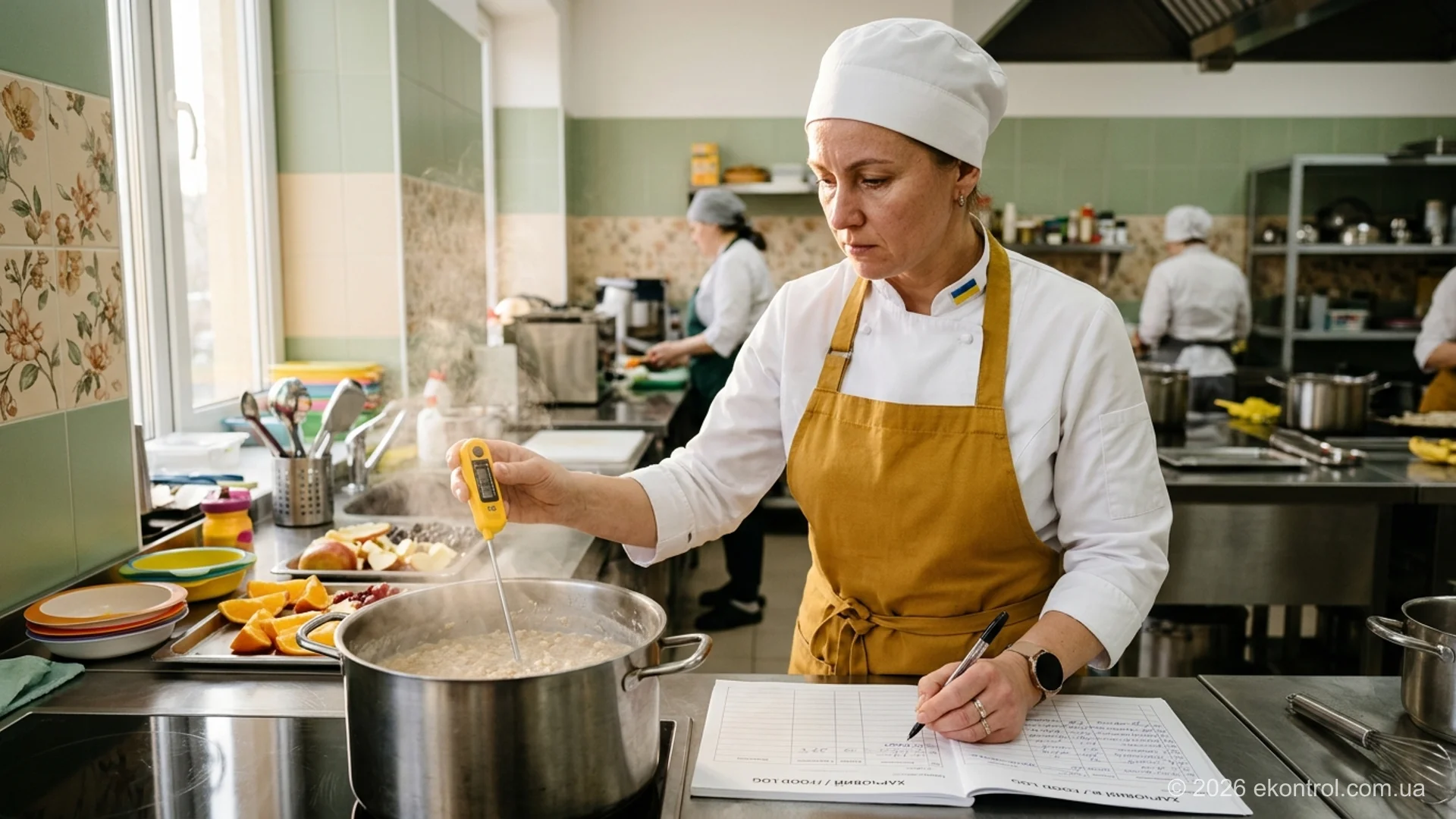
Guidelines No. 2347 give reference points for CCPs: a dish counts as cooked when the thickest part reaches 75 °C (cl. 14.6). On the hot serving line it's held above 63 °C, it can be reheated only once and must be eaten within 30 minutes (cl. 14.7). Fridges are set to 4 °C so that food stays at 5 °C or below at the core, and the temperature is checked at least once a day (cl. 14.2). Separate probe thermometers for raw and ready-to-eat food (cl. 8.2.2) cost next to nothing compared with the consequences of cross-contamination.
Daily retained samples
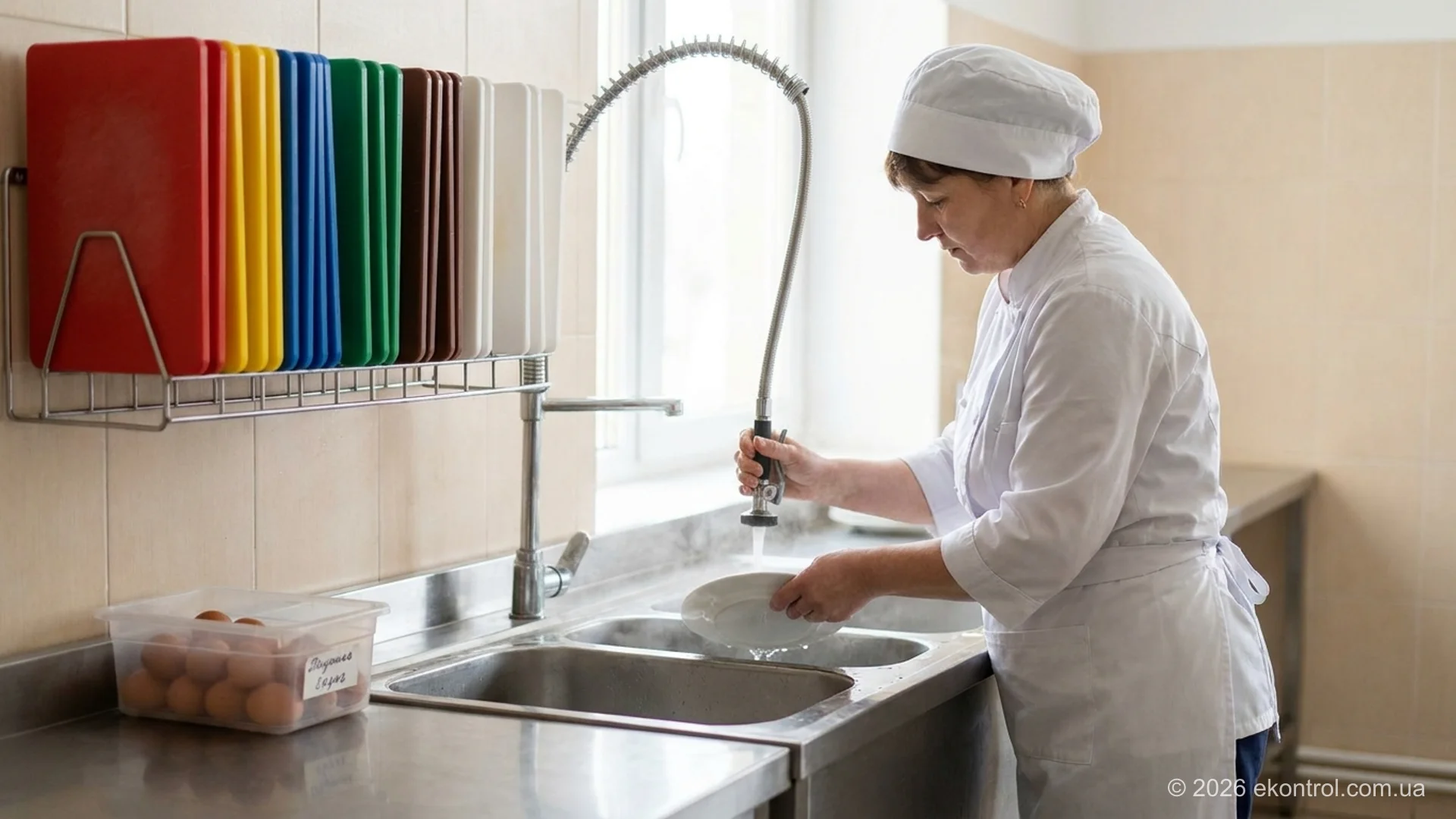
A retained sample of every dish on the menu is kept daily, in a portion for the youngest age group, in a clean, boiled container with a lid, labelled with the date and time. Samples are stored in the kitchen fridge at +4 to +8 °C until the same meal ends the next day (cl. 30). The tasting portion and the retained sample portion are included in the total portion count in advance. We've covered dishwashing, egg handling and board colour coding in detail in our piece on day-to-day HACCP practice in the kitchen unit.
Food safety inspections in kindergartens: what inspectors find and what it costs
Official figures show the scale of oversight. In the first half of 2026, Derzhprodspozhyvsluzhba carried out 6,366 meal-related inspections in education institutions, 2,104 of them in kindergartens. Violations were found in 3,584 institutions, or 56% of those inspected (DPSS data of 11.08.2026). The service doesn't publish a breakdown of violation types for kindergartens alone, so the specifics have to come from regional reports.
A detailed list was published on 24.09.2026 by the Kirovohrad regional office of Derzhprodspozhyvsluzhba after unscheduled inspections of education institutions. The main violations it named include:
- not following the approved seasonal menu and nutrition norms;
- poor keeping of the nutrition-norm log and brakerazh logs;
- missing supplier details, facility numbers, shelf lives and accompanying documents in brakerazh logs;
- improper storage and labelling of sanitary clothing, and not enough of it;
- menu schedules and recipe cards that don't meet requirements;
- HACCP procedures only partly developed or not implemented;
- no state registration of the facility;
- fridge temperature breaches and weak monitoring of them.
Notice how many items on that list concern paperwork rather than equipment. Most of them can be fixed before the inspector arrives without spending anything on renovation.
Fines and orders
Penalties are set by Article 65 of Law No. 2042-VIII. A legal entity is fined 10 minimum monthly wages for breaching hygiene requirements, 30 for failing to implement HACCP procedures, and 8 for not complying with an inspector's order. With the 2026 minimum wage at UAH 8,647, that's UAH 86,470, 259,410 and 69,176. However, for a first violation of this kind the inspector issues an order to fix it, without a penalty report (Art. 65, Part 2). So the real risk for a kindergarten usually isn't the first fine but a follow-up inspection with the order still unfulfilled. Schools sit on the same legal basis, but their meal schedules and norms differ, and we've covered them separately in our article on HACCP for school canteens.
An empty column in the brakerazh log is already a violation
Clause 24 of the Procedure lists the mandatory fields of the incoming food log, and the supplier's facility registration number is one of them. The Kirovohrad office singled out missing data of exactly this kind. Check your log today: if there's a "supplier" column but no facility number, accompanying document number or shelf life, add those columns from the next entry. You can verify a supplier's number in Derzhprodspozhyvsluzhba's open register of facilities.
Checklist for the head: HACCP in a kindergarten in 15 questions
Go through this list with your medical worker and cook. Every "no" means a specific action, not a vague "do better".
- There's an order on meal organisation covering the schedule, timetable and responsible person.
- The brakerazh committee is appointed by order and has terms of reference.
- There's an order on the HACCP team, and the HACCP plan describes children aged 1–4 and 4–6 (7) as the consumers.
- The seasonal menu is approved by Derzhprodspozhyvsluzhba, or taken from the MoH and checked against the current Annex 1.
- The head signs the daily menu schedule, and it shows yields for each age group.
- Every dish has a recipe card, and allergens are marked on the menu.
- The number of meals matches how long children stay (Procedure, cl. 17).
- All kitchen staff have signed today's health log.
- The incoming food log shows the supplier's facility number, accompanying document and shelf life.
- Every dish served today has a signature clearing it for serving.
- Retained samples labelled with date and time are in the fridge at +4 to +8 °C.
- Fridge temperatures were recorded today, and the thermometers are verified.
- The nutrition-norm log is up to date, and the latest four-week analysis has gone to the head.
- Medical books are valid, and staff training is documented.
- The kitchen unit is registered as a facility, and you know its number.
If you've got five or more "no" answers, start with the logs and the menu: that's a week's work, not a renovation. If a contractor runs your meals and also feeds a café, ask to see their HACCP plan: the logic is similar to what we described for cafés and restaurants, but the menu and norms have to be children's. For an in-house kitchen you'll need HACCP implementation tailored to your kitchen unit, or at least an independent readiness assessment before the inspection. That's how HACCP in a kindergarten stops being a binder for the inspector and becomes the normal way the kitchen works.
How we review a kindergarten in one day
On site, an Ekontrol consultant follows the food from delivery to the group room: matches the brakerazh log against delivery notes, measures fridge temperatures with our own thermometer, compares the menu schedule with what actually went into the pot and watches how lunch is portioned in the serving room. You get the findings as a table: nonconformity, clause of the act, what to do and who's responsible. Then the HACCP binder is rewritten around the real kitchen, not the other way round.
Need a certification consultation?
Free ConsultationOn This Page
- HACCP in kindergartens: the rules in force in 2026
- Who does what in a kindergarten: head, nurse, cook and brakerazh committee
- Kindergarten meal schedule: how many meals for how many hours
- Kindergarten nutrition norms by age group: calories and portion sizes from Resolution 305
- Seasonal menu, daily menu schedule and the kindergarten recipe file
- Kindergarten HACCP documents: what goes into the HACCP binder
- HACCP logs in a kindergarten: what to fill in daily and what once a year
- The kindergarten kitchen unit: zones, water, temperatures and group serving rooms
- Food safety inspections in kindergartens: what inspectors find and what it costs
- Checklist for the head: HACCP in a kindergarten in 15 questions
HACCP in kindergartens: the rules in force in 2026
HACCP in a kindergarten is the set of mandatory food safety procedures, built on the seven HACCP principles, that a preschool kitchen unit runs every day: documents, logs, menus and temperature checks. Inspectors judge it by whether the records match the kitchen, not by how thick the binder is. An officer from Derzhprodspozhyvsluzhba (Ukraine's State Service for Food Safety and Consumer Protection) opens the daily menu schedule and the brakerazh log, looks into the fridge, and within ten minutes knows whether the system is alive. Below is a step-by-step guide for the head of a preschool (a ZDO, still often called a DNZ in Ukraine): which documents you need, which logs to keep and how often, which nutrition norms apply to each age group, and what inspectors find most often.
Four acts behind HACCP in a kindergarten
Law No. 771/97-VR requires every food business operator, in Article 21, to run permanent procedures based on HACCP principles, and it states plainly that certifying those procedures isn't mandatory. How to build them is set out in Ministry of Agrarian Policy Order No. 590, with prerequisite programmes and the seven principles. Meal organisation, norms, menus and brakerazh (the acceptance and tasting check of food and dishes) are governed by CMU Resolution No. 305 of 24.03.2021, current version dated 07.07.2026. Clause 13 of its Procedure requires dishes to be cooked under HACCP procedures, so HACCP in education institutions is a direct legal requirement, not a methodologist's wish.
The fourth document is only a recommendation, but it's the most practical one: the HACCP Guidelines for Education Institutions approved by Ministry of Economy Order No. 2347 of 17.11.2020. Its annexes contain ready-made templates for logs, schedules and training records. They're a good place to start if you already know the general logic of the system from our complete HACCP guide.
Who counts as the food business operator
This is where people get confused most. If the kindergarten cooks for itself, it's the operator, and penalties under Article 65 of Law No. 2042-VIII are addressed to the kindergarten as a legal entity. If meals are outsourced or delivered by a caterer, the supplier develops the HACCP procedures for the kitchen, but the kindergarten still runs brakerazh and keeps the logs under Resolution 305. Clause 11 of the Procedure splits responsibility between the founder, the head of the institution and the supplier, so you can't hand all of it to the contractor.
The kindergarten sanitary regulation now points to Resolution 305
A new version of the Sanitary Regulation for Preschool Education Institutions has applied since 05.12.2025: MoH Order No. 234 as restated by Order No. 1604 of 21.10.2025 (amended by Order No. 1714 of 12.11.2025). The current text has no separate requirements on menus, norms or food processing; clauses 4 and 5 of Section I simply refer to the Procedure and Norms of Resolution 305. If your binder still holds extracts from earlier versions of the regulation, check them against the current text, because that's what the inspector will ask about.
Who does what in a kindergarten: head, nurse, cook and brakerazh committee
There's no such thing as a general "person responsible for HACCP" in a kindergarten. Resolution 305 spells out the roles quite precisely, and inspectors will ask about exactly those.
- The head of the kindergarten agrees the meal schedule and catering method with the founder, appoints the responsible person and the brakerazh committee by order, and approves the seasonal menu and the daily menu schedule (Procedure, cl. 19).
- The medical worker draws up the four-week seasonal menu, prepares the daily menu schedule together with the kitchen manager, keeps the nutrition-norm log every day and checks staff medicals and hygiene (cl. 11 and 21).
- The kitchen manager or cook answers for ingredient loading, dish yield, cooking technique, daily retained samples and the sanitary condition of the kitchen unit (cl. 28).
- The brakerazh committee includes at least the storekeeper, the cook, the responsible person and the medical worker (cl. 19, subcl. 2). It accepts deliveries and clears dishes for serving.
What if there's no nurse
It's a common situation: the current sanitary regulation allows medical services under a contract with a healthcare provider instead of a nurse on staff (Section X, cl. 3). The Procedure covers this. Without a medical worker, the responsible person draws up the seasonal menu and the daily menu schedule, checks staff medicals and tastes the finished dishes (cl. 20, subcl. 2). I'd write this into the meal organisation order as a separate line. Otherwise, on inspection day it turns out that everyone and no one did the tasting.
Kindergarten meal schedule: how many meals for how many hours
How many meals a kindergarten serves depends on its opening hours, and clause 17 of the Procedure sets clear thresholds:
- Up to 4 hours: meals can be skipped at the parents' request.
- Over 4 hours: meals are mandatory, once or twice a day (breakfast and/or lunch).
- Over 8 and up to 12 hours inclusive: three meals a day. The indicative schedule for nursery groups is breakfast 8:00–8:20, lunch 11:30–12:00, supper 15:30–16:00; for preschool groups it's 8:30–8:50, 12:30–13:00 and 16:30–16:50.
- Over 12 hours: four meals a day are mandatory, with supper at 18:30–19:00.
- Round-the-clock groups: five meals a day, at least three of them hot.
Meals should be 3–4 hours apart. In state and municipal kindergartens, breakfast, second breakfast, afternoon snack and supper get at least 20 minutes, lunch 25–30 minutes.
Watch the name of the third meal. For a kindergarten open more than 8 hours, the resolution says "supper", not "afternoon snack", and that's not a detail. If you plan it out of habit as a light snack worth 5–10% of daily energy, the three meals won't reach the 80% of daily needs that Table 5 of the Norms requires.
Two more rules apply specifically to preschools: buffets and vending machines aren't allowed in a kindergarten (cl. 15), and the menu can only be a single fixed set, with no choice of dishes (cl. 18). Catering is allowed.
Meals during air raid alerts and blackouts
The resolution accounts for martial law. If children can't be given a hot meal for more than 4 hours after the previous one because of a power cut or time in a shelter, hot food may be replaced with ready-to-eat products (Norms, cl. 21). The founder may build up a stock of water and food for at least 48 hours (Norms, cl. 22). Food that couldn't be finished or served because of an alert is written off by the brakerazh committee in a separate report (Procedure, cl. 24).
Kindergarten nutrition norms by age group: calories and portion sizes from Resolution 305
The norms for kindergartens split children into two age groups: 1 to 4 years and 4 to 6 (7) years. Daily energy value is 1,385 kcal for the younger group and 1,700 kcal for the older one (Norms, Table 1). For ages 1–4, breakfast and supper should each provide 350–415 kcal and lunch 415–485 kcal. For ages 4–6 (7), the figures are 425–510 and 510–595 kcal.
The split by meal comes from the footnote to Table 5: breakfast 25–30%, second breakfast 5–10%, lunch 30–35%, afternoon snack 5–10%, supper 25–30%. Breakfast, lunch and supper together must cover 80–100% of daily needs, five meals 90–100%. A useful detail for the nurse: if daily energy and the energy of each meal are on target, you don't have to calculate protein, fat and carbohydrates separately (Norms, cl. 7).
Restrictions that are easy to miss
A few requirements from the same resolution show up in menus less often than they should. Children under three get no added sugar at all (Annex 1). Potatoes as a separate dish can appear no more than twice a week for a five-day stay (Procedure, cl. 41). Milk and kefir must be 2.5–3.2% fat, cottage cheese at least 5%, sour cream at least 15% (cl. 45).
Clause 47 bans sausages and other processed meat and fish products, meat and eggs from waterfowl, river fish, mushrooms, canned food (except sugar-free juices), fizzy drinks and home-made products in education institutions. The kitchen mustn't make aspic, pâtés, deep-fried items, navy-style pasta with meat, pancakes filled with meat or cottage cheese, or creams. Churn milk can't be used without boiling either.
Portion sizes for kindergartens
Portion masses are given in Annex 1 to the Norms for a five-day stay. Annexes 3 and 4 cover six- and seven-day stays, and Annex 2 covers second breakfast and afternoon snack. Here are the main food groups for breakfast, lunch and supper:
| Food group (Annex 1) | Portions per week | Net portion, ages 1–4 | Net portion, ages 4–6 (7) |
|---|---|---|---|
| Vegetables (excluding potatoes), fresh, frozen or fermented | 15 | 60 g | 80 g |
| Fruit and berries | 10 | 60 g | 80 g |
| Cereals, grains, pulses (cooked dish) | 15 | 80 g | 100 g |
| Potatoes | 4 | 80 g | 100 g |
| Wholegrain bread | 10 | 30 g | 30 g |
| Sea fish (fillet) | 2 | 40 g | 60 g |
| Poultry, excluding waterfowl (skinless, boneless) | 6 | 45 g | 60 g |
| Pork, veal, beef (at lunch) | 2 | 45 g | 60 g |
| Eggs (fully cooked) | 2 | 1 egg | 1 egg |
| Milk or plant-based drinks (breakfast and supper) | 10 | 150 ml | 200 ml |
| Salt (iodised only) | 15 | 0.7 g | 1 g |
| Sugar (breakfast / lunch / supper) | 15 | none under age 3; ages 3–4: 7.5 / 10 / 7.5 g | 7.5 / 10 / 7.5 g |
Seasonal menu, daily menu schedule and the kindergarten recipe file
A kindergarten menu has two layers. The four-week seasonal menu is drawn up for each season (autumn, winter, spring, summer), with portion yields for every age group (Procedure, cl. 3, subcl. 9). The daily menu schedule is built from it: full dish names, the yield for each age group, the number of portions and the gross and net quantities of ingredients, per child as the numerator and for all children as the denominator (cl. 37). There's one menu schedule per kindergarten, with different quantities for each age group.
The MoH menu or your own
You can only use your own seasonal menu once the regional office of Derzhprodspozhyvsluzhba has approved it; a menu recommended by the Ministry of Health (MoH) needs no approval (cl. 36). For children aged 1–6 (7), the MoH has approved recommended four-week menus for three meals a day: for autumn by Order No. 2441 of 05.11.2021 and for winter by Order No. 215 of 03.02.2022. Dishes in the daily menu schedule can only be swapped for objective reasons, such as a failed delivery or doubtful product quality, and only within the same seasonal menu. For example, Thursday's menu can move to Monday and Monday's to Thursday (cl. 37).
Recipe cards for kindergarten dishes
Resolution 305, the sanitary regulation and Guidelines No. 2347 don't refer to any single mandatory "recipe collection for kindergartens". The resolution requires technical documentation for dishes and products (annex to the Procedure), and Guidelines No. 2347 list recipe cards among the core HACCP documents (cl. 25). In practice, a kindergarten recipe file means your own set of technical recipe cards for every dish on the menu: the yield for both age groups, the cooking regime and the allergens. We've covered how to put such a card together and work out gross and net weights in our article on the technological recipe card. Allergen information, including nuts, goes straight into the menu, with a key to the allergen codes next to it (cl. 49). The menu is posted daily on a noticeboard or the kindergarten's website (cl. 34).
The MoH menus are older than the current norms
The MoH's recommended kindergarten menus were approved in 2021–2022, while Annex 1 to the Norms, with the portion sizes, was last amended by Resolution No. 1280 of 08.10.2025. Before you adopt an MoH menu unchanged, check the portion yields and dish frequency against the current annex. You really won't need approval from Derzhprodspozhyvsluzhba, but the nutrition-norm log counts actual portion weights, and any gap will surface in the first four-week analysis.
Kindergarten HACCP documents: what goes into the HACCP binder
People search for "HACCP document templates for kindergartens" more than anything else on this topic, and it's easy to see why: download, file, done. The trouble is that a template doesn't know your kitchen, your supplier or your schedule. Two lists define what goes into the binder: the indicative list of meal organisation documents in the annex to the Procedure of Resolution 305, and the core HACCP documents in clause 25 of Guidelines No. 2347 (which echo clause 3.26 of Order No. 590). Together that's twelve items, summarised in the table below. First, one point about the HACCP plan.
The HACCP plan: your consumers are children
Order No. 590 explicitly names children as a specific consumer group to consider when describing a product (cl. 3.13). For a kindergarten, this means your hazard analysis describes children aged 1–4 and 4–6, not abstract "diners". That's why critical limits for cooking aren't a formality here. You'll find sample forms for each documentation level in our set of HACCP document templates, and the logic of CCPs and critical limits is explained in our breakdown of the seven HACCP principles.
What goes into a kindergarten HACCP binder
| Document | What it should contain | Legal basis |
|---|---|---|
| Order on meal organisation | Meal schedule, catering method and timetable, responsible person | Resolution No. 305, cl. 14, 19, annex to the Procedure |
| Order on the brakerazh committee and its terms of reference | Members: storekeeper, cook, responsible person, medical worker | Resolution No. 305, cl. 19, subcl. 2 |
| Order on the HACCP team | Team members and duties | Order No. 590, cl. 3.26.2; Guidelines No. 2347, cl. 25 |
| Prerequisite programmes | Premises, equipment, water, staff hygiene, cleaning, pests, waste, incoming checks | Order No. 590, Section II; Guidelines No. 2347, cl. 7–14 |
| HACCP plan | Dish descriptions, flow diagrams, hazard analysis, CCPs and critical limits, corrective actions, verification | Order No. 590, cl. 3.13, 3.26.2 |
| Seasonal menu and daily menu schedules | Menu approved by Derzhprodspozhyvsluzhba or an MoH menu; daily schedules signed by the head | Resolution No. 305, cl. 36, 37 |
| Technical documentation (recipe file) | A recipe card for every dish on the menu | Resolution No. 305, annex to the Procedure; Guidelines No. 2347, cl. 25 |
| Personal medical books | Staff admitted to work only with a medical book in the MoH format | Resolution No. 305, cl. 25 |
| Certificates of children's special dietary needs | Issued by a family doctor or paediatrician, with a diagnosis | Resolution No. 305, cl. 10, 39 |
| Supplier contracts and documents | Accompanying documents, the supplier's facility registration number | Resolution No. 305, cl. 23, 24 |
| Kitchen unit registration details | The facility's registration number in the state register | Law No. 771/97-VR, Art. 25 |
| Logs and monitoring records | See the log table below | Resolution No. 305; Guidelines No. 2347, Annexes 2–9, 14 |
HACCP logs in a kindergarten: what to fill in daily and what once a year
Below are the kitchen-unit logs and records that follow from the acts in force, with how often to fill them in and the clause an inspector will cite. The forms in Guidelines No. 2347 are only recommendations: clause 8.4.6 lets the operator decide on the format and scope of records. First, three things kindergartens often trip over; the summary table comes at the end of the section.
There are actually two brakerazh logs
The resolution distinguishes the brakerazh log for food received from suppliers from the brakerazh log for finished dishes, and with catering there's a third one for dishes delivered by the operator. The incoming food log records the product name, the supplier with its facility registration number, the date and time of delivery, the accompanying document number, the quantity, the shelf life, a quality assessment and a signature (cl. 24). Not everything goes in: meat and poultry, sea fish, milk, kefir, sour cream, cheeses, butter, hen's eggs and other products with a "use by" date. If a product is substandard, a brakerazh report is drawn up in three copies, and the supplier has one day to replace food and two hours to replace finished dishes.
A dish may only be served after a personal signature in the finished-dish log, for each dish separately (cl. 29). The actual yield of portioned items is checked by weighing 5–10 portions, while the volume of soups and drinks is taken from the pot's capacity, which is written on the outside of the pot.
The health log and the nutrition-norm log
The cook and the rest of the kitchen staff sign the kitchen staff health log in person every day: date, name and a signature confirming no gut upset and no acute respiratory infection. The medical worker signs separately to confirm no pustular skin conditions (cl. 25). The medical worker fills in the nutrition-norm log daily from the menu schedule, analyses it every four weeks and reports to the head monthly (cl. 11). This is where a gap between the menu on paper and actual purchases shows up fastest.
Paper or electronic logs
Paper logs are page-numbered, bound with string and certified by the head's signature and the kindergarten's stamp. An electronic version is allowed if entries can't be changed and the author of each entry can be identified unambiguously (cl. 3, subcl. 3). A plain spreadsheet in a shared folder doesn't meet that test; you need a system with a change history. HACCP records must be kept for at least three months after the product's shelf life ends (Law No. 771/97-VR, Art. 21).
Summary table of kindergarten kitchen logs
| Log or record | Who keeps it | How often | Legal basis |
|---|---|---|---|
| Kitchen staff health log | Cook and all kitchen staff, medical worker | Daily | Resolution No. 305, cl. 25 |
| Daily log of children being fed | Group teacher passes data to the responsible person | Daily (today for tomorrow, confirmed in the morning) | Resolution No. 305, cl. 4, 20, annex |
| Daily menu schedule | Medical worker and kitchen manager, signed by the head | Daily | Resolution No. 305, cl. 37 |
| Finished-dish brakerazh log | Medical worker or their substitute | Daily, every dish before serving | Resolution No. 305, cl. 29 |
| Nutrition-norm log | Medical worker | Daily | Resolution No. 305, cl. 11 |
| Refrigeration temperature log | Cook or storekeeper | At least once a day | Guidelines No. 2347, cl. 14.2, Annex 9 |
| CCP monitoring records (cooking, hot holding) | Cook | Daily, every batch | Guidelines No. 2347, cl. 14.6, 14.7, Annex 14 |
| Incoming food brakerazh log | Brakerazh committee | Every delivery | Resolution No. 305, cl. 24 |
| General cleaning with detergents | Staff | Weekly | ZDO Sanitary Regulation, Section VII, cl. 17 |
| General cleaning with disinfectants | Staff | Monthly | ZDO Sanitary Regulation, Section VII, cl. 17 |
| Nutrition-norm analysis | Medical worker, reported to the head | Every 4 weeks, report monthly | Resolution No. 305, cl. 11 |
| Four-week seasonal menu | Medical worker and cook, approved by the head | Each season (4 times a year) | Resolution No. 305, cl. 3, 36 |
| Staff training record | Responsible person | Before starting work, after changes, at least once a year | Guidelines No. 2347, cl. 8.4.5, 9.4, Annex 5 |
| HACCP procedure verification | HACCP team | At least once a year | Guidelines No. 2347, cl. 24.2 |
| Drinking water lab test | Founder or head | Once a year and as needed | ZDO Sanitary Regulation, Section V, cl. 5 |
| Pest control records | Contractor and responsible person | As per the contract schedule | Guidelines No. 2347, cl. 10.5, Annex 6 |
Need a HACCP binder built for your kindergarten, not a template?
Ekontrol consultants will develop prerequisite programmes, a HACCP plan and logs for your catering model (own kitchen, outsourcing or catering), check your menu against Resolution 305 and train staff to keep records that stand up to a Derzhprodspozhyvsluzhba inspection.
Talk to an expert about your projectThe kindergarten kitchen unit: zones, water, temperatures and group serving rooms
For an on-site kitchen (the "base kitchen" model), the resolution lists the zones a kitchen unit must have: receiving and storing raw materials, preparation, main cooking, dispatch of finished dishes, the serving line, washing and storing dishes and utensils, and a staff area (Procedure, cl. 15-1). A kindergarten that receives hot meals from a central "hub kitchen" manages with receiving, dispatch, dishwashing and staff zones, but no more than two hours may pass between cooking and serving. Chilled meals from a factory kitchen also require a reheating zone with a combi oven.
The kindergarten sanitary regulation adds requirements that apply specifically to preschools:
- hot water is mandatory all year round, and hot and cold running water must be available in the kitchen unit, group rooms and serving rooms (Section V, cl. 2);
- the kitchen unit has its own separate ventilation system (Section VI, cl. 7);
- everything to do with feeding children, from setting tables and portioning to clearing tables and washing dishes, is done in labelled sanitary clothing: gown, apron and headscarf (Section VII, cl. 13);
- tables in group rooms and plastic bibs are washed with hot water and soap after every meal (Section VII, cl. 16);
- after using the toilet, kitchen staff wash their hands and then disinfect them as well (Section IX, cl. 2).
A group serving room in a kindergarten is really an extension of the kitchen unit. The teaching assistant who portions out lunch in the group handles ready-to-eat food, so the same hygiene rules apply to them as to the cook. People often forget this, and inspectors do walk into the groups.
Temperatures worth recording
Guidelines No. 2347 give reference points for CCPs: a dish counts as cooked when the thickest part reaches 75 °C (cl. 14.6). On the hot serving line it's held above 63 °C, it can be reheated only once and must be eaten within 30 minutes (cl. 14.7). Fridges are set to 4 °C so that food stays at 5 °C or below at the core, and the temperature is checked at least once a day (cl. 14.2). Separate probe thermometers for raw and ready-to-eat food (cl. 8.2.2) cost next to nothing compared with the consequences of cross-contamination.
Daily retained samples
A retained sample of every dish on the menu is kept daily, in a portion for the youngest age group, in a clean, boiled container with a lid, labelled with the date and time. Samples are stored in the kitchen fridge at +4 to +8 °C until the same meal ends the next day (cl. 30). The tasting portion and the retained sample portion are included in the total portion count in advance. We've covered dishwashing, egg handling and board colour coding in detail in our piece on day-to-day HACCP practice in the kitchen unit.
Food safety inspections in kindergartens: what inspectors find and what it costs
Official figures show the scale of oversight. In the first half of 2026, Derzhprodspozhyvsluzhba carried out 6,366 meal-related inspections in education institutions, 2,104 of them in kindergartens. Violations were found in 3,584 institutions, or 56% of those inspected (DPSS data of 11.08.2026). The service doesn't publish a breakdown of violation types for kindergartens alone, so the specifics have to come from regional reports.
A detailed list was published on 24.09.2026 by the Kirovohrad regional office of Derzhprodspozhyvsluzhba after unscheduled inspections of education institutions. The main violations it named include:
- not following the approved seasonal menu and nutrition norms;
- poor keeping of the nutrition-norm log and brakerazh logs;
- missing supplier details, facility numbers, shelf lives and accompanying documents in brakerazh logs;
- improper storage and labelling of sanitary clothing, and not enough of it;
- menu schedules and recipe cards that don't meet requirements;
- HACCP procedures only partly developed or not implemented;
- no state registration of the facility;
- fridge temperature breaches and weak monitoring of them.
Notice how many items on that list concern paperwork rather than equipment. Most of them can be fixed before the inspector arrives without spending anything on renovation.
Fines and orders
Penalties are set by Article 65 of Law No. 2042-VIII. A legal entity is fined 10 minimum monthly wages for breaching hygiene requirements, 30 for failing to implement HACCP procedures, and 8 for not complying with an inspector's order. With the 2026 minimum wage at UAH 8,647, that's UAH 86,470, 259,410 and 69,176. However, for a first violation of this kind the inspector issues an order to fix it, without a penalty report (Art. 65, Part 2). So the real risk for a kindergarten usually isn't the first fine but a follow-up inspection with the order still unfulfilled. Schools sit on the same legal basis, but their meal schedules and norms differ, and we've covered them separately in our article on HACCP for school canteens.
An empty column in the brakerazh log is already a violation
Clause 24 of the Procedure lists the mandatory fields of the incoming food log, and the supplier's facility registration number is one of them. The Kirovohrad office singled out missing data of exactly this kind. Check your log today: if there's a "supplier" column but no facility number, accompanying document number or shelf life, add those columns from the next entry. You can verify a supplier's number in Derzhprodspozhyvsluzhba's open register of facilities.
Checklist for the head: HACCP in a kindergarten in 15 questions
Go through this list with your medical worker and cook. Every "no" means a specific action, not a vague "do better".
- There's an order on meal organisation covering the schedule, timetable and responsible person.
- The brakerazh committee is appointed by order and has terms of reference.
- There's an order on the HACCP team, and the HACCP plan describes children aged 1–4 and 4–6 (7) as the consumers.
- The seasonal menu is approved by Derzhprodspozhyvsluzhba, or taken from the MoH and checked against the current Annex 1.
- The head signs the daily menu schedule, and it shows yields for each age group.
- Every dish has a recipe card, and allergens are marked on the menu.
- The number of meals matches how long children stay (Procedure, cl. 17).
- All kitchen staff have signed today's health log.
- The incoming food log shows the supplier's facility number, accompanying document and shelf life.
- Every dish served today has a signature clearing it for serving.
- Retained samples labelled with date and time are in the fridge at +4 to +8 °C.
- Fridge temperatures were recorded today, and the thermometers are verified.
- The nutrition-norm log is up to date, and the latest four-week analysis has gone to the head.
- Medical books are valid, and staff training is documented.
- The kitchen unit is registered as a facility, and you know its number.
If you've got five or more "no" answers, start with the logs and the menu: that's a week's work, not a renovation. If a contractor runs your meals and also feeds a café, ask to see their HACCP plan: the logic is similar to what we described for cafés and restaurants, but the menu and norms have to be children's. For an in-house kitchen you'll need HACCP implementation tailored to your kitchen unit, or at least an independent readiness assessment before the inspection. That's how HACCP in a kindergarten stops being a binder for the inspector and becomes the normal way the kitchen works.
How we review a kindergarten in one day
On site, an Ekontrol consultant follows the food from delivery to the group room: matches the brakerazh log against delivery notes, measures fridge temperatures with our own thermometer, compares the menu schedule with what actually went into the pot and watches how lunch is portioned in the serving room. You get the findings as a table: nonconformity, clause of the act, what to do and who's responsible. Then the HACCP binder is rewritten around the real kitchen, not the other way round.