
HACCP in the Kitchen Unit: Which Documents Set the Rules for Washing, Handling and Labelling
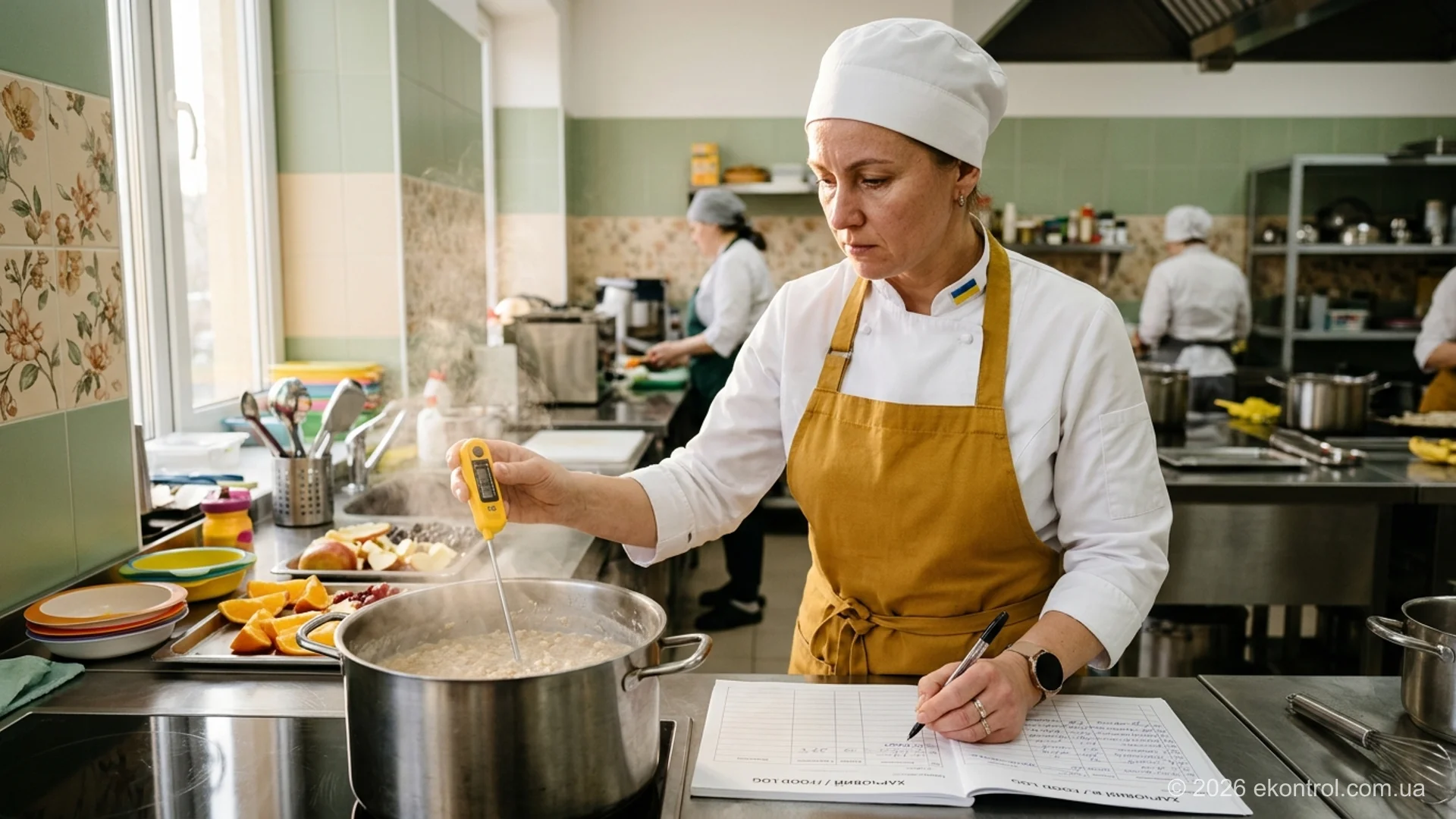
HACCP in the kitchen unit means the permanent food safety procedures built on the seven HACCP principles, together with prerequisite programmes: dishwashing, labelling, temperature control and staff hygiene. Inspectors check them at the sink, not in the binder. An officer from Derzhprodspozhyvsluzhba, Ukraine's food safety authority, looks at which sink the plates go into, where the eggs sit after treatment, whether the cook slices bread on the raw-chicken board, and whether the fridge log matches the thermometer.
Below we walk through how dishwashing, egg handling, colour-coded boards and labelling should look in a school, kindergarten, hospital or staff canteen kitchen (Ukrainians call it a kharchoblok), so it works every day and not just on inspection day.
Plenty of kitchens still have printouts of old sanitary rules taped to the wall, even though the regulations in force look quite different. Here's what an inspector actually relies on in 2026.
The acts worth keeping at hand
The foundation is Law No. 771/97-VR (Article 21: every food business operator must run HACCP-based procedures, while certification is voluntary) and Order No. 590 of the Ministry of Agrarian Policy with its prerequisite programmes. Order No. 2532 of the Ministry of Economy (03.12.2020) gives hard numbers for schools, and the HACCP guidelines for education institutions (Order No. 2347 of 17.11.2020) add recommendations. Cabinet of Ministers Resolution No. 305 covers nutrition standards, food inspection (brakerazh) and logs, and clause 13 of its Procedure requires meals to be prepared under HACCP procedures. The Ministry of Health sanitary regulations for schools (No. 2205) and kindergartens (No. 234 as amended by Order No. 1604 of 21.10.2025) simply refer kitchen matters back to food law.
Cafés and restaurants aren't formally bound by Order No. 2532, but we haven't found any other Ukrainian act in force with figures for manual dishwashing. So treat it as a benchmark and adapt the rest using our HACCP guide for cafés and restaurants.
Hospital kitchens and staff canteens run under the same Order No. 590 and Article 21 of the Law: the sink, the boards and the logs are the same. We describe the overall logic of the system on our page about HACCP implementation.
| Document | What it governs in the kitchen | Who must comply |
|---|---|---|
| Law No. 771/97-VR, Art. 21 | HACCP duty, record retention | All food business operators |
| Ministry of Agrarian Policy Order No. 590 | Prerequisite programmes, washing and disinfection | All food business operators |
| Ministry of Economy Order No. 2532 | Dishwashing temperatures, labelling | School kitchens; others as a benchmark |
| HACCP guidelines No. 2347 | Colour coding, eggs, thermal disinfection, logs | Recommendations for education institutions |
| CMU Resolution No. 305 | Nutrition standards, food inspection, logs, samples | Education and children's recreation facilities |
| MoH sanitary regulations No. 2205 and No. 234 | Work clothing, cleaning, quarantine regime | Schools and kindergartens |
Why the sanitary regulations no longer contain solution tables
The current sanitary regulation for kindergartens (in force since 05.12.2025) and the one for schools don't set egg treatment regimes or disinfectant concentrations for dishes. The operator defines its own washing and disinfection method in a prerequisite programme under clause 2.9.2 of Order No. 590, and takes the concentration and contact time of a registered disinfectant from the manufacturer's label. If your instruction lists a percentage without naming the product, it's time to rewrite it.
HACCP Colour Coding: Cutting Boards and Knives Without a Single State Standard
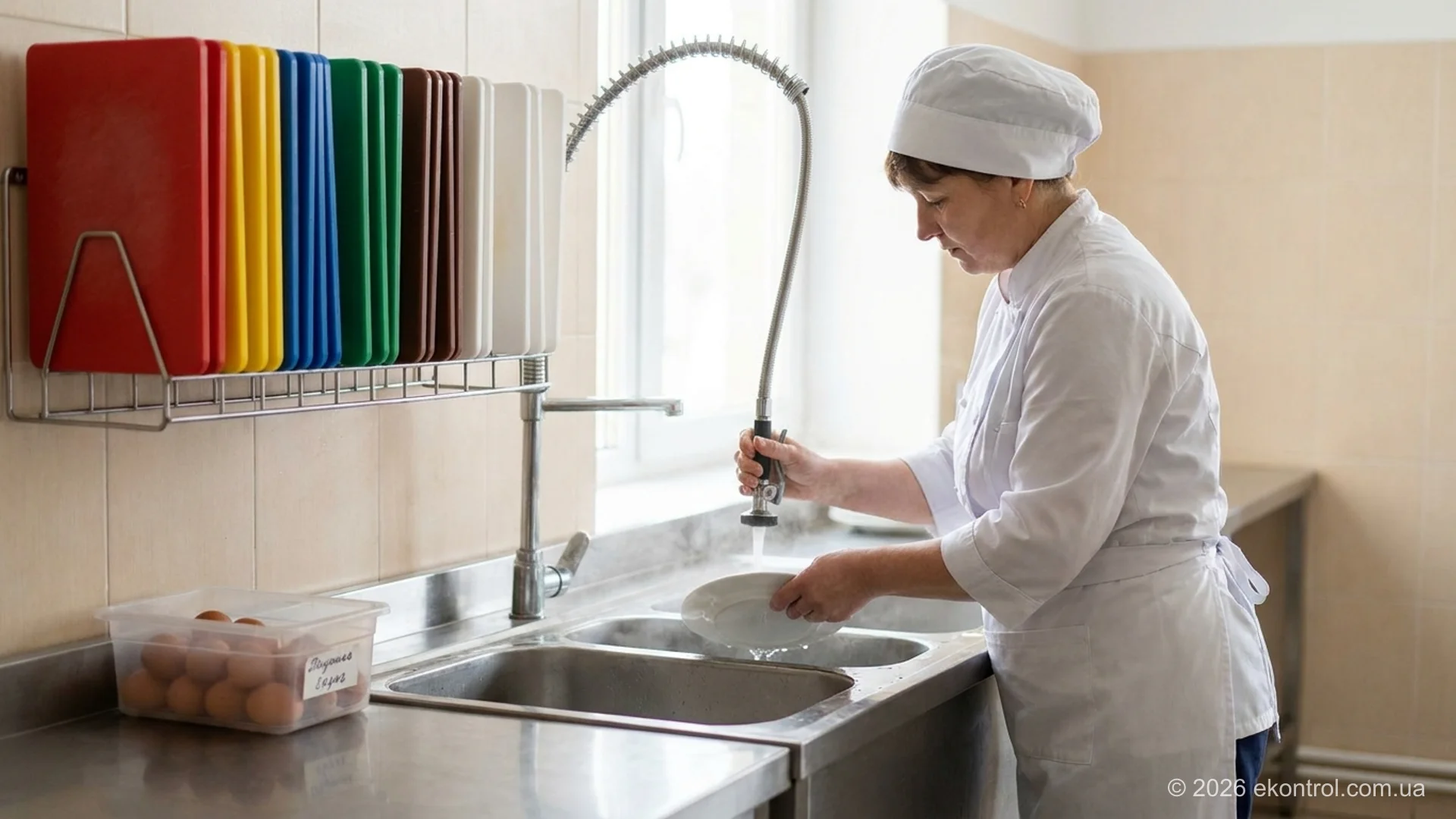
The question kitchen managers ask us most is: "Which board colours are approved in Ukraine?" The honest answer: none. There's no single mandatory colour scheme. Annex 3 to Order No. 2532 gives an example of letter codes (СМ, СР, СО, СМП, ВМ, ВР, ВО, ВМП, З, Х, Г, Т) and explicitly lets the operator introduce its own marking system based on a risk assessment. The HACCP guidelines No. 2347, clause 7.1.3, recommend splitting utensils by colour according to purpose: cooked ready-to-eat food, dairy, bread, vegetables, raw meat, poultry and fish.
Colour doesn't replace the legal requirement, it fulfils it. The requirement is simple: rule out cross-contamination, either physically or by time (Order No. 590, clause 2.5.8), and the same approach runs through the Codex Alimentarius General Principles of Food Hygiene. Colours just make it visible to a cook at seven in the morning.
The scheme we set up in most kitchens
The most common version:
- red: raw meat;
- yellow: raw poultry (some systems use yellow for cooked meat, so check against your own instruction);
- blue: raw fish;
- green for vegetables, herbs and fruit;
- brown for cooked meat, fish and vegetables;
- white for bread, cheese, butter and other deli items.
A seventh, purple set is added where allergen-free or gluten-free meals are prepared. Resolution No. 305 separately requires preventing gluten from getting into gluten-free dishes, so a dedicated set isn't a luxury here.
Colour plus letter, not instead of it
Our advice: don't throw the letters away. The colour and the "СМ" code on the board back each other up, and an inspector reads the logic faster because Order No. 2532 uses letter marking. Mark tables "СХП" (raw foods) and "ГХП" (ready foods), keep knives on magnetic strips in the board colours, and hang the scheme above each workstation.
One detail people underestimate: clause 11, Section II of Order No. 2532 requires food contact surfaces to be smooth and undamaged. A board with deep, dark cuts is no longer smooth, whatever its colour. Budget for replacing boards. We explain how colour coding fits into the wider set of prerequisite programmes in our complete HACCP guide.
Labelling in the Canteen and Kitchen Unit: Tables, Scales, Pots and Cleaning Tools
Coloured boards only solve part of the problem. Labelling in the kitchen covers almost everything that touches food or could contaminate it. Order No. 2532 (clause 21, Section II) requires production tables, cutting boards, kitchen utensils and cookware to be marked by purpose. Annex 3 gives examples:
- tables and scales: "СХП" for raw foods, "ГХП" for ready foods;
- pots and returnable containers carry "ПС" (soups), "ДС" (main courses) and "Н" (drinks);
- boards and knives get the letter codes from the previous section.
Cleaning tools are marked separately: they must be labelled or carry a colour signal (clause 15). In practice that means a bucket and mop for the kitchen that never go near the toilets. The school regulation also requires cleaning workwear to be marked and stored apart.
Labelling decanted food
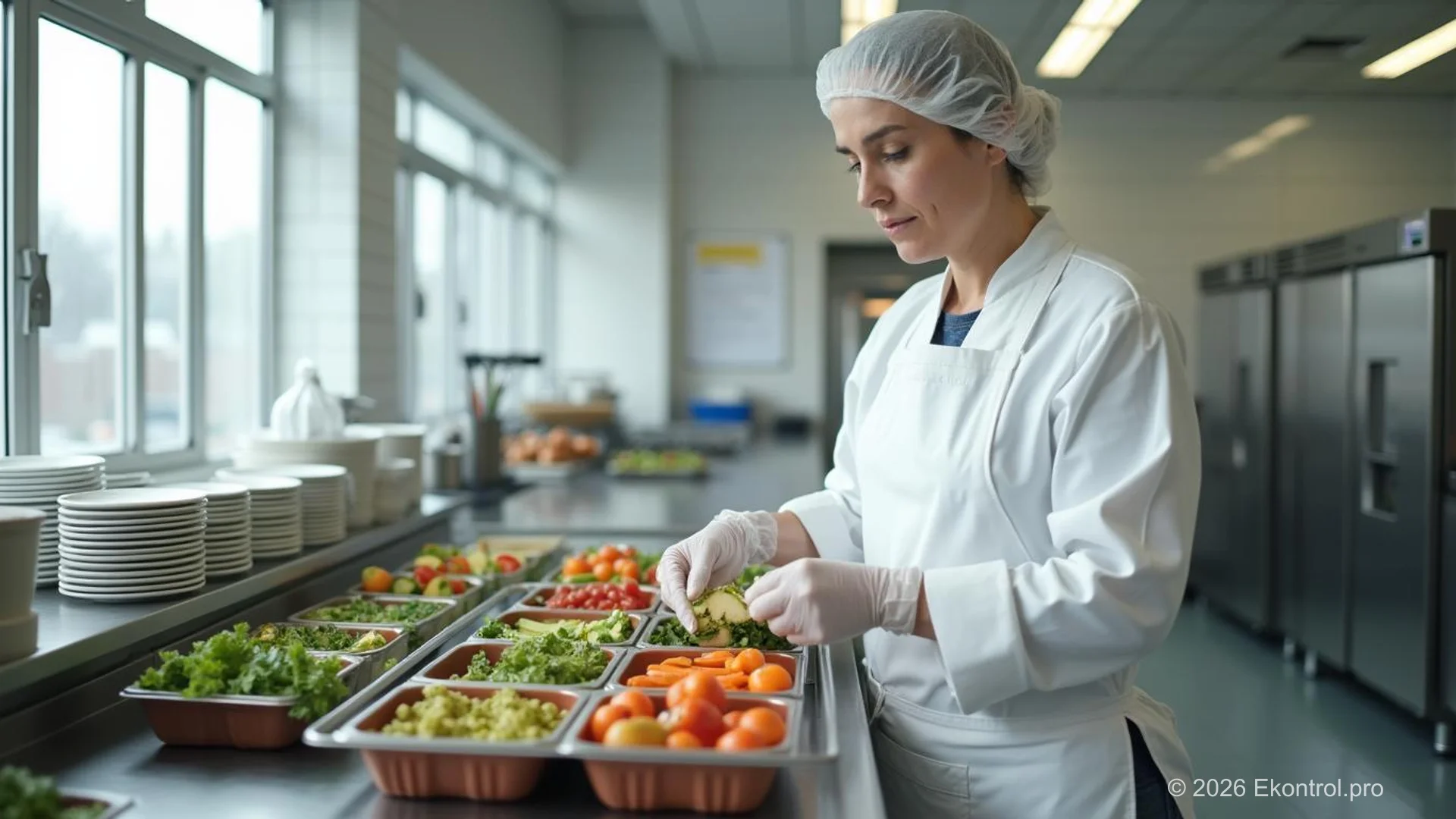
Food decanted from its original packaging should, per the guidelines, sit in closed containers labelled with its name, shelf life and supplier. An open tub of sour cream without a label raises one question for the inspector: when was it opened?
Daily retained samples are labelled under Resolution No. 305: date and time of sampling on every jar, stored in a fridge at +4 to +8 °C until the same meal ends the next day. We cover retained samples and food inspection in more detail in our article on HACCP for school canteens.
A temporary clean zone in a small kitchen
A kindergarten feeding 40 children often has no separate cold prep room. The guidelines allow a temporary clean zone separated by time: clear away raw ingredients, wash and disinfect the table, lay out separate utensils and mark the area as clean. A sign on a stand costs next to nothing and settles an argument with the inspector on the spot.
Egg Handling in the Kitchen Unit Under HACCP: A Separate Container, Soda Solution and No Concentrations from Memory
Eggshells can carry Salmonella, and raw eggs easily contaminate everything around them. Egg handling under HACCP comes down to three things: a separate place, a clear procedure and a record that it was done.
What the current document says
The HACCP guidelines No. 2347 (clause 14.5) advise soaking eggs for 30 minutes in a 2% baking soda solution, or another solution intended for this purpose, before cooking, then washing them under running drinking water. Egg washing needs its own labelled container and its own utensils, and eggs should go into a dish right before heat treatment.
Here's the sequence we write into kitchen instructions:
- Receiving. Check the accompanying documents and shell integrity, reject cracked and dirty eggs. Schools don't use waterfowl eggs: regulation No. 2205 excludes them from the permitted food groups.
- Storage before treatment on the lower fridge shelves, below ready-to-eat food (guidelines, clause 14.2).
- Treatment in a separate container labelled "Eggs": 30 minutes in a 2% baking soda solution, then a rinse under running drinking water.
- Disinfection, if your prerequisite programme includes it, only with a registered product and strictly per its label for concentration and time.
- Treated eggs go into a clean labelled container and are used straight away, right before cooking.
To be honest, we've never seen two identical procedures. Some kitchens use four containers, some use two. Both work if they're written down and the containers are labelled. Washing eggs in the vegetable sink "because it's quicker", though, is something an inspector will reasonably record as a cross-contamination risk.
Eyeballed solutions and concentrations copied from the internet
The most common mistake: a disinfectant concentration copied from someone else's instruction without naming the product. The regulations in force don't set such figures, and guidelines No. 2347 allow only registered products. Write the product's trade name, concentration and contact time from its label into your instruction. Measure the soda: a 2% solution is roughly 20 g of soda per litre of water, not "half a pack per bucket".
Dishwashing and HACCP in the Kitchen Unit: Three Sinks for Tableware, Two for Kitchenware
Dishwashing is governed by a specific document with numbers: Annex 2 to Ministry of Economy Order No. 2532, which is mandatory for school kitchens. Washing happens only in separate sinks with hot running water, and food scraps are scraped into a food waste bin first.
Tableware: three stages
- Sink one: water at no less than +40 °C with detergent dosed per the manufacturer.
- Sink two: water at no less than +40 °C with half the detergent used in sink one.
- Sink three: rinse with water at no less than +65 °C, using a dish rack and a flexible hose with a shower head.
Plates are dried on edge on slatted shelves and stored in closed cabinets.
Kitchenware, cups, cutlery and returnable containers
These are washed separately from tableware, in two stages: sink one with water at no less than +40 °C and detergent, sink two for rinsing with water at no less than +65 °C. Clean cutlery is scalded with boiling water, dried and stored handles up in cassettes. Metal kitchen utensils are heated in an oven after washing. Brushes and cloths are rinsed after work, dried and kept in closed labelled containers.
Where the rule and the recommendation diverge
Here's a detail few people notice. The HACCP guidelines No. 2347 (clause 9.1) describe a different profile: washing with detergent at no less than 45 °C, thermal disinfection of dishes at no less than 78 °C, and a rinse at no less than 45 °C. Order No. 2532 requires a minimum of 40 °C and 65 °C. There's no conflict, since 45 and 78 are above the minimum. We recommend writing the higher values into your instruction and checking them with a thermometer. At 65 °C on the rinse you meet the rule, but you don't get thermal disinfection as the guidelines define it.
The dishwasher within HACCP in the kitchen unit
Order No. 2532 requires the machine to be used for its intended purpose and per the manufacturer's operating rules (clause 19). So wash and rinse temperatures, detergent dosing and filter cleaning intervals come from your model's manual. Copy those figures into an instruction next to the machine and check them against the display once a shift. A machine with clogged filters washes worse than a good manual sink.
A separate regime applies during quarantine. The school regulation (Annex 12) requires boiling dishes that have been scraped and washed, in water or a 2% soda ash solution: 25 minutes for intestinal infections and 45 minutes for viral hepatitis, counted from boiling. That's an epidemic-driven regime, not a daily one.
| Stage | Requirement | How we check | What we record |
|---|---|---|---|
| Sink 1, tableware | At least +40 °C, detergent at manufacturer's dose | Thermometer, measuring cup | Reading |
| Sink 2, tableware | At least +40 °C, half the detergent dose | Thermometer | Reading |
| Sink 3, rinse | At least +65 °C (guidelines: 78 °C for thermal disinfection) | Thermometer under the spray | Reading |
| Dishwasher | Settings from the manufacturer's manual | Machine display once a shift | Reading or deviation |
| Drying and storage | Plates on edge in closed cabinets | Visual check | Deviations only (visual monitoring) |
Preparing your kitchen unit for a food safety inspection?
Ekontrol auditors will walk through your kitchen the way an inspector would: from the sinks and boards to the logs and retained samples. You'll get a list of nonconformities, each tied to a specific clause, plus instructions rewritten for your kitchen and equipment.
Book a kitchen auditHACCP Logs in the Kitchen Unit: What Gets Filled In Daily and What Weekly
HACCP logs often become an end in themselves: a dozen notebooks filled in on Friday for the whole week. An inspector spots identical figures in identical ink within a minute. HACCP Principle 7 in Order No. 590 (clause 3.26) asks for records that match the size of the operation, not the maximum amount of paper.
Mandatory records for an education institution
The annex to the Procedure under Resolution No. 305 gives an indicative list: an order on organising meals, a register of children eating, the staff health log, a seasonal menu, a daily menu, a menu plan, recipe documentation, a log of nutrition standard compliance and three food inspection logs.
The kitchen staff health log
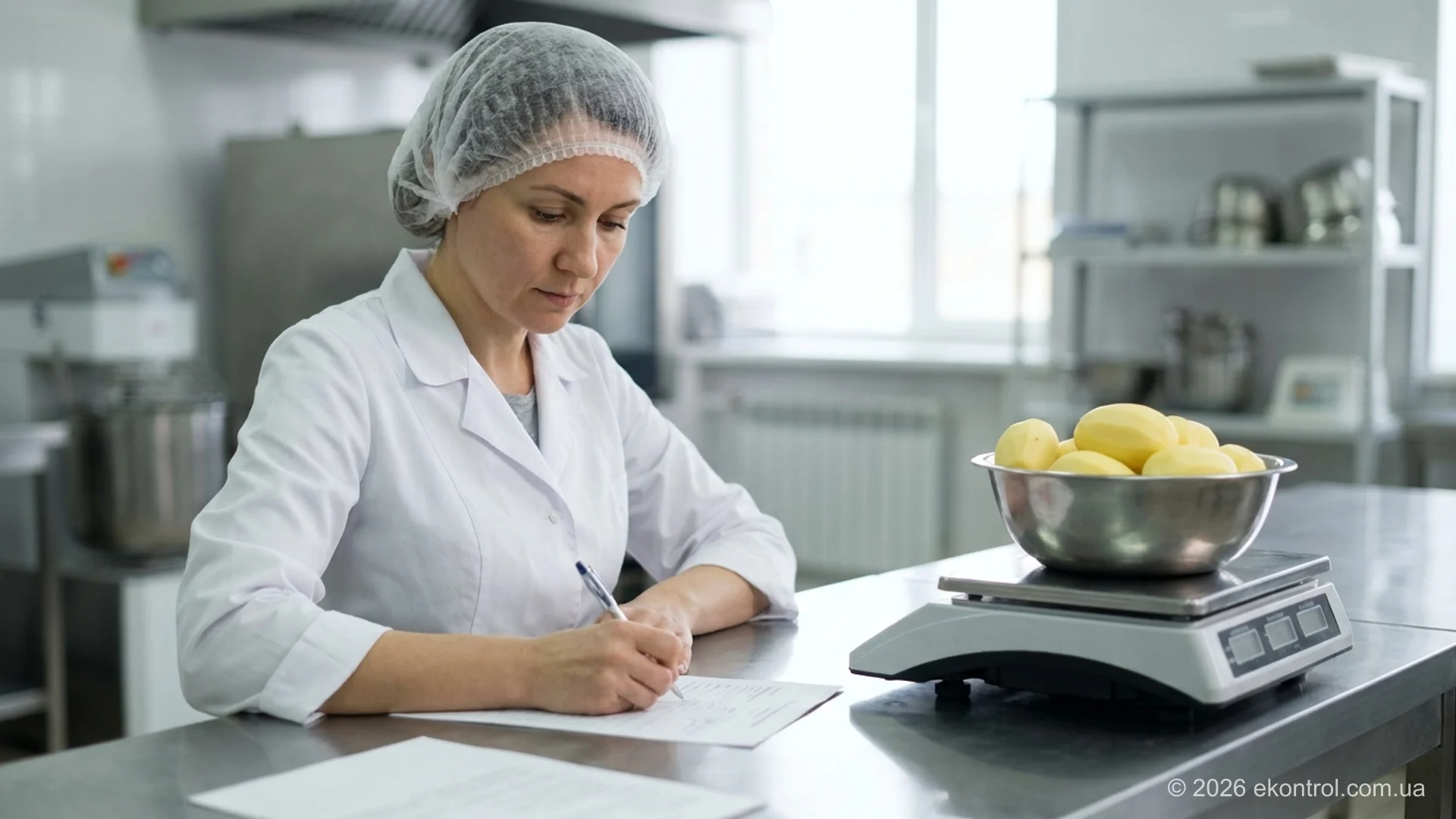
It's filled in every day before work starts. The cook and other staff personally sign that they have no intestinal upset or acute respiratory infection, and the medical worker signs that nobody has pustular skin lesions (clause 25 of the Procedure). A medical record book confirms a check-up once per period; the log confirms today's condition.
The medical worker keeps the nutrition standard compliance log daily based on the menu plan, and compliance is analysed once every four weeks (clause 11). Standards are calculated from recipe cards; we show how to build them in our article on the technological card for a dish.
Prerequisite programme records
Your HACCP system decides the rest. The guidelines No. 2347 provide templates: a cleaning schedule, a list of detergents and disinfectants, a training record, a delivery log and a fridge temperature log. Refrigeration temperature is checked at least once a day. Chilled food is kept at a core temperature of 5 °C or below (the fridge is best set to 4 °C), and freezers run at -18 °C.
Kindergartens have an extra requirement in their regulation: a deep clean of the premises once a week with detergents and once a month with disinfectants (Section VII, clause 17). Hence the deep cleaning log.
How long to keep records, and can they be electronic?
HACCP records are kept for at least three months after the product's shelf life ends (Law No. 771/97-VR, Art. 21, Part 6), and supplier data in schools for six months (Order No. 2532). The food inspection log can be kept on paper, numbered and bound, or electronically, provided entries can't be altered and it's clear who made them.
One more useful rule few people know: where monitoring is visual, the Law lets you record only when a nonconformity occurs (Art. 21, Part 4, item 4). It doesn't cancel the thermometer or food inspection, but it does cut the box-ticking.
| Log or record | Frequency | Who keeps it | Basis |
|---|---|---|---|
| Kitchen staff health log | Daily before the shift | Staff, medical worker | CMU Resolution No. 305, cl. 25 |
| Food inspection log for supplier deliveries | Every delivery | Food inspection committee | CMU Resolution No. 305, cl. 24 |
| Food inspection log for cooked meals | Before every service | Medical worker | CMU Resolution No. 305, cl. 29 |
| Nutrition standard compliance log | Daily, analysis every 4 weeks | Medical worker | CMU Resolution No. 305, cl. 12 |
| Daily retained samples | Daily, every dish on the menu | Cook with the inspection committee | CMU Resolution No. 305, cl. 30 |
| Fridge temperature log | At least once a day | Cook or storekeeper | Guidelines No. 2347, cl. 14.2, Annex 9 |
| Cleaning schedule and deep cleaning log | Per schedule; weekly and monthly in kindergartens | Person in charge | Guidelines No. 2347, Annex 4; regulation No. 234, Sec. VII, cl. 17 |
| Training record for washing and disinfection | Before starting work and yearly | HACCP lead | Guidelines No. 2347, cl. 9.4, Annex 5 |
Typical Inspector Findings on HACCP in the Kitchen Unit and the Cost of Ignoring Them
Numbers first. According to Derzhprodspozhyvsluzhba, in the first half of 2026 its specialists carried out 6,366 food control checks in education institutions: 2,104 in kindergartens and 4,253 in schools. Violations were found in 3,584 institutions, or 56% of those inspected. The service issued 89 orders to remedy violations and imposed 3 administrative fines. Most findings concerned sanitary norms, how kitchens operate, and food safety during cooking and serving.
Law No. 2042-VIII explains that ratio of orders to fines. If a breach of hygiene requirements or missing HACCP procedures is found for the first time, the inspector issues an order without a violation report (Art. 65, Part 2). After that come fines: 10 minimum wages for a legal entity for breaching hygiene requirements (UAH 86,470 with the 2026 minimum wage of UAH 8,647), and 30 minimum wages, or UAH 259,410, for failing to implement HACCP.
What we see most often on pre-audits
The list repeats from kitchen to kitchen:
- one board "for everything", with the coloured ones kept in a cupboard "for inspections";
- a fridge log showing the same figure every day while the thermometer says otherwise;
- detergent poured without a measuring cup;
- eggs washed in the vegetable sink;
- no training records, although Order No. 2532 only allows staff to start work after training confirmed by records.
Each item takes a day or two to fix and costs next to nothing. For a wider look at hygiene risks that grow out of small things, read our piece on hygiene in food production.
An order has a deadline too
A first violation isn't a fine yet, but ignoring an order gets expensive. Law No. 2042-VIII separately penalises failure to comply with orders or late compliance (Art. 65, Part 1, item 19-9). We put every order into a plan with an owner and a date, and record the fix with a photo and a corrective action entry.
HACCP in the Kitchen Unit: A Daily Checklist for Morning, Shift and End of Day
Procedures work when cooks see them as a sequence of actions, not a binder. Here's the checklist we hang on the kitchen door. It doesn't replace your HACCP plan; it shows what that plan looks like on a working day.
Before work starts:
- every staff member has signed the health log, and the medical worker has checked hands;
- fridge and freezer temperatures are recorded;
- sinks are filled, the thermometer shows at least the required level, detergent is measured with a cup;
- coloured boards and knives are in place, damaged ones set aside for replacement.
During the shift:
- deliveries received with food inspection and document checks;
- eggs treated in a separate container per the instruction;
- raw and ready food never cross, on the table or in the fridge;
- cooked meals inspected before service, retained samples taken and labelled.
At the end of the day:
- production tables and sinks washed with hot water and detergent (Order No. 2532, Annex 2);
- sponges replaced: the guidelines allow one sponge for one working day only;
- food waste taken out, which Order No. 2532 requires at least once a shift;
- the day's deviations recorded along with what was done about them.
Once a week the HACCP lead checks the logs against reality: thermometer versus entry, boards versus scheme. Order No. 590 requires washing to be checked by someone who didn't do it (clause 2.9.5); in a small kitchen that's the manager or the nurse.
How we check HACCP in the kitchen unit in one shift
On a diagnostic visit an Ekontrol auditor works through a shift alongside the cooks, from the health log to washing the sinks after lunch. We measure sink and fridge temperatures with our own calibrated thermometer, check boards against the scheme and verify product registration. You get a list where every nonconformity sits next to a regulatory clause and a concrete action.
Where to Start with HACCP in the Kitchen Unit: Five Steps for the Manager
Tempted to rewrite everything? Start with the kitchen, not the paperwork.
- Walk through the kitchen with a notebook and write down how dishes are actually washed, how eggs are treated and where the boards are.
- Compare that with Order No. 2532 and the HACCP guidelines No. 2347. The gaps are your work plan. If you want an independent view, book a pre-assessment of your kitchen's compliance.
- Rewrite the instructions for your real equipment: dishwasher model, detergent trade names, number of sinks. You'll find a document structure in our article on HACCP document templates.
- Train people and record the training. Without cooks who understand why it matters, no log works; we've written about building that engagement in our piece on the food safety team.
- A month later, check whether the procedures have stuck and fix what hasn't.
Kindergartens have their own specifics, with age-based nutrition standards and preschool paperwork, which we cover separately in HACCP in kindergartens.
To refresh the logic of the seven principles the whole system rests on, see our breakdown of the 7 HACCP principles with examples.
HACCP in the kitchen unit works when the cook picks up the red board for meat at seven in the morning without a reminder, and the thermometer in sink three shows its 65 °C on ordinary days, not just inspection day. To get there faster, contact the Ekontrol team: from a one-off consultation to turnkey implementation.
Need a certification consultation?
Free ConsultationOn This Page
- HACCP in the Kitchen Unit: Which Documents Set the Rules for Washing, Handling and Labelling
- HACCP Colour Coding: Cutting Boards and Knives Without a Single State Standard
- Labelling in the Canteen and Kitchen Unit: Tables, Scales, Pots and Cleaning Tools
- Egg Handling in the Kitchen Unit Under HACCP: A Separate Container, Soda Solution and No Concentrations from Memory
- Dishwashing and HACCP in the Kitchen Unit: Three Sinks for Tableware, Two for Kitchenware
- HACCP Logs in the Kitchen Unit: What Gets Filled In Daily and What Weekly
- Typical Inspector Findings on HACCP in the Kitchen Unit and the Cost of Ignoring Them
- HACCP in the Kitchen Unit: A Daily Checklist for Morning, Shift and End of Day
- Where to Start with HACCP in the Kitchen Unit: Five Steps for the Manager
HACCP in the Kitchen Unit: Which Documents Set the Rules for Washing, Handling and Labelling
HACCP in the kitchen unit means the permanent food safety procedures built on the seven HACCP principles, together with prerequisite programmes: dishwashing, labelling, temperature control and staff hygiene. Inspectors check them at the sink, not in the binder. An officer from Derzhprodspozhyvsluzhba, Ukraine's food safety authority, looks at which sink the plates go into, where the eggs sit after treatment, whether the cook slices bread on the raw-chicken board, and whether the fridge log matches the thermometer.
Below we walk through how dishwashing, egg handling, colour-coded boards and labelling should look in a school, kindergarten, hospital or staff canteen kitchen (Ukrainians call it a kharchoblok), so it works every day and not just on inspection day.
Plenty of kitchens still have printouts of old sanitary rules taped to the wall, even though the regulations in force look quite different. Here's what an inspector actually relies on in 2026.
The acts worth keeping at hand
The foundation is Law No. 771/97-VR (Article 21: every food business operator must run HACCP-based procedures, while certification is voluntary) and Order No. 590 of the Ministry of Agrarian Policy with its prerequisite programmes. Order No. 2532 of the Ministry of Economy (03.12.2020) gives hard numbers for schools, and the HACCP guidelines for education institutions (Order No. 2347 of 17.11.2020) add recommendations. Cabinet of Ministers Resolution No. 305 covers nutrition standards, food inspection (brakerazh) and logs, and clause 13 of its Procedure requires meals to be prepared under HACCP procedures. The Ministry of Health sanitary regulations for schools (No. 2205) and kindergartens (No. 234 as amended by Order No. 1604 of 21.10.2025) simply refer kitchen matters back to food law.
Cafés and restaurants aren't formally bound by Order No. 2532, but we haven't found any other Ukrainian act in force with figures for manual dishwashing. So treat it as a benchmark and adapt the rest using our HACCP guide for cafés and restaurants.
Hospital kitchens and staff canteens run under the same Order No. 590 and Article 21 of the Law: the sink, the boards and the logs are the same. We describe the overall logic of the system on our page about HACCP implementation.
| Document | What it governs in the kitchen | Who must comply |
|---|---|---|
| Law No. 771/97-VR, Art. 21 | HACCP duty, record retention | All food business operators |
| Ministry of Agrarian Policy Order No. 590 | Prerequisite programmes, washing and disinfection | All food business operators |
| Ministry of Economy Order No. 2532 | Dishwashing temperatures, labelling | School kitchens; others as a benchmark |
| HACCP guidelines No. 2347 | Colour coding, eggs, thermal disinfection, logs | Recommendations for education institutions |
| CMU Resolution No. 305 | Nutrition standards, food inspection, logs, samples | Education and children's recreation facilities |
| MoH sanitary regulations No. 2205 and No. 234 | Work clothing, cleaning, quarantine regime | Schools and kindergartens |
Why the sanitary regulations no longer contain solution tables
The current sanitary regulation for kindergartens (in force since 05.12.2025) and the one for schools don't set egg treatment regimes or disinfectant concentrations for dishes. The operator defines its own washing and disinfection method in a prerequisite programme under clause 2.9.2 of Order No. 590, and takes the concentration and contact time of a registered disinfectant from the manufacturer's label. If your instruction lists a percentage without naming the product, it's time to rewrite it.
HACCP Colour Coding: Cutting Boards and Knives Without a Single State Standard
The question kitchen managers ask us most is: "Which board colours are approved in Ukraine?" The honest answer: none. There's no single mandatory colour scheme. Annex 3 to Order No. 2532 gives an example of letter codes (СМ, СР, СО, СМП, ВМ, ВР, ВО, ВМП, З, Х, Г, Т) and explicitly lets the operator introduce its own marking system based on a risk assessment. The HACCP guidelines No. 2347, clause 7.1.3, recommend splitting utensils by colour according to purpose: cooked ready-to-eat food, dairy, bread, vegetables, raw meat, poultry and fish.
Colour doesn't replace the legal requirement, it fulfils it. The requirement is simple: rule out cross-contamination, either physically or by time (Order No. 590, clause 2.5.8), and the same approach runs through the Codex Alimentarius General Principles of Food Hygiene. Colours just make it visible to a cook at seven in the morning.
The scheme we set up in most kitchens
The most common version:
- red: raw meat;
- yellow: raw poultry (some systems use yellow for cooked meat, so check against your own instruction);
- blue: raw fish;
- green for vegetables, herbs and fruit;
- brown for cooked meat, fish and vegetables;
- white for bread, cheese, butter and other deli items.
A seventh, purple set is added where allergen-free or gluten-free meals are prepared. Resolution No. 305 separately requires preventing gluten from getting into gluten-free dishes, so a dedicated set isn't a luxury here.
Colour plus letter, not instead of it
Our advice: don't throw the letters away. The colour and the "СМ" code on the board back each other up, and an inspector reads the logic faster because Order No. 2532 uses letter marking. Mark tables "СХП" (raw foods) and "ГХП" (ready foods), keep knives on magnetic strips in the board colours, and hang the scheme above each workstation.
One detail people underestimate: clause 11, Section II of Order No. 2532 requires food contact surfaces to be smooth and undamaged. A board with deep, dark cuts is no longer smooth, whatever its colour. Budget for replacing boards. We explain how colour coding fits into the wider set of prerequisite programmes in our complete HACCP guide.
Labelling in the Canteen and Kitchen Unit: Tables, Scales, Pots and Cleaning Tools
Coloured boards only solve part of the problem. Labelling in the kitchen covers almost everything that touches food or could contaminate it. Order No. 2532 (clause 21, Section II) requires production tables, cutting boards, kitchen utensils and cookware to be marked by purpose. Annex 3 gives examples:
- tables and scales: "СХП" for raw foods, "ГХП" for ready foods;
- pots and returnable containers carry "ПС" (soups), "ДС" (main courses) and "Н" (drinks);
- boards and knives get the letter codes from the previous section.
Cleaning tools are marked separately: they must be labelled or carry a colour signal (clause 15). In practice that means a bucket and mop for the kitchen that never go near the toilets. The school regulation also requires cleaning workwear to be marked and stored apart.
Labelling decanted food
Food decanted from its original packaging should, per the guidelines, sit in closed containers labelled with its name, shelf life and supplier. An open tub of sour cream without a label raises one question for the inspector: when was it opened?
Daily retained samples are labelled under Resolution No. 305: date and time of sampling on every jar, stored in a fridge at +4 to +8 °C until the same meal ends the next day. We cover retained samples and food inspection in more detail in our article on HACCP for school canteens.
A temporary clean zone in a small kitchen
A kindergarten feeding 40 children often has no separate cold prep room. The guidelines allow a temporary clean zone separated by time: clear away raw ingredients, wash and disinfect the table, lay out separate utensils and mark the area as clean. A sign on a stand costs next to nothing and settles an argument with the inspector on the spot.
Egg Handling in the Kitchen Unit Under HACCP: A Separate Container, Soda Solution and No Concentrations from Memory
Eggshells can carry Salmonella, and raw eggs easily contaminate everything around them. Egg handling under HACCP comes down to three things: a separate place, a clear procedure and a record that it was done.
What the current document says
The HACCP guidelines No. 2347 (clause 14.5) advise soaking eggs for 30 minutes in a 2% baking soda solution, or another solution intended for this purpose, before cooking, then washing them under running drinking water. Egg washing needs its own labelled container and its own utensils, and eggs should go into a dish right before heat treatment.
Here's the sequence we write into kitchen instructions:
- Receiving. Check the accompanying documents and shell integrity, reject cracked and dirty eggs. Schools don't use waterfowl eggs: regulation No. 2205 excludes them from the permitted food groups.
- Storage before treatment on the lower fridge shelves, below ready-to-eat food (guidelines, clause 14.2).
- Treatment in a separate container labelled "Eggs": 30 minutes in a 2% baking soda solution, then a rinse under running drinking water.
- Disinfection, if your prerequisite programme includes it, only with a registered product and strictly per its label for concentration and time.
- Treated eggs go into a clean labelled container and are used straight away, right before cooking.
To be honest, we've never seen two identical procedures. Some kitchens use four containers, some use two. Both work if they're written down and the containers are labelled. Washing eggs in the vegetable sink "because it's quicker", though, is something an inspector will reasonably record as a cross-contamination risk.
Eyeballed solutions and concentrations copied from the internet
The most common mistake: a disinfectant concentration copied from someone else's instruction without naming the product. The regulations in force don't set such figures, and guidelines No. 2347 allow only registered products. Write the product's trade name, concentration and contact time from its label into your instruction. Measure the soda: a 2% solution is roughly 20 g of soda per litre of water, not "half a pack per bucket".
Dishwashing and HACCP in the Kitchen Unit: Three Sinks for Tableware, Two for Kitchenware
Dishwashing is governed by a specific document with numbers: Annex 2 to Ministry of Economy Order No. 2532, which is mandatory for school kitchens. Washing happens only in separate sinks with hot running water, and food scraps are scraped into a food waste bin first.
Tableware: three stages
- Sink one: water at no less than +40 °C with detergent dosed per the manufacturer.
- Sink two: water at no less than +40 °C with half the detergent used in sink one.
- Sink three: rinse with water at no less than +65 °C, using a dish rack and a flexible hose with a shower head.
Plates are dried on edge on slatted shelves and stored in closed cabinets.
Kitchenware, cups, cutlery and returnable containers
These are washed separately from tableware, in two stages: sink one with water at no less than +40 °C and detergent, sink two for rinsing with water at no less than +65 °C. Clean cutlery is scalded with boiling water, dried and stored handles up in cassettes. Metal kitchen utensils are heated in an oven after washing. Brushes and cloths are rinsed after work, dried and kept in closed labelled containers.
Where the rule and the recommendation diverge
Here's a detail few people notice. The HACCP guidelines No. 2347 (clause 9.1) describe a different profile: washing with detergent at no less than 45 °C, thermal disinfection of dishes at no less than 78 °C, and a rinse at no less than 45 °C. Order No. 2532 requires a minimum of 40 °C and 65 °C. There's no conflict, since 45 and 78 are above the minimum. We recommend writing the higher values into your instruction and checking them with a thermometer. At 65 °C on the rinse you meet the rule, but you don't get thermal disinfection as the guidelines define it.
The dishwasher within HACCP in the kitchen unit
Order No. 2532 requires the machine to be used for its intended purpose and per the manufacturer's operating rules (clause 19). So wash and rinse temperatures, detergent dosing and filter cleaning intervals come from your model's manual. Copy those figures into an instruction next to the machine and check them against the display once a shift. A machine with clogged filters washes worse than a good manual sink.
A separate regime applies during quarantine. The school regulation (Annex 12) requires boiling dishes that have been scraped and washed, in water or a 2% soda ash solution: 25 minutes for intestinal infections and 45 minutes for viral hepatitis, counted from boiling. That's an epidemic-driven regime, not a daily one.
| Stage | Requirement | How we check | What we record |
|---|---|---|---|
| Sink 1, tableware | At least +40 °C, detergent at manufacturer's dose | Thermometer, measuring cup | Reading |
| Sink 2, tableware | At least +40 °C, half the detergent dose | Thermometer | Reading |
| Sink 3, rinse | At least +65 °C (guidelines: 78 °C for thermal disinfection) | Thermometer under the spray | Reading |
| Dishwasher | Settings from the manufacturer's manual | Machine display once a shift | Reading or deviation |
| Drying and storage | Plates on edge in closed cabinets | Visual check | Deviations only (visual monitoring) |
Preparing your kitchen unit for a food safety inspection?
Ekontrol auditors will walk through your kitchen the way an inspector would: from the sinks and boards to the logs and retained samples. You'll get a list of nonconformities, each tied to a specific clause, plus instructions rewritten for your kitchen and equipment.
Book a kitchen auditHACCP Logs in the Kitchen Unit: What Gets Filled In Daily and What Weekly
HACCP logs often become an end in themselves: a dozen notebooks filled in on Friday for the whole week. An inspector spots identical figures in identical ink within a minute. HACCP Principle 7 in Order No. 590 (clause 3.26) asks for records that match the size of the operation, not the maximum amount of paper.
Mandatory records for an education institution
The annex to the Procedure under Resolution No. 305 gives an indicative list: an order on organising meals, a register of children eating, the staff health log, a seasonal menu, a daily menu, a menu plan, recipe documentation, a log of nutrition standard compliance and three food inspection logs.
The kitchen staff health log
It's filled in every day before work starts. The cook and other staff personally sign that they have no intestinal upset or acute respiratory infection, and the medical worker signs that nobody has pustular skin lesions (clause 25 of the Procedure). A medical record book confirms a check-up once per period; the log confirms today's condition.
The medical worker keeps the nutrition standard compliance log daily based on the menu plan, and compliance is analysed once every four weeks (clause 11). Standards are calculated from recipe cards; we show how to build them in our article on the technological card for a dish.
Prerequisite programme records
Your HACCP system decides the rest. The guidelines No. 2347 provide templates: a cleaning schedule, a list of detergents and disinfectants, a training record, a delivery log and a fridge temperature log. Refrigeration temperature is checked at least once a day. Chilled food is kept at a core temperature of 5 °C or below (the fridge is best set to 4 °C), and freezers run at -18 °C.
Kindergartens have an extra requirement in their regulation: a deep clean of the premises once a week with detergents and once a month with disinfectants (Section VII, clause 17). Hence the deep cleaning log.
How long to keep records, and can they be electronic?
HACCP records are kept for at least three months after the product's shelf life ends (Law No. 771/97-VR, Art. 21, Part 6), and supplier data in schools for six months (Order No. 2532). The food inspection log can be kept on paper, numbered and bound, or electronically, provided entries can't be altered and it's clear who made them.
One more useful rule few people know: where monitoring is visual, the Law lets you record only when a nonconformity occurs (Art. 21, Part 4, item 4). It doesn't cancel the thermometer or food inspection, but it does cut the box-ticking.
| Log or record | Frequency | Who keeps it | Basis |
|---|---|---|---|
| Kitchen staff health log | Daily before the shift | Staff, medical worker | CMU Resolution No. 305, cl. 25 |
| Food inspection log for supplier deliveries | Every delivery | Food inspection committee | CMU Resolution No. 305, cl. 24 |
| Food inspection log for cooked meals | Before every service | Medical worker | CMU Resolution No. 305, cl. 29 |
| Nutrition standard compliance log | Daily, analysis every 4 weeks | Medical worker | CMU Resolution No. 305, cl. 12 |
| Daily retained samples | Daily, every dish on the menu | Cook with the inspection committee | CMU Resolution No. 305, cl. 30 |
| Fridge temperature log | At least once a day | Cook or storekeeper | Guidelines No. 2347, cl. 14.2, Annex 9 |
| Cleaning schedule and deep cleaning log | Per schedule; weekly and monthly in kindergartens | Person in charge | Guidelines No. 2347, Annex 4; regulation No. 234, Sec. VII, cl. 17 |
| Training record for washing and disinfection | Before starting work and yearly | HACCP lead | Guidelines No. 2347, cl. 9.4, Annex 5 |
Typical Inspector Findings on HACCP in the Kitchen Unit and the Cost of Ignoring Them
Numbers first. According to Derzhprodspozhyvsluzhba, in the first half of 2026 its specialists carried out 6,366 food control checks in education institutions: 2,104 in kindergartens and 4,253 in schools. Violations were found in 3,584 institutions, or 56% of those inspected. The service issued 89 orders to remedy violations and imposed 3 administrative fines. Most findings concerned sanitary norms, how kitchens operate, and food safety during cooking and serving.
Law No. 2042-VIII explains that ratio of orders to fines. If a breach of hygiene requirements or missing HACCP procedures is found for the first time, the inspector issues an order without a violation report (Art. 65, Part 2). After that come fines: 10 minimum wages for a legal entity for breaching hygiene requirements (UAH 86,470 with the 2026 minimum wage of UAH 8,647), and 30 minimum wages, or UAH 259,410, for failing to implement HACCP.
What we see most often on pre-audits
The list repeats from kitchen to kitchen:
- one board "for everything", with the coloured ones kept in a cupboard "for inspections";
- a fridge log showing the same figure every day while the thermometer says otherwise;
- detergent poured without a measuring cup;
- eggs washed in the vegetable sink;
- no training records, although Order No. 2532 only allows staff to start work after training confirmed by records.
Each item takes a day or two to fix and costs next to nothing. For a wider look at hygiene risks that grow out of small things, read our piece on hygiene in food production.
An order has a deadline too
A first violation isn't a fine yet, but ignoring an order gets expensive. Law No. 2042-VIII separately penalises failure to comply with orders or late compliance (Art. 65, Part 1, item 19-9). We put every order into a plan with an owner and a date, and record the fix with a photo and a corrective action entry.
HACCP in the Kitchen Unit: A Daily Checklist for Morning, Shift and End of Day
Procedures work when cooks see them as a sequence of actions, not a binder. Here's the checklist we hang on the kitchen door. It doesn't replace your HACCP plan; it shows what that plan looks like on a working day.
Before work starts:
- every staff member has signed the health log, and the medical worker has checked hands;
- fridge and freezer temperatures are recorded;
- sinks are filled, the thermometer shows at least the required level, detergent is measured with a cup;
- coloured boards and knives are in place, damaged ones set aside for replacement.
During the shift:
- deliveries received with food inspection and document checks;
- eggs treated in a separate container per the instruction;
- raw and ready food never cross, on the table or in the fridge;
- cooked meals inspected before service, retained samples taken and labelled.
At the end of the day:
- production tables and sinks washed with hot water and detergent (Order No. 2532, Annex 2);
- sponges replaced: the guidelines allow one sponge for one working day only;
- food waste taken out, which Order No. 2532 requires at least once a shift;
- the day's deviations recorded along with what was done about them.
Once a week the HACCP lead checks the logs against reality: thermometer versus entry, boards versus scheme. Order No. 590 requires washing to be checked by someone who didn't do it (clause 2.9.5); in a small kitchen that's the manager or the nurse.
How we check HACCP in the kitchen unit in one shift
On a diagnostic visit an Ekontrol auditor works through a shift alongside the cooks, from the health log to washing the sinks after lunch. We measure sink and fridge temperatures with our own calibrated thermometer, check boards against the scheme and verify product registration. You get a list where every nonconformity sits next to a regulatory clause and a concrete action.
Where to Start with HACCP in the Kitchen Unit: Five Steps for the Manager
Tempted to rewrite everything? Start with the kitchen, not the paperwork.
- Walk through the kitchen with a notebook and write down how dishes are actually washed, how eggs are treated and where the boards are.
- Compare that with Order No. 2532 and the HACCP guidelines No. 2347. The gaps are your work plan. If you want an independent view, book a pre-assessment of your kitchen's compliance.
- Rewrite the instructions for your real equipment: dishwasher model, detergent trade names, number of sinks. You'll find a document structure in our article on HACCP document templates.
- Train people and record the training. Without cooks who understand why it matters, no log works; we've written about building that engagement in our piece on the food safety team.
- A month later, check whether the procedures have stuck and fix what hasn't.
Kindergartens have their own specifics, with age-based nutrition standards and preschool paperwork, which we cover separately in HACCP in kindergartens.
To refresh the logic of the seven principles the whole system rests on, see our breakdown of the 7 HACCP principles with examples.
HACCP in the kitchen unit works when the cook picks up the red board for meat at seven in the morning without a reminder, and the thermometer in sink three shows its 65 °C on ordinary days, not just inspection day. To get there faster, contact the Ekontrol team: from a one-off consultation to turnkey implementation.